 PledgeBox
How to Calculate Shipping Costs for Crowdfunding
Learn how to calculate shipping costs for your Kickstarter or Indiegogo campaign. Our guide covers dimensional weight, international fees, and pledge managers.
Learn how to calculate shipping costs for your Kickstarter or Indiegogo campaign. Our guide covers dimensional weight, international fees, and pledge managers.
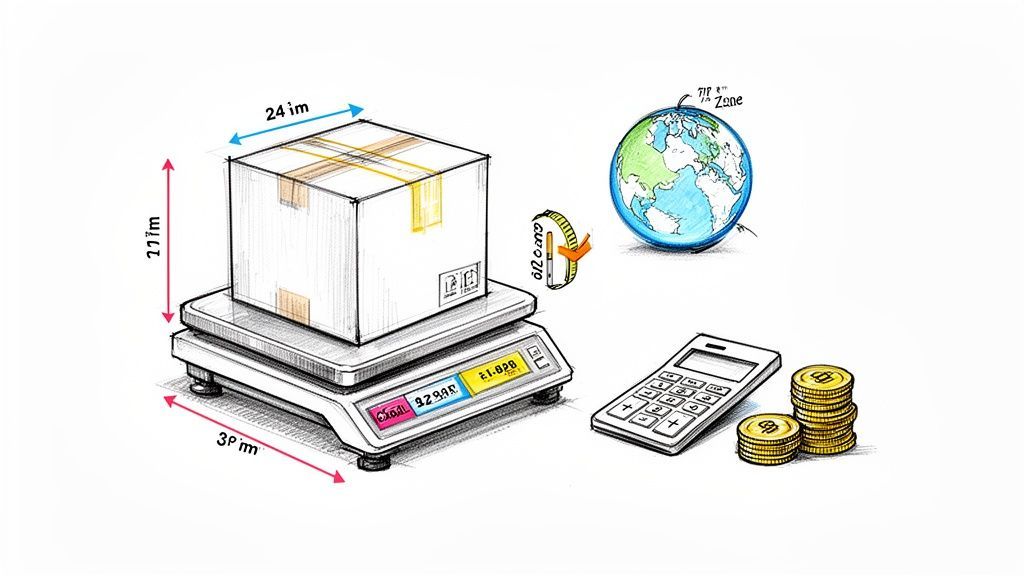
When you're trying to figure out shipping costs for your crowdfunding campaign, it all boils down to four things: your package's weight, its dimensions, where it's going, and which carrier service you use. Get any one of these wrong, and you could be looking at a serious budget shortfall that chews right through your profits. Nailing this from the get-go isn't just a good idea—it's essential for a successful project.
Shipping isn't just the last thing you do; it's a huge part of your campaign's strategy that can either protect your profits and reputation or completely sink them. Too many creators treat it like an afterthought, only to find a massive, heartbreaking gap between the shipping fees they collected and what it actually costs to send rewards out the door. This isn't a minor hiccup; it's one of the most common reasons promising projects end up in the red, even after a wildly successful funding run.
Picture this: a creator launches a gorgeous board game and raises $100,000. They've estimated a flat $15 shipping fee for everyone, worldwide. But after the campaign ends, they discover that sending a single game to a backer in Australia actually costs $45. With thousands of international backers, that $30 loss on each package quickly spirals into a five-figure deficit, wiping out their entire profit margin and then some. This isn't just a hypothetical horror story—it happens all the time.
Getting your shipping calculations right is, first and foremost, about protecting your own finances. When you know your real costs upfront, you can either build them into your funding goal or, more commonly, charge your backers the correct amount after the campaign.
This transparency is also a huge part of building trust. Nothing sours the backer experience faster than getting hit with surprisingly high shipping fees months later or, even worse, finding out the creator miscalculated so badly they can't even afford to deliver the rewards.
Here’s why it’s so critical to get this right:
Think of the Kickstarter pledge manager like Amazon—a simple, one-size-fits-all marketplace. In contrast, the PledgeBox pledge manager is like Shopify; it gives you the power and customization needed to handle the complex reality of fulfillment.
This is where a dedicated pledge manager becomes indispensable. For instance, using PledgeBox is free to send the backer survey, which means you can collect all the addresses and reward choices you need without paying anything upfront. The platform only charges 3% of upsell if there's any. This model is perfect for creators because it lets you gather all the critical shipping information first, then charge for shipping based on the most accurate, real-time rates available.
When it comes to calculating shipping costs, everything really boils down to four key pieces of information. Getting a solid grip on these isn't just about dodging unexpected fees; it's about building a fulfillment strategy that's predictable and profitable right from the start. Each factor plays off the others, ultimately determining the final price you'll pay to get your awesome rewards into your backers' hands.
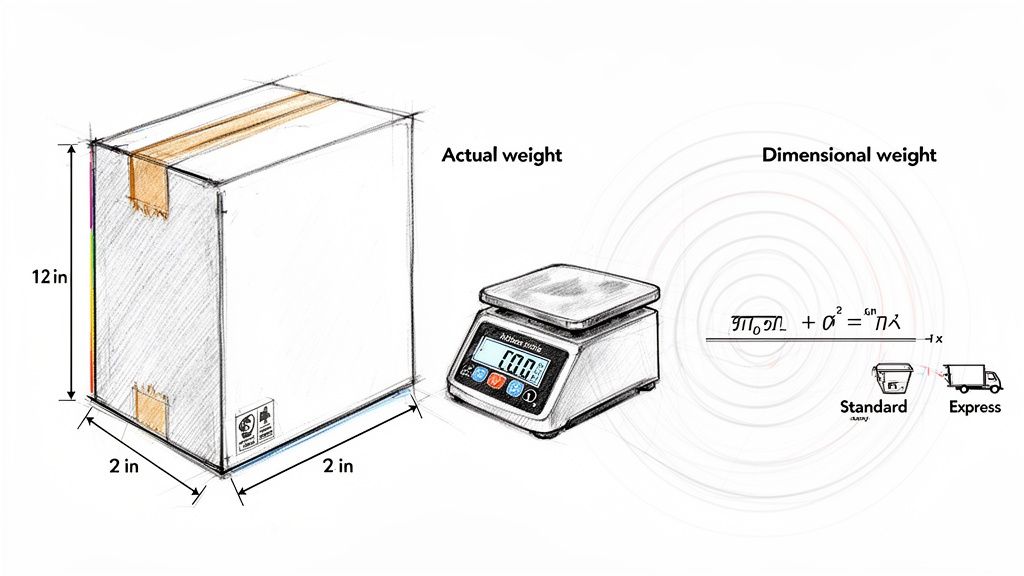
Let's start with the most straightforward metric: what the scale says.
This is simply how heavy your reward is once it's all packed up and ready to go. To get this number, you absolutely need a reliable postage scale and your final, ship-ready package. That means the reward itself, any add-ons, and all the packaging—the box, bubble wrap, packing peanuts, and even the tape.
Don't just estimate this part. Weighing only the product and guessing at the packaging weight is a classic rookie mistake. Those few extra ounces add up incredibly fast across thousands of shipments, turning a tiny oversight into a massive, budget-eating expense. Weigh everything together to get the true actual weight.
This is the one that trips up so many creators and sends budgets spiraling. Carriers like UPS, FedEx, and DHL don't just care about how heavy your package is; they're also concerned with how much space it hogs on their trucks and planes. This concept is called dimensional weight (or DIM weight).
Here's the crucial part: carriers calculate both the actual weight and the dimensional weight, then charge you for whichever is greater. A lightweight but bulky reward—think foam miniatures or a collector's edition with a lot of protective air space—can cost way more to ship than you'd ever guess.
The formula generally involves multiplying the package's length, width, and height, then dividing by a special number (a "divisor") set by the carrier. For a box that’s 12x8x6 inches, the dimensional weight could be billed at 3.5 pounds, even if the contents only weigh 2 pounds.
Ignoring dimensional weight is one of the single biggest financial mistakes you can make. It has sunk countless campaigns that otherwise looked successful on paper.
To see how this plays out, let's look at how dimensional weight can sneak up on you with a common board game reward.
This table shows how a slightly larger box can push the billable weight higher than the actual weight, directly impacting your shipping cost.
| Metric | Example Package (Board Game) |
|---|---|
| Actual Weight | 4 lbs |
| Package Dimensions | 14" (L) x 12" (W) x 4" (H) |
| Carrier Divisor | 166 (common for domestic ground) |
| Dimensional Weight Calc. | (14 x 12 x 4) / 166 |
| Dimensional Weight | 4.04 lbs |
| Billable Weight | 4.04 lbs (the greater of the two) |
In this case, the actual weight (4 lbs) and dimensional weight (4.04 lbs) are almost the same, so the cost impact is minimal. But if your packaging were just a bit bigger, that dimensional weight could easily jump to 5 or 6 lbs, significantly increasing your cost. For a deeper dive, check out our guide on using a https://www.pledgebox.com/post/cubic-calculator-for-shipping.
How fast do you want it to get there? The speed of delivery has a massive influence on the price. Your choice between a slower ground service and an expedited air service can easily double or even triple your shipping costs.
Choosing the right service level is a balancing act. You need to give backers a reasonable delivery window without completely destroying your profit margins.
The last piece of the puzzle is distance. Carriers don't charge based on exact mileage. Instead, they divide the country (and the world) into shipping zones. These zones radiate out from your shipping origin—the warehouse or fulfillment center you're shipping from. A package going to Zone 2 might just be a state over, while one headed to Zone 8 is likely going clear across the country.
Naturally, each jump to a higher zone number comes with a higher price tag. This is precisely why offering a single flat-rate shipping fee is so risky. Charging a backer in Zone 2 the same as a backer in Zone 8 guarantees you'll lose money on every distant shipment. When setting your final prices, it's vital to account for these variable costs. A great model for this is Cost Plus Pricing, which helps ensure every expense is covered before you determine your product price.
Taking your campaign global is an exciting step, but it throws a real curveball into your shipping cost calculations: customs. International shipping isn’t just about how far a package travels; it’s about navigating a maze of duties, taxes, and fees that can change drastically from one country to the next. Get this wrong, and you're looking at angry backers and rewards stuck in customs limbo.
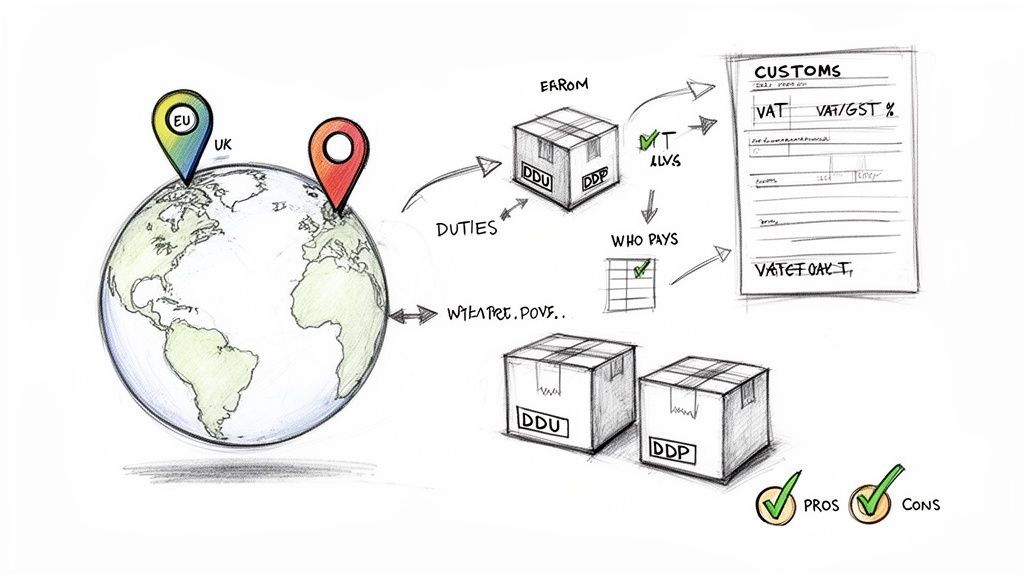
To ship internationally without pulling your hair out, you first need to understand two key approaches: Delivery Duty Unpaid (DDU) and Delivery Duty Paid (DDP). The path you choose here will directly shape your backer's experience—and your budget.
Think of this choice as deciding who gets the bill from customs when a package lands in its destination country. It’s a simple question with big consequences.
DDU (Delivery Duty Unpaid): This is the go-to method for most crowdfunding campaigns. You pay to get the package to the backer's country, but the backer is on the hook for paying any import duties, VAT (Value Added Tax), or customs fees to get it released. It's definitely simpler on your end, but it can lead to a nasty surprise for backers who weren't expecting an extra bill.
DDP (Delivery Duty Paid): With this "friendly" approach, you prepay all those duties and taxes. Your backer gets their reward delivered right to their door with nothing more to pay. While this creates a fantastic, seamless experience, it means you have to accurately calculate and collect all those fees upfront, adding a layer of complexity to your finances.
Whatever you decide, being crystal clear with your backers is non-negotiable. State your policy right on your campaign page and repeat it in your post-campaign survey. Surprising someone with a customs bill is the fastest way to turn a happy backer into an unhappy commenter. For a deeper dive, check out our article on 5 ways to navigate customs and VAT for Kickstarter.
Trying to forecast these fees is a huge part of calculating shipping costs accurately. You can't just guess. Major regions like the European Union and the United Kingdom have very specific VAT rules that you absolutely cannot ignore.
These fees are calculated based on the declared value of your reward—which is typically the manufacturing cost, not the pledge amount. Since rates and rules can change, you have to research the current thresholds and percentages for the main countries you'll be shipping to. This homework lets you either give backers a heads-up on potential DDU costs or collect the right amount for DDP.
The Kickstarter pledge manager is a bit like Amazon—it’s straightforward but pretty limited. A dedicated pledge manager like PledgeBox, on the other hand, operates more like Shopify; it's a powerful and customizable platform that gives you total control over complex shipping and tax rules.
This is where having the right tool is a game-changer. You can send your backer survey for free with PledgeBox, which means you can collect addresses and confirm reward choices without any upfront cost. It only charges 3% of upsell if there's any, allowing you to set up sophisticated, region-specific shipping rules and even collect VAT/GST directly from backers who need to pay it.
While you need to focus on today's rates, it helps to know the bigger picture. Historically, international shipping has actually gotten cheaper over the long run. For example, real dry bulk freight rates fell by a massive 79% between 1850 and 2020. Of course, that long-term trend was filled with plenty of short-term spikes and volatility.
This tells us that global fulfillment is generally becoming more accessible. However, the reality for any single campaign is that prices can swing wildly. This is exactly why collecting shipping fees after your campaign ends, using real-time rates through a pledge manager, is the safest and most accurate strategy. It protects you from sudden price hikes and ensures you charge your backers a fair price based on market conditions at the moment of fulfillment.
Knowing how to calculate shipping costs is the first major battle. Actually saving money on shipping is how you win the war and protect your profits. Once your calculations are solid, you can stop just forecasting expenses and start actively cutting them down. These strategies can make a huge difference to your campaign's bottom line.
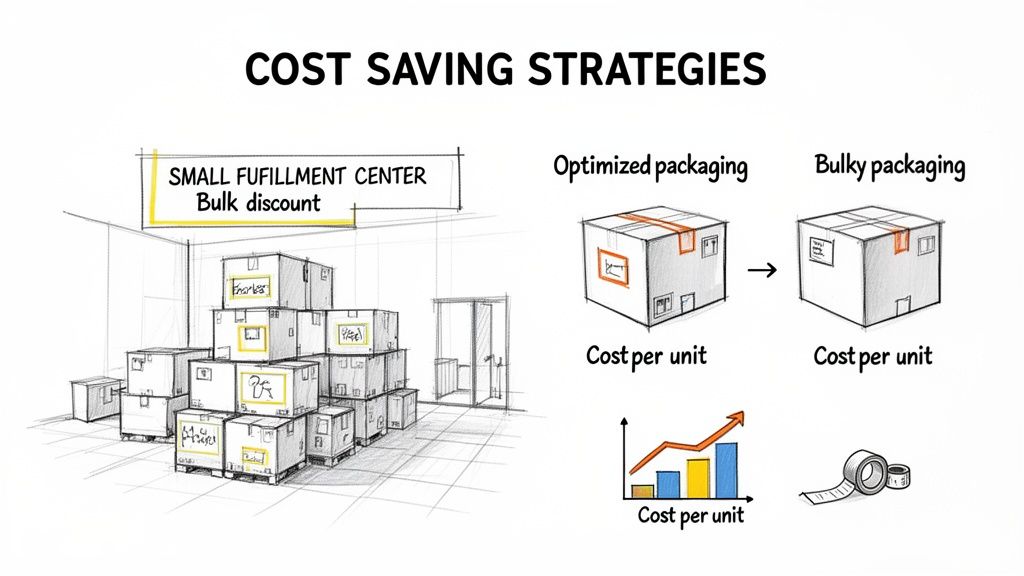
One of the single most effective ways to lower your spend is to team up with a third-party logistics (3PL) provider or fulfillment center. These companies ship truly massive volumes of packages every single day, giving them access to heavily discounted bulk shipping rates an individual creator could only dream of. Passing those savings on to you is a core part of their business.
Working with a fulfillment center isn't just about getting better rates. It also completely offloads the enormous operational headache of picking, packing, and shipping thousands of rewards yourself.
This kind of partnership brings a few game-changing advantages:
Sure, there are management and storage fees involved, but the savings on shipping and the immense value of your own time often make this a no-brainer, especially for larger campaigns. For a comprehensive guide on practical methods, you can read more about how to reduce shipping costs.
As we've already covered, dimensional weight is a notorious budget-killer. The fix is to get obsessive about your packaging, making it as small and lightweight as possible without ever sacrificing protection for your rewards. Every inch and every ounce you shave off saves you money—and that adds up fast when you're multiplying it by thousands of shipments.
Take the time to actually test different box sizes and protective materials. Can you use a custom-fit mailer instead of a generic, bulky box? Is there a lighter packing material that offers the same protection as those heavy foam inserts? For a deeper dive, check out our guide on how to reduce shipping costs for your business.
To really get a grip on your efficiency, you have to look at your expenses on a per-reward basis. This is where a cost-per-unit analysis becomes your secret weapon. This calculation gives you a clear, standardized metric to compare different shipping scenarios and pinpoint the most cost-effective methods for each of your reward tiers.
The formula is dead simple: divide your total freight cost by the number of units you shipped. For instance, if a pallet of 600 rewards costs $1,200 to ship to your fulfillment center, your cost is $2.00 per unit. Shippers who consistently track this data and fine-tune their strategies save an average of 12% annually compared to those who just set it and forget it.
Understanding the cost-per-unit for each reward tier helps you see exactly where your money is going. You might find that a heavier add-on dramatically increases the shipping cost for a certain pledge level, information you can use to adjust pricing in future campaigns.
This kind of detailed analysis is what lets you make smarter decisions down the line. A pledge manager like PledgeBox is essential here. Think of the Kickstarter pledge manager like Amazon—it’s a simple, one-size-fits-all marketplace. In contrast, the PledgeBox pledge manager is like Shopify; it’s a powerful, highly customizable platform built for serious creators.
Crucially, PledgeBox is free to send the backer survey and only charges 3% of upsell if there's any. This structure lets you gather all the data you need, run your cost analysis, and then set precise, zone-based shipping rates that protect your margins—all without any upfront platform fees. It’s simply a smarter way to manage the financial backend of your fulfillment.
You've done the hard work of calculating your shipping costs, but that's really just half the battle. Now comes the tricky part: actually collecting those funds from your backers without creating a confusing, frustrating mess. This is where a dedicated pledge manager becomes the most critical tool in your fulfillment toolkit.
Trusting Kickstarter's bare-bones, built-in survey system to handle something this complex is a mistake I see too many new creators make—and it's a costly one. The industry standard, and frankly the only safe way to protect your budget, is to collect shipping fees after your campaign ends. It lets you charge based on real-time carrier rates and your backers' confirmed addresses, not the wild guesses you made months ago.
Collecting shipping fees after the campaign is over isn't just a preference; it's a strategic move that protects your profits and keeps your backers happy. You’re no longer guessing what shipping rates will look like six months down the line. Instead, you're charging the actual cost at the moment of truth: fulfillment.
This approach gives you a few massive advantages:
You can see how platforms like PledgeBox are built to handle this, focusing on surveys, upsells, and shipping management all in one place.
The whole point of a tool like this is to simplify what is an incredibly complex logistical puzzle. It gives you a command center to manage backer data and keep your fulfillment finances in check.
Let's think about this with an analogy. The Kickstarter pledge manager is like Amazon—a simple, closed marketplace with very few options. It gets the job done on a basic level, but offers almost no flexibility for a creator looking to build a brand.
A powerful pledge manager like PledgeBox, on the other hand, is like Shopify. It’s a robust, customizable platform that puts you in the driver's seat of the entire post-campaign experience. This is absolutely essential when you need to set up sophisticated shipping rules by country or zone, accurately charge VAT for backers in the EU or UK, and offer exciting add-ons that can seriously boost your final funding total.
A great pledge manager turns the post-campaign chaos into a streamlined, profitable operation. It’s not just another expense; it’s an investment in getting your fulfillment right the first time.
What really seals the deal for most creators is the pricing. PledgeBox is free to send the backer survey, so you can get all your essential address and reward data locked in without paying a dime upfront. The platform only charges 3% of upsell if there's any. It's a performance-based model, meaning the tool literally pays for itself through the extra revenue it helps you bring in.
This setup lets you manage the financial side of fulfillment with real intelligence. You can create granular shipping tables that charge a backer in Australia differently from one in Germany, collect the right tax amounts to stay compliant, and give backers a smooth, professional portal to finalize everything. That level of control is non-negotiable for anyone serious about calculating shipping costs accurately and running a profitable campaign from start to finish.
Alright, you've soaked up all the strategies and are ready to tackle fulfillment. Let's pull everything we've covered into one final checklist. Think of this as your action plan to make sure nothing slips through the cracks as you move from raising funds to shipping rewards.
Getting fulfillment right is all about being methodical. When you approach it this way, what seems like a massive, overwhelming task breaks down into a series of simple, manageable steps. This is how you protect your budget and keep your backers happy.
Before a single package leaves your hands (or your fulfillment partner's), run through these critical checkpoints. Each one is a piece of the puzzle to calculating shipping costs accurately and dodging those common, costly mistakes.
This simple flowchart breaks down exactly how to manage your backers once the campaign clock stops ticking.
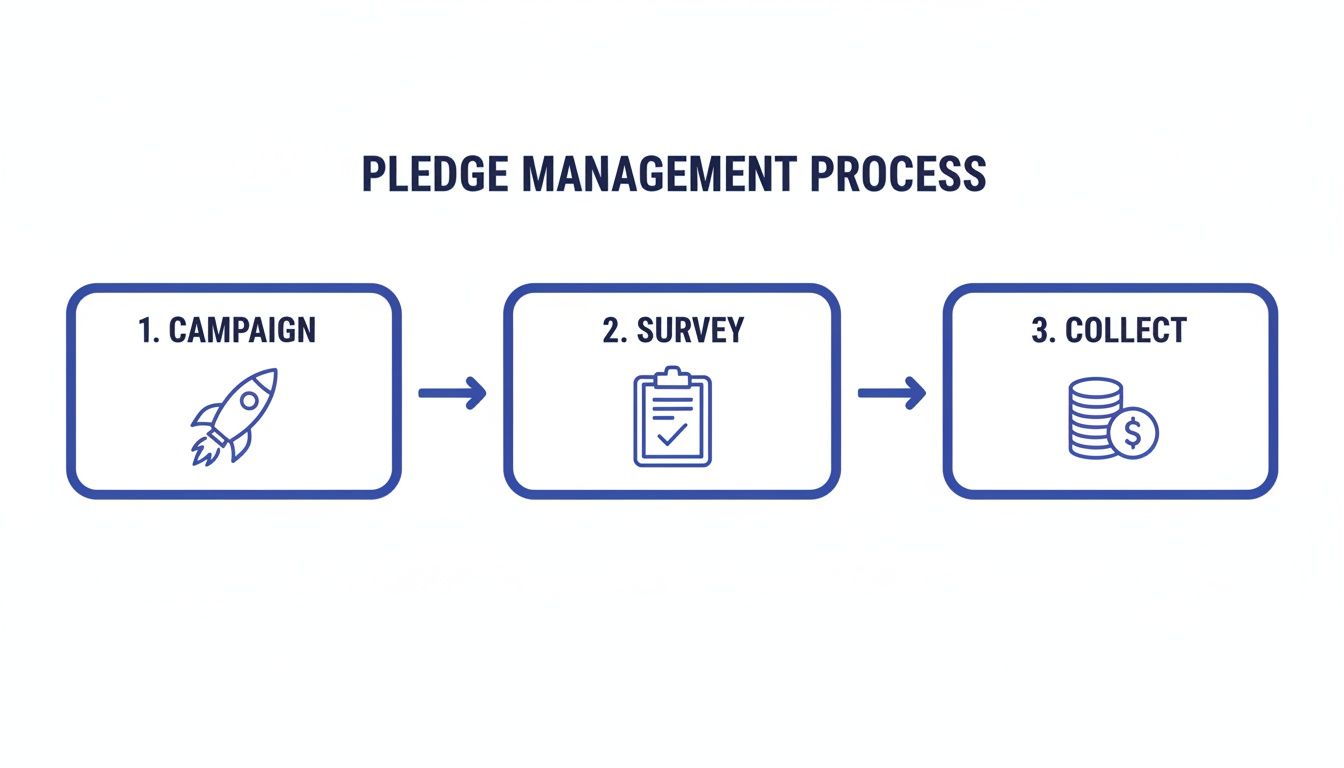
As you can see, a structured post-campaign phase isn't complicated, but it's essential for collecting fees efficiently and getting fulfillment right.
Think of the Kickstarter pledge manager as Amazon—a simple, one-size-fits-all marketplace. In contrast, the PledgeBox pledge manager is like Shopify; it’s a powerful, customizable platform built to handle the complexities of a growing brand.
Remember, tools like PledgeBox are free to send your backer survey and only charge 3% of upsells if there are any. This gives you a professional, low-risk way to handle your entire fulfillment workflow, from collecting addresses to charging precise shipping fees. Following these steps is the best way to ensure your hard-earned funding turns into a successful, profitable project.
When you're deep in the weeds of crowdfunding fulfillment, it's natural for the same questions to pop up. I've heard these from countless creators, so let's tackle some of the most common ones with quick, straightforward answers.
My advice is always the same: charge for shipping after the campaign is over, using a pledge manager. Shipping rates are a moving target, constantly changing. If you charge during the campaign, you're just guessing.
By waiting, you can bill your backers based on the actual, real-time rates for their specific, confirmed address. This one decision protects you from two major pitfalls: undercharging and wiping out your profits, or overcharging and scaring off potential backers before they even pledge.
Hands down, the single most expensive mistake I see is creators underestimating or completely ignoring dimensional weight. It's a classic rookie error. They meticulously weigh their product and calculate shipping costs based on that number alone.
But carriers don't just care about how heavy a box is; they care about how much space it takes up on their truck. A big but lightweight reward—think board games, foam inserts, or a set of unboxed miniatures—can get hit with a surprisingly high billable weight. This blind spot can lead to a catastrophic budget shortfall when it's time to actually ship everything out.
This is where a good pledge manager really shines. It lets you get incredibly granular with your shipping rules for different countries. You can easily set up distinct shipping fees for major hubs like the US, EU, UK, and Canada, and then create a catch-all "Rest of the World" category for everyone else.
Think of the Kickstarter pledge manager as Amazon—it’s a basic, one-size-fits-all marketplace. A dedicated pledge manager like PledgeBox is more like Shopify; it’s a powerful, customizable platform built to handle the real-world complexities of shipping a product globally.
Beyond just shipping rates, a smart pledge manager can automatically calculate and collect VAT or GST for backers in regions like the EU and UK. This is absolutely critical for staying compliant with international tax laws. More importantly, it ensures you aren't forced to pay those hefty tax bills out of your campaign funds, which can seriously eat into your bottom line.
A tool like PledgeBox is built for this. You can set up all these complex rules without a headache. And the best part? PledgeBox is free to send the backer survey and only charges 3% on upsells if you make any, making it a no-brainer for managing global fulfillment without breaking the bank.
Ready to finally get a handle on your post-campaign chaos? PledgeBox makes everything from backer surveys and address collection to charging accurate shipping and VAT feel simple. Get started today and see how easy fulfillment can be.
PledgeBox
The All-in-One Toolkit to Launch, Manage & Scale Your Kickstarter / Indiegogo Campaign