 PledgeBox
Your Crowdfunding Budgeting Proposal Sample and Guide
Use our budgeting proposal sample to master your crowdfunding campaign costs. This guide offers a free template and expert advice to build a winning budget.
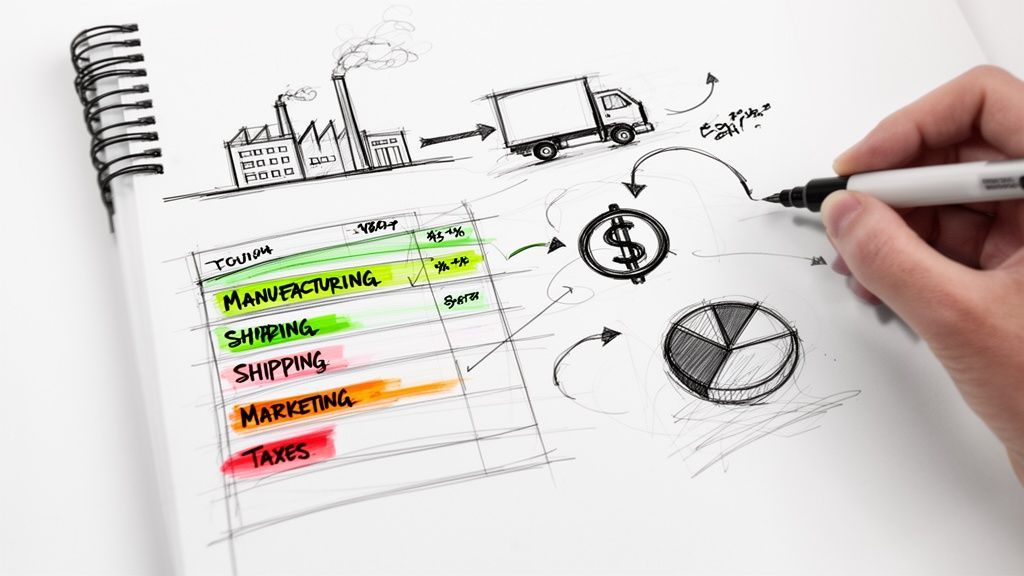
Use our budgeting proposal sample to master your crowdfunding campaign costs. This guide offers a free template and expert advice to build a winning budget.
Think of a budgeting proposal sample as more than just a spreadsheet—it's your strategic roadmap. It details every single potential cost, from pre-launch marketing all the way through final fulfillment. This is the document that separates the campaigns that succeed from the ones that fizzle out, turning your creative idea into a financially sound project.
We've put together a guide to help you build one from the ground up.
Let's be honest, staring at the financial side of your project can feel daunting. A lot of creators fall into the trap of thinking a brilliant idea is all it takes. The hard truth? Success is grounded in the numbers. A solid budget isn't just about tracking what you spend; it's the very foundation of your campaign, ensuring you can actually deliver on your promises to backers without hitting a cash crunch.
The crowdfunding world is littered with cautionary tales. While Kickstarter has helped launch over 650,000 projects raising an incredible $7.68 billion, only about 38% actually hit their funding goal. Worse yet, a staggering 35% of those successful campaigns are abandoned after funding because of cash flow problems. A detailed budget is your best defense against becoming one of them.
To budget like a pro, you need to understand the tools you'll be using, especially after the campaign clock runs out. Think of it this way: Kickstarter is like Amazon—it's a massive marketplace where backers can discover and fund your project. But once the campaign is over, you need your own command center.
This is where a pledge manager like PledgeBox comes into play. If Kickstarter is Amazon, PledgeBox is your Shopify—it’s your own powerful backend storefront. It’s where you’ll manage your backer relationships, accurately collect shipping fees and taxes, and—crucially—generate extra revenue through upsells and add-ons. This is a vital distinction for your budget because it opens up a whole new income stream after you've already met your initial goal.
The best part? PledgeBox is free to send the backer survey and only charges 3% of the upsell if there's any. This makes it a totally risk-free way to boost your project’s bottom line.
A truly bulletproof budget isn't a static document you create once and forget. It's a living plan that evolves through three distinct phases of your campaign, each with its own financial challenges and opportunities.
Breaking your budget down into these stages helps you anticipate costs with much greater accuracy and keep your finances healthy. To learn more about this, check out our in-depth guide on how to create a crowdfunding budget.
It's also essential to build in effective strategies for positive cash flow. Properly managing your funds ensures you have the capital you need when you need it, from paying your manufacturer to getting rewards out the door.
To give you a clearer picture, here’s a high-level overview of how successful campaigns typically allocate their funds. This isn't a rigid formula, but it provides a realistic benchmark to help you plan your own project.
| Budget Category | Typical Allocation Percentage | Key Considerations |
|---|---|---|
| Manufacturing & Tooling | 30% - 40% | Get multiple quotes; factor in mold/tooling costs separately. |
| Shipping & Fulfillment | 20% - 30% | Often the most underestimated cost. Includes packaging and labor. |
| Platform & Payment Fees | 8% - 10% | Typically ~5% for the platform and ~3-5% for payment processing. |
| Marketing & Advertising | 5% - 15% | Pre-launch and live campaign ad spend. Can vary wildly. |
| Taxes / VAT | Variable | Depends heavily on your location and where backers are. Crucial to research. |
| Contingency Fund | 10% | Non-negotiable. Covers unexpected delays, errors, or price hikes. |
This table should serve as a starting point. Your own project's numbers will vary based on its complexity, but mapping your costs against these benchmarks is a great way to spot potential red flags early on.
Alright, let's move past the big-picture numbers and get into the real nuts and bolts of your financial plan. This is where a campaign’s success is truly decided. A solid budgeting proposal needs to break down every single potential expense. Trust me, getting this wrong isn't an option—underestimating just one of these areas can sink your entire project.
We're going to dig into the specific line items you absolutely have to account for, with some real-world advice to help you sidestep the most common financial traps. From the factory floor to your backer's doorstep, every dollar needs a job.
This flow chart gives you a clear visual of the different financial stages of a crowdfunding campaign, from your initial investment all the way to final delivery.
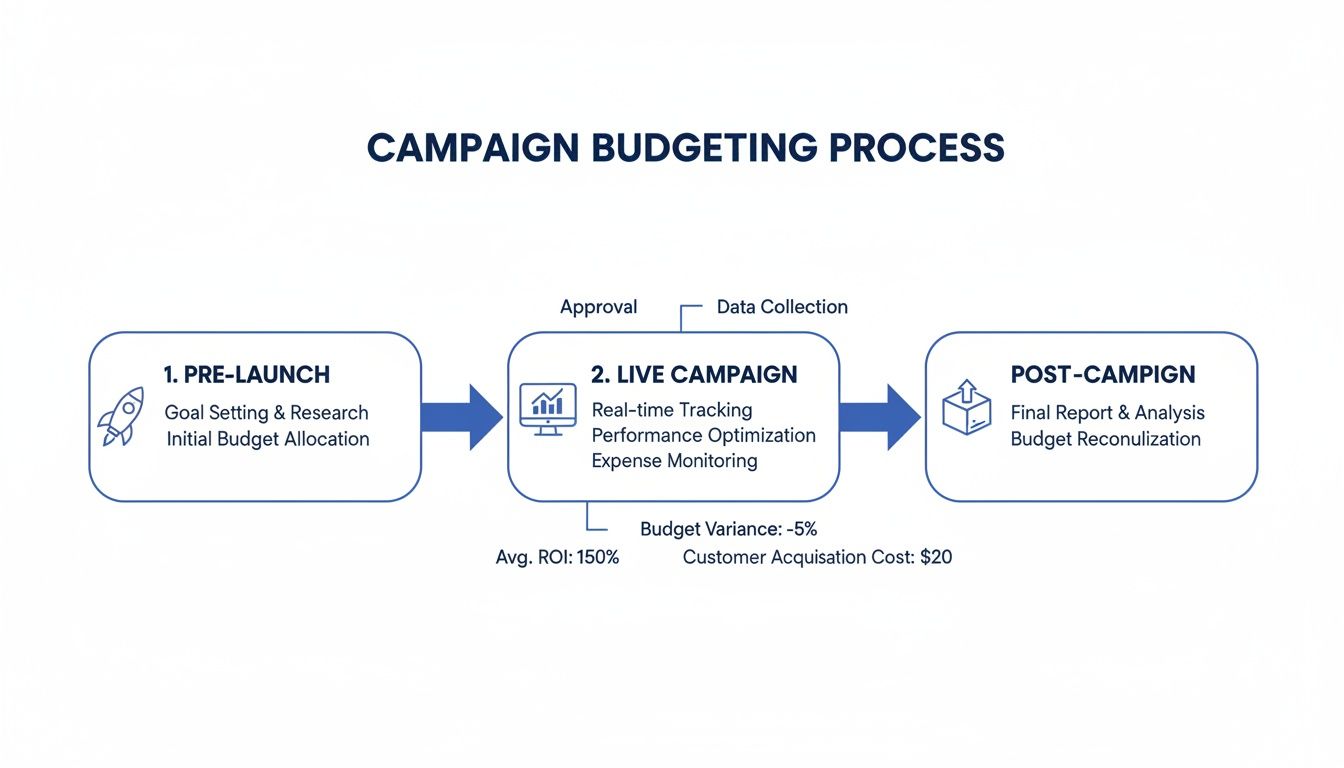
As you can see, your budget isn't static. It has to adapt as you move from pre-launch, through the live campaign, and into post-campaign fulfillment, which is where the bulk of your expenses will actually hit.
This is almost always the biggest single expense on your sheet, and it’s loaded with variables. Your cost per unit is directly tied to your Minimum Order Quantity (MOQ)—that's the smallest order a factory is willing to produce for you. Go for a lower MOQ, and your per-unit cost shoots up. Commit to a larger order, and you can bring that price down significantly.
Don't just get one quote and call it a day. I always recommend reaching out to at least three to five different manufacturers to get a feel for the market. To get accurate quotes, you need to provide them with a detailed technical pack, including all your material specs and design files.
And don't forget to ask specifically about tooling or mold costs. These are the one-time fees for creating the custom equipment needed to make your product, and they can run anywhere from a few thousand to tens of thousands of dollars. You have to cover this cost entirely with your campaign funds before the first unit even comes off the line.
I've seen it happen time and time again: shipping is the silent campaign killer. It's notoriously complex and causes more budget blowouts than almost anything else. Your costs here go way beyond just postage. You’ve got to think about:
International shipping is its own beast. Every country has different rules, taxes, and items they won't allow. A package that costs $10 to ship within the US could easily cost $30-$40 to get to Europe or Australia, and that's before any duties or taxes the backer has to pay. Trying to guess these costs months in advance is a massive gamble.
Here's a pro tip: collect shipping fees after the campaign ends using a pledge manager. This lets you charge backers the exact, real-time rate based on their specific location and order. It's the single best way to protect your margins from guesswork. To really get a handle on this, check out our detailed guide on how to reduce shipping costs.
These are the non-negotiable costs of using crowdfunding platforms. They’re predictable, but you have to account for them precisely. Forgetting about this 8-10% slice of your total funds raised can create a serious budget shortfall.
Here’s the standard breakdown:
So, for every $100 you raise, you should only expect to see about $90-$92 in your bank account. On a $50,000 funding goal, that’s around $5,000 in fees you need to budget for right off the top.
The old "if you build it, they will come" fantasy simply doesn't work in crowdfunding. You need a dedicated budget to drive traffic to your campaign page, and that spending starts long before you launch and continues right up to the final hours.
Your marketing budget should cover:
A classic rookie mistake is pinching pennies on marketing. While there's no magic number, setting aside 5-15% of your funding goal for advertising is a realistic range for a competitive campaign. For that $50,000 goal, we're talking about a $2,500 to $7,500 promotion budget.
This brings us to a key strategic point. Think of Kickstarter as a discovery marketplace (like Amazon), whereas a pledge manager like PledgeBox is your personal storefront (like Shopify). This is a critical distinction because PledgeBox lets you keep marketing and selling after the campaign is over. Better yet, PledgeBox is free to send the backer survey and only charges 3% of the upsell if there's any. This risk-free model gives you a powerful tool to not only manage fulfillment but also boost your total revenue, helping to offset some of these core campaign costs.
That moment the campaign clock hits zero and you see "Successfully Funded" is pure magic. But here's the thing—this is where the real financial tightrope walk begins. It's a critical phase where even the most promising projects can stumble if they haven't planned for what comes next.
Your budget proposal has to look beyond the campaign itself and account for the complex world of post-campaign finance, from surprise costs to massive new revenue opportunities.
I’ve seen too many creators get blindsided by overlooking these post-campaign expenses. We're not talking about small details; these are major financial hurdles that can completely evaporate your profits if you aren't prepared for them from day one.
One of the biggest financial traps out there is underestimating international taxes, especially Value Added Tax (VAT) and Goods and Services Tax (GST). This is a big one.
If you've got backers in the UK, the European Union, or a handful of other countries, you are on the hook for collecting and paying these taxes. And they aren't a small slice of the pie, either—VAT rates in some EU countries can climb as high as 27%.
Let’s put that into perspective. A $50 pledge from a backer in Hungary suddenly has an extra $13.50 in taxes tacked on that you have to pay out of your funds. Now, multiply that mistake across hundreds or even thousands of international backers. You're looking at a budget disaster.
Trying to pre-calculate and bake these taxes into your Kickstarter pledge tiers is a logistical nightmare. The proven best practice is to collect VAT and GST after the campaign ends, based on each backer's specific shipping destination. This is the only way to ensure accuracy and protect your project's bottom line.
While managing post-campaign costs is about playing defense, there’s also a powerful offensive move you can make to seriously boost your revenue: upsells and add-ons.
The backer survey isn't just a form for collecting addresses. It's your single best opportunity to offer your community more value and bump up your average pledge amount. This is exactly where a dedicated pledge manager becomes one of the most valuable tools in your arsenal.
Think of it this way: if Kickstarter is the big marketplace where backers first find you (like Amazon), a pledge manager like PledgeBox is your own powerful, backend storefront (like Shopify). It turns a simple survey into a personalized shopping experience.
You can offer your backers all sorts of exclusive items, such as:
This strategy doesn't just thrill your most dedicated supporters; it also injects fresh capital into your project right when you need it most for that first big manufacturing payment.
Using a solid pledge manager is the key to pulling off this post-campaign financial strategy. It lets you accurately collect the correct shipping fees and taxes after the campaign, saving you from the dangerous guesswork of trying to estimate those costs months in advance. You can see how this fits into the bigger picture in our guide to crowdfunding fulfillment services.
A great budgeting proposal sample has to account for these global realities. For instance, while North America makes up 40-41% of the crowdfunding market—with the U.S. market projected to hit USD 928.6 million by 2030—tapping into global demand means preparing for complexities like high EU VAT rates. A tool like PledgeBox is essential here, as its upsell and add-on features can significantly boost your revenue, helping offset those international costs.
But here's what makes this so accessible: the business model. PledgeBox is completely free to send the backer survey. No setup fees, no monthly charges, and no per-backer costs. The platform only charges 3% of the upsell if there's any.
That means it’s a completely risk-free way to grow your revenue. If you don't sell any add-ons, you don't pay a dime. This model frees you up to focus on what matters most—delivering an incredible product—without stressing about upfront software costs.
Theory is great, but it's time to roll up your sleeves and put it into practice. To help you build a solid financial plan, we’ve put together a free, downloadable budgeting proposal sample as a spreadsheet. This isn't just a blank canvas; it's a structured tool designed to walk you through every potential expense so nothing gets missed.
This section will show you exactly how to use our template, breaking down each category so you can confidently plug in your own numbers and build a realistic budget from day one.
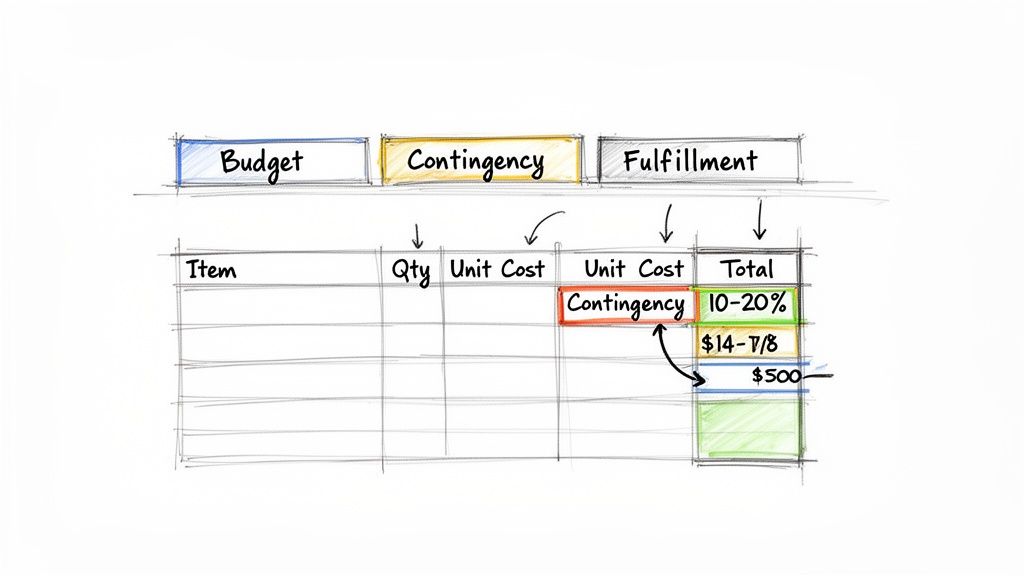
Our goal here is to take the guesswork out of budgeting and give you the tools to set your campaign up for success.
Before we jump into the individual line items, let's talk about the most critical part of your budget: the contingency fund. Think of it as your project's safety net. Skipping this is one of the biggest—and most common—mistakes new creators make. We strongly recommend setting aside a buffer of 10-20% of your total estimated costs.
Why is this non-negotiable? Because things happen.
This fund isn't "extra" cash; it’s a planned expense for the unplanned. A 15% buffer can be the difference between a minor hiccup and a campaign-ending disaster.
To show you how our budgeting proposal sample works in a real-world scenario, let's fill it out for a hypothetical board game project. Imagine we're creating a high-quality tabletop game called "Galaxy Guilds" and our goal is to manufacture 5,000 units.
Our template is broken down into the key cost categories we've covered, with formulas that automatically calculate your totals and percentages. This gives you an instant snapshot of where every dollar is going.
A key piece of advice I always give creators: be conservative with your revenue estimates and generous with your cost estimates. It's always better to end up with a surplus than a shortfall.
Let's plug in some numbers for our "Galaxy Guilds" campaign, which has a funding goal of $125,000.
This table shows how our downloadable template can be used in practice, giving you a clear financial picture for a common type of crowdfunding project.
| Line Item | Estimated Cost | Percentage of Budget | Notes |
|---|---|---|---|
| Manufacturing | $50,000 | 40% | $10/unit cost for 5,000 units. |
| Shipping & Fulfillment | $31,250 | 25% | Avg. cost of $6.25/unit. Crucial to validate with real quotes. |
| Platform & Payment Fees | $12,500 | 10% | Assumes ~10% total fees from Kickstarter and Stripe. |
| Marketing & Advertising | $12,500 | 10% | Pre-launch and live campaign ad spend. |
| Contingency Fund | $18,750 | 15% | Safety net for unexpected price hikes or errors. |
| TOTAL | $125,000 | 100% | Our total funding goal. |
Laying out the numbers this way removes all the guesswork. You can see immediately that to deliver your game and keep the lights on, your funding goal must be at least $125,000. This data-driven approach takes emotion out of the equation and lets you set a goal based on reality.
Remember, a platform like Kickstarter is your marketplace—it's where you find and build your initial audience. But for everything that comes after the campaign, you need your own storefront. This is where a pledge manager like PledgeBox comes in. It's the Shopify to Kickstarter's Amazon, and PledgeBox is free to send the backer survey and only charges 3% of upsell if there's any. This gives you a risk-free way to increase your total funds raised, adding even more breathing room to your budget.
A budget spreadsheet is a great starting point, but it's just that—a start. Your numbers are only as good as the data behind them, and in the real world of crowdfunding, a static document becomes outdated the moment your campaign ends. To truly protect your margins, you have to move from a fixed proposal to a dynamic financial strategy.
That's where smart tools come in. Modern platforms are much more than just survey-senders; they're powerful financial instruments that validate your costs in real-time. This is how you stop guessing and start making data-driven decisions, ensuring every dollar is accounted for.
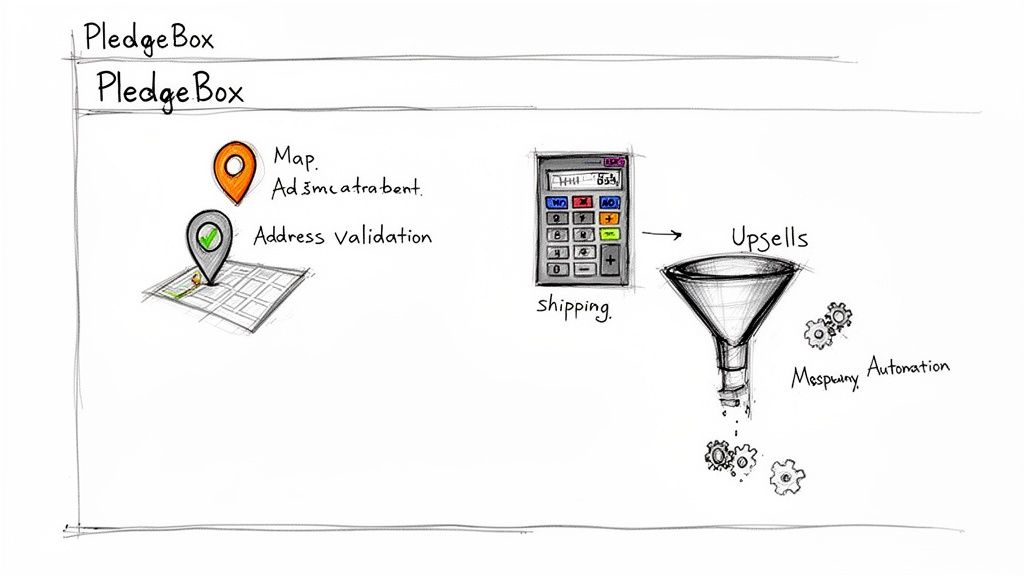
This shift isn't just helpful—it's essential for survival. With the crowdfunding market projected to hit $108.6 billion by 2033, the stakes are higher than ever. Tech and hardware projects alone make up 28% of this market, and their biggest pitfall is almost always the budget. Unsuccessful projects often have budget miscalculations averaging a staggering 40%.
The single biggest gamble in any campaign is trying to estimate shipping and taxes months before you actually ship anything. A pledge manager like PledgeBox completely flips this script, turning a risky guess into a precise, real-time calculation.
Instead of baking a flat, hopeful shipping rate into your Kickstarter rewards, you collect the exact shipping and tax amounts from each backer based on their final address and order weight. It's a total game-changer. A good pledge manager with integrated shipping solutions pulls live rates from carriers, so you aren't silently losing money on every single international package.
It also automates the incredibly messy process of calculating VAT and sales tax—a headache that can single-handedly sink a campaign if you get it wrong.
To really get it, think of it this way: Kickstarter is like your Amazon storefront. It’s a massive marketplace perfect for discovery and finding your first wave of customers. But once that initial rush is over, you need your own shop to manage those relationships and build on that success.
A pledge manager like PledgeBox is your Shopify. It's the powerful backend that gives you full control over the entire post-campaign experience. It’s where you handle logistics, talk to your backers, and—most importantly—keep generating revenue.
This control goes way beyond just collecting fees. Features like Google Maps-powered address validation might seem small, but they drastically cut down on returned packages. A single corrected address could save you $20 on a reshipment. Multiply that by hundreds of backers, and you’re suddenly reclaiming thousands of dollars for your project.
The best pledge managers aren't just cost-savers; they're revenue-generators. Your backer survey is the perfect opportunity to offer high-margin add-ons and upsells to your most passionate supporters. This is pure profit, added directly on top of your campaign funds.
And here's the best part: it can be a completely risk-free strategy. For instance, PledgeBox is always free to send the backer survey and only charges 3% of the upsell if there's any. If you don't sell any add-ons, you don't pay a dime.
This model gives you a massive opportunity to boost your project's financial health without adding a single line item to your expense sheet. To truly get the most out of this, you need to know how to calculate marketing ROI that actually drives profit. By integrating these tools, you’re not just following a budget; you’re building a resilient financial engine for your entire project.
Even with a rock-solid budgeting proposal sample, you’re bound to have questions. Planning a campaign has a ton of moving parts, and it's totally normal for a few things to feel unclear. Let's tackle some of the most frequent questions we hear from creators to help you lock in your financial plan with confidence.
This is one of the most critical questions, and my answer is always the same: don't skip it. You absolutely need a contingency fund of 10-20% of your total budget. Think of this as your project's safety net—it's there to catch you when unexpected manufacturing delays, surprise shipping hikes, or currency fluctuations happen.
Let's say your budget is $100,000. A 15% buffer gives you an extra $15,000 to play with. That cushion could be the very thing that saves your project if a key component cost suddenly spikes right before production. Trying to run a campaign without it is one of the biggest gambles a creator can take.
Yes, a thousand times yes. Collecting shipping and taxes after the campaign using a pledge manager isn't just a good idea; it's the industry standard for a reason. Trying to guess these costs months ahead of time is a recipe for disaster and can completely wipe out your profit margins.
When you charge backers the exact amount based on their final shipping address and order details, you leave no room for error. Platforms like PledgeBox are built specifically for this, protecting your project's funds from the dangerous guesswork of pre-campaign estimates.
The relationship between Kickstarter and PledgeBox is a lot like Amazon vs. Shopify. Kickstarter is the marketplace where people discover your project. PledgeBox is your powerful back-end store where you control the financial nuts and bolts and nail the customer experience. This separation is key to smart financial management.
Nine times out of ten, the biggest and nastiest hidden cost is international fulfillment. This isn't just shipping; it's the whole tangled web of shipping rates, taxes, and duties. Carrier prices are always changing, and tax laws are wildly different from one country to the next. It’s an area where it's incredibly easy to make very expensive mistakes.
The best defense here is a robust pledge manager that has shipping solutions built right in. These tools can automate the mind-numbing calculations needed for global fulfillment, saving you from costly errors and hours of manual data entry.
For any project more complex than a single sticker, the answer is a resounding yes. Kickstarter's survey is a basic tool that gets the job done for simple campaigns with one or two reward tiers. But a dedicated pledge manager like PledgeBox unlocks some serious, game-changing advantages.
What kind of advantages?
Remember that Amazon vs. Shopify analogy? A pledge manager gives you a powerful backend to manage and grow your revenue. With PledgeBox, the model is essentially risk-free. PledgeBox is free to send the backer survey and only charges 3% of the upsell if there's any, making it an essential tool for maximizing your campaign's financial success.
Ready to build a budget that puts your campaign on the path to success? PledgeBox offers an all-in-one toolkit to manage your finances from pre-launch all the way through fulfillment, helping you deliver on your promises and maximize your revenue. Explore how PledgeBox can help you today!
PledgeBox
The All-in-One Toolkit to Launch, Manage & Scale Your Kickstarter / Indiegogo Campaign