 PledgeBox
Order Fulfillment Logistics for Crowdfunding Success
Master order fulfillment logistics for your crowdfunding campaign with proven strategies to streamline shipping, reduce costs, and delight backers in 2026.
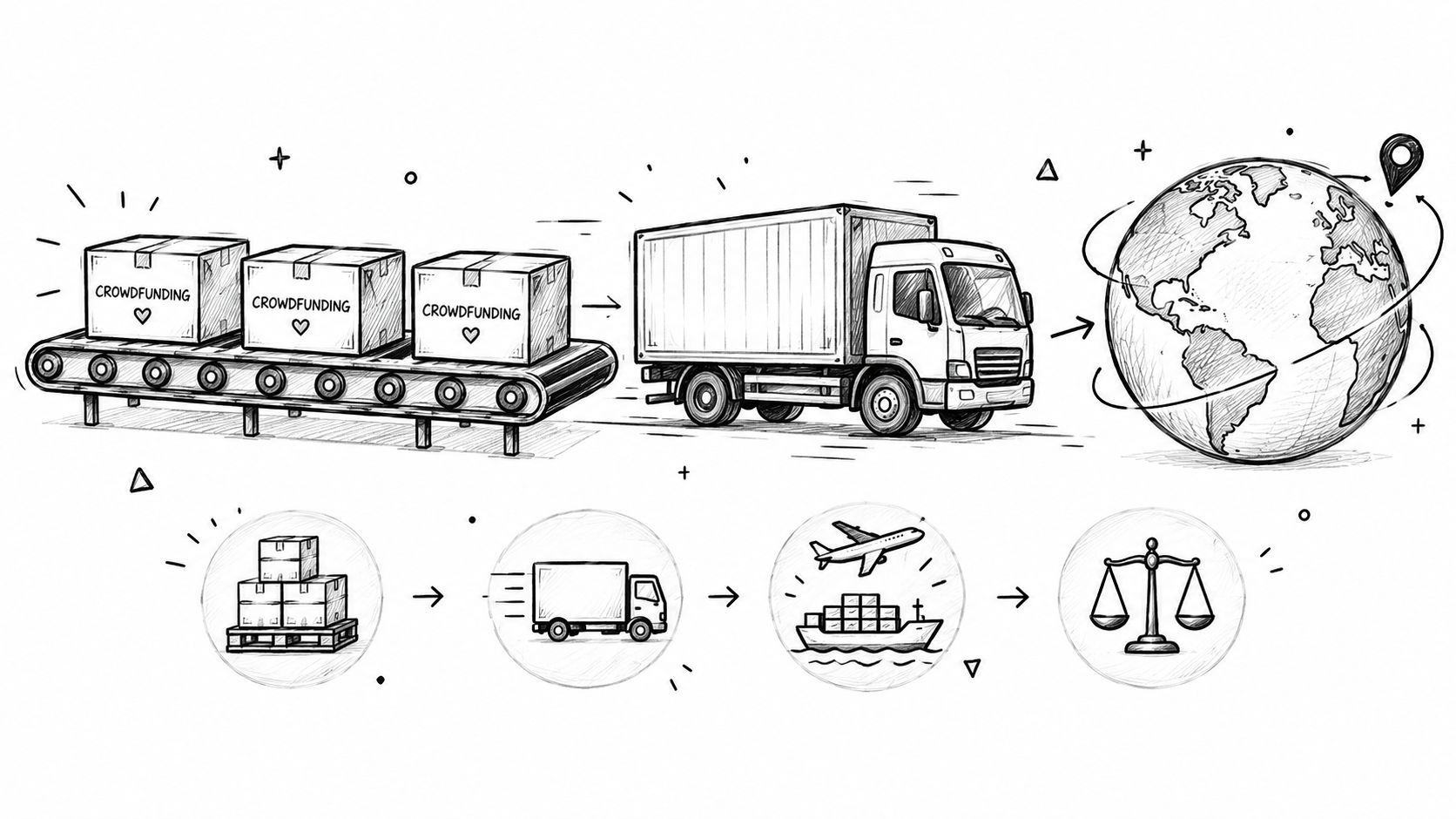
Master order fulfillment logistics for your crowdfunding campaign with proven strategies to streamline shipping, reduce costs, and delight backers in 2026.
You've hit the funding goal, sent the celebratory update, and started answering messages about production. Then the practical questions arrive. Which address should you use when a backer moved? Who pays the missing customs charge? Where should inventory sit, and how will your warehouse know which reward combination belongs in each box?
That's the point when a crowdfunding campaign stops being only a product launch. Order fulfillment logistics turns you into a warehouse coordinator, tax administrator, carrier negotiator, and customer support agent at the same time. I've shipped three campaigns, and the hardest lessons came after the money arrived. A pledge manager isn't a luxury at that stage. It's the control point between a clean handoff and a long sequence of refunds, replacements, and exhausted replies.
The first campaign I shipped felt successful until fulfillment began. The reward looked simple on the campaign page, but the post-campaign reality included multiple variants, international addresses, shipping charges, and backers who changed their selections after the campaign closed. A spreadsheet could hold the information, but it couldn't reliably validate it, track changes, or turn every combination into a warehouse-ready instruction.
The next failure usually starts small. One address lacks an apartment number. One backer selects an accessory that has already sold out. One shipment goes to an old address because the creator exported data too early. None of these problems looks fatal by itself. Together, they create reshipments, support tickets, delayed production decisions, and public complaints from people who already paid.

The operational pivot happens when you need a final, trustworthy order file. That file must connect the backer, reward, variant, shipping destination, tax treatment, payment status, and any add-ons. If one field is missing, your fulfillment partner either pauses the order or makes an assumption. Assumptions are expensive when they involve international delivery.
The cost structure makes the stakes even sharper. Shipping accounts for nearly 90% of total e-commerce fulfillment costs, with last-mile delivery representing the largest component, according to Statista's overview of e-commerce logistics. A small mistake in address data can therefore trigger more than inconvenience. It can force a second shipment through the most expensive part of the chain.
Practical rule: Don't measure fulfillment by whether parcels leave the warehouse. Measure it by whether the right reward reaches the right person without manual rescue.
A smooth campaign gives backers clear survey deadlines, a controlled way to update information, and realistic delivery expectations. The creator gets structured exports, visible order status, and a process for exceptions. A troubled campaign does the opposite. It treats fulfillment as a final administrative task, then discovers that every earlier promise has become a logistics instruction.
That's why the pledge manager matters so much. It captures the decisions that determine what gets packed, where it goes, what the backer pays, and how your vendor receives the order. Funding proves demand. Fulfillment proves whether you can convert that demand into a delivered product and a customer relationship worth keeping.
A campaign can be fully funded and still fail in the handoff after checkout. One unanswered survey field becomes an incomplete export, which becomes a warehouse exception, which can become a wrong item, a delayed parcel, or a refund request. Order fulfillment logistics works as a connected chain, so each decision needs an owner and a clear cutoff.
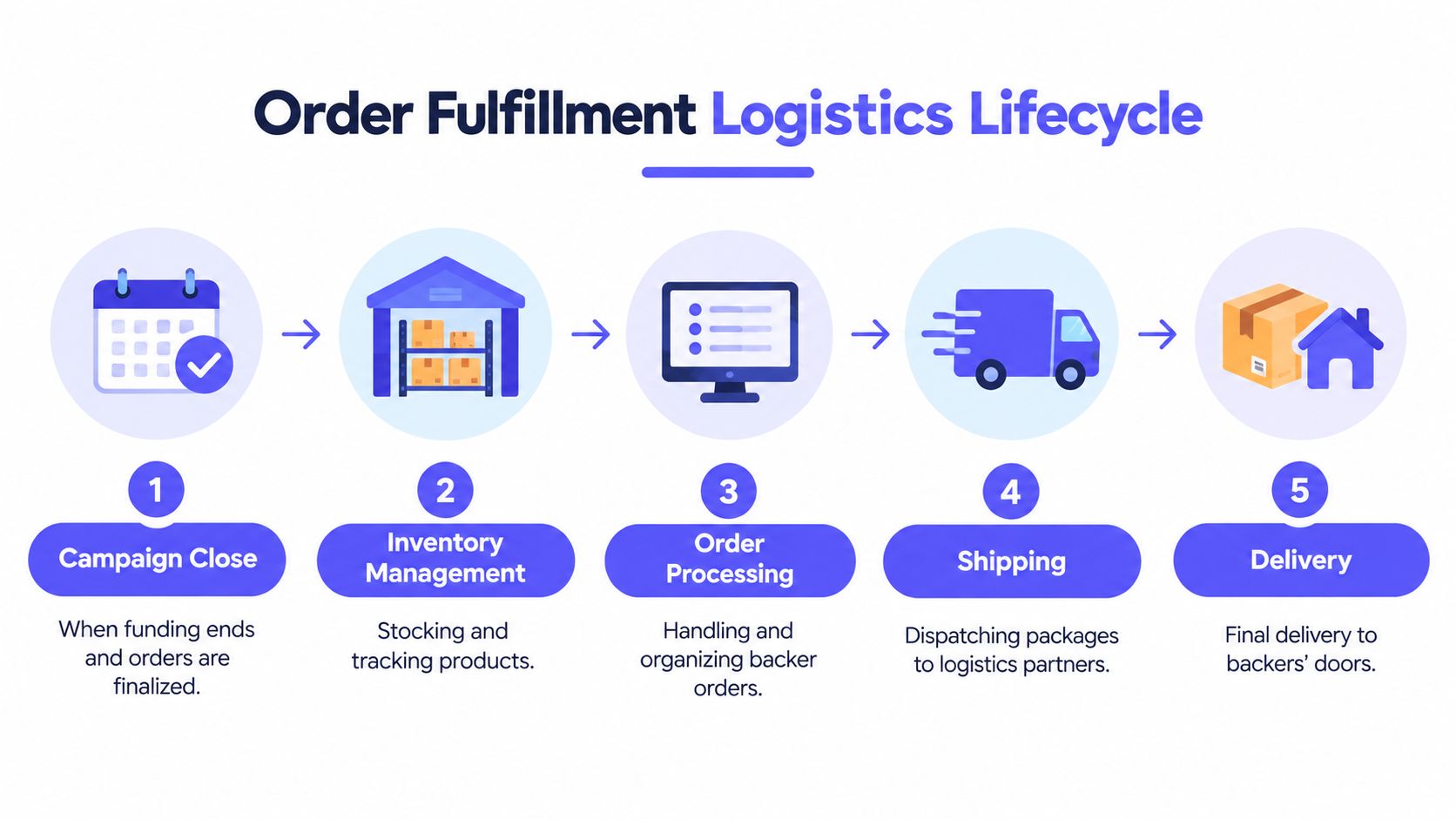
Campaign close defines the orders you must deliver. Reconcile campaign payments with the pledge manager, identify incomplete orders, and lock the reward combinations your team can actually fulfill. If backers can still change variants or destinations, do not send the warehouse file until the cutoff is explicit and enforced.
The survey should collect the details that drive packing and delivery: address, reward choice, shipping charge, tax information, and add-ons. Use conditional questions so a backer selecting one variant does not receive irrelevant fields. Structured options produce cleaner exports than free-text requests, especially when several colors, sizes, or bundles share similar names.
For a practical explanation of connecting surveys, orders, and delivery preparation, review this guide to crowdfunding order fulfillment.
Inventory management requires a dependable link between each SKU and each reward configuration. Track finished goods separately from components, reserve stock for approved orders, and flag shortages before the packing queue opens. A warehouse cannot solve a mapping problem created in the pledge manager.
Order processing verifies payment status, address completeness, reward selection, add-ons, shipping method, and tax amounts. Isolate exceptions before release. A note such as “include the blue one” forces a packer to interpret the order. Convert it into a defined SKU or return it for clarification.
A usable export should answer these questions without another email:
Shipping starts when the fulfillment team picks, packs, labels, and hands over the parcel. Packaging can change the available service and final cost, particularly for fragile or oversized rewards. Carrier tracking should return to the customer-facing system instead of remaining inside a vendor portal.
Delivery closes the first cycle, not the support work. Monitor failed deliveries, returns, customs holds, and damage reports, then define who approves reshipments or refunds. International backers also need realistic timing. Statista's e-commerce logistics data reports that fewer than 5% of cross-border orders are delivered within two days, so a fast domestic promise should not be copied into every destination.
The simplest way to understand the platform choice is this: Kickstarter's pledge manager is like Amazon, while PledgeBox's pledge manager is like Shopify. Kickstarter keeps the experience close to the marketplace where the campaign happened. PledgeBox gives the creator a separate operating environment with more control over surveys, add-ons, exports, and fulfillment preparation.
Neither model is automatically right. A straightforward campaign with limited reward complexity may benefit from native integration. A campaign with variants, late backers, tax collection, or several fulfillment vendors may need more control than a closed marketplace workflow provides.
Kickstarter says its native pledge manager has no upfront cost, but it deducts its usual fees from payments made within the pledge manager. Its support documentation also describes the survey as the place to collect addresses, reward preferences, and other fulfillment details. Kickstarter further says it applies the same fees to shipping and add-on funds raised through the pledge manager, while taxes raised there aren't charged fees. Review Kickstarter's pledge manager guidance and its pledge manager fee FAQ before calculating your net proceeds.
PledgeBox states that it's free to send the backer survey when no payment is collected, and that it charges only a 3% platform fee on upsell revenue if backers buy add-ons through the survey. That means there's no upfront or per-backer survey charge under the stated model. Always check the current terms before launch because platform details may change.
| Feature | Kickstarter Pledge Manager | PledgeBox |
|---|---|---|
| Survey distribution | Native post-campaign workflow | Dedicated survey workflow |
| Add-ons | Collected through the pledge manager, with Kickstarter's stated fee treatment | Upsell revenue is charged at 3% when add-ons are purchased |
| Tax treatment | Kickstarter says taxes raised through the pledge manager aren't charged fees | Supports collection workflows for shipping and VAT or tax |
| Backer editing | Creators can allow editable survey responses and choose when editing closes | Supports structured survey collection and fulfillment preparation |
| Vendor handoff | Export and integration options depend on the campaign setup | Downloadable reports and direct vendor exports |
| Late backers | Useful within the native campaign ecosystem | Supports late backer and pre-order workflows |
Kickstarter's editable survey responses show that its system is built for post-campaign fulfillment, not merely checkout. The creator can let backers update answers after checkout and decide when editing closes, as described in Kickstarter's product update. Choose based on the complexity you need to control, not just the convenience of keeping everything in one account.
A campaign can collect orders successfully and still fail after the pledge deadline. A warehouse may lack the data needed for customs, a carrier may reject an address, or an unexpected tax bill may turn a paid order into a support ticket. International fulfillment works only when country rules, inventory location, payment collection, and backer communication are designed as one process.
Start by assigning responsibility for every amount. Shipping fees, VAT or other taxes, duties, and platform fees are separate entries in the campaign model. Kickstarter says it applies its usual fees to shipping and additional add-on funds raised through its pledge manager, while taxes raised there are not charged fees, according to its pledge manager fee information. Record who collects each amount, who remits it, and what the backer sees before setting a reward price.
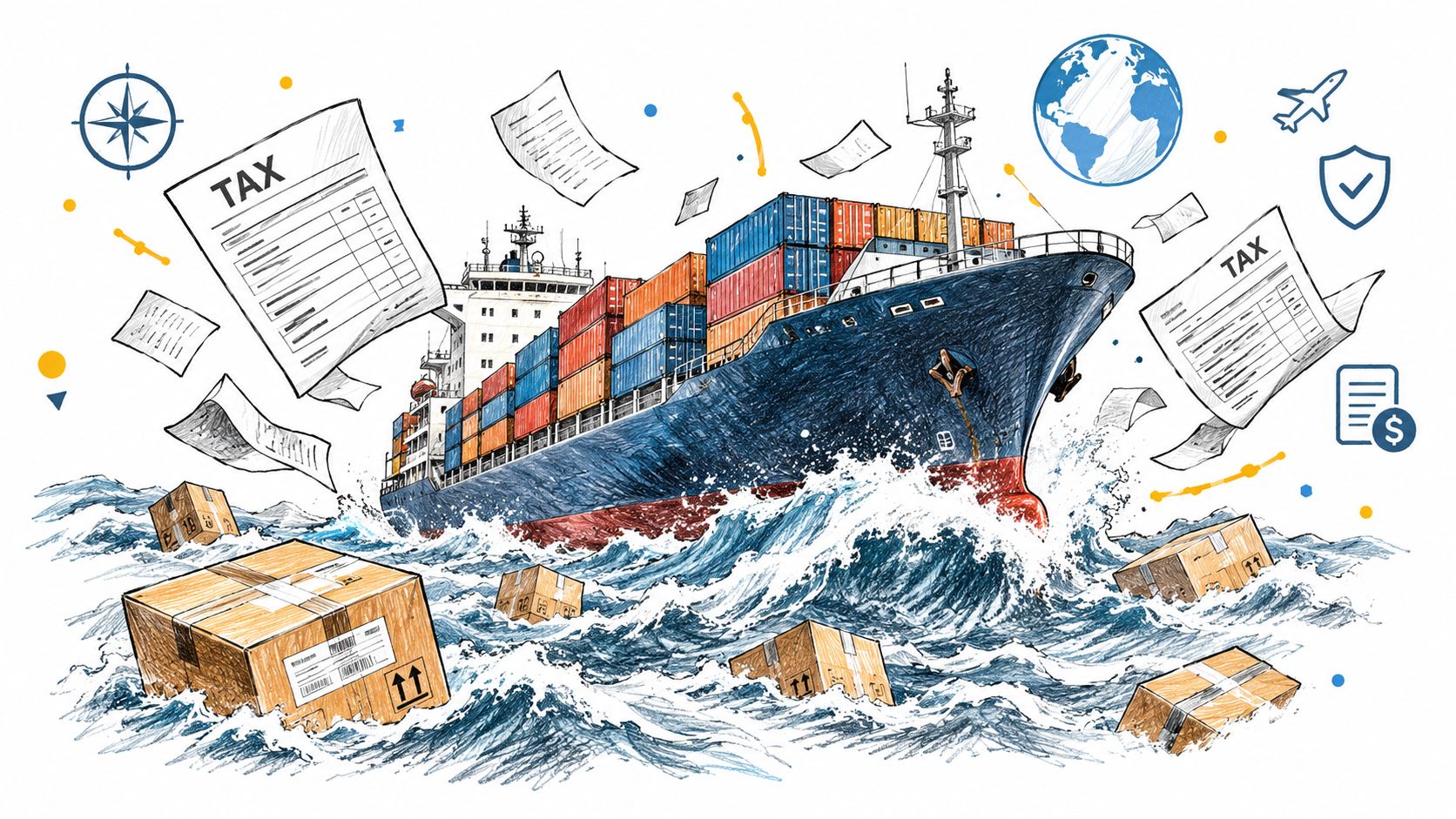
Warehouse placement determines more than transit time. A regional node can reduce distance to backers, while also adding storage charges, replenishment work, stock transfers, and separate reporting. A single facility simplifies control but can expose distant orders to longer routes, extra customs handling, and higher last-mile costs.
Tax planning must follow the inventory decision. Review international tax compliance for crowdfunding before stock is split across regions, because the storage location, seller of record, destination, and collection method can change the obligations your business must handle.
A practical choice depends on product value, package dimensions, destination concentration, replenishment speed, and the registrations your business can support. Do not promise regional delivery speed until the selected warehouse and carrier can serve the expected order volume.
Address validation needs its own checkpoint. Country-specific formatting, apartment details, postal codes, transliteration, and recipient names can affect sorting and delivery. Store the structured address separately from the label output, then hold incomplete or suspicious records for review instead of sending them into the warehouse file.
Carrier handoffs create another failure point. Confirm which party supplies customs data, who handles duties and taxes, and what happens when a parcel is refused or returned. Tell backers what they may need to pay and give support staff a clear process for held shipments.
Cross-border delivery also requires an honest window. Fewer than 5% of cross-border orders arrive within two days, according to Statista's e-commerce logistics coverage. Use domestic delivery as a separate benchmark, not as the promise for international backers. Record the service level by destination and keep tracking events connected to the original order record.
A scalable workflow reduces decisions before the warehouse sees an order. On my campaigns, the most damaging habit was exporting too early, then trying to reconcile changes across email, spreadsheets, and vendor files. The better approach is to create a controlled sequence with explicit gates.
First, configure the survey. Map every reward and add-on to an internal SKU. Make shipping and tax questions conditional where possible, and decide which answers backers can edit after checkout.
Second, validate responses. Check incomplete addresses, duplicate records, unsupported destinations, unpaid balances, and reward combinations that don't match available inventory. Hold exceptions in a separate queue. Don't let a warehouse file contain both approved orders and unresolved questions.
Third, close the survey deliberately. Announce the deadline, send reminders, and record the cutoff. A survey that's always open makes production and allocation difficult because your order population never stabilizes.
Fourth, export for the vendor. Use a consistent file structure with the order identifier, recipient information, SKU lines, quantities, shipping service, tax fields, and exception status. If the vendor requires CSV or Excel, provide that format rather than asking staff to retype data.
PledgeBox supports auto shipment tracking, Google Maps-powered address validation, downloadable reports, and direct vendor exports. Those tools address separate failure points, from bad addresses to manual data entry and missing delivery updates. Its survey model also means the survey can be sent without an upfront fee when no payment is collected, with only 3% charged on upsell revenue when add-ons are purchased, according to PledgeBox's pricing information.
SPS Commerce reports that order processing volumes have increased 95% since 2019, and identifies AI orchestration, automation, visibility, and error reduction among the main responses discussed for 2026 in its supply chain trends coverage. The figure describes industry reporting, not a forecast for your campaign, but the operational lesson is useful. Adding labor alone doesn't fix a workflow that produces unclear instructions.
Use automation for reminders, address checks, tracking notifications, and status changes. Keep human review for exceptions, unusual reward combinations, damaged inventory, and tax questions. The goal isn't to remove judgment. It's to reserve judgment for the cases that need it.
For a more detailed operating sequence, use this order fulfillment workflow guide as a checklist for survey collection, validation, and vendor handoff.
A campaign can look fully funded until inventory reaches the warehouse. Then mixed reward tiers, missing addresses, customs paperwork, and carrier exceptions arrive together. The right fulfillment model depends on the product, destination mix, inventory flow, and time you can give to daily operations, not on a universal order threshold.
Self-fulfillment can work for compact products, manageable destinations, and a team that can handle picking, packing, and support. It becomes risky when production arrives in one large wave or orders contain different components. A third-party logistics provider, or 3PL, supplies warehouse processes, carrier relationships, and operating staff without requiring you to build the full system yourself. For a practical explanation of how these providers fit into the supply chain, review this guide to browse third party logistics. A hybrid setup can keep local or premium orders in-house while a 3PL handles the wider shipment population.
Ask every provider how it receives inventory, identifies SKUs, handles kitting, records exceptions, manages returns, and sends tracking data back to you. Request a sample export before signing. If the file is difficult to read, your support team will struggle to answer delivery questions when volume rises.
Warehouse accuracy needs a measurable target. Best-in-class distribution center operations achieve more than 99.68% order picking accuracy, meaning fewer than 32 picking errors per 10,000 orders, according to Yale's distribution center metrics white paper. Use that figure as a benchmark, not as a promise from every provider.
Inventory accuracy requires a separate check. ASCM says warehouses commonly target 99.5% or higher inventory accuracy, with high-performing operations using monthly cycle counts across rotating SKU segments, as explained in ASCM's warehouse KPI guidance. Cycle counts suit small teams because they audit stock without stopping the entire operation for a full count.
Warehouse test: Ask what happens when the system shows an item in stock but the picker cannot find it. The response reveals how the provider handles exceptions.
National postal services often suit lightweight residential orders and broad coverage. Regional carriers can work well where they maintain strong local networks. Freight forwarders fit bulk inventory moving between countries or into distribution hubs, rather than ordinary individual parcels.
Compare the full service, not just the headline rate. Check dimensional pricing, tracking quality, address correction, customs support, delivery exceptions, insurance, and return handling. A cheaper label can create higher support costs if it produces more failed deliveries.
Before shipping begins, connect warehouse, carrier, and pledge data. Use one status language for paid, ready, held, shipped, delivered, and exception orders. Clear statuses show whether to add labor, change a carrier, reposition inventory, or revise the backer promise. They also expose survey or inventory problems before those issues become refunds and support overload.
PledgeBox lets creators collect backer details, manage shipping and tax fields, validate addresses, track shipments, and export fulfillment-ready data to vendors. Build the survey and warehouse handoff before the final inventory file is due, so post-campaign decisions do not become a last-minute operational crisis.
PledgeBox
The All-in-One Toolkit to Launch, Manage & Scale Your Kickstarter / Indiegogo Campaign