 PledgeBox
Kickstarter Payment Methods: Your 2026 Guide
Kickstarter payment methods - Understand Kickstarter payment methods, backer options, creator fees, & failed pledges. Discover how PledgeBox streamlines
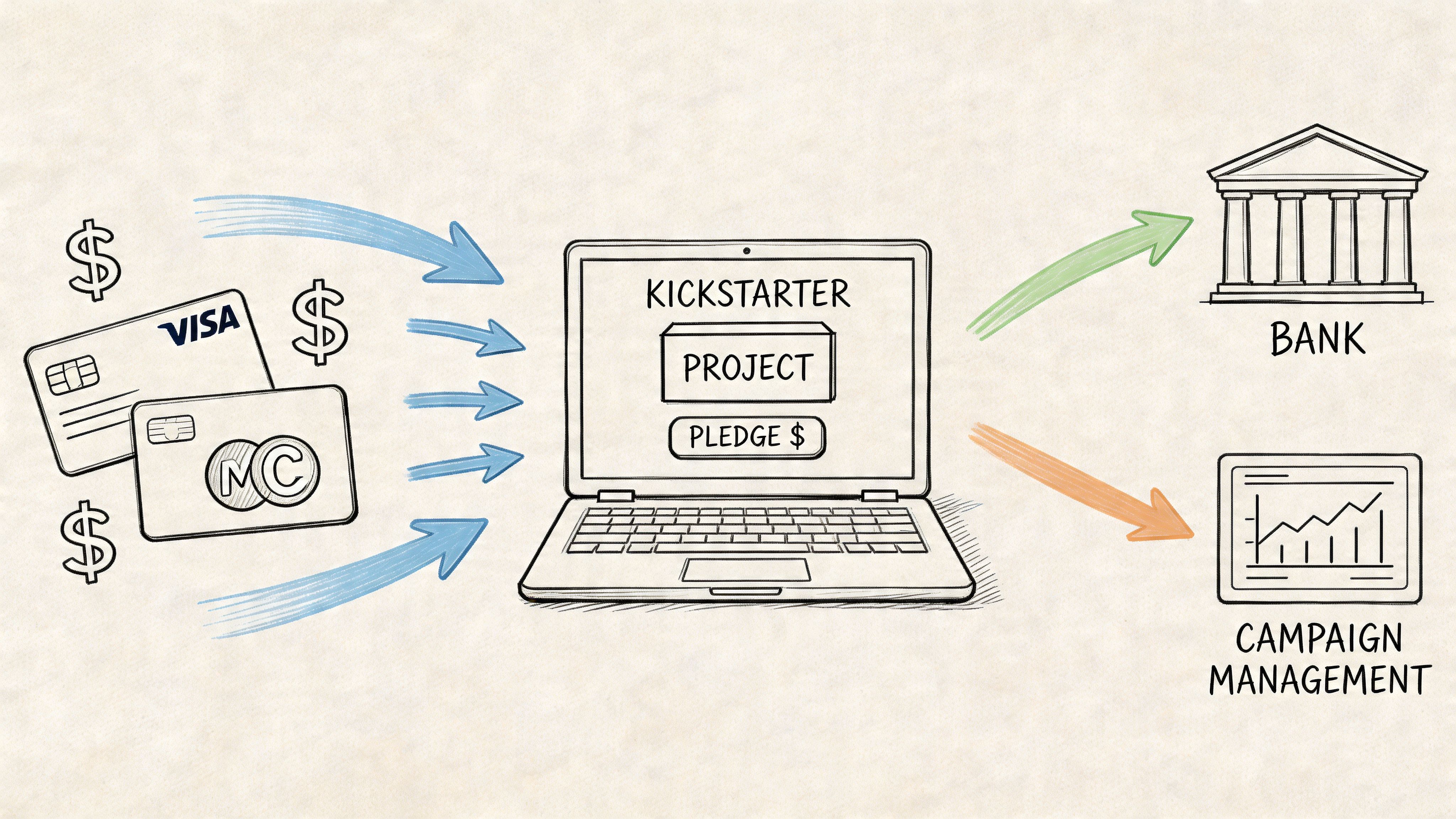
Kickstarter payment methods - Understand Kickstarter payment methods, backer options, creator fees, & failed pledges. Discover how PledgeBox streamlines
The campaign ends. The funding bar is green. Messages start coming in from friends, backers, and maybe a manufacturer who suddenly replies much faster than before.
Then the useful panic hits.
You look at the total on the campaign page and realize that number is not the money you can spend. Some pledges will fail. Fees come out first. Your bank setup matters. If you’re shipping a physical product, the initial pledge is only one part of the actual payment workflow. Shipping, taxes, late add-ons, address fixes, and post-campaign collections all show up after the celebration.
That’s why creators who understand kickstarter payment methods usually make better decisions long before launch. They write cleaner reward tiers. They explain charges more clearly to backers. They avoid underpricing. And they don’t assume Kickstarter’s native payment collection solves the whole financial job.
A first-time creator usually thinks in one straight line: backer pledges, campaign funds, money arrives. In practice, it works more like a chain of separate systems. One system authorizes the pledge. Another collects it. Another transfers it. Then a different layer handles fulfillment-era payments that Kickstarter itself doesn’t manage well.
That gap is where campaigns lose margin imperceptibly.
A funded campaign creates two opposite feelings at the same time. Relief, because people said yes. Anxiety, because now the money has to survive the trip from pledge screen to your bank account without getting chipped away by fees, payment failures, and post-campaign surprises.
Most creators first discover this when they start asking very practical questions. Which pledges go through? When does Kickstarter transfer the funds? How much disappears before the payout lands? What happens if a backer’s card fails? And if your project includes physical rewards, how do you collect shipping and any later extras without turning your comments section into a support queue?
The important mindset shift is simple. Funding success is not the end of the payment process. It’s the start of financial operations.
Practical rule: Treat the number on your campaign page as gross demand, not spendable cash.
Kickstarter is strong at the front end. It helps backers commit to your project inside a familiar checkout flow. But the closer you get to fulfillment, the more you have to think like an operator instead of a marketer.
That means keeping the payment lifecycle in view:
A lot of creators only prepare for the first two steps. The profitable ones prepare for all five.
A backer lands on your page, likes the product, picks a reward, enters card details, and clicks pledge in under a minute. For them, that moment should feel as easy as buying on Amazon. For you, it matters because every bit of friction at checkout affects conversion long before you deal with payouts, failed charges, or fulfillment.

Kickstarter runs payments through Stripe, so creators do not set up a custom stack of gateways inside the campaign. Backers typically pay with major debit or credit cards, including Visa, MasterCard, American Express, Discover, JCB, and UnionPay, though support varies by project location and card network.
That limitation matters more than new creators expect. If a backer cannot use the card they trust, or if the supported options are narrower in their region, conversion drops. You usually will not see an angry message. You just lose the pledge.
Kickstarter also keeps the checkout flow standardized, which helps trust. The trade-off is control. Creators get a familiar front-end payment experience, but they do not get much flexibility to customize how money is collected inside the campaign. If you want a clear breakdown of the fee stack tied to that setup, this guide on what percentage Kickstarter takes from each pledge is a useful reference.
Backers commit during the campaign, but their cards are charged only if the project reaches its funding goal. That all-or-nothing model helps conversion because the backer is saying yes to the project before money leaves the account.
It also creates a common misunderstanding. A pledge on the campaign page is not collected cash yet.
From an operator’s view, that changes how you read your numbers. Mid-campaign momentum looks like sales activity, but the actual cash collection happens later, after the project closes successfully. That gap is one reason Kickstarter works more like Amazon on the front end. It gives buyers a familiar place to commit. It does not give creators full store-level control over what happens after the order.
International checkout usually succeeds or fails on clarity. Backers need to understand the reward, the likely total cost, and whether the payment process feels familiar enough to trust.
Currency recognition plays a bigger role than many first-time creators assume. If your reward tiers are hard to translate mentally into a backer’s local price expectations, hesitation goes up. A simple fix is to write approximate currency equivalents into the reward description or campaign copy, especially for your most popular tiers.
The same principle applies to shipping expectations. Even before you collect shipping later, backers want to know whether they are looking at a local-feeling purchase or an uncertain international transaction. Clear copy improves conversion.
Backers judge the project and the transaction at the same time.
That is the main front-end story with Kickstarter payment methods. Kickstarter gives you a trusted checkout wrapper, which is good for getting the initial pledge. But once the campaign ends, creators still need a system that behaves more like Shopify than Amazon. That is where the financial gaps start to show, and where a pledge manager such as PledgeBox becomes much more than a nice-to-have.
When the campaign closes successfully, creators switch from selling to reconciling. This is the stage where optimism usually meets arithmetic.

Kickstarter has taken a 5% fee from every successfully funded campaign since 2009, and by 2013 the platform had already processed over $569 million in pledges, according to the published research on Kickstarter’s transaction scale and platform economics.
That 5% is easy to remember because it’s the cleanest fee in the stack. It’s also the one new creators fixate on, usually because it’s visible and easy to model.
The problem is that it’s only one layer.
Payment processing adds another layer, at which point campaign structure starts to matter. Fee modeling tied to Stripe-based Kickstarter processing shows variable processing fees of 3% to 5% plus $0.20 per successful pledge. That fixed component hits smaller pledges harder, and the effect is sharper when your campaign depends on lots of low-price rewards.
Here’s the practical point. A campaign with many small backers can feel healthy in the dashboard and still produce disappointing net revenue once the fees are applied. A campaign with cleaner tiers and fewer tiny transactions is often easier to fulfill profitably.
| Cost layer | What it means for creators |
|---|---|
| Kickstarter fee | Kickstarter keeps 5% of successfully funded campaigns |
| Processing fee | Payment processing can add 3% to 5% + $0.20 per successful pledge |
| Low-tier pressure | Small pledges get squeezed more because the fixed fee matters more |
If you want a plain-language explanation of how creators think about those deductions, this short guide on what percentage Kickstarter takes is a useful reference.
The payout process isn’t just about how much money you receive. It’s about when you can rely on it.
Your manufacturer deposit, packaging decisions, and freight booking won’t wait for you to feel financially organized. If your planning assumes that the campaign total becomes usable cash immediately, you’ll make bad commitments. If your bank verification or payout setup is incomplete, the stress compounds fast.
Don’t budget from the campaign total. Budget from expected collected funds after fees, failed charges, and operational holdbacks.
That’s the part many creators learn late. Kickstarter gives you momentum. It doesn’t give you margin discipline. You have to build that yourself.
One of the most expensive misunderstandings in crowdfunding is thinking a successful pledge is the same thing as collected money.
It isn’t.

A pledge is intent. Cash is what survives the actual charge attempts.
Backers change cards. Banks block transactions. Some accounts run into insufficient funds. Others trip fraud checks. All of that happens after your campaign has already celebrated success.
This matters even more with Pledge Over Time, Kickstarter’s installment option for qualifying pledges. Kickstarter’s own setup splits eligible pledges into three automatic charges, and the feature can make higher-priced rewards easier for backers to accept. But the risk doesn’t disappear. It just spreads out over more collection events.
According to the documentation and related analysis, installment decline rates in broader e-commerce can run 7% to 10% per transaction, and that can compound across multiple charges, potentially eroding 20% to 30% of expected funds from Pledge Over Time backers. The key issue is that Kickstarter’s official documentation does not quantify that risk for creators in a detailed way, as noted in Kickstarter’s Pledge Over Time common questions.
That gap is where first-time creators get blindsided.
Installments help a backer say yes to a higher tier. For premium rewards, that can absolutely improve accessibility. But creators need to separate conversion benefit from cash certainty.
If your manufacturing plan depends on the full value of those pledges arriving on schedule, installment-based funding creates a softer foundation than the campaign total suggests. The second and third payments are future collection events, not guaranteed cash already in hand.
A useful way to think about it is this:
If you want a broader grounding in how recurring or staged collections go wrong, this article on payment default is worth reading because it frames the operational risk clearly.
Creators often treat failed payments as a support issue. They’re really a revenue operations issue.
You need a process for payment follow-up, especially once the campaign moves beyond Kickstarter’s initial collection window. That includes reminders, alternative collection options for post-campaign obligations, and a clean way to reconnect a backer with what they still owe. This practical guide on how to collect payments from customers is useful if you’re building that workflow.
A failed pledge is not just a billing event. It can become an inventory planning problem, a support problem, and a fulfillment problem at the same time.
Pledge Over Time isn’t bad. “Set it and forget it” is bad.
Kickstarter does one payment job very well. It captures the initial pledge inside the campaign.
For many physical product creators, that’s not enough.
Once the campaign ends, real-world variables start showing up. Shipping costs shift by region. Taxes and VAT need to be handled correctly. Some backers want extras after the campaign. Others need to upgrade rewards, split shipments, or fix address details before fulfillment locks.
Kickstarter’s native payment flow isn’t built to handle that whole mess with much flexibility.
The practical gap appears the moment you try to keep all costs inside the original reward tiers. If you bake uncertain shipping or tax assumptions into those prices, you usually end up in one of two bad positions.
Either you overcharge backers early and reduce conversion, or you undercharge and absorb the difference yourself later.
Neither outcome is healthy. One slows the campaign. The other damages fulfillment economics.
The hidden loss doesn’t always show up as one dramatic mistake. It shows up in small operational failures:
This is why a campaign can look successful publicly and still feel financially tight behind the scenes.
Kickstarter is a campaign platform first. Physical reward fulfillment needs a second layer of financial control.
That second layer matters most when your product isn’t digital and your backers aren’t all in one country. The more variables you have, the less workable a one-time campaign charge becomes.
A pledge manager exists because the campaign total is not the final transaction map.
The easiest analogy is this. Kickstarter’s native survey and post-campaign flow are like Amazon. They’re standardized, constrained, and designed around a platform rulebook. A dedicated pledge manager is like Shopify. You get more control over how you collect money, structure choices, and run the business side of fulfillment.
That distinction matters more than most first-time creators realize.

A proper pledge manager sits between campaign success and fulfillment execution. It turns a loose backer list into a structured order system.
That means you can do things Kickstarter doesn’t handle cleanly on its own:
This is also where payment flexibility improves. Kickstarter’s in-campaign collection is tied to its own system. Post-campaign, creators often need broader control over how additional money is collected and tracked.
Kickstarter’s Pledge Over Time feature splits qualifying pledges into three monthly charges through Stripe. It can lower the initial authorization burden, but it also keeps those transactions inside Kickstarter’s framework. The same source notes that moving post-campaign items like shipping and VAT into a custom Stripe or PayPal flow via a pledge manager gives creators more control, and that hardware startups have seen up to 25% incremental revenue by decoupling fulfillment payments, based on the analysis tied to Kickstarter’s payment forms and post-campaign flow.
The practical lesson is simple. You don’t want your entire post-campaign economy trapped inside the same system that was designed mainly to secure the initial pledge.
| Kickstarter native flow | Dedicated pledge manager |
|---|---|
| Standardized | Configurable |
| Good for initial pledge capture | Better for fulfillment-era collections |
| Limited post-campaign payment control | Better handling of shipping, taxes, and add-ons |
| Works like a marketplace checkout | Works more like your own order system |
For creators comparing tools, this guide on how to select the right pledge manager gives a practical checklist.
One option in this category is PledgeBox. It supports Stripe and PayPal for post-campaign collection, the backer survey is free to send, and it charges 3% only on upsell revenue if there is any. That pricing model changes the risk calculation for creators because you’re not paying upfront just to collect survey data and fulfillment details.
If Kickstarter is where backers commit, a pledge manager is where creators regain control.
That’s the key distinction. Campaign platforms are built to help you get funded. Fulfillment platforms are built to help you keep more of what that funding should become.
A funded campaign can still turn into a messy cash flow problem if payment operations are loose.
The fix is usually simple. Decide before launch how money, data, and follow-up will move once the campaign ends. Kickstarter handles the front-end pledge collection. Your team still has to reconcile payouts, recover failed charges, collect post-campaign balances, and pass clean order data into fulfillment. That second half is where creators lose margin.
Treat payout setup as part of launch readiness. Confirm the legal entity, bank account, account holder name, and tax details early. Then make sure the same account is the one your finance or operations lead will reconcile later. A payout sent to the wrong entity or an account your team does not actively manage creates avoidable delays.
Use one working document or system for payment operations. It should track reward rules, shipping assumptions, tax handling, add-ons, refund rules, and ownership by task. If that information lives across scattered notes, support inboxes, and spreadsheets, errors start showing up as soon as surveys go out.
Confusing pricing creates hesitation. It also creates support tickets later.
For international campaigns, write tiers so backers can understand the full cost quickly. If your campaign is not based in the US, make prices easy for US backers to interpret. As noted earlier, many non-US creators still rely heavily on US support, so unclear currency presentation can cost conversions. Clear tier naming, plain shipping expectations, and upfront notes on what is charged later reduce drop-off during the pledge decision.
I have seen creators remember the marketing plan and forget the collection plan. That usually ends with rushed survey edits, payment confusion, and manual cleanup.
Use a checklist:
Confirm payout readiness
Verify banking, permissions, and who will reconcile deposits.
Review tier economics
Check whether fees, taxes, freight, and packaging still leave enough margin.
Draft failed payment messages early
Prepare short, plain-language reminders before cards start failing.
Split campaign funds from fulfillment collections
Track shipping, taxes, and add-ons as a separate money stage.
Test survey logic before sending
Run through product selection, regional shipping rules, and tax triggers like a backer would.
A survey is not just a form. It is the handoff between funding and fulfillment.
Build it the way an operations team would build an order intake flow. Ask only for information you need to ship correctly and charge correctly. That usually means SKU selection, shipping destination, tax treatment, add-ons, and a final review step. If a response cannot be used without manual interpretation, the question needs to be rewritten.
This is also the point where the Amazon versus Shopify difference becomes practical. Kickstarter works like a marketplace checkout. It is strong at capturing the initial commitment in a standardized way. Post-campaign collection works better in a system you can configure more like your own store. That is why many creators bring in a pledge manager once the campaign closes.
A tool like PledgeBox matters here because it gives you a controlled place to collect shipping, taxes, and upsells after the campaign, instead of forcing all of that into ad hoc spreadsheets and support threads.
Campaign totals get attention. Usable cash is what keeps production moving.
Track expected payout dates, recovery rates on failed payments, and the timing of post-campaign collections in the same operating view. That gives you a clearer picture of what money is available for tooling, deposits, freight, and fulfillment. Creators who need a broader operating framework can borrow a few basics from small business cash flow management.
The strongest payment workflow is the one your team can reconcile, your backers can understand, and your fulfillment partner can trust.
That is the standard to aim for. If the process works only when one person remembers every exception, it is not a system yet.
Most creators start by asking what payment methods Kickstarter accepts. That’s a useful question, but it’s too small.
The better question is how money moves through the entire campaign lifecycle, from pledge commitment to final fulfillment collection. Once you look at it that way, the weak spots become obvious. The initial checkout is only the first layer. Fees reshape your net. Failed payments reduce what looked secure. Installments help conversion but add uncertainty. And the post-campaign period creates new payment needs that Kickstarter alone doesn’t manage cleanly.
That’s why crowdfunding finance has to be run like operations, not celebration.
If you’re building physical products, the most dangerous mistake is assuming the campaign total is the whole business model. It isn’t. You need a method for collecting what comes later, tracking who paid, and protecting margins during fulfillment. Creators who think this way usually make calmer decisions because they can see cash flow as a system, not a surprise. If you want a useful broader primer on that mindset, this guide to small business cash flow management is a solid read.
Kickstarter can launch demand. It can’t run your entire post-campaign economy for you.
Take that part seriously, and you stop acting like a project creator who got funded once. You start operating like a business.
If you want a simpler post-campaign workflow, PledgeBox gives creators a way to send backer surveys for free, collect shipping and taxes, and only charges 3% on upsell revenue if there is any. This addresses the truth that Kickstarter gets the campaign funded, while the pledge manager handles the messy part that comes after.
PledgeBox
The All-in-One Toolkit to Launch, Manage & Scale Your Kickstarter / Indiegogo Campaign