 PledgeBox
Top 10 Film Documentary Grants for 2026
Discover the top 10 film documentary grants for 2026. Our guide covers eligibility, deadlines, and tips to secure funding for your project.
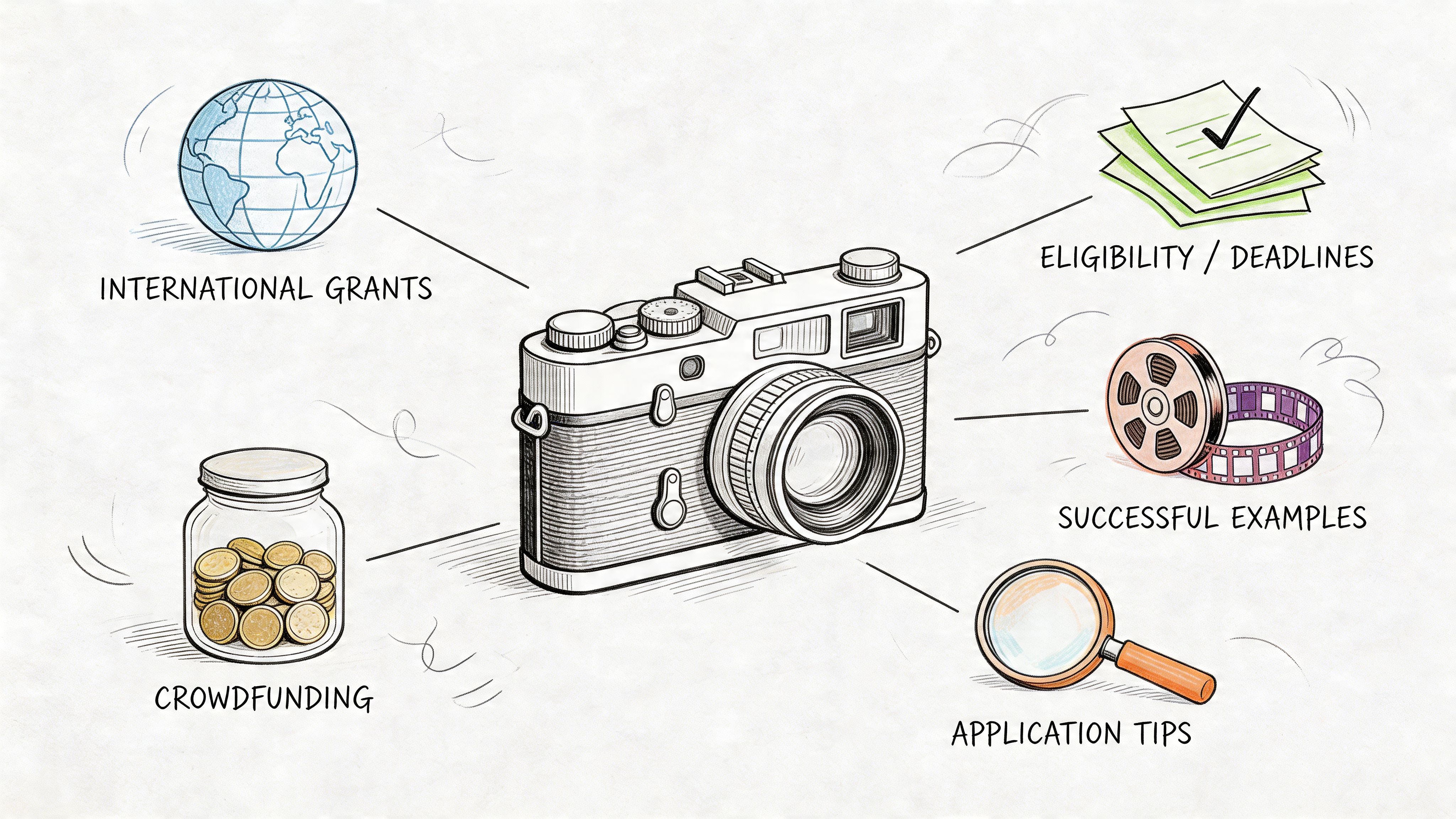
Discover the top 10 film documentary grants for 2026. Our guide covers eligibility, deadlines, and tips to secure funding for your project.
You have a promising documentary. Access is real, the characters are there, and a teaser proves the film has shape. Then the financing plan falls apart. That is the point where many strong projects lose a year.
Film documentary grants help at key moments. They can pay for development research, a production sprint, an editor, archival clearances, or the final push to picture lock. They also do something less obvious but just as useful. A respected grant can validate the project for broadcasters, fiscal sponsors, donors, and future collaborators.
Grants still rarely cover the full budget, and experienced producers do not build as if they will. Review cycles are slow. Eligibility rules are narrow. Some funds support only one stage, one region, one issue area, or one type of filmmaker. If the entire plan depends on a yes from a single program, the project usually stalls between deadlines.
The better model is hybrid funding. Use grants where institutional money does its best work: early development, finishing funds, issue-driven outreach, and prestige that helps other money come in. Use crowdfunding for flexible cash, audience proof, and momentum between grant decisions. Pair that with post-campaign systems that keep revenue going after the public launch, the same way creators in other sectors build layered funding plans with tools discussed in this guide to alternative funding strategies for inventors. Documentary producers can apply the same logic with sharper audience targeting and stronger campaign rewards.
I have seen filmmakers spend six months chasing the biggest name on the list instead of the best fit for the stage they are in. That usually ends with a polished rejection and no new footage, no rough cut, and no clearer path to market. The producers who keep moving make tighter choices. They match the ask to the stage, the funder to the format, and the grant plan to a backup source of cash.
That is the frame for this guide. The grants below are worth serious attention, but the primary advantage comes from combining them intelligently. A grant can finance the next milestone. A crowdfunding campaign can widen the audience and close timing gaps. A post-campaign tool like PledgeBox can help extend revenue after the campaign ends, which matters if your film needs a longer runway than any single grant cycle will provide.

Sundance is still one of the first names filmmakers mention when they talk about film documentary grants, and for good reason. It supports nonfiction projects across development, production, and post, and the signal value is almost as important as the money. When a project lands here, other funders usually pay closer attention.
The scale also matters. In 2025, the fund awarded unrestricted grants totaling over $1.5 million to 32 nonfiction projects from 24 countries, including support across development, production, post-production, and one impact campaign for a completed film, according to the 2025 Sundance Institute Documentary Fund grantees announcement.
Sundance is strongest when your film already has a clear artistic spine. Access alone won’t carry an application. You need a project that feels authored, not just important.
A few practical realities make it especially useful:
If you’re trying to assemble a broader financing plan after a grant win, it helps to understand adjacent fundraising models, including funding paths creators use outside traditional grants.
Practical rule: Apply to Sundance when your project has a strong directorial point of view and a sample that already feels like the film, not a research packet pretending to be one.
Prestige attracts volume. That means competition is brutal, and you can’t treat this as a starter grant. If your materials are still soft, save the application until your story engine is obvious on the page and on screen.

You finish a strong sample, start sending grant applications, and then run into a different kind of opportunity. ITVS does more than write a check. It is assessing whether your film can work inside a public media system with editorial oversight, delivery requirements, and a defined audience promise.
Producers who understand that distinction submit better applications.
ITVS works best for documentaries that are built to reach a broad public audience and can hold up under a commissioning process. If your project fits that lane, the upside is real. You are not only pursuing funding. You are also pursuing a distribution path, editorial partnership, and public television exposure that many independent grants do not offer.
That changes how I would position the project from day one. A strong ITVS application needs story clarity, rights discipline, a realistic production schedule, and a team that can handle notes without losing the film’s core point of view.
ITVS is one piece of the finance stack, not the whole stack. Public media decisions take time, and filmmakers still need cash to keep development, production, and audience-building moving while they wait. That is why the smartest approach is usually hybrid. Pair selective grant applications with crowdfunding, then use post-campaign tools and Kickstarter alternative platforms and campaign support tools to keep revenue coming in after the initial public push.
That approach also makes your project stronger for funders. A campaign can prove audience interest, sharpen your pitch, and give you materials that read less like theory and more like a film already gathering momentum.
ITVS tends to favor films that can communicate clearly to a public-facing audience and still feel authored.
A common mistake is using festival language only. Public media commissioners are asking a different question. They want to know who this film serves, why it belongs on public television, and whether the team can deliver it responsibly.
ITVS can add money, legitimacy, and access to a real outlet. It also narrows the margin for improvisation. If your process depends on staying loose until late in the edit, or if the film’s power comes from withholding context from the audience, the fit may be poor.
Apply when you can show both editorial strength and operational control. That combination is what makes ITVS worth pursuing.

Some programs give money. Some change the trajectory of a filmmaker. Chicken & Egg’s (Egg)celerator Lab belongs in the second group.
This one is valuable because it addresses a problem producers know well but many funders ignore. First and second features don’t fail only because of lack of cash. They fail because directors are isolated, producers are spread too thin, and nobody is shaping the project’s strategy with the same care they’re giving the edit.
The lab structure, mentorship, and retreats matter as much as the grant itself. When a director is early in a feature career, that support can prevent expensive mistakes in production design, story scope, and market positioning.
This is also where hybrid planning starts to matter. Many filmmaker resources talk about grants and crowdfunding as separate lanes. In practice, they overlap. Existing grant coverage often skips the operational side of combining the two, even though filmmakers regularly need both. That gap is one reason many creators look for platforms like Kickstarter alternatives and support tools that can carry the campaign further after the public funding push.
Chicken & Egg is targeted. That focus is part of its strength, but it also means many applicants won’t qualify. If you’re eligible, the key question isn’t “is this prestigious?” It is. The fundamental question is whether you’re ready for a yearlong process that asks you to absorb feedback, rethink strategy, and grow in public with a cohort.
If I were advising an eligible director choosing between a slightly larger check elsewhere and this lab, I’d usually take the lab if the project still needs structural help.

Firelight’s Documentary Lab has built a reputation for doing something many grant programs don’t do well. It develops filmmakers, not just projects. For U.S.-based filmmakers of color making a first or second feature, that distinction matters.
The most useful part of Firelight isn’t only the project grant. It’s the yearlong structure around mentorship, professional development, and access to people who understand both the craft and the institutional terrain.
A lot of film documentary grants end after the award notice. Firelight keeps going. That continuity helps when a project hits the predictable middle stretch, where access changes, edits get expensive, and fundraising momentum slows.
The broader market split also makes this kind of support more strategic than it looks. Educational and social-impact documentaries attract nearly 34% of institutional and academic funding interest globally, according to Global Growth Insights’ documentary film and TV show market report. If your project has strong public value and impact potential, Firelight can help you position it for that ecosystem rather than leaving you to improvise the language yourself.
Firelight works best for filmmakers who want sustained engagement and who understand that career support is part of the value. It’s less useful if you only need a quick gap-financing bridge and don’t want to participate in a cohort process.
Firelight is one of the programs where the network can outlast the grant. That’s often worth more than a larger one-time check.
The practical downside is eligibility. If you don’t meet the program’s criteria, it’s not a near miss. It’s not your lane. But if you do qualify, it’s one of the strongest combinations of money, mentorship, and long-term field positioning available.

You have a strong character, early access, and a story that is starting to move. What you do not have yet is the footage package that makes other funders say yes. Catapult sits in that gap, and that is why producers pay attention to it.
This grant is built for development. That means early shooting, exploratory travel, teaser production, and the materials that help a documentary move from promising idea to financeable project. In practical terms, Catapult is often less about paying for your film and more about paying for the proof that helps the rest of your financing stack come together.
That distinction matters.
A lot of filmmakers wait too long to apply for development support, or they apply too early with a proposal that is still mostly argument and not yet cinema. Catapult tends to reward projects that can show why access is real, why the story is active now, and what the team expects to capture in the near term. The question is rarely, “Is this topic important?” The real question is, “Why will this footage be worth watching?”
Catapult works best when you treat it as one part of a wider funding strategy. A development grant can pay for the scenes and teaser that make your crowdfunding campaign more credible. Then the campaign can bring in audience money, validate demand, and give you a stronger base for later grant and investor conversations.
I have seen this sequence work well. First, use development funding to get strong sample material. Next, launch crowdfunding with something better than a talking-head pitch. After the campaign, use a tool like PledgeBox to capture post-campaign orders, keep revenue coming in, and avoid letting momentum disappear once the platform closes. For documentary teams building a hybrid model, that handoff matters.
Catapult usually favors specificity over scale. A contained project with unusual access can be more fundable than a huge issue film that still feels abstract on the page.
Strong signs include:
Weak signs include:
The trade-off is straightforward. Catapult is extremely useful if you are at the proving stage. It is less useful if your project already has extensive footage and needs finishing money, or if it is still too early to show why your camera belongs in the room.
If you apply, be concrete. Name the characters, the turning points, the access, and the scenes you expect to capture soon. Development funding goes to projects that can turn early belief into visible evidence.

The Pare Lorentz Fund is one of the more specific entries on this list, and that specificity is useful. It tends to favor documentaries with a clear social dimension, public value, and a visual approach that does more than merely record events.
When filmmakers ask whether IDA’s theme-driven funds are worth the effort, my answer is yes, but only if your project naturally belongs there. Chasing thematic alignment after the fact usually produces weak applications.
This fund suits films that educate without flattening into advocacy videos. It’s a good lane for projects that are urgent, civic, and visually intentional.
IDA’s brand also carries weight. Even when the grant amount isn’t the entire answer, the endorsement can help with later asks to donors, fiscal sponsor networks, and finishing supporters.
The biggest issue is pathway. Nomination structures and staged review processes can narrow the route in. That doesn’t make the fund inaccessible, but it does mean you need to be realistic about your entry point and timing.
If your film’s strongest asset is reporting, apply with reporting. If its strongest asset is cinematic treatment, show that. Don’t write the application in generic impact language and hope the sample carries it.
A practical note for producers building a stack: theme-based grants like this often pair well with a later audience campaign, especially when the film’s community is already active. The grant validates the project’s public importance. The campaign tests whether that importance translates into a committed audience.

Late-stage funding is some of the hardest money to raise, which is exactly why SFFILM’s Documentary Film Fund keeps showing up on serious producers’ lists. By the time you hit post, everyone assumes the film is nearly done. In reality, post is where costs become concentrated and deadlines turn brutal.
This fund is built for that stage.
A documentary can look “close” and still be far from deliverable. Edit time expands. Archival fees hit. Sound, color, legal, and music all show up at once. A post-focused grant is useful because it speaks directly to that bottleneck rather than pretending a generic production award will cover it.
SFFILM is also practical in another way. It doesn’t only offer cash. It can add visibility and artist development benefits that help a team think beyond finishing into launch.
The strongest candidates usually already know what the money will solve. Not “finish the film,” but something more concrete.
This is not a development fund dressed up as post support. If you’re still discovering the film from scratch, you may be too early. But if you’ve got structure, characters, and a workable cut, SFFILM can be exactly the bridge you need.
I like this grant most for films that are artistically strong but financially squeezed at the point where a little focused support can materially improve the final work.

You have a climate film with a strong central story, a team that can finish it, and real potential for screenings beyond the festival circuit. Then the usual grant problem shows up. General documentary funds may like the craft, but they do not always understand why outreach, partnerships, or community screenings belong in the budget. Doc Society’s Climate Story Fund is one of the few programs built for that reality.
That focus matters. Climate projects are often judged on two tracks at once: cinematic strength and public usefulness. A fund that already works in that subject area saves you from spending the whole application explaining why the issue matters.
Doc Society is a strong fit for films that need more than production money. It tends to reward projects that can connect story, audience, and impact in a credible way. For climate documentaries, that combination is often the difference between a film that premieres and disappears, and one that keeps working through partners, educators, advocates, or community organizers.
I tell producers to be honest about the trade-off here. Mission alignment helps, but it also raises the bar. If climate is only a secondary theme, the application will feel forced. If climate justice, biodiversity, extraction, adaptation, or policy is central to the film’s engine, this fund can be a much better match than a broad documentary grant.
The weak application says, “This issue is urgent.”
The stronger application says who the audience is, what the film changes for them, and how the team will carry that work after the campaign or premiere window.
That is also why this grant fits well inside a hybrid funding plan. Use grants like this to cover mission-aligned needs that conventional backers may overlook. Use crowdfunding to prove audience demand, build your email list, and pre-sell the film’s community. Then use a post-campaign tool like PledgeBox to keep collecting late support, merchandise sales, and add-ons after the main campaign closes. For climate films in particular, that stack makes sense because the audience often wants to participate, not just watch.
I rate this fund highly for teams that already know how the film will travel once it is finished. That clarity improves the grant application and makes every later funding step easier.

NEH is a serious option for documentaries grounded in history, culture, philosophy, religion, literature, or related humanities inquiry. It is not a general documentary grant. That’s why many filmmakers misread it.
If your project is built on humanities scholarship and public engagement, NEH can be one of the strongest institutional fits in the field. If it isn’t, the application will feel painful fast.
NEH rewards rigor. You need a nonprofit applicant or fiscal sponsor, a coherent humanities framework, and a project that can show scholarly depth without becoming inaccessible. The upside is that institutional credibility from a grant like this can change how later funders see the project.
The challenge is selectivity and process discipline. The plan notes for this program include transparent funding tracks and recent success-rate information, which tells you something simple: you shouldn’t apply casually.
Before you draft the narrative, ask two questions.
NEH is excellent for films that translate scholarship into public storytelling. It’s a poor fit for projects trying to retrofit an academic frame onto a more general social issue documentary.
I’ve seen teams strengthen an NEH application by treating scholars as real collaborators, not advisory names added late for credibility. That usually improves the film itself, not just the proposal.

You have a strong investigative documentary, a reporting plan, and a rough cut budget that already looks too small. Then you check the fund list and see a program with the right editorial DNA, but it is under strategic review and not accepting applications. Such is the situation with the IDA Enterprise Documentary Fund.
It still matters because it has long represented a specific corner of nonfiction funding. Journalistic, accountability-driven work needs backers who understand reporting timelines, verification, legal review, and the fact that some stories get more expensive as they get better.
I would not put this fund into an active financing schedule right now. I would use it as a standard.
If your film would have been a fit here, that tells you something useful about how to package it for the rest of your financing plan. You need to show reporting depth, editorial judgment, and a clear public-interest case. General documentary grants may respond to character, access, or artistic approach. Journalism-centered support usually asks a harder question first: what has been proven, and what still needs reporting?
That distinction affects budget strategy too. Investigative films often spend money earlier than other docs. Research, fact-checking, legal review, security planning, and archival clearance can hit before you have a polished trailer or broad funder momentum.
Use the pause to get your project finance-ready in ways that help across grants, donors, and supporters.
That last point matters more than many first-time teams expect. For investigative work, crowdfunding is not just cash. It is early proof that an audience cares about the reporting. A grant can validate the journalism. A campaign can validate demand. Together, they give you a stronger financing story than either one alone.
I have seen producers make a common mistake here. They wait for the perfect journalism fund to reopen instead of using the project’s reporting strength to raise a first layer of money elsewhere. The better move is usually to apply to aligned grants, run a disciplined crowdfunding campaign once the story stakes are clear, and treat post-campaign revenue as part of the financing model rather than a bonus.
The IDA Enterprise Documentary Fund is worth watching. It is just not a fund you can count on today. Build as if it may return, but finance as if it will not.
| Program | Funding & Support 💰 | Eligibility & Reach 👥 | Competitiveness/Quality ★ | Unique Selling Points ✨🏆 |
|---|---|---|---|---|
| Sundance Institute Documentary Fund | 💰 Nonrecoupable grants (varies) | 👥 Global (English materials required); feature docs | ★★★★★ Very competitive (20–25/1,300+) | ✨ Prestigious validation; 🏆 unlocks additional financing & visibility |
| ITVS Open Call | 💰 Co‑production funding (up to $400k features / $50k shorts) | 👥 U.S. public‑media projects; shorts & features | ★★★★ High, editorial partnership & deliverables | ✨ PBS distribution pathway; 🏆 sizable awards + editorial support |
| Chicken & Egg, (Egg)celerator Lab | 💰 $40,000 production grant (installments) | 👥 First/second‑time women & gender‑expansive directors | ★★★★ Competitive; single annual window | ✨ Yearlong mentorship + 2 retreats (costs covered); 🏆 strong pipeline for emerging directors |
| Firelight Media, Documentary Lab | 💰 $25,000 project grant (fellowship) | 👥 U.S.‑based BIPOC filmmakers (1st/2nd features) | ★★★★ Cohort limited; selective | ✨ Customized mentorship & career development; 🏆 deep network in public media |
| Catapult Film Fund, Development Grant | 💰 Development grants (varied amounts) | 👥 Early‑stage feature docs with access-driven stories | ★★★★ Highly competitive | ✨ Focus on early footage & pitch support; 🏆 strong festival/funder recognition |
| IDA Pare Lorentz Documentary Fund | 💰 Typical grants ≈ $25,000 + stipends | 👥 Feature‑length, theme‑aligned projects (nomination) | ★★★★ Selective; nomination steps | ✨ Thematic focus on social issues; 🏆 IDA credibility & consultation |
| SFFILM Documentary Film Fund (DFF) | 💰 ~$10k–$20k post‑production grants | 👥 International; projects ~ready for post | ★★★ Practical; limited awards | ✨ Late‑stage cash + coaching/member benefits; 🏆 industry visibility |
| Doc Society, Climate Story Fund | 💰 Up to $125,000 (production & impact) | 👥 International climate‑focused nonfiction | ★★★★ Competitive but larger awards for theme fit | ✨ Impact campaign support & networks; 🏆 substantial mission funding |
| NEH, Media Projects | 💰 Development up to $75k; Production up to $700k | 👥 U.S. nonprofit or fiscal‑sponsor; humanities projects | ★★★★★ Rigorous; ~8% success rate | ✨ Significant institutional funding & credibility; 🏆 boosts fundraising capacity |
| IDA Enterprise Documentary Fund | 💰 Historically significant editorial funding | 👥 Global investigative/journalism‑forward projects | ★★★★ Historically very competitive; currently paused | ✨ High editorial standards; 🏆 ideal for investigative nonfiction (applications paused) |
A documentary team gets a development grant, spends it well, and still runs short in post. Then the campaign goes live with no system for late backers, add-ons, or fulfillment. I have seen that pattern more than once. The film is good, the support is real, and the financing plan still breaks because each funding source was treated as a separate event instead of part of one structure.
Sustainable producing comes from building that structure early.
Grants are selective, slow, and tied to stage, subject, or institutional fit. Crowdfunding moves faster, but it only works if the project already has a clear audience and a reason to act now. Put together, they do different jobs well. Grants can cover research, access, production, post, or impact work that fits a funder’s mission. Crowdfunding can fill timing gaps, prove audience demand, and bring in cash while applications are pending or restricted funds cannot be used for overhead, deliverables, or outreach.
That hybrid model is what many documentary teams need. Grant money rarely covers the full path from development to delivery, especially once legal, archival, insurance, outreach, travel, accessibility, and deliverable costs start stacking up.
The sequence matters.
Apply for grants first when you need legitimacy, sample material, or a way to advance the project to the next stage. Launch crowdfunding once the film has enough footage, access, or story tension to give supporters confidence. Use post-campaign tools after that to keep revenue coming in instead of treating the campaign close date as the finish line.
A practical workflow looks like this:
Filmmakers miss timing on crowdfunding all the time. Some launch with nothing but a logline and a cause. Others wait until the film is basically done and supporters no longer feel needed. The stronger campaigns usually sit in the middle. There is enough material to persuade people, and there is still a clear problem their money helps solve.
Operations matter just as much as fundraising. After a campaign, the team still has to manage surveys, reward selection, shipping, taxes, digital delivery, add-ons, and backer data. If that work lives in spreadsheets and scattered inbox threads, revenue slips away and the producer absorbs more admin than the project can afford.
Kickstarter’s pledge manager setup works like a large marketplace. It is familiar and centralized. PledgeBox works more like a direct storefront for your backers. It gives teams more control over branded surveys, add-ons, late pledges, shipping logic, tax collection, and fulfillment exports. For documentary projects, that flexibility matters because backers often want a mix of film access, community screenings, classroom materials, signed items, or issue-based participation.
Cost matters too. PledgeBox is free to send the backer survey and charges 3% on upsells if there are any. For indie documentary budgets, that can be the difference between a useful post-campaign system and another tool the team avoids because every fee hits the finishing budget.
Long-term career stability usually comes from stacking small advantages across projects. A grant that validates the film. A campaign that shows audience demand. Better records on what converted. Cleaner fulfillment. A backer list you can return to on the next release. That is how one funded film turns into a repeatable producing model.
If you’re building a hybrid financing plan, PledgeBox is worth a hard look. It helps documentary teams handle the messy part after a campaign goes live or closes, including branded backer surveys, add-on upsells, late pledges, shipping fees, VAT and tax collection, address validation, and fulfillment exports. It’s free to send the backer survey and only charges 3% on upsells if there’s any, which makes it a practical fit for indie film teams that need flexibility without another upfront platform cost.
PledgeBox
The All-in-One Toolkit to Launch, Manage & Scale Your Kickstarter / Indiegogo Campaign