 PledgeBox
What Percentage Does Kickstarter Take From Creators?
Uncover what percentage does Kickstarter take in fees. Our guide breaks down the 5% platform fee, payment processing, and hidden costs for your campaign budget.
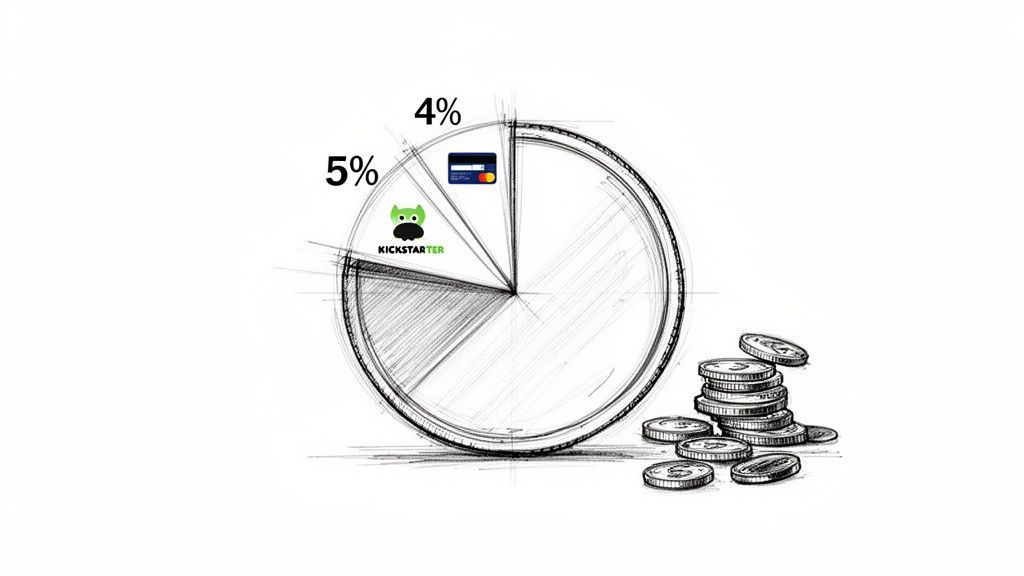
Uncover what percentage does Kickstarter take in fees. Our guide breaks down the 5% platform fee, payment processing, and hidden costs for your campaign budget.
So, you're asking, "what percentage does Kickstarter take?" It’s a great question, but the answer isn't a single number. It’s actually two. For any successfully funded campaign, you should budget for a combined 8% to 10% of your total funds to cover both Kickstarter’s platform fee and the separate payment processing fees.
This means the amount you actually pocket will be noticeably less than the total you raised on your campaign page.
When you launch a project on Kickstarter, you're basically partnering up. The platform gives you the stage, the tools, and the audience, and you bring the creative vision. In return for that infrastructure, Kickstarter takes a cut of your earnings—but only if you hit your funding goal. No success, no fee.
Getting a handle on this fee structure is the first step to building a budget that’s realistic and, most importantly, profitable.
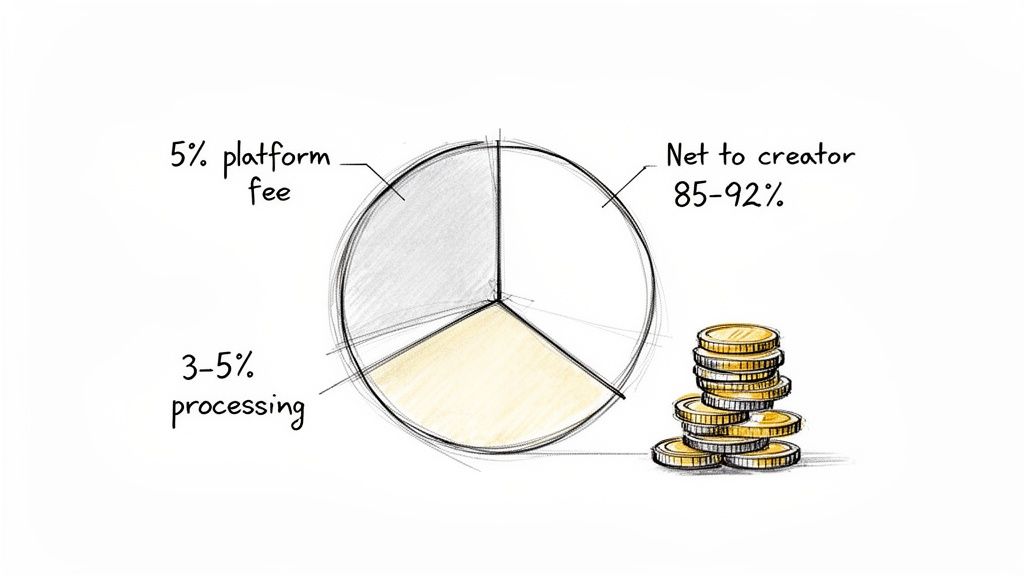
That 8-10% slice of your funding pie is made up of two distinct parts: Kickstarter’s own platform fee and the transaction fees from its payment processor, Stripe.
Let's quickly summarize what you can expect.
| Fee Type | Typical Percentage | What It Covers |
|---|---|---|
| Platform Fee | 5% | Access to Kickstarter's platform, community, and campaign management tools. |
| Payment Processing | 3% - 5% (+ a small fixed fee per pledge) | The cost of securely processing every single backer credit card transaction. |
As you can see, these two fees cover different parts of the crowdfunding process. Here's a closer look at each:
Kickstarter's Platform Fee: This one is super straightforward. Kickstarter takes a flat 5% cut of the total funds you raise. This fee is what pays for the use of their platform, their discovery tools, and access to their massive community of backers. Again, if your project doesn't meet its funding goal, you pay nothing.
Payment Processing Fees: These are separate charges from Stripe for handling every single backer transaction. The fees usually land somewhere between 3% to 5%, plus a small fixed amount for each pledge (like $0.20). This rate can change a bit depending on your backer's location and currency.
Put them together, and you get a clearer picture. For example, let's say your campaign is a huge success and raises $100,000. You'd pay $5,000 to Kickstarter (5%), plus another $3,000-$5,000 in payment processing fees. That's a total cost of $8,000-$10,000, which is where that 8%-10% figure comes from. You can dive deeper into their fee structures on Kickstarter's official page.
This is exactly why smart post-campaign financial management is a game-changer.
Once the confetti settles and your campaign ends, the real work begins. Managing your backers and getting all their final details is the next critical phase, and this is where a pledge manager becomes your best friend.
You can think of Kickstarter's pledge manager like Amazon—it gets the job done for simple transactions but doesn't offer much flexibility. A dedicated tool like PledgeBox, on the other hand, is like Shopify. It gives you a powerful, customizable platform to manage backers, sell add-ons, and handle all the post-campaign logistics.
Here's the best part: PledgeBox is free to send the backer survey and only charges 3% of upsell if there's any. This model lets you collect shipping info, offer cool add-ons, and boost your final profit without paying a dime upfront.
To really get a handle on what percentage does Kickstarter take, you have to look past the headline number. The total cut from your funding isn't a single charge—it's actually a combo of two different fees, each with its own job. Understanding this two-part structure is the secret to accurately predicting how much money you’ll actually walk away with.
First up is Kickstarter’s 5% platform fee. This is pretty straightforward. Think of it as your ticket to the party—it gives you access to their huge built-in audience, the credibility of their brand, and all the tools you need to build and run your campaign page.
What’s really important here is that this is a success fee. If your campaign doesn’t hit its funding goal, you don't owe Kickstarter a dime. Their all-or-nothing model means they only get paid when you succeed, so they’re just as invested in your project as you are.
The second piece of the puzzle is the payment processing fee, which is a bit more of a moving target. Handled by partners like Stripe, these fees are totally separate from Kickstarter's cut and usually fall somewhere between 3% to 5% of the funds you raise. This is what covers the cost of securely handling every single credit card transaction from your backers.
But here’s a detail that often catches creators by surprise: the fee usually includes a small, fixed amount for every single pledge, typically around $0.20 to $0.30. It sounds tiny, but it can add up in a big way.
A campaign that raises $50,000 from 100 high-value backers will pay less in total fees than one that raises the same amount from 5,000 small backers. Why? Because of the snowball effect of thousands of those little fixed transaction fees.
This means your total fee percentage can creep up if your project attracts a ton of low-dollar pledges. Industry data backs this up, showing that once you combine the 5% platform fee with payment processing, the effective rate often ends up between 8% and 10%. On a $250,000 campaign, that’s roughly $20,000 to $25,000 gone before you even think about manufacturing. You can explore more crowdfunding statistics to see how this plays out across different projects.
This fee structure is exactly why smart post-campaign management is a game-changer. Using a dedicated pledge manager isn't just about organizing backers—it's about protecting the funds you have left and even boosting your overall revenue.
To put it in perspective, think of Kickstarter's pledge manager like Amazon—it gets the basic job done. A dedicated pledge manager like PledgeBox, on the other hand, is like Shopify. It gives you the power and flexibility to accurately collect complex shipping fees, manage VAT, and sell high-margin add-ons to your existing backers.
Best of all, PledgeBox is free to send the backer survey and only charges 3% of upsell if there's any. This means you can manage your community without cutting into your campaign funds and only pay for the extra money you make.
Understanding the theory behind Kickstarter's fee structure is one thing, but seeing it play out with real numbers is another. To truly get a feel for what percentage Kickstarter takes from your hard-earned funds, let's walk through a few practical scenarios. We'll break down the math for campaigns of different sizes to show you exactly how much you can expect to see in your bank account.
This visual gives you a quick snapshot of how the money flows—from the total amount pledged by backers down to what you actually receive after fees.
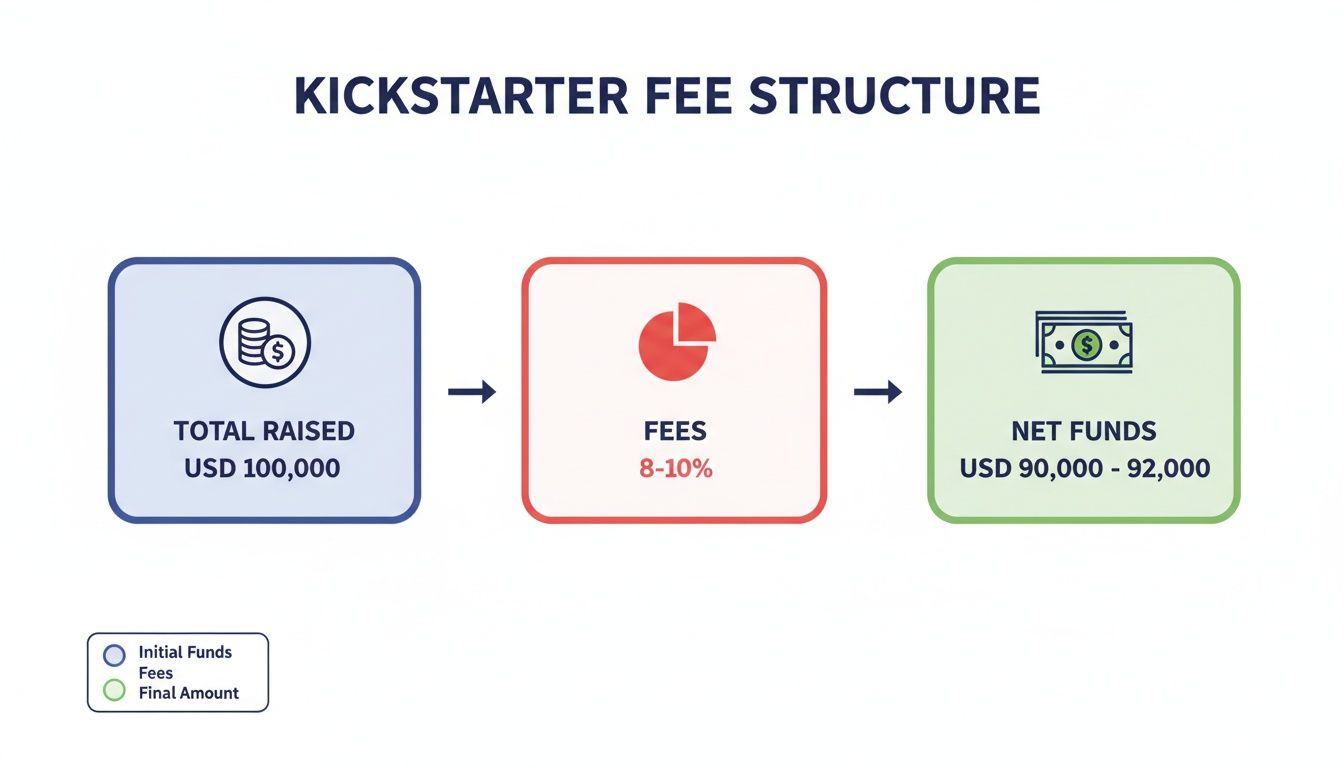
As you can see, that combined percentage creates a noticeable dent in the initial pledge total, which is why budgeting for it is so important.
Let's start with a modest but very common campaign goal: $10,000. This is a popular target for first-time creators launching something like a zine, a custom enamel pin, or a simple tabletop game.
In this scenario, the amount that actually lands in your bank account would be around $9,100. While it seems close, that $900 difference is a big deal when every single dollar has a job to do.
Now, let's scale up to a more ambitious project aiming for $50,000. This could be for a more complex board game with custom miniatures or a small-batch run of a new tech gadget.
Here, your take-home amount shrinks to $45,500. The total fees are now large enough to cover a significant production cost on their own, which really highlights why precise budgeting is non-negotiable.
Finally, let’s look at what happens with a blockbuster campaign that pulls in $250,000. At this level, the numbers get serious, fast.
After fees, you’d receive $227,500. Seeing over $22,000 vanish from your total really drives home why smart post-campaign financial management is critical. For more help on this, check out our in-depth guide on how to craft a Kickstarter project budget.
To make these breakdowns even clearer, here’s a table showing how the fees scale.
This table gives you a side-by-side look at how the numbers change as your campaign grows, showing the total fees and the final net amount you'd receive.
| Total Raised | Kickstarter Fee (5%) | Est. Payment Fees (~4%) | Total Fees | Net Funds Received |
|---|---|---|---|---|
| $10,000 | $500 | $400 | $900 | $9,100 |
| $50,000 | $2,500 | $2,000 | $4,500 | $45,500 |
| $100,000 | $5,000 | $4,000 | $9,000 | $91,000 |
| $250,000 | $12,500 | $10,000 | $22,500 | $227,500 |
As the funding total climbs, so does the chunk taken by fees. It's a simple percentage, but the real-dollar impact becomes much more significant on larger projects. Planning for this from day one is the key to avoiding nasty surprises later on. This is also where a pledge manager becomes an indispensable part of your toolkit.
Think of Kickstarter’s pledge manager as Amazon—functional but limited. In contrast, a tool like PledgeBox is your Shopify—a powerful platform you control. PledgeBox is free to send the backer survey and only charges 3% of upsell if there's any, turning a necessary task into a profit opportunity.
Focusing only on what percentage Kickstarter takes is like looking at the tip of an iceberg. Sure, the 8-10% in platform and processing fees is visible, but the real costs of running a successful campaign are lurking just beneath the surface, ready to sink unprepared creators.
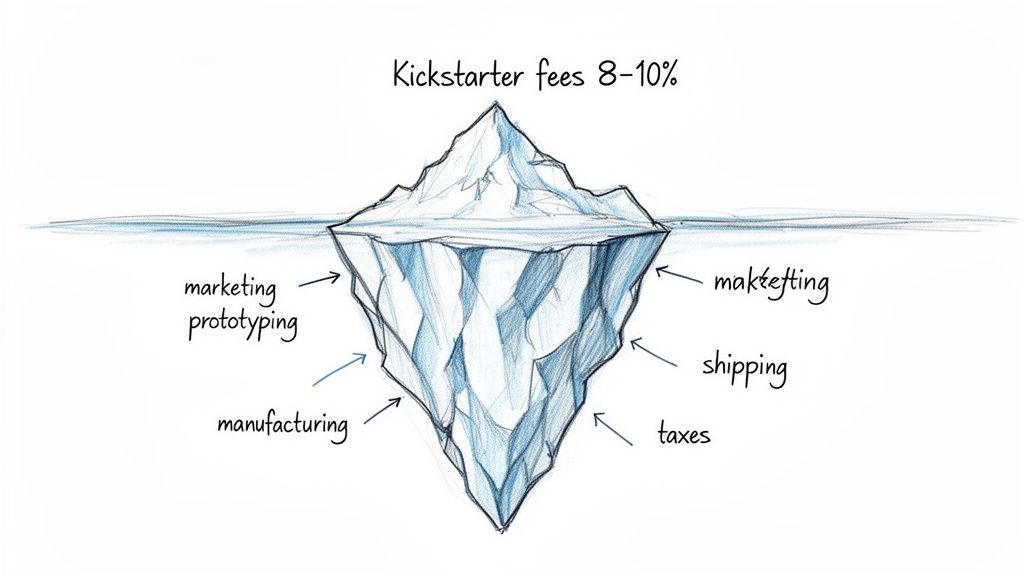
A profitable project demands a budget that goes far beyond what you pay the platform. These indirect costs are where so many campaigns get into financial trouble, turning a massive funding total into a post-campaign scramble for cash.
The financial reality is that Kickstarter's direct fees are often just a small fraction of your total project expenses. To build a sustainable business from your campaign, you have to account for several other critical costs that can add up faster than you think.
Commonly overlooked expenses include:
Beyond production, you also have to navigate the murky waters of taxes and financial services. The funds you raise are often considered income, and sales taxes or VAT can become a major headache. Failing to account for these can completely wipe out your profits. We dive deeper into this in our guide to the unseen costs of Kickstarter and the VAT dilemma.
On top of that, creators need to budget for professional help. For example, understanding the cost of managing your tax affairs is crucial for keeping your campaign's finances healthy. When you combine all these factors, the real cost of a campaign skyrockets.
While Kickstarter’s fees represent the direct cut, indirect costs like advertising, fulfillment, and taxes commonly push the total campaign cost well beyond the initial 8-10%. Industry data shows many successful creators allocate 10-30% of funds to marketing alone, leading to combined costs that can reach 23-38% of gross pledges.
This highlights a critical truth: your gross funding total is not your budget. In fact, many seasoned creators recommend setting aside a 10% "Oh Shit, I Forgot" (OSIF) fund to cover the inevitable surprises. By planning for these hidden costs from day one, you can ensure your project stays profitable long after the campaign clock runs out.
Once your campaign successfully funds, the celebration is short-lived because the real work is just beginning. The question of what percentage Kickstarter takes starts to feel less important than what you actually do with the funds you have left. This is where a pledge manager becomes one of the most powerful tools in your entire arsenal.
So what is a pledge manager? It's a service that helps you manage all your backers after the campaign officially ends. Think of it as your post-campaign headquarters for collecting shipping addresses, handling order tweaks, and getting everything finalized before fulfillment.
To really get why a dedicated pledge manager is so valuable, it helps to think in analogies. Imagine Kickstarter’s pledge manager is like Amazon. It’s a closed system, a straightforward marketplace designed for simple transactions. It gets the basic job done—collecting addresses—but it offers very little control or flexibility.
Now, think of a third-party pledge manager like PledgeBox as your own personal Shopify store. Suddenly, you're in the driver's seat. This control is what transforms the post-campaign phase from a logistical nightmare into a brand-new revenue stream.
With a tool like PledgeBox, you can finally collect complex shipping fees and taxes after the campaign ends, and with precision. This is a massive advantage because it means you don't have to guess these costs months ahead of time. You charge backers the real costs based on their actual location and final order, which protects your margins from getting eaten alive.
But the real magic is in the upsells. A proper pledge manager lets you set up a post-campaign storefront where your backers can easily buy add-ons. These are often high-margin items that can give your final profit a serious boost, helping you offset the percentage Kickstarter takes. You can learn more about this by exploring the importance of a pledge manager in Kickstarter projects.
Think of it this way: Kickstarter gets your project funded. A pledge manager ensures it becomes profitable. By giving backers an easy way to add more to their pledge, you can often increase your total funding by an additional 10-20%.
This is where you need to pay close attention to the business model of your pledge manager. Many will charge you upfront fees or take a slice of your total campaign funds, regardless of how you use their platform. Some, however, operate on a much more creator-friendly model.
PledgeBox, for example, has a unique advantage here. You can send the backer survey for free and only pay a 3% fee on any new revenue you generate from upsells. If you don't sell a single add-on, you pay nothing for the survey and backer management tools. This turns the pledge manager into a pure profit center, not just another campaign expense. It’s a risk-free way to maximize your earnings long after the initial campaign is over.
Not all pledge managers are built the same, and the differences in their business models can have a massive impact on your campaign's final profit. After accounting for what percentage Kickstarter takes, the last thing you want is another tool eating into your remaining funds. This is where a creator-first approach can save you a surprising amount of money.
Think of Kickstarter’s pledge manager like Amazon—they get the job done, but that’s about it. A dedicated pledge manager like PledgeBox, on the other hand, is like Shopify. It gives you the control to not just manage logistics but actually boost your bottom line.
The PledgeBox website shows you just how much you can do.
This isn't just about sending a survey; it’s about managing backers, selling more products, and handling the messy details of shipping with ease.
What really sets PledgeBox apart is its pricing model, which is designed to be completely risk-free for creators.
PledgeBox is completely free to send the backer survey. The platform only charges a 3% fee on the upsell revenue you generate. If you don't sell any add-ons, you pay absolutely nothing for the powerful survey and backer management tools.
This approach flips the script entirely. Your pledge manager stops being just another expense and becomes a new profit center for your campaign. You get a full suite of professional tools without any upfront cost, letting you:
By getting rid of any upfront fees and only taking a small cut of the new money you earn, PledgeBox ensures you keep more of the funds you worked so hard to raise. It lets you focus on what really matters—fulfilling rewards and building your community—without worrying about another big bill cutting into your profits.
Let's tackle some of the most common questions creators have when they're trying to wrap their heads around the financial side of a campaign.
Nope. This is one of the best things about Kickstarter's all-or-nothing model. Their 5% platform fee and all the payment processing fees only kick in if your project successfully hits its funding goal.
If you don't make it, your backers aren't charged a dime, and you owe nothing to Kickstarter. It's a risk-free way to test your idea.
This is a big one, and it trips up a lot of new creators. The smartest move by far is to collect shipping costs and taxes after the campaign is over, using a pledge manager.
Trying to bake these costs into your pledge tiers is a recipe for disaster. You'll either undercharge and eat into your profits, or overcharge and scare away potential backers. A pledge manager lets you calculate the exact costs based on each backer's specific location and their final order, which is far more accurate.
Think of it this way: Kickstarter is like Amazon for raising funds. A dedicated pledge manager like PledgeBox is your post-campaign Shopify, giving you the detailed control you need to manage orders and protect your margins. Best of all, PledgeBox is free to send the backer survey and only charges 3% of upsell if there's any.
A "dropped pledge" is when Kickstarter can't collect the money from a backer after the campaign ends. It’s usually due to an expired credit card, insufficient funds, or a bank flagging the transaction. It's a frustrating but normal part of the process.
As a rule of thumb, you should expect to lose about 3-5% of your total funding to dropped pledges. It's crucial to build this buffer into your budget.
Pledge managers can be a lifesaver here. They give backers a simple way to update their payment info, which can help you recover a good chunk of those dropped pledges and turn a potential loss back into secured funding.
It’s another one of those moments where having the right tool for the job really pays off.
Success on Kickstarter comes down to managing the details. PledgeBox gives you a powerful, all-in-one toolkit to handle everything from pre-launch buzz to final fulfillment. Its pledge manager turns post-campaign logistics from a headache into a new revenue stream. Best of all, it's free to send your backer surveys—you only pay a 3% fee on funds you raise from upsells. Learn more at https://www.pledgebox.com.
PledgeBox
The All-in-One Toolkit to Launch, Manage & Scale Your Kickstarter / Indiegogo Campaign