 PledgeBox
How to Get Money from Kickstarter Fees and Timing
See how to get money from Kickstarter, what fees come out, when the payout lands, and how much cash is left to build.

See how to get money from Kickstarter, what fees come out, when the payout lands, and how much cash is left to build.
You get paid only if your campaign hits its funding goal; Kickstarter then keeps 5%, and processing commonly takes another 3% to 5%, so a $100,000 campaign leaves about $90,000 to $92,000 before taxes and fulfillment. That's money available to meet obligations, not profit you can safely take home.
The fee range in Kickstarter's fee guidance creates a meaningful gap between the public funding total and the money left to build and ship. Failed payments, refunds, and delivery costs can widen that gap further.
If you're learning how to get money from Kickstarter, work backward from spendable cash rather than forward from an impressive campaign total. Your job is to fund a deliverable project, get the collected proceeds into your bank, and keep later survey revenue separate from the original payout.
A $100,000 campaign can leave roughly $90,000 to $92,000 after platform and percentage-based processing fees, using the rates in Kickstarter's official fee schedule. That schedule lists a 5% platform fee, additional processing commonly ranging from 3% to 5%, and U.S. processing of 3% plus $0.30 per pledge, with 5% plus $0.08 for pledges below $10.
Those fixed per-pledge charges matter. A campaign with many small pledges doesn't have the same processing calculation as one with fewer, larger pledges, even when both show the same funding total.
The table translates those listed rates into a subtraction list. The processing rows describe alternative pledge categories or campaign settings, not charges you should all add together.
| Charge | When it applies | Rate to plan | Effect on $100,000 |
|---|---|---|---|
| Platform fee | Goal reached | 5% | $5,000 |
| U.S. processing | Pledges of $10 or more | 3% + $0.30 per pledge | About $3,000 plus $0.30 times pledge count |
| Micropledge processing | Pledges under $10 | 5% + $0.08 per pledge | Apply the rate to small-pledge dollars, then add $0.08 per small pledge |
| Other-market processing | Non-U.S. campaign processing | Commonly 3% to 5% | About $3,000 to $5,000 |
| Missed goal | Deadline below the goal | No fees | $0 charged and $0 paid out |
Use the processing schedule for your campaign's country and pledge structure. A backer's location alone isn't a reliable way to choose the fee rate, and the broad processing range isn't an exact quote for every campaign.
The headline net estimate also assumes the campaign total is collected. A pledge that never clears isn't money you can allocate to a supplier.
Your spreadsheet should distinguish the campaign-page total from actual collections and the resulting transfer. Give each deduction its own row rather than hiding everything inside an estimated net percentage.
Taxes and shipping aren't necessarily deductions Kickstarter takes from the transfer. They're still claims on the money after it arrives, which is why a bank deposit can look healthy while the production budget is already short.
Practical rule: Don't approve a factory budget from the campaign-page total. Approve it from collected cash after fees and protected obligations.
Keep the original pledge total visible for reporting, but make cash available for commitments the number your team uses to authorize spending. That prevents a marketing milestone from becoming an accidental purchase order.
Your funding goal should be the smallest amount that lets you deliver the project safely, not the smallest number that looks easy to reach. Kickstarter's funding handbook says to cover production and fulfillment while accounting for its 5% fee, payment processing, taxes, and contingency.
A low goal can still be dangerous if reaching it leaves you unable to manufacture the promised rewards. An ambitious goal creates a different problem when it asks your audience to fund expansion that isn't necessary for the base project.
Begin with supplier quotations and the actual reward mix. A unit price from a factory is only part of your cost because the reward must also survive packaging, transport, delivery, and support.
Build separate spreadsheet lines for:
Use a dedicated Kickstarter project budget worksheet approach to keep those categories explicit. Don't bury uncertain freight or tooling costs inside a general miscellaneous line.
Then test the funded quantity, not just your preferred large production run. If the supplier's attractive unit price requires an order you can't afford at the goal, that quotation doesn't validate your minimum budget.
Consider the hypothetical acquisition model described in After the Campaign: a $100,000 target at an average pledge of $100 requires 1,000 backers, and an assumed 5% visitor-to-backer conversion rate implies approximately 20,000 qualified visitors. These are planning assumptions, not a promised conversion rate.
Assign responsibility for bringing qualified visitors from email, relevant communities, press, affiliates, and retargeting. Give each channel a distinct tracking link so you can distinguish useful traffic from attention that never becomes pledges.
An email subscriber isn't automatically a backer. Test whether people understand the product, accept the reward price, and are willing to commit before you rely on the full list.
If the audience can't support the calculated goal, reduce the project's scope or keep preparing. Don't remove shipping, support, or contingency to force the spreadsheet to balance.
Stretch goals need the same discipline. Extra components, finishes, or reward variants should pass their own cost and delivery check before you promise them, even when the campaign appears comfortably funded.
The path from a live project to money in the bank is a sequence, not a withdraw button. Your campaign can look successful before collections, account checks, and the bank transfer are complete.
Use this process overview to distinguish campaign activity from actual cash movement.
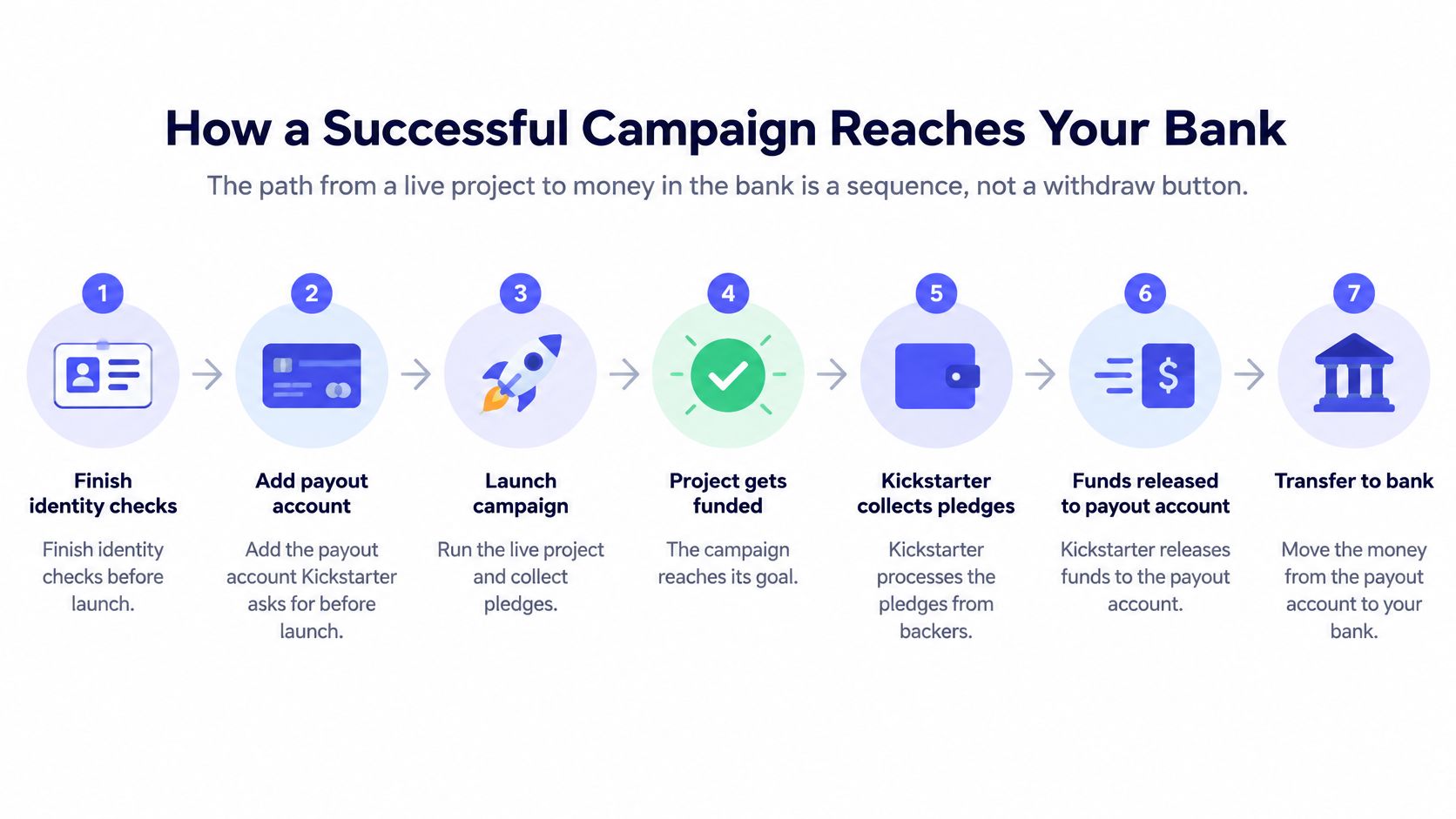
Finish identity checks before launch. Complete the information Kickstarter requests and resolve outstanding verification prompts. Use consistent creator and business details so you don't create avoidable questions when money is ready to move.
Confirm the payout account. Enter the account Kickstarter asks for and carefully check the banking details. Don't assume that having a creator profile means the payout setup is finished.
Run the campaign without weakening its economics. Use substantive updates to answer questions about making, testing, and shipping the product. Avoid promising uncosted extras to keep the pledge total moving.
Let successful pledges become collections. Once the campaign ends successfully, Kickstarter processes backer payments and retries failed cards. Treat unresolved payments as pending, not as money available for a deposit.
Reconcile the expected transfer. Match collected pledges against deductions and the payout information available in your creator dashboard. Keep a record of the difference between pledged, collected, and transferred amounts.
Check payout status and bank receipt. Use the dashboard's expected transfer information rather than assuming a universal arrival date. A platform transfer status and a usable bank balance are different checkpoints.
Release spending against cleared money. Schedule supplier payments with room for collection and banking delays. Don't promise a factory that its deposit will arrive the morning after your campaign closes.
Ask your manufacturer to specify when its deposit is due, what confirms a production slot, and what happens if payment arrives later than expected. Put those terms beside your anticipated payout milestones in the cash calendar.
For planning purposes, leave room measured in weeks rather than building a schedule around immediate access. That's a budgeting precaution, not a guaranteed Kickstarter payout timetable.
Keep your accountant's reconciliation separate from your production team's purchase approvals. The accountant needs the gross-to-net trail; the production team needs to know which cleared funds are authorized for which commitments.
This video provides another format for reviewing the campaign-to-payment workflow.
If the transfer doesn't match your expectation, investigate the collection and deduction records before changing the production plan. Borrowing against an unexplained shortfall can turn a reconciliation issue into an expensive operating decision.
Historical Kickstarter figures reproduced in a document hosted by the U.S. Patent and Trademark Office report that 14% of projects ended without a single pledge, while 78% of projects that raised more than 20% of their goal ultimately funded successfully. These are historical associations, not a promise that crossing a threshold guarantees payment.
The useful lesson is about preparation. A creator who launches with people ready to pledge has a different starting position from one who publishes a page and waits for strangers to discover it.
These situations require different responses. Promotion can help an underfunded campaign, but it can't make an unpaid pledge usable cash.
| Situation | What happens to the money | What to do |
|---|---|---|
| Goal missed | Backers aren't charged and no fees are taken | Relaunch only with a smaller validated goal and a credible audience plan |
| Zero pledges | No collections can begin | Have an email list ready at launch |
| Weak early progress | The project remains exposed to missing its goal | Activate the owned audience rather than adding uncosted rewards |
| Dropped pledges | The collected total falls before payout | Keep a cancellation allowance in the budget |
| Failed cards | Some pledges never clear | Budget from confirmed collections, not the public total |
A smaller relaunch goal is only useful if a smaller, deliverable project supports it. Lowering the number while leaving every reward obligation unchanged doesn't solve the underlying problem.
For a quiet launch, start with the people who already know the project. Send a direct email explaining what's available, why it matters, and what someone needs to do to pledge.
Check whether qualified visitors understand the offer. A confusing demonstration, unclear delivery scope, or reward ladder that hides the main product can stop interested people from acting.
Don't respond to every slowdown with another reward tier. New variants create production and support work, and they may do nothing to address the reason people aren't backing.
A relaunch needs a changed plan, not just a new deadline.
Before relaunching, identify what has materially improved: validated costs, a clearer offer, a smaller feasible scope, or a stronger audience. If none of those has changed, repeating the campaign is unlikely to address the original weakness.
For a funded campaign with failed cards, use payment reminders and clear support instructions rather than broad promotional messaging. The backer has already expressed interest; the unresolved task is collection.
Kickstarter's fulfillment research found that about 9% of projects failed to deliver rewards, 8% of pledged dollars went to failed projects, and 7% of backers didn't receive the reward they selected. Funding success and delivery success are different outcomes.
Treat the payout as a production budget with a deadline. A larger campaign can increase your exposure when it brings more destinations, reward variants, packaging requirements, and customer-service work.
Freeze the fulfillment reserve before approving expansion, extra inventory, or discretionary personal withdrawals. The reserve should have named purposes rather than serving as a loose cushion anyone can borrow from.
Reserve rules
- Protect original rewards. Keep the money needed to make and deliver existing promises unavailable for stretch-goal spending.
- Cover predictable exceptions. Include quality checks, replacement units, damaged parcels, refunds, and support.
- Plan for logistics changes. Hold room for freight adjustments and destination-specific delivery problems.
- Authorize releases deliberately. Reduce the reserve only when the corresponding risk has passed or a documented cost has been settled.
Publish the reserve amount and its purpose in your first substantive post-funding update. You don't need to share confidential supplier terms to explain that you've protected delivery cash.
Before placing the factory order, reconcile reward quantities and variants. A campaign total won't tell the manufacturer how many units of each configuration to build, and an incorrect mix can leave you paying for inventory while backers still wait.
The checklist below keeps the main spending controls visible during fulfillment.
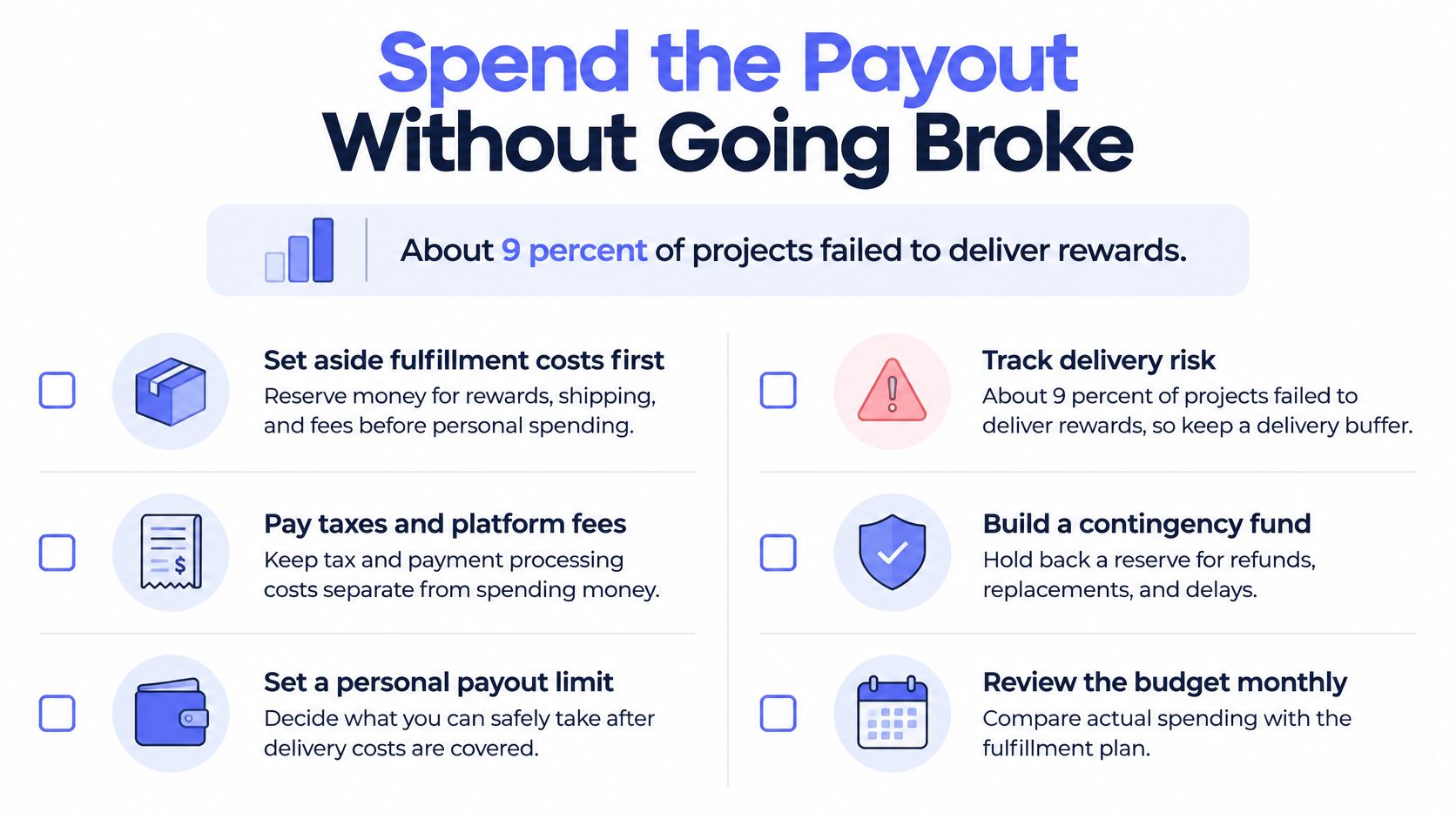
A project can have enough money overall and still lack cash when a deposit or freight invoice falls due. Record supplier deposits, production balances, warehouse charges, tax obligations, and delivery payments by expected payment date.
For a broader method of organizing those inflows and outflows, Wealth Collective's practical cash flow guide for small businesses is a useful companion to a campaign-specific budget. Apply that cash-calendar discipline to the actual production schedule rather than assuming every bill arrives after the next collection.
Model shipping by destination and parcel configuration. A board game with an expansion may need different packaging from the base game, while a hardware replacement can require another full shipping charge.
Decide how you'll handle refunds and substitutions before problems arise. Write down who approves them, where the money comes from, and how the decision changes inventory.
When a supplier confirms a delay, tell backers what changed, what remains uncertain, and when you'll provide the next update. Silence doesn't preserve the budget, and vague reassurance makes later decisions harder to explain.
Only consider personal profit after delivery obligations, taxes, and unresolved risks are accounted for. The fact that money is sitting in your account doesn't make it surplus.
PledgeBox is free to send the backer survey and only charges 3% of upsell sales if there are any. We charge no setup fee or campaign fee on the original Kickstarter or Indiegogo funds, and that original pledge isn't charged our platform fee again.
A useful comparison is that Kickstarter's pledge manager is like Amazon, a managed marketplace-style buying experience, while PledgeBox's pledge manager is like Shopify, a creator-controlled storefront and checkout layer. It's an analogy about the buying experience, not a claim that the platforms have identical features or terms.
The original Kickstarter transfer and post-campaign payments shouldn't be treated as the same pot of money. A shipping payment has a delivery obligation attached to it, tax collected may need to be remitted, and an add-on creates another item to produce or supply.
Use separate spreadsheet categories for original pledge proceeds, add-on sales, shipping collections, tax collections, and late orders. Record payment charges and refunds against the relevant category so you can see what each activity contributes.
For each proposed add-on item, calculate the extra product cost, packaging, handling, and shipping impact before offering it. A complementary accessory can make sense; an entirely new product can introduce another development project after you've already committed to delivery.
Don't rely on hypothetical upsells to close a gap in the original reward budget. Backers can complete their survey without buying an optional extra.
To add your project, select Add New Project in Pledge Manager, choose Kickstarter or Indiegogo, and enter the campaign URL. Prepare the reward mapping and fulfillment questions before sending the survey so backers receive clear, relevant choices.
Additional survey payments can use connected Stripe or PayPal accounts. Reconcile those transactions separately from the Kickstarter payout instead of trying to match every later payment to the campaign-page total.
Send the survey when the answers can guide real fulfillment decisions. Collect the address, reward selections, and other required details, then set a clear process for reminders and final changes.
Your immediate next action is to create separate ledger tabs for the Kickstarter transfer and survey collections. Open the survey with the delivery reserve still protected, and approve additional production only when confirmed orders and cleared payments justify it.
PledgeBox helps you collect backer details, manage shipping and tax payments, and offer optional add-ons after your campaign ends. Visit PledgeBox to connect your project and prepare a backer survey while keeping the original Kickstarter payout separate from later revenue.
PledgeBox
The All-in-One Toolkit to Launch, Manage & Scale Your Kickstarter / Indiegogo Campaign