 PledgeBox
7 Board Game Projects: Platforms and Tools Compared
Compare 7 board game projects platforms and tools, from campaign hosting to pledge management and post-campaign fulfillment for creators in 2026.
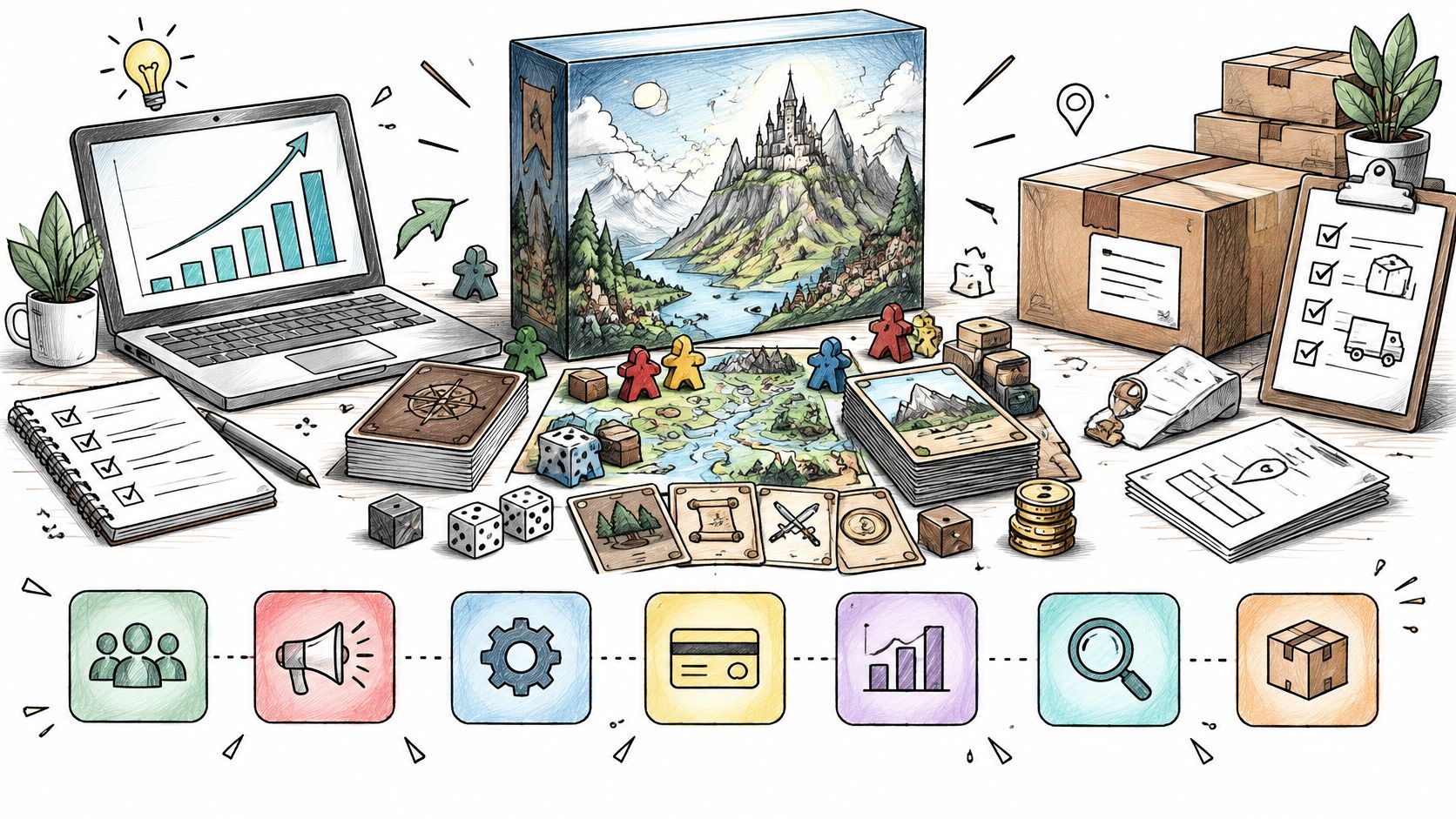
Compare 7 board game projects platforms and tools, from campaign hosting to pledge management and post-campaign fulfillment for creators in 2026.
The campaign closes past its goal at 11pm, and by the next morning the work has changed shape. You're in a spreadsheet matching backer emails to reward tiers so you can quote shipping to six countries, and three backers have already asked where the VAT line is. One of them wants the deluxe upgrade, which so far exists only as a comment thread. None of that was on the campaign page.
Funding proves demand. Fulfillment is a different business, with different software.
The campaign platform answers one question: will people pay for this? Everything after it is logistics, and logistics is where the money you raised quietly leaks out.
The seven tools below are compared on that second phase. Two host campaigns, two combine hosting with post-campaign services, one exists purely for the work after the goal, and two only help you research what everyone else did. Each one takes off some tasks and hands others back to you.
Kickstarter is still where most tabletop money changes hands. Its Games category collected $270 million in pledges during 2024 (Kickstarter's games category report), set against 35,512 creative projects launched across the platform in that year (Kickstarter's 2024 creative download). For a first board game project, that familiarity does real work. Backers already have an account, a saved card, and a mental model of how a campaign runs.
You know the layout you're building toward:
The platform hosts the pitch, the pledge tiers, and the update feed. It does not quote shipping by destination, reconcile VAT, or sell an upgrade after the campaign closes. All-or-nothing funding also means a project that lands at 96% of goal collects nothing, which makes a thin pre-launch list the most expensive mistake available here.
What it does well
Where it costs you
Start a draft at Kickstarter only when the audience exists.
Gamefound is the closest thing to a tabletop-native alternative, and choosing it changes your workload rather than just your logo. The platform reported more than $85 million in tabletop crowdfunding during 2024 (Gamefound's 2024 summary), spread across 215 successful tabletop campaigns, against 5,320 on Kickstarter (Polygon's analysis of the largest board game crowdfunds). Read those together and the trade-off is plain. Smaller room, more concentrated attention, and a real chance your campaign is the biggest thing on the page that week.
The reason hobby publishers gravitate here is structural. Late pledges, add-ons, and multi-box reward bundles live inside the same system as the original campaign, so you aren't exporting backer data into a second tool mid-flight.
That matters most for projects with expansions, language editions, or a dozen SKUs. For those, the setup work is heavier up front: reward mapping, shipping rules, and add-on availability all need decisions before launch, not after.
Strengths that hold up
What to watch
If you're weighing the two paths, this breakdown of PledgeBox and Gamefound covers where the post-campaign responsibilities land in each. The interface itself is straightforward once configured.
The economics of the sector explain why fee structure deserves its own section. Tabletop crowdfunding peaked at roughly $270 million in successfully funded projects in 2021 and settled near $220 million in 2024, even as the number of funded projects kept climbing, with the average successful campaign at about $41,400, described as the lowest in a decade (BoardGameWire's sector report). The average campaign is smaller than it used to be. A fee that sounds negligible on a blockbuster can eat a small project's margin.
BackerKit sits in two markets at once. It hosts campaigns directly, and it sells pledge management and email marketing to creators running campaigns elsewhere, including on Kickstarter and Indiegogo.
That duality is useful if you want one vendor relationship. It also means your costs depend on which services you switch on, and some marketing options carry their own eligibility rules or additional charges. Before you commit, price the exact bundle rather than the headline option.
The trade-offs
The logic that governs choosing an ecommerce platform for growth applies here too. A lower headline fee loses to migration cost and workflow fit almost every time. For a direct feature comparison, this PledgeBox and BackerKit breakdown is the place to start.
Geography should shape your platform choice more than most creators admit. The combined playing-cards and board-games market was valued at about $19.9 billion in 2024, with board games taking 73.4% of revenue, and Asia-Pacific alone accounting for 39.5% of that revenue (Grand View Research's market analysis). The market is projected to reach roughly $31.9 billion by 2030, a reported compound annual growth rate of 8.3% between 2025 and 2030.
Read that as a warning about assumptions. Your backer base is not automatically North American, and a campaign page that only speaks to one region leaves money on the table.
Indiegogo is a general reward-based crowdfunding platform rather than a tabletop venue, which is both its limitation and its argument. If your game has a hook that travels beyond hobby forums, that broader surface can help. If it's a heavy euro for experienced players, the audience match is weaker than a tabletop-first platform.
Strengths
Limits
The platform lives at Indiegogo, and its campaign page design is familiar territory for most backers. Pair it with a fulfillment plan before you fall in love with it.
PledgeBox doesn't host your campaign. It takes over the morning after, which is where board game projects with heavy reward trees usually need the most help. The survey, the add-ons, the shipping quote, the tax line, and the address change three weeks later all run through one backer portal.
The pricing model is the part most creators ask about first. Sending the backer survey is free, with no setup fee and no charge on your original Kickstarter or Indiegogo funds, and the platform fee is 3% of any additional money a survey collects, such as add-ons, upgrades, shipping, or VAT (PledgeBox pricing). Collect no extra payment and there's no platform collection fee to absorb.
Kickstarter's native survey exists to gather shipping addresses and simple answers. That's the right tool for a campaign with one reward and one shipping zone. It's the wrong tool once backers want a second copy, a playmat, or a language swap. PledgeBox handles customizable fields, product variants, add-ons, post-campaign upsells, shipping fees, tax collection, and address updates until orders lock (how Kickstarter's post-campaign tools compare).
What it doesn't do: it won't drive discovery or replace launch marketing. If your backer list is thin, no pledge manager fixes that. Test your survey logic against your real reward and shipping plan before the first invitation goes out, and check how add-on charges affect your margins once payment processing is added. The toolkit itself starts at PledgeBox.
Trackers answer a narrower question than creators expect. They show you what launched and how it's performing, not whether your list will convert. Those are different problems, and the gap is expensive.
The Sea Beasts campaign is the clean illustration. An initial run raised $35,586, well short of what manufacturing and fulfillment required. After the creator rebuilt the marketing and audience validation, testing produced a $4.34 cost per lead, a $24.78 cost per purchase, and a 19.22% landing-page conversion rate. The relaunch cleared its $15,000 goal in 11 minutes and finished at $672,720 from 5,414 backers (Kickstarter's case study on the relaunch). The sharpest number: 1,245 VIP backers converted at 44.37%, against 9.16% among 761 non-VIP backers.
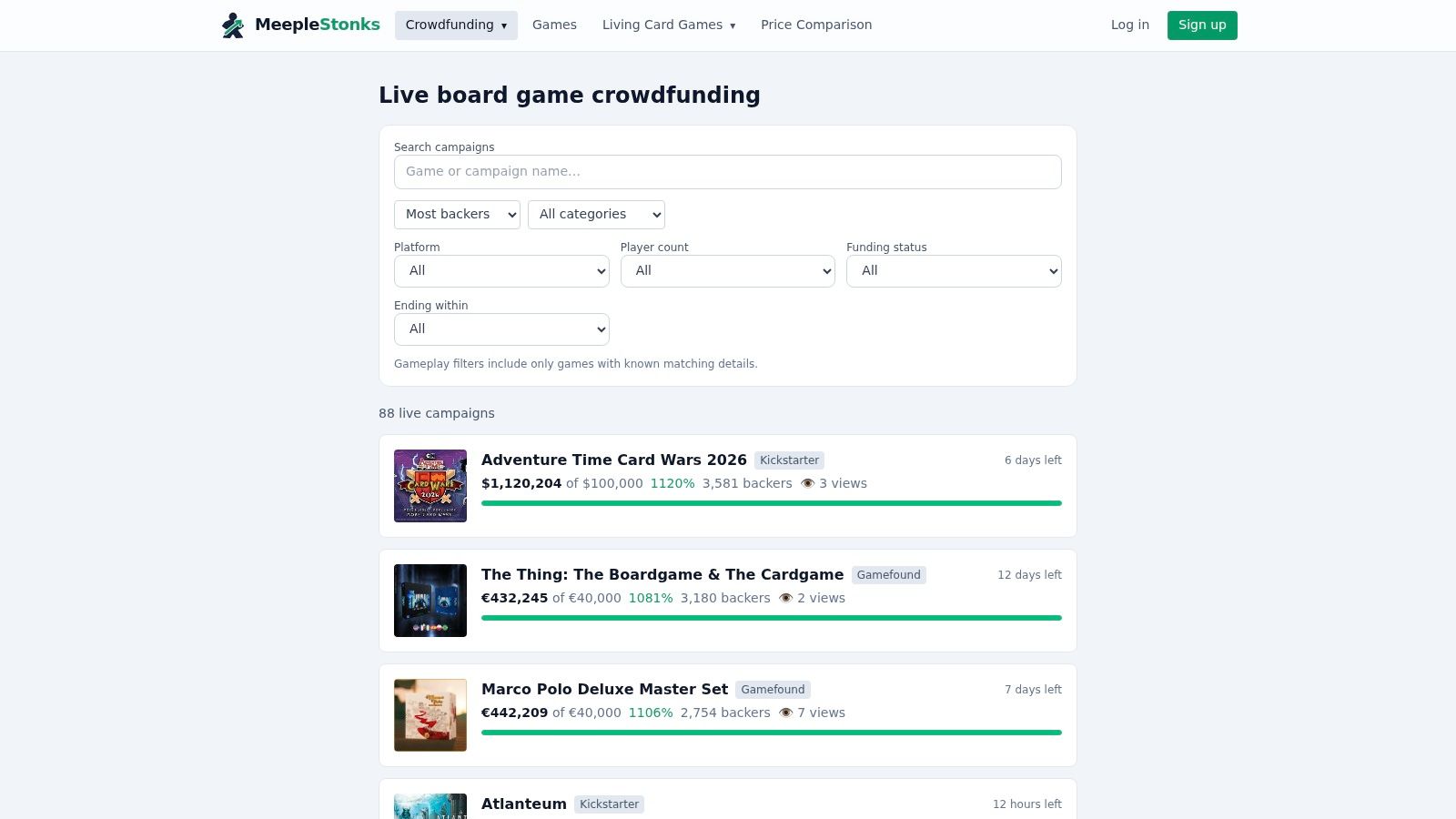
MeepleStonks monitors board game campaigns on Kickstarter and Gamefound, with trending views and a campaign calendar. Use it to see how comparable projects are priced, which tiers they lead with, and how your launch window collides with someone else's.
Practical rule: scan live campaigns for pricing and positioning patterns, then validate your own audience separately. A tracker tells you what the market did. It never tells you what your list will do.
Strengths
Limits
The tool sits at MeepleStonks, and the live project list is the fastest way in.
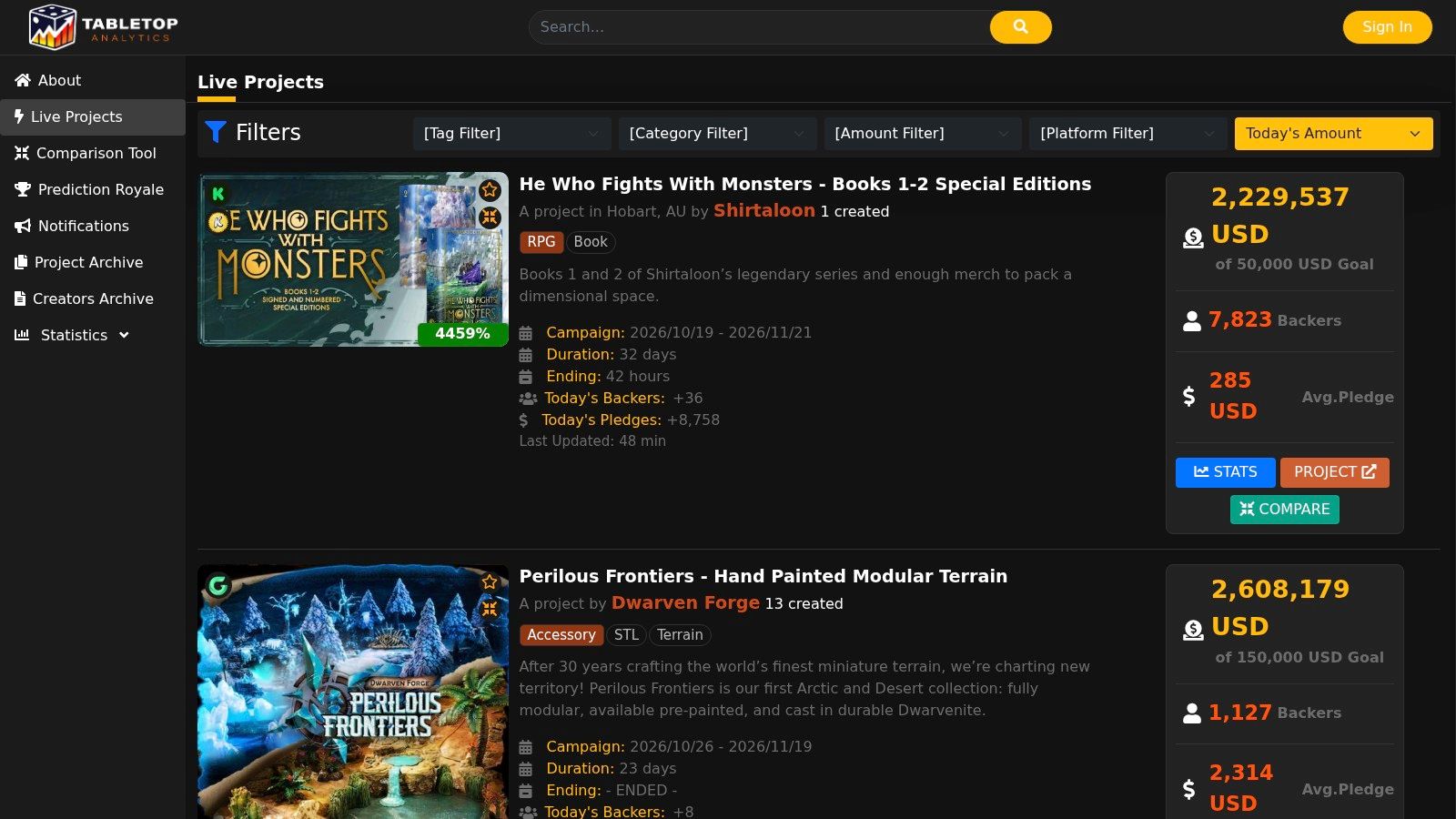
Live trackers are useful for a launch window. Historic archives are useful for a publishing plan. Tabletop Analytics leans toward the second job, with a searchable record of past tabletop crowdfunding projects and campaign information you can compare across years.
That archive earns its keep in three situations: sizing a print run against similar projects, checking whether a publisher has run this kind of campaign before, and studying how a category's reward structures have shifted. A designer pitching a publisher can walk in with comparable campaign histories instead of a hunch.
Historical results are context, not a forecast. Backer counts from a 2019 campaign don't transfer to a market where the average successful campaign is smaller and shipping costs have moved. Use the archive to frame expectations with your manufacturer, your fulfilment partner, and your own budget.
Limits
The tool is at Tabletop Analytics. Pair it with a data-led view of how campaigns convert, such as this analysis of crowdfunding results in the gaming industry, and you'll know what to promise your manufacturer.
| Item | Campaign hosting | Pledge management | Best for |
|---|---|---|---|
| Kickstarter | Yes; all-or-nothing campaigns | Limited; often needs separate tools | Creators seeking a familiar platform and broad tabletop discovery |
| Gamefound | Yes; tabletop-focused campaigns | Yes; includes late pledges and add-on support | Board-game projects with complex rewards or add-ons |
| BackerKit Crowdfunding | Yes; also supports campaigns hosted elsewhere | Yes; offers pledge management and email marketing | Creators wanting campaign hosting and post-campaign services |
| Indiegogo | Yes; reward-based campaigns | Yes; services available | Creators seeking a general-purpose alternative to Kickstarter |
| PledgeBox | No; post-campaign toolkit | Yes; surveys, shipping, taxes, and add-ons | Managing backers and fulfillment after a campaign |
| MeepleStonks | No; tracks campaigns | No; research tool only | Monitoring live board-game campaigns and calendars |
| Tabletop Analytics | No; research tool only | No; research tool only | Studying historical tabletop crowdfunding campaigns |
The order of decisions matters more than the tool names. Work through it in this sequence and you won't buy anything twice.
The distinction I'd draw for any creator choosing a post-campaign system is the one between a marketplace and a storefront. Kickstarter's Pledge Manager works like Amazon: it's the place the campaign lives, and the transactional surface belongs to the platform. PledgeBox Pledge Manager works like Shopify: a configurable storefront you run for your own backers, where you set the products, variants, shipping rules, and tax lines. Both are legitimate. They answer different questions.
On cost, the model is simple to state. Sending the backer survey is free, and PledgeBox charges 3% only on add-on upsell sales made during surveys, if there are any. PledgeBox holds Trusted Expert recognition from both Kickstarter and Indiegogo, and creators on 19,000+ projects have sent surveys through the platform.
One more piece of the checklist that's easy to skip: accessibility. Research from Portugal found the board game community showed inclusive intentions but still needed stronger alignment between attitudes and practice, alongside more accessible game designs (Universidade Lusófona study on inclusion and accessibility in modern board gaming). Build those questions into your survey and your component spec together.
Fulfillment architecture decides whether the campaign turns into a business. One small publisher went from a 2019 Kickstarter launch to about 260,000 units sold and $10 million in revenue by 2022, shipping an average of 7,000 units a month, and cut fulfillment costs by up to 40% after connecting its storefront to its fulfillment network through an integration, roughly $1 million in savings over one year (Amazon's supply chain case study of Very Special Games). Nothing about that came from campaign revenue alone.
The same discipline behind integrated digital marketing explained applies to a campaign stack. No single channel carries the result; the handoffs between them do.
Map your reward tiers, add-ons, and shipping destinations before you choose anything. The tool decision gets easy once the operational map exists.
PledgeBox handles the part that starts the morning after your campaign closes: branded backer surveys, add-on upsells, shipping fees, VAT collection, address validation, late pledges, and vendor-ready fulfillment exports. If your board game project has more than one reward tier or ships to more than a couple of countries, that's usually where the manual work and the leaked margin both live. Send your first survey free and see the workflow at PledgeBox.
PledgeBox
The All-in-One Toolkit to Launch, Manage & Scale Your Kickstarter / Indiegogo Campaign