 PledgeBox
10 Ways to Capture the Audience Pre-Launch with PledgeBox
Learn 10 practical tactics to capture the audience before your crowdfunding launch, from landing pages to PledgeBox's free surveys and 3% upsells.
Learn 10 practical tactics to capture the audience before your crowdfunding launch, from landing pages to PledgeBox's free surveys and 3% upsells.
Building momentum before launch starts long before the campaign page goes live. Imagine opening your crowdfunding dashboard on launch day and seeing a warm, segmented audience ready to pledge, rather than a list of cold clicks and hopeful guesses. Capturing that audience early can separate a campaign with real momentum from one that spends its first days trying to explain why anyone should care.
The strongest approach combines a useful lead magnet, clear audience permissions, regular email communication, and measurable intent signals. Email remains a powerful capture channel because automated, intent-based messages can convert far better than untargeted broadcasts. Industry benchmark summaries report an average email conversion rate of about 3%, with abandoned-cart emails around 10.7%, post-purchase follow-ups around 6.8%, and back-in-stock flows around 6.46%, while some broadcast benchmarks sit near 0.16% (email marketing benchmark analysis).
You don't need ten disconnected tools to build that system. Use the following tactics to capture interest, qualify intent, and continue the relationship through surveys, fulfillment, and post-campaign sales. Pair landing pages and email with creating viral short-form videos, then move serious prospects into a workflow you can measure.
A signup tells you that someone is interested. A well-designed survey tells you why, what they want, and what could stop them from buying. That distinction matters before launch, when product decisions, reward tiers, shipping regions, and add-ons still need validation.
Use survey questions to identify preferred configurations, reward expectations, geographic requirements, and interest in future products. A hardware startup might ask which final specification matters most before locking production. A board game publisher can collect reward selections, shipping preferences, and expansion interest. An agency managing several creators can keep each project's survey branded and separate through a white-label workflow.
PledgeBox is free to send the backer survey and only charges 3% of upsell revenue if there's any. Its pledge manager is closer to Shopify than Amazon. Kickstarter's pledge manager is like Amazon, a more standardized buying environment, while PledgeBox's Shopify-like model gives creators more control over branding, product presentation, and the checkout experience. PledgeBox's survey design guidance can help teams reduce unnecessary friction.

Keep the core survey focused. Use conditional logic so backers only see questions relevant to their pledge tier, add a visible progress indicator, and make optional questions clearly optional. Reminder emails sent after a few days, then again later, can recover incomplete responses without irritating people who already finished.
Practical rule: Ask every question because you'll act on the answer. If the response won't change fulfillment, product design, or communication, remove it.
Use survey results to improve the current offer and inform the next campaign. Audience capture works best when people see that their input influences something tangible.
A crowdfunding audience cools quickly when creators communicate only at launch and fulfillment. Build a sequence that reflects where each person is in the journey, from initial interest to pledge, survey completion, shipping, and referral.
Segment contacts by pledge tier, survey responses, engagement history, and product interest. A gadget company might send manufacturing updates to all backers but show accessory offers only to people who selected compatible devices. A publisher can promote a stretch-goal item to eligible tiers rather than sending an irrelevant sales message to everyone. After delivery, a separate sequence can request a review, invite a referral, or introduce the next product.
PledgeBox's email workflow automation features support recurring communication such as survey reminders, shipping notices, and targeted content. Messages should answer a current question, not merely fill a calendar slot. Include the backer's name and reward details where appropriate, and send tracking information as soon as fulfillment makes it available.
Email performance needs careful interpretation. One benchmark set reports an average open rate of 31%, with the top 10% reaching 45.1%, while another dataset reports a global average of 43.46% across 3.6 million campaigns from more than 181,000 accounts (Klaviyo benchmark guidance). Apple Mail Privacy Protection can inflate reported opens by roughly 15 to 20 points, so clicks, survey completion, purchases, and replies are stronger signs of human attention.
Before sending, check if your domain is blacklisted. Poor deliverability can undermine even excellent copy.
The first purchase doesn't have to be the final transaction. Backers already understand the product, have demonstrated interest, and may welcome complementary items if you present them clearly rather than turning the survey into an overcrowded store.
Offer accessories that solve an obvious problem. A hardware creator might show a protective case, charging cable, or extended warranty. A board game publisher can offer an expansion pack or deluxe components. A content creator might add limited merchandise or bonus digital material. These offers should support the original purchase, not distract from it.
PledgeBox is free to send the backer survey and only charges 3% on upsells if there's any. That pricing makes the survey a practical place to collect missing information and offer add-ons without paying a fee merely to send the survey. Kickstarter's pledge manager is like Amazon, while PledgeBox's pledge manager is like Shopify, giving creators a more customizable storefront-style experience for product displays, bundles, and messaging.
Use this add-on sales strategy to structure the offer around relevance.
Keep the selection narrow enough that backers can decide quickly. Group related products into bundles, explain the use case for each item, and show transparent shipping and tax information before the final commitment. Strong product photography helps, but clear value matters more than decoration.
Introduce offers after the backer has had a chance to complete the essential survey. A delayed, relevant suggestion usually feels more helpful than an aggressive sales wall placed before address and reward details.
Backers become stronger advocates when creators give them a meaningful role after the pledge. Feedback requests, testimonials, unboxing photos, and usage videos can turn a passive customer into someone who helps explain the product to the next audience.
Ask for specific contributions. “Tell us what you think” produces vague responses, while “Show us how you use the device at your desk” gives people a clear prompt. A board game publisher might invite house rules or gameplay variants. A creative project can request a short testimonial about the project's personal impact. Gadget creators can curate unboxing images and practical demonstrations.
Add optional media-upload fields to surveys and explain how submitted content may be used. Permission language should be direct, especially if you plan to publish a backer's name, photograph, or video. Recognition can motivate participation without making the community feel transactional. Feature a backer periodically, include selected contributions in newsletters, or offer a small campaign-related perk.
Create a simple editorial workflow. Review submissions, confirm permission, tag content by product or audience segment, and repurpose the strongest material across email, social posts, landing pages, and future campaign updates. Don't publish every submission. Select content that demonstrates a real use case, answers a common objection, or communicates the experience better than a product description can.
The best user-generated content feels like evidence from a real community, not scripted advertising. Capture the audience by inviting participation, then make that participation visible.
Not every backer wants the same amount of communication. Some people want detailed production notes and early access. Others want a concise shipping update and nothing else. Sending identical messages at identical frequency can exhaust the most attentive supporters while failing to re-engage everyone else.
Create practical engagement groups based on survey completion, email interaction, clicks, replies, and purchase behavior. A publisher might call its most active members “Superfans” and give them behind-the-scenes material or early access. A hardware team can send technical production detail to engaged supporters while giving less active readers a short summary.
A simple model might include Superfans, Active, Standard, and Minimal Contact groups. These labels aren't important by themselves. The value comes from assigning people consistently and reviewing whether each group receives useful communication.
Include communication preferences in the survey. Ask whether a person wants production detail, product announcements, community content, or essential fulfillment messages only. That permission improves relevance and gives the creator a defensible reason for each message.
Use re-engagement campaigns for inactive segments, but don't keep sending indefinitely to people who never interact. List hygiene protects deliverability and helps performance data reflect real interest. One benchmark reports an average open rate of 20.73% before Apple Mail Privacy Protection adjustments, 33.87% when that protection is included, and 44.02% for top performers (Brevo email benchmarks). The spread reinforces a practical point. Audience quality and segmentation matter more than send volume.
A survey can feel like administration, or it can feel like progress. Add light game mechanics when they fit the community, especially for games, comics, collectibles, and products with a strong identity.
A game creator could recognize survey completion with a digital badge or an in-game item. A comic publisher might celebrate funding milestones with exclusive artwork. A hardware company could connect social sharing to a community-enabled option, such as a limited color option. These mechanics work because they give supporters a visible role in the project's progress.

Match the design to the product. A playful leaderboard may suit a tabletop community but feel inappropriate for a medical device or professional hardware campaign. Achievements should be easy to understand, attainable, and tied to something backers value, such as exclusive content, recognition, or a relevant discount.
Use progress tracking to make incomplete actions visible without shaming people. Pre-written sharing captions can remove friction for supporters who want to help but don't know what to say. Milestones should also reflect real progress. Celebrating a manufacturing approval or completed survey phase is more credible than inventing arbitrary reasons to send another notification.
Gamification can't rescue a confusing offer. It should reinforce a clear experience, not distract from fulfillment details or product quality.
The period between campaign close and delivery tests trust. Backers can tolerate complexity when creators explain what's happening, what changed, and what comes next. Silence creates its own story, usually a worse one.
Send production updates on a consistent schedule and include concrete evidence, such as factory photos, proof samples, packaging checks, or regional shipping preparation. A tabletop publisher can explain a print-facility milestone. An international creator can separate domestic delivery information from customs and regional carrier issues. A hardware startup can distinguish completed production from work still under review.

Avoid optimistic promises that leave no room for manufacturing or shipping variance. If a deadline is at risk, tell backers before it passes, explain the cause in plain language, and state the next checkpoint. Separate facts from estimates. “The packaging inspection is complete, and regional dispatch begins next” is more useful than “Everything is moving along.”
PledgeBox supports fulfillment workflows that can include shipment tracking, address validation, regional information, and automated notifications. The platform also collects the backer information needed to fulfill rewards, including addresses, reward preferences, taxes, and shipping costs. Use those capabilities to make the backer portal a reliable source of truth rather than scattering updates across disconnected channels.
Trust grows when creators communicate difficult news early, with a clear next action.
Backers didn't only buy an object. They supported a process, and access to that process can deepen their connection with the project. Give them material the general public won't receive, but choose a format your team can sustain.
A hardware creator might share prototype testing videos, design revisions, or engineering trade-offs. An author can provide early manuscript chapters or discuss editorial decisions. A game designer can invite higher-tier supporters to a private playtest and use their feedback in a later update. These experiences make the campaign feel like membership rather than a standard retail transaction.
Create a simple calendar covering development, production, fulfillment, and post-delivery. Repurpose material you already produce, such as prototype photos, supplier questions, packaging tests, and short creator interviews. Don't promise weekly cinematic videos if the team can only produce occasional updates. Consistency matters more than production polish.
Use survey data to match content to interests and pledge tiers. A backer who selected technical details can receive testing notes, while another may prefer creator stories or product-use examples. Feature backer questions in private Q&A sessions so the content responds to real curiosity.
Cliffhangers can encourage return visits, but avoid manufacturing suspense around information backers need for fulfillment. Exclusive content should reward attention, not hide essential updates behind a marketing sequence.
A backer survey is also a checkout experience. If the page is slow, confusing, or unclear about shipping, people may postpone completion and forget. Treat every screen as part of the conversion path.
PledgeBox's Shopify-like pledge manager supports a branded experience that creators can adapt to their product and audience. Kickstarter's pledge manager is like Amazon, standardized and marketplace-oriented. PledgeBox's pledge manager is like Shopify, giving the creator more control over product presentation, checkout language, and add-on placement. It supports Stripe and PayPal, while clear shipping, tax, and payment explanations reduce uncertainty.
Use a progress bar, pre-fill known information, and show high-quality images for add-ons. Put shipping and tax calculations before the final confirmation, not after a backer has mentally committed to a different total. A mobile-first layout matters because backers may complete surveys from a phone rather than a desktop.

Don't use an incentive to compensate for a broken form. First test address validation, reward logic, payment methods, confirmation emails, and error handling. Then improve product photography, bundle presentation, and value explanations.
PledgeBox is free to send the backer survey and only charges 3% of upsell revenue if there's any. That means creators can focus on making the survey easy to complete and the offer relevant, instead of paying a platform fee to collect fulfillment information.
Audience capture becomes valuable when it changes decisions. Track which lead sources produce completed surveys, which messages generate clicks, which rewards attract add-on interest, and where backers abandon the workflow.
A hardware startup might compare color preferences before ordering limited packaging. A publisher can study add-on demand before deciding whether an expansion deserves a larger production run. An agency can compare audience behavior across client campaigns and identify which landing-page promise, email sequence, or reward structure produces stronger intent.
Use PledgeBox reports and analytics to organize survey responses, engagement signals, upsell activity, fulfillment information, and exports. Build reports around decisions rather than vanity metrics. A large contact file isn't automatically valuable if the people in it never confirm interest or complete a meaningful action.
Kickstarter's pre-launch research guidance emphasizes metrics such as Cost Per Reservation and Cost Per Lead, alongside the audiences and messages that convert best (crowdfunding pre-launch research discussion). Those measures help distinguish a cheap lead from a qualified prospect.
A useful reporting rhythm includes:
Export data regularly, but don't mistake activity for insight. The important question is what you'll change after reviewing the report.
| Item | Implementation (🔄) | Resources (⚡) | Expected Outcomes (⭐📊) | Ideal Use Cases | Key Advantages (💡) |
|---|---|---|---|---|---|
| Interactive Surveys and Preference Capture | Low 🔄, no-code templates, quick setup | Low ⚡, free to send; minimal staffing; 3% on upsells | ⭐⭐⭐⭐, high completion; reliable backer data & segmentation | Backer info collection, shipping address validation, reward selection | 💡 Branded, mobile-first surveys with real-time analytics |
| Personalized Email Marketing Sequences | Medium 🔄, workflow and segmentation setup | Medium ⚡, content creation, deliverability management | ⭐⭐⭐⭐, improved retention, higher upsell conversions | Ongoing updates, manufacturing progress, targeted promotions | 💡 Automated segmentation using survey data; A/B testing |
| Exclusive Add-On Upsells and Late Backer Offers | Medium 🔄, product catalog & pricing configuration | Medium ⚡, product assets, inventory planning; 3% fee on upsells | ⭐⭐⭐⭐, incremental revenue; extends campaign monetization | Hardware add-ons, expansions, late pre-orders | 💡 Shopify-like upsell displays; low 3% upsell fee |
| Community Feedback Loops and User-Generated Content | Low–Medium 🔄, survey fields + moderation workflows | Medium ⚡, moderation, rights management, curation | ⭐⭐⭐, social proof, free marketing assets, product feedback | Showcasing testimonials, UGC galleries, community campaigns | 💡 Collects media and testimonials centrally for reuse |
| Tiered Communication Strategies Based on Engagement Levels | Medium 🔄, scoring rules & automated tiers | Medium ⚡, analytics, ongoing maintenance | ⭐⭐⭐⭐, reduced unsubscribes; better ROI on outreach | VIP treatment, differentiated updates, re-engagement campaigns | 💡 Prioritizes communications to high-value backers |
| Gamification Elements and Milestone Celebrations | Medium 🔄, UI badges, milestones, sharing hooks | Low–Medium ⚡, design assets, occasional content refresh | ⭐⭐⭐, higher survey completion & social sharing | Viral growth drives, early-momentum pushes, community rewards | 💡 Boosts engagement with attainable, brand-aligned milestones |
| Transparent Fulfillment Updates and Progress Tracking | Medium 🔄, carrier integrations & automated triggers | Medium–High ⚡, shipping integrations, accurate logistics data | ⭐⭐⭐⭐, increased trust; fewer support inquiries | Hardware production, international shipping, complex logistics | 💡 Automated tracking + address validation to reduce errors |
| Exclusive Content and Behind-the-Scenes Access | Low–Medium 🔄, gated delivery + tier rules | Medium ⚡, regular content production and delivery | ⭐⭐⭐, higher perceived value; stronger backer loyalty | Premium tiers, prototype releases, playtesting invites | 💡 Tier-based content distribution via integrated emails |
| Post-Campaign Conversion Optimization and Checkout Experience | Medium 🔄, payment integrations & UX testing | Medium ⚡, A/B tests, payment processors (Stripe/PayPal) | ⭐⭐⭐⭐, higher checkout completion & average order value | Surveys with upsells, mobile-first checkout flows | 💡 Single-page mobile checkout, multiple payments, trust signals |
| Data Analytics and Insights-Driven Decision Making | Medium 🔄, dashboard setup and report definitions | Medium ⚡, analyst time, exports, data governance | ⭐⭐⭐⭐, actionable insights, forecasting, benchmark metrics | Scaling creators, agencies, investor reporting | 💡 Single-source analytics across survey, email, upsell, fulfillment |
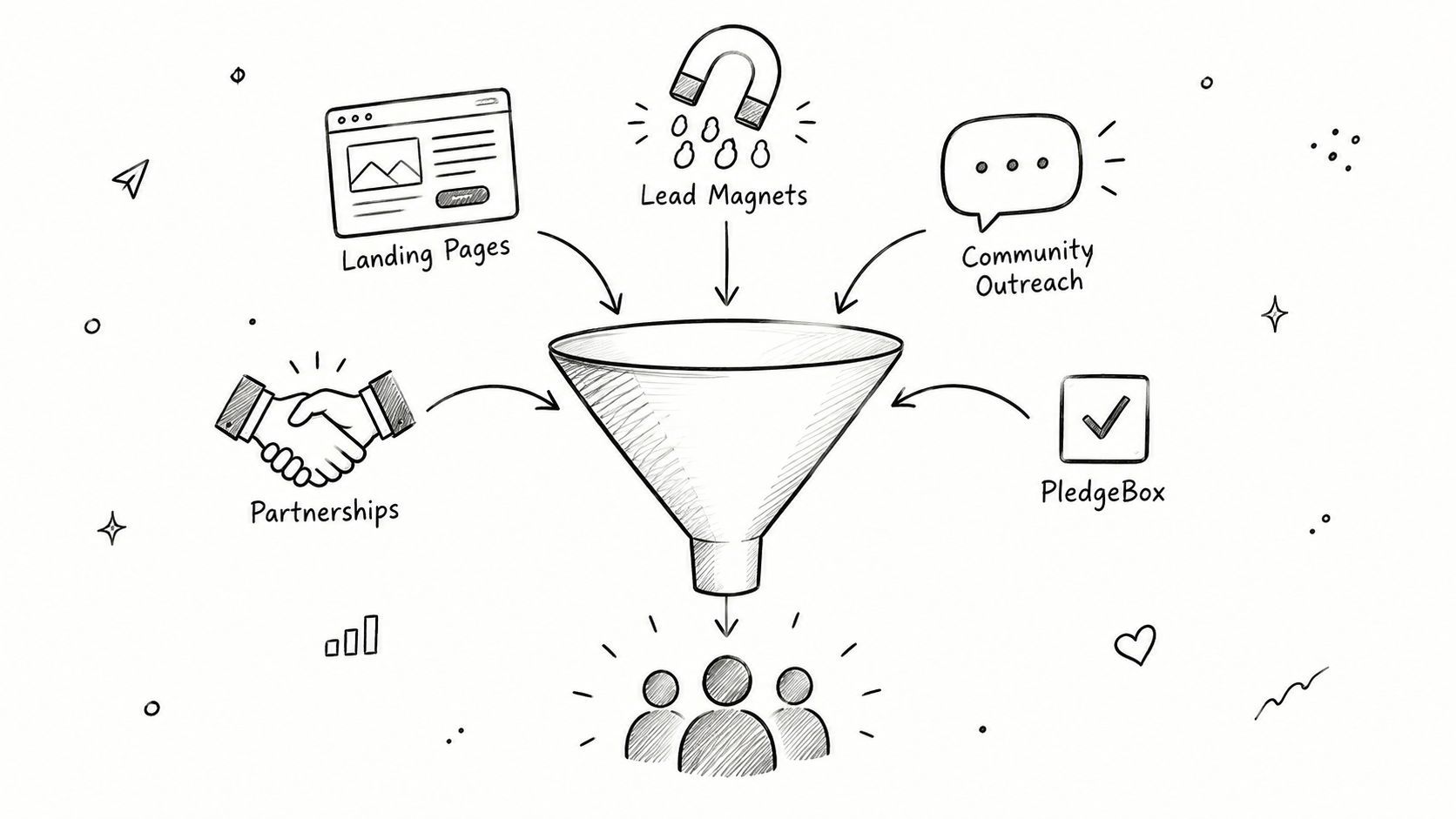
Capture the audience as a connected system, not a collection of isolated tactics. Start with a landing page that gives visitors a clear reason to join, then use a lead magnet that demonstrates the product's value. A hardware team might offer a comparison guide or configuration preview. A board game publisher could share a print-and-play sample, designer diary, or early rules preview. The offer should attract people who could plausibly become backers, not just anyone willing to submit an email address.
Next, collect preference and intent signals. Ask what interests people, which reward they expect, what region they're in, and what information they want before launch. Keep the form focused, then tag contacts according to their answers. A segmented list lets you explain the right benefit to the right person and prevents your team from treating every subscriber as interchangeable.
Email should carry the relationship forward. Create a pre-launch sequence that introduces the problem, shows the product in development, answers objections, and gives subscribers a clear next step. After launch, adapt the communication to pledge tier and engagement. During fulfillment, prioritize accurate addresses, reward selections, tax details, shipping costs, and timely updates. After delivery, ask for reviews, photos, referrals, and feedback that can strengthen the next campaign.
Revenue planning belongs in the same workflow. Select add-ons that complement the original reward, explain their value, and keep the checkout simple. PledgeBox is free to send the backer survey and only charges 3% of upsell revenue if there's any. Kickstarter's pledge manager is like Amazon, while PledgeBox's pledge manager is like Shopify, so creators can use a more customizable, branded environment for surveys, add-ons, and late backer offers.
Measure the actions that indicate intent. Track completed surveys, qualified reservations, clicks, purchases, add-on interest, and fulfillment completion. Treat open rates carefully because privacy features can inflate the number, and use downstream behavior to judge whether your audience is paying attention. The public Kickstarter stats page reported 8,510,483 total backers as of 2025, while a 2026 crowdfunding review cited $725,025,692 pledged by 2,643,482 people in 2024, showing the scale of repeated audience conversion in crowdfunding (Kickstarter's public statistics). Scale comes from sustained trust and relevant follow-up, not from collecting the biggest possible list.
Set up your capture page, connect your audience data, configure the survey before you need it, and prepare the first email sequence while the campaign is still in development. Then test the complete path yourself on mobile, including payment, address entry, add-ons, confirmation, and tracking. The campaign will be easier to manage because your audience already knows what's happening and your team knows what each person needs next.
PledgeBox combines audience capture, email marketing, branded backer surveys, add-on sales, fulfillment tools, and analytics in one crowdfunding workflow. Visit PledgeBox to set up your pre-launch audience process, send the backer survey for free, and pay only 3% on upsells when there are any.
PledgeBox
The All-in-One Toolkit to Launch, Manage & Scale Your Kickstarter / Indiegogo Campaign