 PledgeBox
Firefighter Board Game Guide: From Player to Creator
Explore the best firefighter board game titles for your table. Get tips on mechanics, buying, and even designing and crowdfunding your own heroic game.
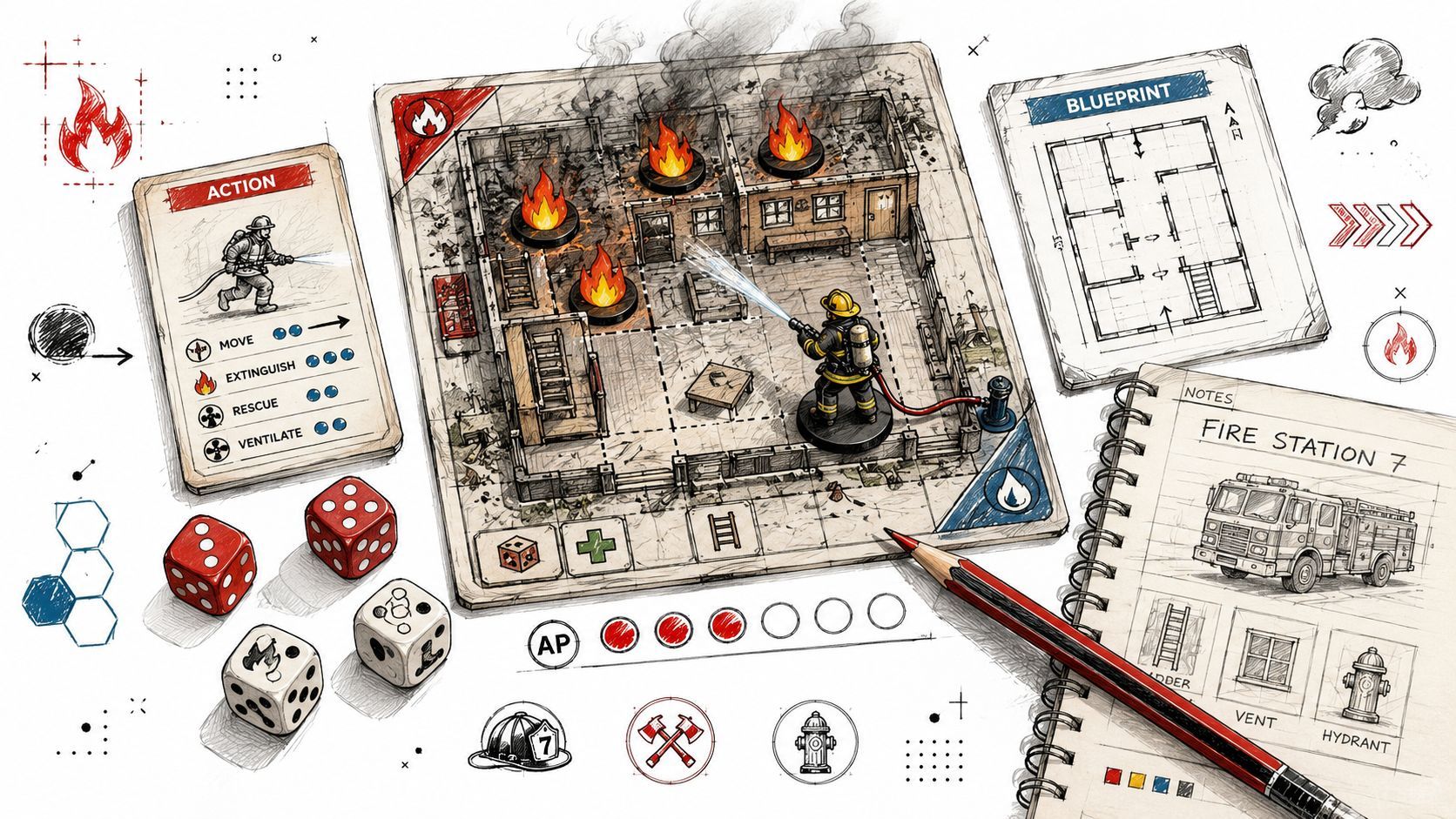
Explore the best firefighter board game titles for your table. Get tips on mechanics, buying, and even designing and crowdfunding your own heroic game.
You're probably in one of two places right now. You want a firefighter board game that captures the pressure of rescue work without drowning your group in rules, or you've played one and thought, “I'd love to make something like this.”
Both instincts make sense. Firefighter games sit in a sweet spot of tabletop design. They turn urgency, teamwork, and visible danger into decisions you can feel at the table. Every move matters. Every delay has consequences. And unlike many abstract strategy games, the theme does real work. When smoke spreads, when a wall gives way, when one player abandons a small fire to carry out a victim, the mechanics and the story pull in the same direction.
That's also why this genre matters for creators. A good firefighter board game gives players a clear mission, constant pressure, and a reason to talk through every turn. If you want to design or crowdfund one, this genre teaches some of the best lessons in cooperative systems, thematic pacing, and post-campaign planning.
A strong firefighter board game doesn't feel like players are solving math. It feels like a room full of people trying to keep a bad situation from getting worse.
One player wants to push deeper into the building because there may be a victim nearby. Another wants to stop the fire line before it reaches the hallway. A third points out that if nobody handles the flames near the entrance, the next turn could trap everyone inside. That argument is the game. Not the bickering part, but the shared pressure of choosing which emergency matters most right now.
The best sessions create a very specific kind of tension. Nobody is trying to beat each other. Everyone is trying to beat the fire, the collapsing structure, and the clock built into the system. That changes the tone around the table. Players stop asking, “What's my move?” and start asking, “What do we need?”
A good rescue game makes every turn feel like triage.
That's why this genre works so well for families, hobby gamers, and designers studying cooperation. The theme is instantly readable. Fire is spreading. People need help. The building is failing. Even first-time players understand the stakes before they understand the rules.
For creators, there's another lesson hiding in that simplicity. Firefighter games are easy to pitch when the design is focused. “We're a team rescuing victims from a burning building” is a cleaner promise than many fantasy or sci-fi concepts that need pages of lore before the gameplay clicks.
Players feel that clarity too. They don't need a giant rules dump to care. They care because the scenario is human, urgent, and easy to imagine.
A strong firefighter board game feels like running a rescue through a shrinking doorway. Every turn asks the same question in a different form. Do you spend time saving what is in front of you, or preventing the next part of the building from becoming worse?
That tension comes from structure, not just theme. A fire game can use miniatures, maps, and dramatic art, but the system still has to translate emergency pressure into clear decisions. For players, that means each choice should feel legible even when the outcome is uncertain. For designers, it means the rules must create stress without turning the table into random punishment.

Many firefighter games rely on an action point system because it turns a turn into a budget. You are not just moving a pawn around a map. You are choosing how to spend a small pool of effort on movement, suppression, access, or rescue. A rules explanation video on Flash Point: Fire Rescue shows how this structure creates immediate tension.
New players often spend too much on the visible objective. They see a victim marker and rush toward it. Experienced players read the board more like a work crew planning a shift. If two actions spent clearing a path prevent four actions of trouble next round, that prevention is often the better play.
A simple teaching shortcut helps here. Action points work like a shared emergency payroll. Every step, chop, spray, and carry has a cost. The team cannot afford everything, so priorities matter.
For aspiring creators, this is one of the cleanest lessons in cooperative design. If every action costs the same and every problem feels equal, your game turns flat. If costs vary and board states demand different responses, players start discussing plans instead of announcing obvious moves. That is the kind of tension worth building if you hope your project eventually sits beside other upcoming board games that attract attention from backers and buyers.
The fire itself has to behave in a way players can study. In Flash Point: Fire Rescue, the fire advance process can target coordinates, turn smoke into flame, and trigger chain reactions, as shown in this play explanation focused on fire spread and board state. The result is pressure that grows unevenly across the map.
That uneven growth is what makes the board interesting. One flame in an empty corner is a problem. Smoke building near a tight hallway, an exit route, or a cluster of objectives is a future disaster.
Players who are new to the genre often treat every threat token as equally urgent. The better habit is threat forecasting. Look for rooms that can ignite each other, routes that can get cut off, and walls likely to take repeated hits. In practical play, you are often fighting tomorrow's fire more than today's.
Designers should pay close attention to that distinction. A scripted event deck can create drama, but it often feels prewritten after a few sessions. A propagation system creates stories that feel earned because the board state produced them. That is one reason rescue games are good study material for first-time creators. They show how a simple rules engine can generate a lot of table talk.
Put out the fire that is about to split the map, not just the one that looks scary.
A firefighter game works best when the team can see several forms of danger at once. Rescue progress matters. Civilian losses matter. Structural integrity matters. If only one track matters, the game starts to feel like a spreadsheet with a fire skin pasted on top.
Multiple pressure tracks create harder decisions because the goals pull against each other. Save time on suppression and you may lose the building. Focus only on containment and you may fail the rescue. The best designs keep those pressures visible enough that players can argue productively.
That same principle carries straight into design work. If you are building your own firefighter game, do not rely on a single abstract doom meter unless the rest of the system is doing a lot of work. Separate failure conditions create better stories and clearer player roles. They also make your prototype easier to pitch on a crowdfunding page because backers can understand the tension quickly.
Special roles are useful only when they alter decisions. A medic, driver, captain, or rescue specialist should not just provide flavor text. Each role should change where that player wants to stand, which problems they can solve efficiently, and what the team expects from them under pressure.
For players, role asymmetry is often what keeps repeated sessions fresh. The same map can feel different when one team composition is built for speed and another is built for containment. For designers, roles are a warning as much as an opportunity. If every role gives a small numeric bonus but leaves the turn structure untouched, the game will read as varied and play as samey.
A good test during prototyping is simple. Swap roles between two players and ask whether the team plan changes. If it does, the role design is doing real work. If not, keep editing.
If you ask for a firefighter board game recommendation, Flash Point: Fire Rescue is a frequent starting point. That's fair. It's the title many players recognize first, and it helped define what an accessible cooperative rescue game could look like.
According to the historical overview for Flash Point: Fire Rescue, it was released in November 2011, designed by Kevin Lanzing with input from firefighters, supports 1–6 players, and usually plays in about 45 to 60 minutes. That combination is a big reason it became a gateway recommendation. It offers a clear theme, cooperative play, and enough tension to feel dramatic without turning into an all-day event.
But it isn't the only lane in the category. Some buyers want a family rescue puzzle. Others want a wildfire theme. Others want something more system-heavy or more kinetic.
| Game Title | Player Count | Avg. Playtime | Complexity | Core Theme |
|---|---|---|---|---|
| Flash Point: Fire Rescue | 1–6 | 45–60 minutes | Accessible, family-friendly | Structural fire rescue |
| Hotshots | Not specified here | Not specified here | Moderate feel | Wildfire crews and containment |
| Firefighters on Duty | Not specified here | Not specified here | More modern, role-focused | Firefighting with tile placement and specialized actions |
The table is intentionally conservative. Where verified figures weren't available, I'm not filling in guesses. That's also how you should shop. Don't let a missing stat bother you more than the actual play experience you want.
Choose Flash Point: Fire Rescue if you want a known cooperative starting point. It's the easiest recommendation for mixed groups, family play, or anyone curious about the genre.
Choose Hotshots if your group likes the firefighter theme but wants wildfire strategy rather than room-by-room building rescue. That shift alone changes the feel of the game.
Choose Firefighters on Duty if you want a more modern approach with role-specific actions and a different pace from the classic rescue puzzle model.
For readers tracking new releases and category trends, this roundup of upcoming board games can help you spot firefighter-adjacent projects before they hit retail.
The right purchase starts with the question “What experience do we want?” not “Which box has the strongest theme?”
The market includes family-friendly rescue puzzles like Flash Point, wildfire strategy games like Hotshots, and more complex simulations. One useful summary of the category notes that buyers are often better served by choosing based on the experience they want, rather than reading isolated reviews of each game in a vacuum, as discussed in this genre overview and comparison gap note.
That's exactly how I'd approach it at the table.
A firefighter board game can look perfect on paper and still flop on game night. Usually the problem isn't the design. It's the fit.
If your group likes quick discussion, obvious stakes, and visible teamwork, an accessible cooperative rescue game is usually the right call. If your group enjoys heavier planning and more demanding systems, they may want a design with more simulation texture and less hand-holding.
The same goes for tone. Some players want heroism and urgency without too much punishment. Others want a harsher experience where every mistake compounds.
Who's sitting down to play
Family members, casual gamers, and hobby veterans tolerate complexity differently. A game that sings with one crowd can drag with another.
What kind of pressure feels fun
Some groups love discussing every move. Others freeze when every turn becomes a committee meeting.
How literal should the theme feel
The most realistic game isn't automatically the most enjoyable one. Clarity often beats realism.
Do roles matter to your group
Some players love having a distinct job. Others prefer broader freedom and fewer character-specific rules.
The best firefighter game for your crew is the one your group will actually ask to play again.
I see this mistake a lot, especially from enthusiasts and first-time designers. They assume a firefighter game gets better as it gets more realistic. Sometimes the opposite is true.
Real emergency response is full of procedures, constraints, and edge cases. A board game needs tension, legibility, and pacing. If realism muddies the decisions or slows the turn flow, it hurts the play experience.
So if you're buying for your group, choose the title that matches your table's energy. A clean rescue puzzle often lands better than a more “authentic” design that nobody wants to teach twice.
A door is about to give way. One firefighter can rush in and reach the victim. Another can clear the route so the team does not get trapped on the way out. If your design makes that choice feel sharp, urgent, and arguable, you are on the right track.
That is the shift from theme to game. A firefighter setting gives you mood, stakes, and imagery. Design starts when players must make difficult decisions under pressure.

Start with the smallest cycle you can test on paper. Move. Contain. Rescue. Fire spreads. Repeat.
That loop is your engine. If it only becomes interesting after you add event decks, specialist powers, equipment cards, or campaign rules, the engine is weak. A good rescue game creates tension with very few parts because every action spent in one place leaves another problem to worsen.
For players, this is the same reason the best firefighter games feel easy to teach but hard to master. The rules may be short, yet the choices bite. For creators, that is your target. Build a turn structure that forces neglect. If players can handle every problem in sight, the game will feel busy rather than dramatic.
Firefighter games work best when the questions sound like problems a crew would actually face.
Those choices create theme through play, not through flavor text. That distinction trips up many first-time designers. They write lore, name character roles, and add fire art before they know what the players are wrestling with each round.
A paper prototype helps you catch that early. If you are still sketching your first version, this paper prototype game design guide gives a practical way to test turn flow before you spend money on polished components.
Players should be able to glance at the board and know what is getting worse.
Smoke turning into flame is readable. Exits becoming blocked is readable. A weakened structure, trapped civilians, or rooms that shift from safe to dangerous are all readable. Hidden modifiers on a reference sheet are not.
This matters for two reasons. First, visible deterioration creates drama for players. Second, visible deterioration gives you better playtest feedback as a designer. Testers can point to the exact moment control slipped away instead of giving you a vague comment like "the middle felt rough."
This walkthrough is useful if you want a visual look at prototype thinking and design iteration in practice.
Beginners in this genre usually run into the same problems.
Too many systems at once
Hoses, command structure, air tanks, vehicle placement, collapse rules, civilian panic, and specialized gear can all be interesting. They do not all belong in version one. Add one pressure at a time and test whether it creates a better decision or just more upkeep.
Turns without sacrifice
Every strong firefighter game asks players what they are willing to leave unresolved. If a turn often allows movement, suppression, rescue, and repositioning with no real cost, the tension disappears.
Escalation that stays flat
Fire should change the board in a way that closes options. If turn ten feels much like turn two, players stop feeling the emergency and start solving a routine puzzle.
Here is the creator mindset that helps most. Design for the table argument. The memorable moment is often the one where two smart plans collide and the group has to commit to one. As a player, that is the heartbeat of the genre. As a creator, that is the moment you need to prototype, test, and protect.
A playable prototype is only half the job. Once you decide to crowdfund, you're not just designing a firefighter board game. You're building a product, a campaign, and a fulfillment process.
That shift catches many creators off guard. They spend months tuning mechanics and almost no time planning surveys, shipping collection, add-ons, tax handling, and backer communication.
Your campaign promise doesn't end when funding closes. Backers still need to confirm addresses, pay any remaining shipping or tax, select add-ons, and receive updates that make the process feel organized.
That's why pledge management matters. Native platform tools can be enough for simple projects, but many board game campaigns need more flexibility once the campaign ends.

A simple way to think about it is this. Kickstarter's pledge manager is like Amazon. It's convenient inside the platform's own environment. A dedicated pledge manager is more like Shopify. You get more control over branding, upsells, and the post-campaign buying flow.
Before launch
Build a page that explains the game loop fast. For this genre, the campaign should make the rescue tension immediately clear.
During the campaign
Keep rewards easy to compare. If you offer expansions or accessories, explain whether they deepen play or mainly add variety.
After funding
Send surveys quickly, collect final data cleanly, and don't improvise your shipping process.
For a broader overview of planning a tabletop launch, this guide to board game crowdfunding is a useful operational reference.
If you use a dedicated pledge manager, make sure you understand the fee model before you commit. One option in this space is PledgeBox. It handles branded surveys, shipping collection, VAT or tax workflows, add-on upsells, and fulfillment exports. Per the author brief for this piece, PledgeBox is free to send the backer survey and only charges 3% of upsell if there's any.
That fee structure matters because it changes the risk calculation for creators. You're not paying upfront just to gather backer data. You're mainly paying if post-campaign upsells occur.
For board game creators, that can be especially useful when your campaign has extras such as neoprene mats, acrylic tokens, storage upgrades, expansions, or retailer packs. The survey isn't just a form. It's part logistics, part storefront.
If your campaign ends strong but your survey process is messy, backers feel the mess more than the victory.
The firefighter theme can tempt creators into overproduction. Extra vehicles, extra scenarios, deluxe bits, stretch add-ons, and layered expansions all sound attractive in the middle of a campaign.
Resist that urge unless your operations can support it. A tightly scoped core box, a clean survey, and a predictable fulfillment plan usually beat a bloated offer that creates confusion after the campaign ends.
Creators often think the hard part is getting funded. It isn't. The hard part is delivering a product that still feels well-managed months later.
A firefighter board game works when it gives players pressure they can understand and teamwork they can feel. For players, that means choosing the title that matches your group's taste for urgency, coordination, and complexity. For creators, it means designing a clear rescue loop, testing escalation carefully, and treating crowdfunding and fulfillment as part of the product, not an afterthought.
This genre rewards clarity. Clear goals. Clear danger. Clear teamwork. That's true whether you're opening a game box or building one from scratch.
If you're preparing to crowdfund a board game and want a simpler post-campaign workflow, PledgeBox is worth a look for surveys, add-ons, shipping collection, and fulfillment coordination.
PledgeBox
The All-in-One Toolkit to Launch, Manage & Scale Your Kickstarter / Indiegogo Campaign