 PledgeBox
Air Umbrella Kickstarter A Case Study for Creators
A deep dive into the Air Umbrella Kickstarter failure. Learn why it collapsed post-campaign and how to avoid the same fate with modern crowdfunding tools.
A deep dive into the Air Umbrella Kickstarter failure. Learn why it collapsed post-campaign and how to avoid the same fate with modern crowdfunding tools.
A lot of crowdfunding failures look mysterious from the outside. The Air Umbrella didn't. It looked like the future, funded like a hit, and then became a clear lesson in what happens when a striking concept outruns engineering and operations.
The air umbrella kickstarter became famous because the pitch was easy to grasp in seconds. Instead of fabric, it promised a real-world “invisible umbrella” that would use air to push rain away from the user.
That kind of concept is catnip for crowdfunding. It's visual, surprising, and simple enough to spread across social feeds and gadget blogs without much explanation. But the same qualities that make a campaign viral can hide the harder question every creator has to answer before launch. Can this thing be built, delivered, and supported at scale?
Air Umbrella is still one of the cleanest examples of a campaign that won attention first and lost trust later. People didn't just back a gadget. They backed a story about near-future consumer tech becoming real.
Creators should study it for a different reason. The usual takeaway is “bad idea” or “impossible product.” That's too shallow. The more useful lesson is that crowdfunding failure often comes from a stack of smaller execution problems. Technical uncertainty, vague timelines, weak post-campaign systems, and inconsistent communication can turn excitement into suspicion very quickly.
Practical rule: A campaign doesn't fail only when the product is flawed. It also fails when the team has no disciplined process for what happens after the funding ends.
That's why Air Umbrella still belongs in any serious conversation about hardware crowdfunding. It sits right next to broader patterns covered in these common crowdfunding failure pitfalls, but it adds a sharper operational lesson. Viral funding doesn't rescue a campaign from weak execution. It magnifies every weakness.
Air Umbrella didn't need a complicated pitch. It had one powerful advantage. Anyone could see the concept and instantly understand why it might be exciting.
The campaign launched in late September 2014 and quickly passed its original goal. Kickstarter tracking later recorded US$102,240 pledged from 825 backers, or 1,022% of goal, over a 30-day campaign from September 24 to October 24, 2014, as reported in ITV's campaign coverage.

This kind of hardware concept tends to move for three reasons:
Air Umbrella had all three. That matters because Kickstarter momentum is rarely just about product quality. It's often about whether the idea can travel quickly between strangers. This one could.
Virality creates a hidden tax. When a campaign takes off fast, creators lose room to iterate in private. Every rough edge becomes public. Every optimistic claim hardens into an expectation. Every prototype limitation starts to matter more because more people are watching.
A campaign like this also attracts backers who aren't evaluating manufacturing risk in detail. They're reacting to possibility. That's one reason high-concept hardware can surge so fast and then hit a wall once the discussion moves from “Wouldn't this be amazing?” to “How exactly will this ship?”
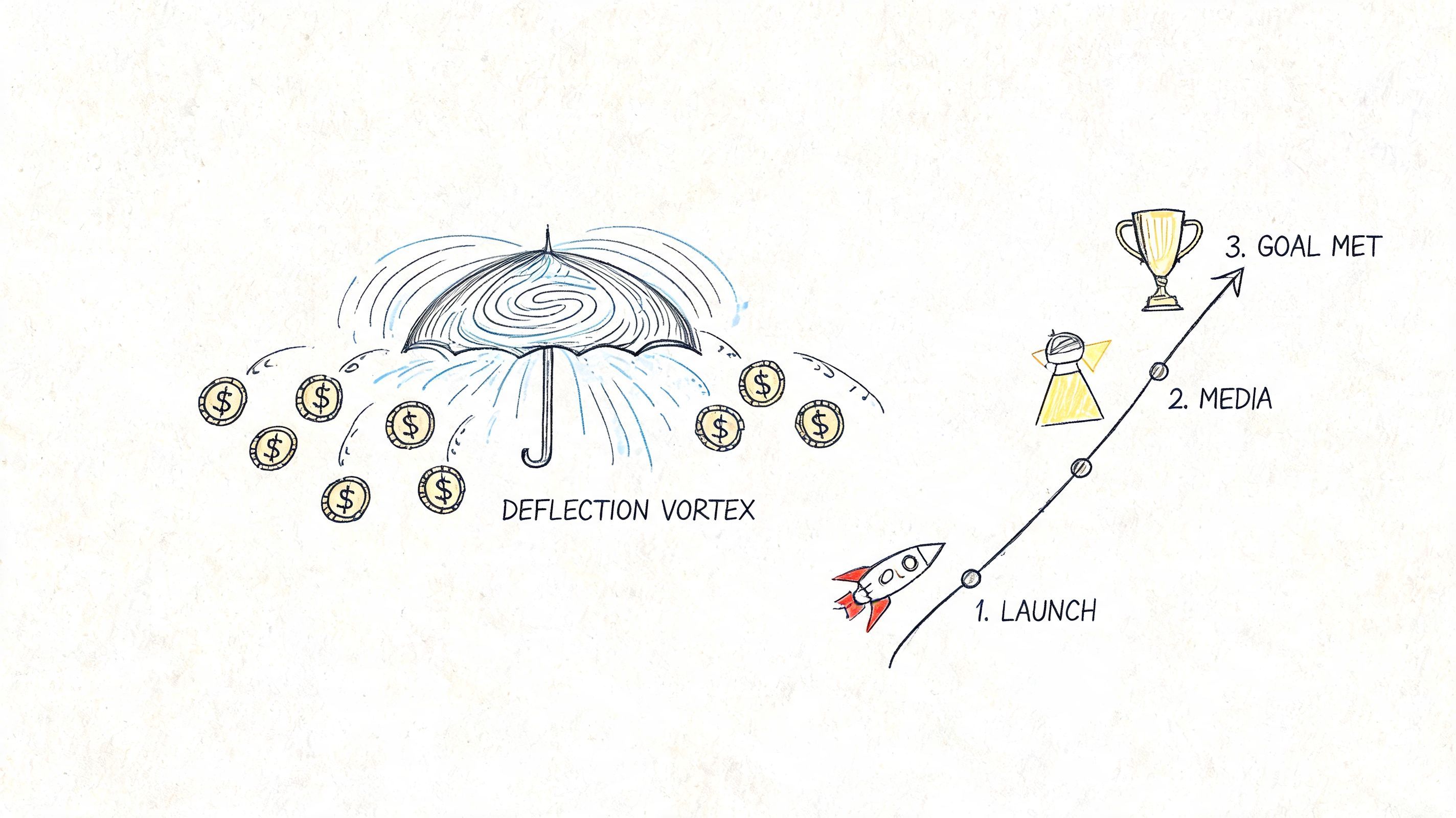
For creators, the lesson isn't to avoid ambitious products. It's to understand that a highly shareable concept buys attention, not execution. Teams that want the upside of that attention need a launch plan for media, a realistic prototype story, and a strong post-campaign system. If you want to understand how creators intentionally build that first wave of visibility, this guide on how Kickstarter campaigns ignite viral buzz is worth reading.
The campaign promised a clean science-fiction experience. The prototype pointed to a much messier hardware reality.
Historical reporting on the project described an invisible umbrella with multiple planned versions, including a larger telescoping model that reportedly weighed about 850g and was expected to run for roughly 15 to 30 minutes per charge. GearJunkie's retrospective captures those claims and the missed release target clearly in its historical summary of Air Umbrella.

A fabric umbrella blocks rain with passive coverage. Air Umbrella had to push enough air, in the right shape and at the right speed, to deflect falling water around a moving person. That is not a small engineering jump. It turns a simple carry item into a battery-powered airflow system that has to perform outdoors, in variable weather, close to the user's head and hands.
That creates a hard set of trade-offs:
| Challenge | Why it matters in use |
|---|---|
| Battery drain | Sustained airflow uses power fast, which limits runtime |
| Weight | More battery capacity adds bulk to a product meant for carrying |
| Noise | A stronger motor and fan are harder to make quiet in a handheld device |
| Weather variability | Crosswinds, shifting rain, and walking speed change the protection zone |
| Comfort | Daily-use products have to feel normal to carry, hold, and recharge |
Creators run into this problem often with high-concept hardware. A prototype can prove that a physical effect exists. It does not prove that the effect can be packaged into a product people will tolerate every day.
That distinction matters more than the demo.
The reported weight and runtime raised concern long before shipping entered the picture. For a commuting product, short battery life and a relatively heavy handheld form factor are not minor details. They shape whether the device fits real routines, whether users forgive recharge requirements, and whether the product still feels useful once weather conditions stop being controlled.
I use one test when I review campaigns like this for founders. Does the demo show repeatable performance in ordinary conditions, or does it show a carefully framed proof of concept?
Air Umbrella looked persuasive on video because the idea was easy to grasp. The evidence for repeatable outdoor performance was thinner. That is where many hardware teams get trapped. They treat an exciting demonstration as if it has already answered the harder questions about runtime, durability, user comfort, and consistency in the field.
The original campaign footage is still useful to watch with a builder's eye instead of a backer's eye:
A stronger campaign would have narrowed the promise earlier. It would have shown repeated tests in wind, clarified realistic battery expectations, and positioned the first version as an experimental device with strict limitations rather than a ready replacement for a normal umbrella. That would not have made the concept less ambitious. It would have made the risks legible, which is the first step toward keeping a technical setback from turning into a full campaign failure.
Most postmortems stop at feasibility. That misses the bigger operational lesson.
A campaign can survive technical setbacks if the team communicates clearly, narrows scope, and manages backer expectations with discipline. What backers struggle to forgive is confusion. Once updates become vague, timelines drift without structure, and nobody can tell what stage the project is in, confidence starts to collapse.

From a backer's side, operational failure doesn't arrive as a formal announcement. It arrives in fragments:
That pattern matters because crowdfunding backers are unusually tolerant when teams are honest. They know hardware is difficult. They don't expect perfection. They do expect a visible management process.
Reporting on the failed Air Umbrella noted that the Kickstarter eventually fell apart and that some refunds were made. That reporting also highlighted a gap many campaign writeups ignore: how fulfillment, testing, and claims management should be structured once funding closes, as discussed in Hackaday's retrospective on the failed Air Umbrella.
That's the practical center of this case. Teams often spend months polishing launch assets and almost no time designing the post-campaign machine. But once a project funds, the work changes completely. Now the team needs to run a controlled operation:
Backers can handle uncertainty. They can't handle disorder.
Air Umbrella is useful because it shows how a campaign can become famous for the wrong reason. It wasn't only that the product looked impractical. It was that the project became an example of why funding totals are a poor measure of success if the team can't carry the campaign through the operational middle.
Air Umbrella is useful because it turns a famous flop into a creator checklist. The lesson is not just that the idea was risky. The lesson is that risky ideas need stricter proof, clearer decision points, and a post-campaign system that can survive bad news.
Founders usually present the part that looks futuristic. Backers eventually judge the part that has to work in the rain, on the street, in a bag, with a battery, in wind, around other people.
That is the discipline gap Air Umbrella exposed. The concept drew attention. The primary test was whether the product remained practical once power limits, noise, comfort, and everyday handling entered the picture. As noted earlier, those trade-offs were visible long before fulfillment became a problem.
I tell hardware teams to identify the single feature most likely to fail under normal use and make that the center of pre-launch testing. If the product depends on one fragile assumption, validate that assumption first.
Use questions like these:
Campaign communication breaks down when creators use updates to preserve excitement instead of reducing uncertainty.
Backers do not need polished optimism. They need management signals. A good update names the problem, states what changed internally, and gives the next checkpoint with a date or decision trigger. That format is simple, but it forces discipline inside the team.
My rule for troubled campaigns is plain. If an update cannot answer "What happened, what are you doing, and when will we hear from you again?", it is not ready to send.
This is the lesson creators miss when they study Air Umbrella. The failure was not only technical. It was operational. Once a campaign funds, the work shifts from storytelling to order management, exception handling, and controlled communication. Teams that do not build that machine early end up improvising under pressure.
That is why a post-campaign pledge manager workflow for Kickstarter projects matters. It does not rescue a weak product. It gives creators a structure for collecting data, confirming orders, handling shipping changes, and managing edge cases before those tasks turn into public confusion.
Before launch, decide how you will handle:
| Operational area | What creators should decide early |
|---|---|
| Backer data collection | What information is required, when it will be locked, and how errors will be corrected |
| Shipping charges | Whether rates are collected during the campaign or after regions and costs are confirmed |
| Reward structure | Which tiers are simple enough to pack and ship without manual intervention |
| Support ownership | Who answers backer issues, what counts as an exception, and how refunds are approved |
| Vendor handoff | What file format, SKU structure, and fulfillment status markers partners will need |
I like ambitious hardware. Some breakthrough campaigns start with products that look slightly improbable. But the operating standard has to rise with the ambition.
If the product is novel, the fulfillment plan should be boring. If the engineering is uncertain, the communication cadence should be fixed. If manufacturing assumptions are still moving, reward complexity should come down, not go up.
That is the practical takeaway from Air Umbrella. Creators do not fail only because they aimed high. They fail because they launch high-risk products with low-discipline operations.
If there's one operational tool that would have changed the shape of a campaign like Air Umbrella, it's a pledge manager. Not because software can fix a weak product. It can't. But it can stop a difficult project from turning into an administrative mess.
Most creators first encounter post-campaign work through native platform tools. Those are fine for basic collection, but they're rarely enough once rewards, shipping, taxes, add-ons, and late changes start piling up. The difference is easiest to explain with a simple comparison. Kickstarter's pledge manager is like Amazon, and a dedicated pledge manager is like Shopify. One gives you a basic marketplace-style flow. The other gives you control over your own post-campaign storefront and operations.

A proper pledge manager helps teams handle the unglamorous work that destroys campaigns when it's done manually:
That last point is more important than most founders realize. A lot of campaign stress isn't caused by one dramatic mistake. It's caused by hundreds of tiny data errors that pile up into support tickets, warehouse confusion, and avoidable delays.
A campaign with technical uncertainty needs stronger post-campaign controls, not weaker ones. If manufacturing shifts, the team needs a reliable way to revise timelines, confirm addresses later, collect shipping at the right moment, and isolate affected backer groups.
That's where a tool like PledgeBox's explanation of why a pledge manager matters for Kickstarter projects becomes practical rather than theoretical. One option in this category is PledgeBox, which lets creators send the backer survey for free and only charges 3% of upsell revenue if there's any. That fee model matters because it removes the friction of needing to pay for basic backer organization, while still giving teams room to offer add-ons and late-order options where appropriate.
Operational advice: Don't treat the survey as paperwork. Treat it as the handoff from fundraising to fulfillment.
I've seen creators delay survey setup because they assume they can clean things up later. Usually they can't. Once support requests scatter across email, comments, DMs, and spreadsheets, every correction becomes slower and more expensive.
The best post-campaign setups are boring in the right way. Backers know what to do. Data lands in one place. Shipping charges are handled deliberately. Updates reference real milestones. That doesn't make a campaign flashy. It makes it finishable.
Air Umbrella still gets remembered for the spectacle. It should be remembered for the sequence.
First came a concept that was perfect for attention. Then came the harder reality of turning that attention into a viable product and a managed operation. That second phase is where crowdfunding campaigns succeed or fail.
The lasting value of the air umbrella kickstarter is that it compresses several hard truths into one story. A visual idea can fund fast. A prototype can impress without proving consumer readiness. A team can clear its goal and still lose control after the campaign if fulfillment planning and backer communication aren't already in place.
For creators, that's useful. It gives you a standard that's tougher than “Did we get funded?” The actual test is simpler and more demanding. Can you validate the product truthfully, communicate setbacks clearly, and run the post-campaign workload like an operation instead of an improvisation?
That's the blueprint modern teams should keep. Not the fantasy of viral funding as the finish line, but the discipline required after the applause fades.
If you want a cleaner post-campaign workflow, PledgeBox helps creators collect surveys, manage add-ons, handle shipping and tax collection, and keep fulfillment data organized without upfront survey fees.
PledgeBox
The All-in-One Toolkit to Launch, Manage & Scale Your Kickstarter / Indiegogo Campaign