 PledgeBox
Training Program Development for Crowdfunding Creators
Master training program development for crowdfunding creators with a practical guide on needs analysis, learning design, delivery, and measuring real impact.
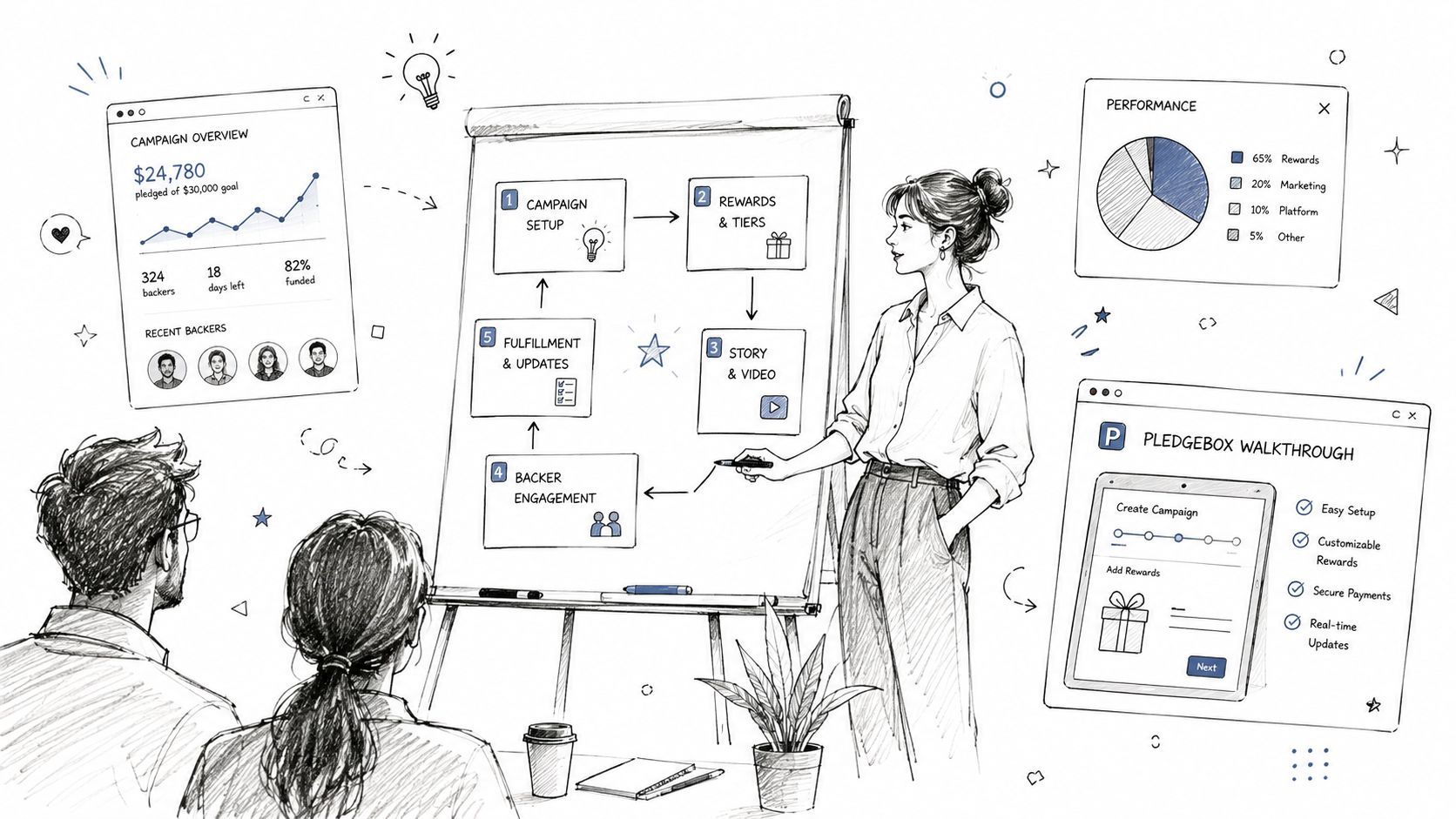
Master training program development for crowdfunding creators with a practical guide on needs analysis, learning design, delivery, and measuring real impact.
Your campaign is funded, the backer inbox is full, and the team is now improvising everything that happens after the launch page goes dark. One person is trying to write the survey, another is guessing at add-on logic, and nobody has the same playbook for fulfillment, refunds, or late backer handling. That's the moment training program development stops being an abstract HR phrase and becomes the difference between a clean post-campaign system and a pile of avoidable mistakes.
For crowdfunding creators and agencies, the problem isn't usually ambition. It's that post-campaign work is messy, repetitive, and easy to hand off to whoever's available. A strong training program gives that work structure, so your team isn't learning by damaging live campaigns.
The core task is to turn scattered know-how into a repeatable operating system for surveys, upsells, handoffs, and support. When that system is built well, the team can work faster without making the same errors every cycle.
The classic failure point shows up right after a campaign overperforms. The creator expected 500 backers, got 5,000, and now the team is handling survey logic, shipping questions, and upsell offers with no shared process. One person knows how to patch the issues, but the knowledge lives in their head, not in the team.
That's why training program development matters in crowdfunding work. It isn't a one-time workshop about “best practices,” it's the way a team keeps pace with launch volume, client turnover, and the fact that post-campaign revenue often depends on the quality of survey and upsell execution. The labor market signal backs that up, too. The U.S. Bureau of Labor Statistics projects 11% growth from 2024 to 2034 for training and development specialists, which points to structural demand for this skill set, not a passing trend.
The spending side tells the same story. U.S. corporate training spending reached $102.8 billion in 2025, up 4.9% from $98.0 billion in 2024, and organizations still averaged about 40 training hours per employee with roughly $874 per learner in direct learning expenditures, according to recent training development statistics. That's a lot of sustained investment for one reason, teams need systems that stick.
Practical rule: if a workflow affects refunds, fulfillment, or upsells, it needs training, not tribal memory.
Crowdfunding teams feel this more sharply than most. Agencies juggle multiple clients at once, creators rotate contractors midstream, and each campaign can bring a new reward structure, country mix, or fulfillment edge case. If the team doesn't have a repeatable training model, every launch becomes a reinvention exercise.
The upside of treating learning as a program is simple. You stop asking whether someone “gets it” and start asking whether the team can execute the same workflow cleanly on the next campaign. That's the standard that matters here.
This article gives you a working model for building training that improves real backer behavior, not just workshop attendance.
Start with the business outcome you need. For crowdfunding teams, that's usually some combination of higher survey completion, fewer fulfillment mistakes, cleaner refund handling, and better add-on performance. A useful needs analysis maps each outcome to a visible failure in the workflow, then to a skill the team lacks.
The mistake most teams make is jumping straight into content. They say, “We need survey training,” when the gap might be that nobody can configure shipping tiers, write a clear upsell block, or recognize where backers are dropping off in the survey. The analysis has to connect the behavior you want with the behavior you're seeing.

Use three columns: business goal, observed problem, and skill gap. If survey completion is low, the observed problem might be confusing copy, too many steps, or weak reminder logic. If add-ons are weak, the gap might be poor offer framing rather than weak product demand.
A single page is enough if it stays concrete. Write the issue in operational language, then turn it into a learning objective with three parts, action, condition, and criterion.
For example:
That format matters because it makes the objective testable. It also stops training from drifting into vague goals like “understand the system better,” which nobody can verify later.
A practical template looks like this:
| Business goal | Observed problem | Learning objective |
|---|---|---|
| Higher survey completion | Backers abandon mid-survey | Build a shorter survey flow that reduces friction |
| Lower fulfillment errors | Shipping tiers are set inconsistently | Configure shipping logic correctly for each region |
| Better upsell performance | Add-ons are buried or unclear | Write and place an upsell block that is easy to act on |
If you want a tighter way to gather the inputs, the internal feedback collection methods framework is useful because it forces the team to separate anecdote from evidence. That's the right habit before anyone writes curriculum.
Good needs analysis ends with a decision, not a mood. If you can't point to the exact task that failed, the objective is still too broad.
Once the objectives are clear, the curriculum should get smaller, not bigger. Crowdfunding teams don't need a sprawling classroom model. They need a few modules that match the actual campaign flow, then a template that makes each module fast to produce and easy to reuse.
I usually see better adoption when the program has three or four modules, not ten. For creators and agencies, the most useful cluster is pre-launch conversion, backer survey configuration, upsell design, and fulfillment handoff. That keeps the material tied to the campaign lifecycle instead of abstract training theory.
A practical module template can stay consistent while the examples change:
That format works because it mirrors how people remember operational work. They hear the rule, watch the task, do the task, then get corrected before it reaches a live campaign.
The most valuable live exercise is the survey and upsell workflow, because that's where teams either create clean revenue or create support debt. A PledgeBox backer survey is especially useful as a practice surface because it's free to send the survey and only charges 3% of upsell sales if there are any, which makes experimentation low risk. The native Kickstarter pledge manager behaves more like Amazon, locked to the original reward structure with less storefront flexibility, while a PledgeBox pledge manager feels more like Shopify, where you can shape the branded experience, configure your own upsell flow, and support late backer pre-orders.
That distinction should be taught plainly. Teams need to know which system is rigid and which one is flexible, because the wrong mental model leads to bad setup choices. A module on backer surveys should show the live screen, the logic behind each field, and the exact point where an upsell offer becomes part of the backer experience.
For structure ideas worth borrowing, top training design strategies is a useful reference because it reinforces chunking, practice, and feedback without overcomplicating the curriculum.
If a module can't be reused next campaign, it's probably too tied to the person who built it.

Delivery choice changes the economics. Solo creators usually need one clear path through the material, while agencies need something that can be reused across clients without rebuilding from scratch. That's why the best format is usually a blend, not a single channel.
A workable split is straightforward. Async video handles concept teaching, live workshops handle Q&A and edge cases, and hands-on walkthroughs handle assessment because they produce a real artifact, not just a quiz score. That artifact matters more than enthusiasm in a debrief.
| Delivery channels for crowdfunding training | Cost per learner | Retention strength | Best for |
|---|---|---|---|
| Live workshops | Higher | Strong for edge cases | Agency teams, client-specific issues |
| Async video | Lower | Good for concept recall | Solo creators, repeatable fundamentals |
| Hands-on walkthroughs | Low marginal cost | Strong for transfer | Real workflow practice, assessment |
The cheapest rehearsal surface is the hands-on workflow itself. With a PledgeBox survey, the team can practice on a live-looking setup without paying anything to send the survey, and only owe the 3% upsell fee if a trainee-built flow converts. That makes it a practical assessment tool, not just a platform choice.
Solo creators usually benefit from async video first because they need speed and don't want to sit through long live calls. Agencies, on the other hand, often need a live working session because client setups create edge cases that don't fit a single recording. Both groups still need the same thing at the end, a completed workflow that can be exported, reviewed, and reused.
The delivery decision should also match the team's operating tempo. If campaigns change fast, you want short modules and one live working session. If your agency manages several clients with different reward structures, the live workshop becomes the place where context gets translated into action.
For teams that want a knowledge-sharing setup that scales across repeated launches, the knowledge-sharing systems resource is worth a look because it lines up well with reusable walkthroughs and artifact-based learning. That's a better fit than generic LMS thinking for most campaign teams.
A training program isn't finished when people nod along in the room. It's finished when they use the workflow on a real campaign and the numbers move in the right direction. That's why evaluation has to go beyond attendance, satisfaction, and a post-session quiz.
The cleanest model still uses four levels, reaction, learning, behavior, and results. In a crowdfunding context, that means a quick reaction poll after the session, a hands-on score from the workflow exercise, a later check on whether the trained team is completing surveys correctly, and then a business look at whether upsell revenue or survey performance improved. The timing matters, because immediate agreement doesn't prove transfer.
The evaluation cadence should stretch out over time. Immediate feedback happens in days, behavior change should be checked in 1 to 3 months, and business impact belongs in 6 to 12 months, because the useful signal appears after the team has had to apply the process more than once. That staged approach is supported by training guidance that recommends measuring reaction, learning, behavior, and results separately, rather than collapsing everything into one score, and by meta-analytic evidence showing only moderate average effects across those outcome types in training research, which means follow-up is not optional. See the broader framework in training evaluation guidance and the practical checklist in campaign performance metrics.
The warning sign is transfer failure. One review reports that typical organizational training succeeds only about 10% of the time when success means improved individual and organizational performance, while another source says only 10% to 20% of trained material may transfer into the work setting and that about 70% of trainees stop using learned skills within a year, according to organizational training research. That's exactly why end-of-course satisfaction can't be the finish line.
If the team can pass the quiz but still break the workflow on the next launch, the training failed where it counted.
The easiest way to run this is to keep the pilot small and the review loop tight. Days 0 to 15 should be about the needs analysis and a single pilot cohort, ideally one live campaign or one client account where the workflow is visible. That keeps the scope manageable and makes it easier to see whether the training maps to actual work.
From day 16 to 45, run the blended curriculum, one async module set, one live workshop, and one hands-on walkthrough. The two checkpoint metrics during the pilot should be survey completion rate and add-on conversion, because those are the clearest signals that the team is applying what they learned.
That final comparison should be simple. If the trained team is still making the same setup mistakes, the problem is usually content clarity or reinforcement, not learner motivation. If the workflow improved, document the exact version that worked and keep it as the default module.
The PledgeBox pledge manager is the cheapest rehearsal environment for this kind of pilot because the survey is free to send and the only fee is the 3% upsell charge if the flow converts. That makes it a clean place to test live training behavior without paying for every attempt up front.
The first failure is skill without transfer. Teams can learn the concept, pass the exercise, and still stumble on the next real campaign because the training never touched the live workflow. The fix is blunt: every module needs a real walkthrough that ends with a working artifact the team will use.
The second failure is designing for one learner type only. Crowdfunding teams often include people with mixed literacy, low digital confidence, or multilingual needs, and the material breaks down when it leans too hard on text-heavy slides or chart interpretation. The fix is to use visuals with limited text, hands-on practice, group discussion, and optional written detail for people who want it.
The third failure is post-training collapse. A team can look great in week one and revert to old habits by week three because nobody reinforced the process. The fix isn't more slides, it's manager follow-up plus a 30-day application check that asks whether the team is still using the skill on active campaigns.

The common thread is simple. Training program development is a long game, and the cheapest insurance is a live rehearsal surface where the team can practice the exact workflow before it matters. A free backer survey with only a 3% upsell fee if the offer converts gives you that space without turning every test into a cost center.
If you're building your next campaign workflow and want the training to stick, use PledgeBox as the place where your team rehearses the survey and upsell process before it goes live. It keeps the practice environment close to the actual work, which is what makes the learning transferable. Start there, then turn the finished workflow into the standard your next launch runs on.
PledgeBox
The All-in-One Toolkit to Launch, Manage & Scale Your Kickstarter / Indiegogo Campaign