 PledgeBox
Decision Making Framework Guide for Crowdfunding Success
Learn how a decision making framework helps crowdfunding creators choose rewards, budgets, and fulfillment partners with confidence and clarity.
Learn how a decision making framework helps crowdfunding creators choose rewards, budgets, and fulfillment partners with confidence and clarity.
Two weeks after a funded campaign, a hardware creator sits at a desk covered with reward-tier notes, VAT questions, backer addresses, and three fulfillment quotes. Every option feels permanent. Lower the reward price and the margin shrinks. Add shipping later and backers may leave. Choose the wrong pledge manager and customer data, fees, or fulfillment details become harder to control.
A decision making framework is a repeatable system that turns a messy choice into a clear yes, no, or defer. It doesn't guarantee a perfect outcome. It gives you a consistent way to frame the question, compare trade-offs, document ownership, and review what happened.
That matters because crowdfunding decisions rarely arrive one at a time. Shipping can reduce your margin, late backers can complicate fulfillment, and every creator eventually faces the Amazon-versus-Shopify question: should fulfillment stay inside Kickstarter's standardized environment, or move to a more configurable storefront? This guide connects decision science to reward design, survey timing, VAT handling, supplier selection, and pledge manager costs. By the end, you'll have a one-page aid you can tape above your desk before fulfillment begins.
Crowdfunding creates a dangerous illusion of completion. The campaign reaches its funding goal, but the operational decisions have only changed shape. You still need to confirm what each backer ordered, calculate shipping zones, collect missing information, decide whether add-ons are safe, and protect the margin promised by the original reward design.
A framework helps because it separates the decision itself from the anxiety around it. Instead of asking, “What should we do with the pledge manager?” write, “Which system lets us collect accurate fulfillment data while preserving the margin and control we need?” That question can be answered with evidence. The vague version invites opinions.
Shipping pressure appears after the campaign closes. A reward that looked profitable at launch can become difficult once packaging, freight, address corrections, taxes, and regional delivery rules enter the calculation. Your framework should make landed cost and fulfillment complexity visible before you confirm the tier.
Backer churn often starts with delayed or unclear post-campaign communication. If a survey arrives too late, asks confusing questions, or hides shipping charges until the final screen, backers may postpone completion or request refunds. Survey timing is therefore a decision with operational consequences, not a minor administrative task.
Platform choice creates a different kind of confusion. Kickstarter describes its pledge manager as included without additional upfront cost, while its usual campaign fees still apply to payments made through it, including a 5% platform fee and a roughly 3–5% card-processing fee, excluding taxes, as stated in its pledge manager guidance. PledgeBox's published pricing model says its backer survey is free to send and charges only 3% of upsell revenue if there's any. Those models aren't interchangeable, so compare the cost against the control and workflow you really need.
For every material choice, write five lines:
Practical rule: If you can't state the decision in one sentence, you're not ready to compare options.
A decision framework won't remove uncertainty. It will stop uncertainty from becoming paralysis. It also creates a record your team can revisit when a supplier misses a date, a backer asks for a change, or a new fulfillment quote alters the economics.
Decision science didn't begin with startup dashboards. Its roots reach back to modern probability theory in the 17th century, when thinkers such as Pascal and Bernoulli developed ways to reason about uncertain outcomes. That shift matters to creators because every reward tier is a bet about demand, cost, and behavior. You estimate what might happen, then choose how much risk to accept.
Management thinkers later moved the subject from abstract probability to organizational practice. Fayol formalized management ideas in 1916, Barnard developed systems-oriented thinking in 1938, and Herbert Simon described bounded rationality in 1948. Simon's model recognized that people make choices with limited time, information, and attention. His four stages were problem finding, intelligence, design, and choice, a sequence that maps neatly to campaign operations. You find the fulfillment problem, gather evidence, design alternatives, and choose a path.
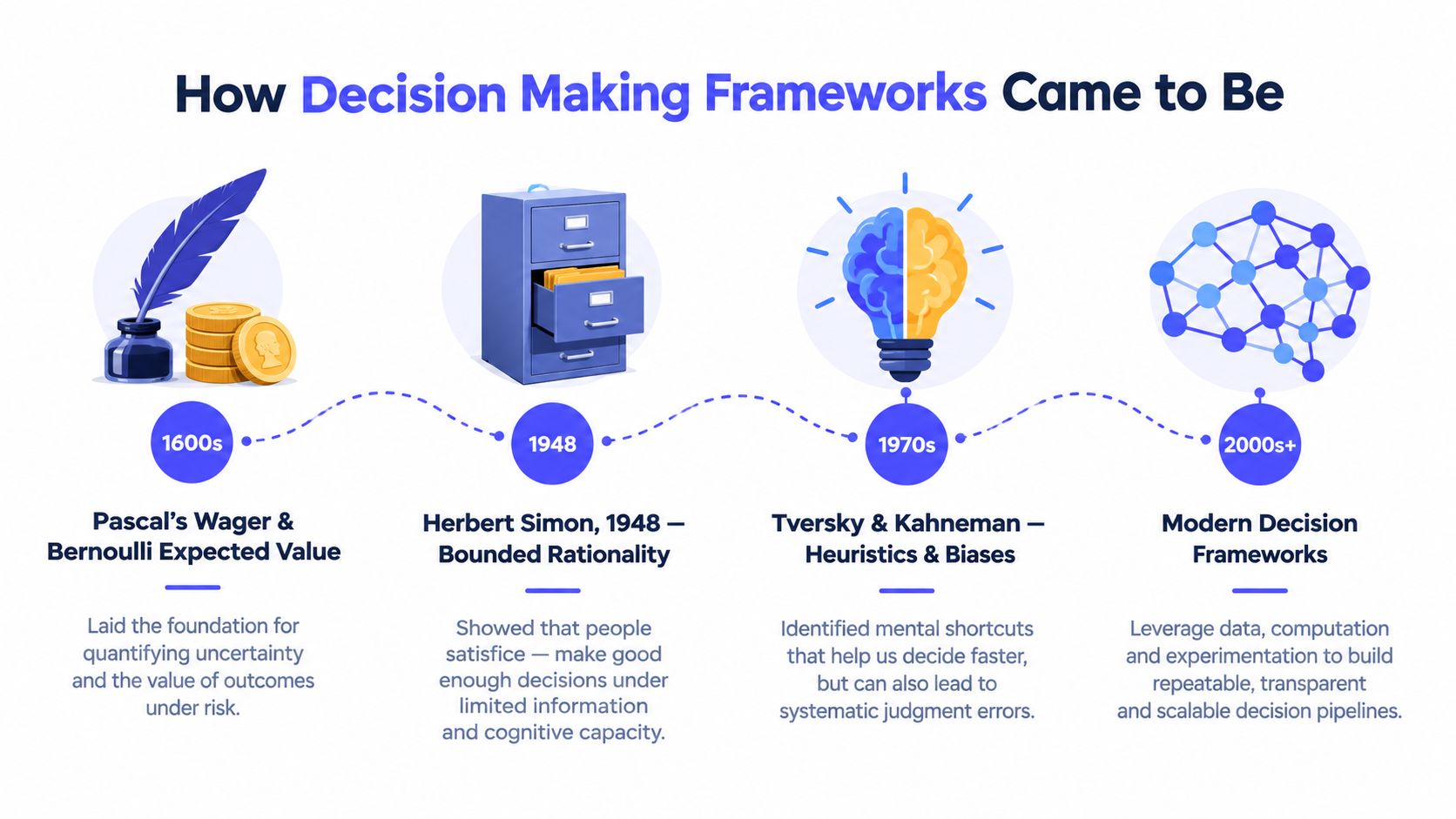
The later development of SWOT analysis in the 1960s and decision trees in 1968 brought structured comparison into more practical settings, as documented in this history of decision making research. Behavioral research then showed why people don't always follow rational models. Heuristics can make a fast decision possible, but they can also cause a creator to overvalue a familiar supplier, react to one loud backer, or assume a popular reward will remain profitable at higher volume.
Modern evidence-to-decision frameworks add explicit criteria and adaptation. The National Academies' decision framework overview describes phases that include preparation, implementation, evaluation, adaptation, and long-term outcomes. That cycle suits crowdfunding better than a one-time “launch and forget” mentality.
A modern decision making framework is a tool, not a guarantee.
For a creator facing a fulfillment deadline, good enough and documented often beats perfect and late. The historical progression from rational choice to bounded rationality explains why. You don't need complete information before choosing a reward configuration or pledge manager. You need a defensible process, a clear owner, and a review point when better evidence becomes available.
Different frameworks solve different problems. A role model clarifies who decides. A prioritization model ranks choices. A decision tree shows how later conditions change the path. Treating them as interchangeable is a common source of confusion.
| Framework | Type | Speed | Best for Solo Creator | Best for Team | Top Use Case |
|---|---|---|---|---|---|
| RACI | Role-based | Moderate | Useful for defining outside support | Strong for teams with three or more people | Assigning reward, supplier, and fulfillment responsibilities |
| DACI | Role-based | Fast once roles are clear | Helpful when one creator needs a final approver | Strong for cross-functional campaign teams | Choosing a pledge manager or launch vendor |
| RAPID | Role-based | Deliberate | Usually heavy for one person | Strong when decisions carry competing interests | High-stakes supplier or pricing decisions |
| Eisenhower | Prioritization | Very fast | Excellent for daily triage | Useful for sorting shared task queues | Separating urgent survey fixes from important strategy |
| Weighted scoring | Prioritization | Moderate | Strong default choice | Strong when people can agree on criteria | Pricing, reward design, and vendor comparison |
| Decision tree | Analytical | Moderate to slow | Useful for conditional choices | Useful when teams need visible scenarios | VAT handling, shipping zones, and late-pledge rules |
Use Eisenhower when your problem is a crowded task list. A missing address field may be urgent, while redesigning a stretch goal may be important but not immediately blocking. The model helps you protect fulfillment-critical work from attractive distractions.
Use weighted scoring when options involve competing values. For a reward tier, you might compare margin, shipping risk, production complexity, and backer appeal. The point isn't to pretend the score is objective. The point is to make your assumptions visible.
A decision tree works when one answer creates different next steps. For example, if a region requires VAT-inclusive pricing, you may choose a different checkout configuration than you would for a region where tax is collected separately. Draw the branches before you commit.
Are you deciding who owns the work?
Are you sorting tasks by urgency?
Are you comparing options across several criteria?
Does each answer create a different future path?
Solo creators should default to weighted scoring for substantial choices. Teams with three or more people benefit from RACI because responsibility becomes harder to infer as more contributors enter the workflow. The best framework is the lightest one that exposes the trade-off you might otherwise miss.
A campaign pipeline turns decision science into a habit. The sequence below follows the practical order used by data-driven decision processes: define the question, gather and process evidence, analyze options, share the result, and act, as outlined in this data decision-making framework.
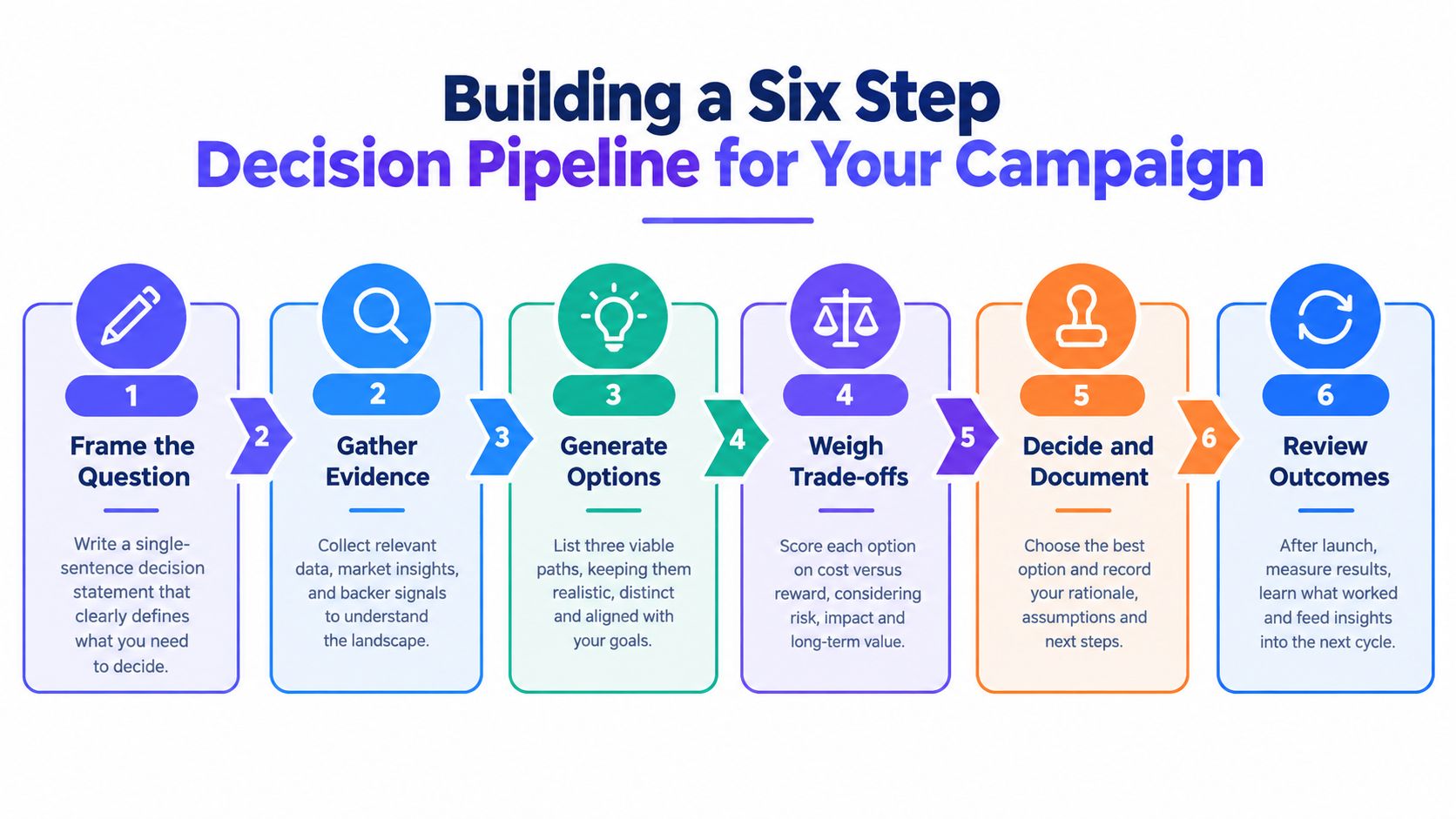
Write one sentence with a clear object and outcome: “Should we add a $79 print-and-play tier?” A useful question can also address VAT-inclusive pricing, the length of a late-pledge window, or whether to offer an upsell before surveys close. Avoid combining several decisions in one sentence.
Collect backer survey signals, competitor reward menus, production quotes, shipping-zone costs, and supplier terms. Clean the information before comparing it. A quote that excludes packaging shouldn't sit beside a landed-cost quote as if they're equivalent.
Create at least three viable paths. For the print-and-play example, options might include adding the tier, bundling it with an existing reward, or postponing it until a late-pledge phase. Three options reduce the false pressure of choosing between yes and no.
Score each option against criteria such as margin, shipping risk, fulfillment complexity, backer value, and reversibility. Give more weight to the criteria that protect the campaign's actual objective. A cost-benefit analysis for crowdfunding decisions can help you separate immediate revenue from the work and risk created later.
Record the owner, date, chosen option, rejected alternatives, and reason. Add whether the decision is reversible. A shipping-zone setup may be changed before fulfillment, while a production order may be difficult to unwind.
After rewards arrive, compare the decision with what happened. Review refund requests, address corrections, fulfillment errors, upsell performance, and supplier communication. This closes the loop for reward design, VAT handling, survey timing, supplier choice, shipping zones, and late-pledge length.
The pipeline works because each step has a different job. Framing prevents the wrong question. Evidence protects against guesswork. Options reveal flexibility. Scoring exposes trade-offs. Documentation creates accountability. Review turns one campaign into better judgment for the next.
The following video provides another practical visual explanation of the process:
A pledge manager decision can alter fulfillment long after the campaign ends. The tool determines how you collect surveys, sell add-ons, accept late pledges, handle payments, export orders, and communicate with backers. Treat it like choosing the warehouse workflow for a reward shipment. A convenient interface matters, but the actual test is whether every order reaches fulfillment with the right data.
Frame the decision narrowly: Which pledge manager provides the survey and fulfillment workflow we need at an acceptable cost, while giving us enough control over add-ons and customer data? Compare the platform-native option, a marketplace manager that charges 5% on every transaction, and PledgeBox, whose published model offers a free backer survey and charges only 3% on upsell revenue if there's any.
| Criteria | Platform-Native, e.g. Kickstarter | Marketplace Manager, 5% on all | PledgeBox, Free survey, 3% on upsells |
|---|---|---|---|
| Upfront survey cost | No additional upfront cost | Depends on provider | Free to send |
| Transaction model | Usual campaign fees apply | 5% on every transaction | 3% only when upsell revenue is generated |
| Add-on catalog | More standardized | Often configurable | Configurable for add-ons and pre-orders |
| Multi-currency display | Check platform rules | Check provider rules | Confirm the available setup for your campaign |
| Late-backer handling | Platform-dependent | Provider-dependent | Designed for post-campaign offers |
| Data and workflow control | More platform-controlled | Varies | More creator-configurable |
Compare survey control, fees, and fulfillment exports in this crowdfunding pledge manager overview before scoring the options.
Export your current backer CSV and test whether each option imports the fields your fulfillment partner needs. Check customer-support response expectations, VAT rules, address validation, shipping charges, refunds, and add-on changes. A feature belongs in your score only after you test it or confirm it in the provider's documentation.
Kickstarter's support materials explain that its pledge manager collects addresses, reward preferences, and other fulfillment details. The tool has no upfront cost and deducts usual fees from payments made through it, as described in this Kickstarter pledge manager explanation. That makes it suitable for a standardized workflow. A different choice may fit better when you need a configurable storefront, more post-campaign offers, or a direct customer relationship.
The comparison becomes clearer through an everyday shopping analogy. Kickstarter's pledge manager works like Amazon, a closed marketplace with standardized rules and a platform-owned shopping environment. PledgeBox works like Shopify, a more configurable storefront where the creator controls more of the post-campaign experience. This comparison also appears in PledgeBox's explanation of pledge books.
Decision test: Choose the platform whose constraints match your fulfillment process, not the one with the longest feature list.
A decision log might state: “We selected the native manager because our rewards are fixed, our survey needs are simple, and we do not need a broad add-on catalog. We rejected the marketplace option because its 5% charge applies to every transaction. We selected PledgeBox because the campaign required a free survey, configurable post-campaign sales, and a 3% charge only on upsell revenue if any is generated. Owner: operations lead. Review: after the first fulfillment export.”
Hex & Hatchet is a fictional two-person studio running a $180,000 Kickstarter for a dice-crafting game. The founders are close enough to every decision that disagreement feels personal, so they use the six-step pipeline to create distance between the people and the problem.
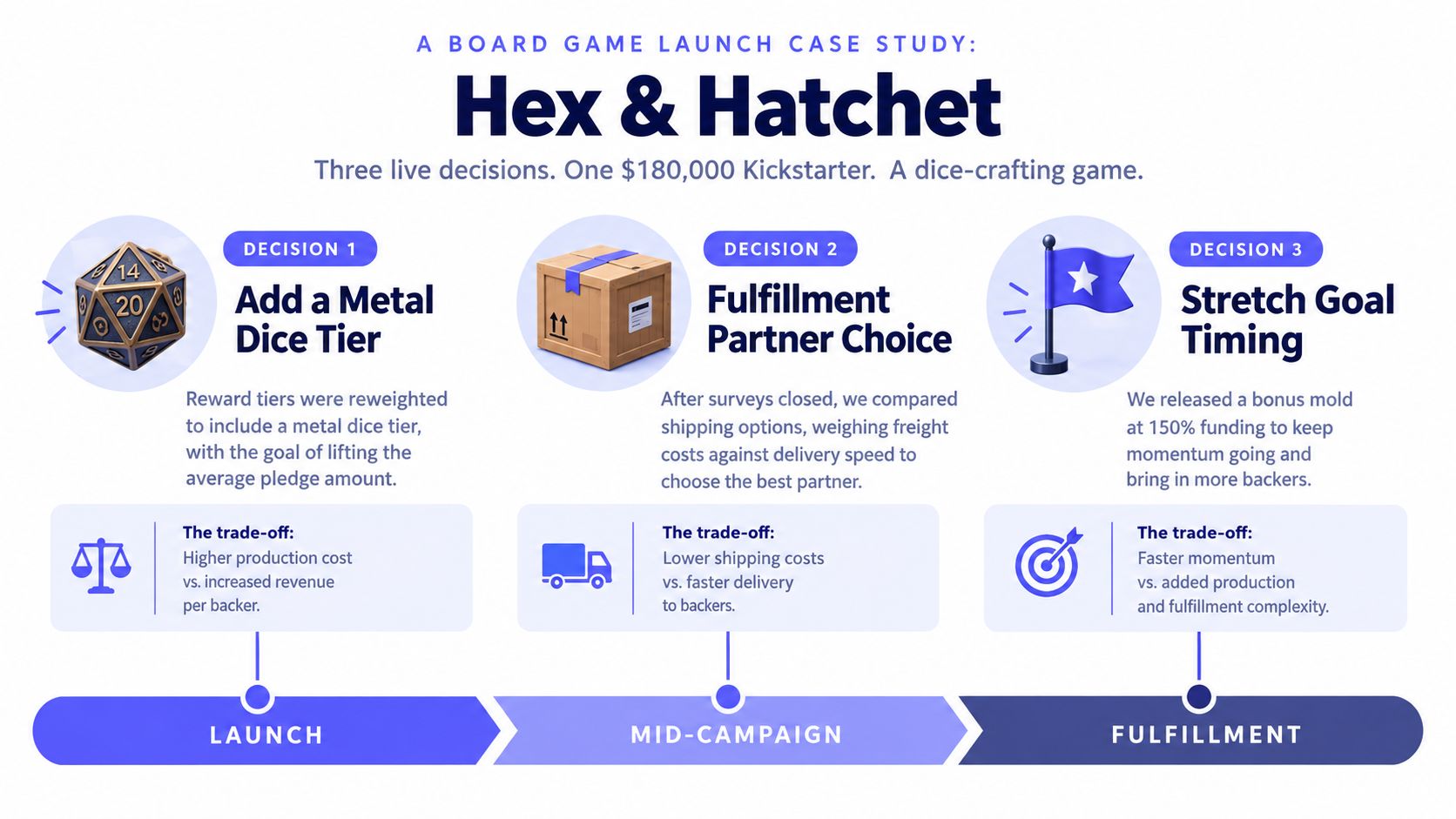
The question is whether to add a metal-dice upgrade at a $12 landed cost. They gather comments from backers, supplier quotes, packaging requirements, and the expected effect on fulfillment complexity. Their margin floor is 22%, so they score the upgrade against margin, breakage risk, packaging weight, and perceived reward value.
They compare three options: no upgrade, a metal-dice add-on, or a separate premium tier. The add-on wins because it preserves the original reward structure and lets interested backers choose the added complexity. They document the owner, decision date, assumptions, and a review point after surveys close.
Two Asian fulfillment houses offer different DDP rates and delivery schedules. Hex & Hatchet compares freight, regional coverage, communication, damage handling, and the supplier's 4.1-star rating. The cheaper quote loses after the team adds expected address problems and slower support to the risk score.
The framework catches a hidden issue when AI-assisted demand forecasting suggests a larger print run that would lower unit cost. The founders add capital lock-up to the criteria. A lower unit price isn't automatically better if it leaves the studio holding inventory and cash it can't use for freight, support, or corrections.
The studio considers a 14-day late-pledge window after delivery. It weighs additional sales against support load, inventory availability, and the risk of separating late backers from the main fulfillment run. The team chooses a limited window with a defined stock cap, then records the condition that the offer closes when remaining inventory reaches the threshold.
After delivery, the founders review actual shipping variance, support tickets, upgrade demand, and inventory left over. Their reusable decision log contains the question, options, criteria, selected path, owner, date, assumptions, and review result. The fictional numbers above illustrate how a framework can make trade-offs visible. They aren't evidence of a real campaign outcome.
Post-campaign mistakes tend to repeat because creators rush from funding success into execution. A one-page aid creates a pause long enough to catch the expensive omissions.
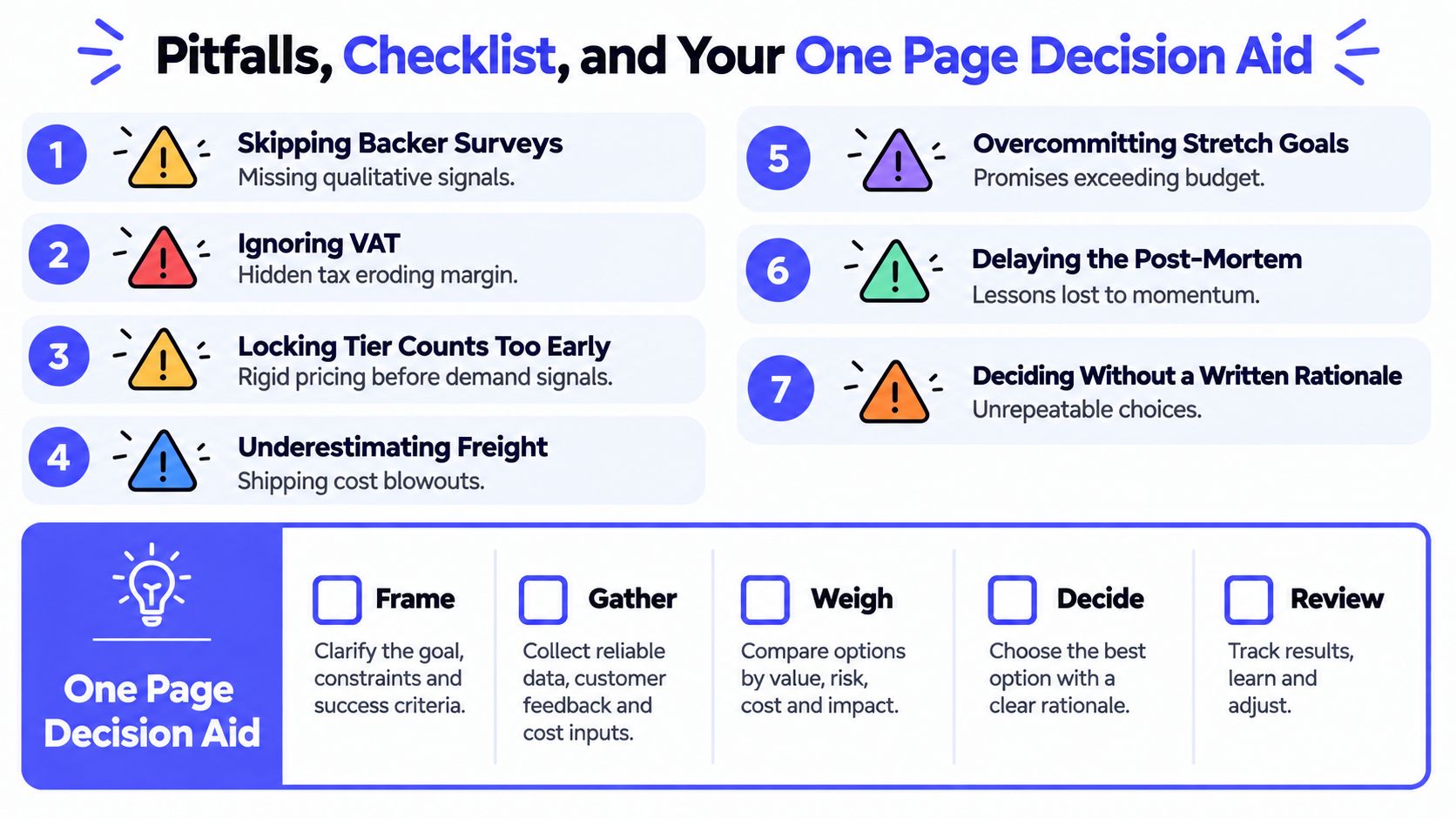
Use the complete crowdfunding success checklist as a companion, then mark these items yes or no:
Choose the framework by asking three questions: How many people are involved? How reversible is the decision? How much time do you have? Use RAPID when several stakeholders need explicit roles, weighted scoring when one person compares trade-offs, and a decision tree when the answer creates materially different next steps.
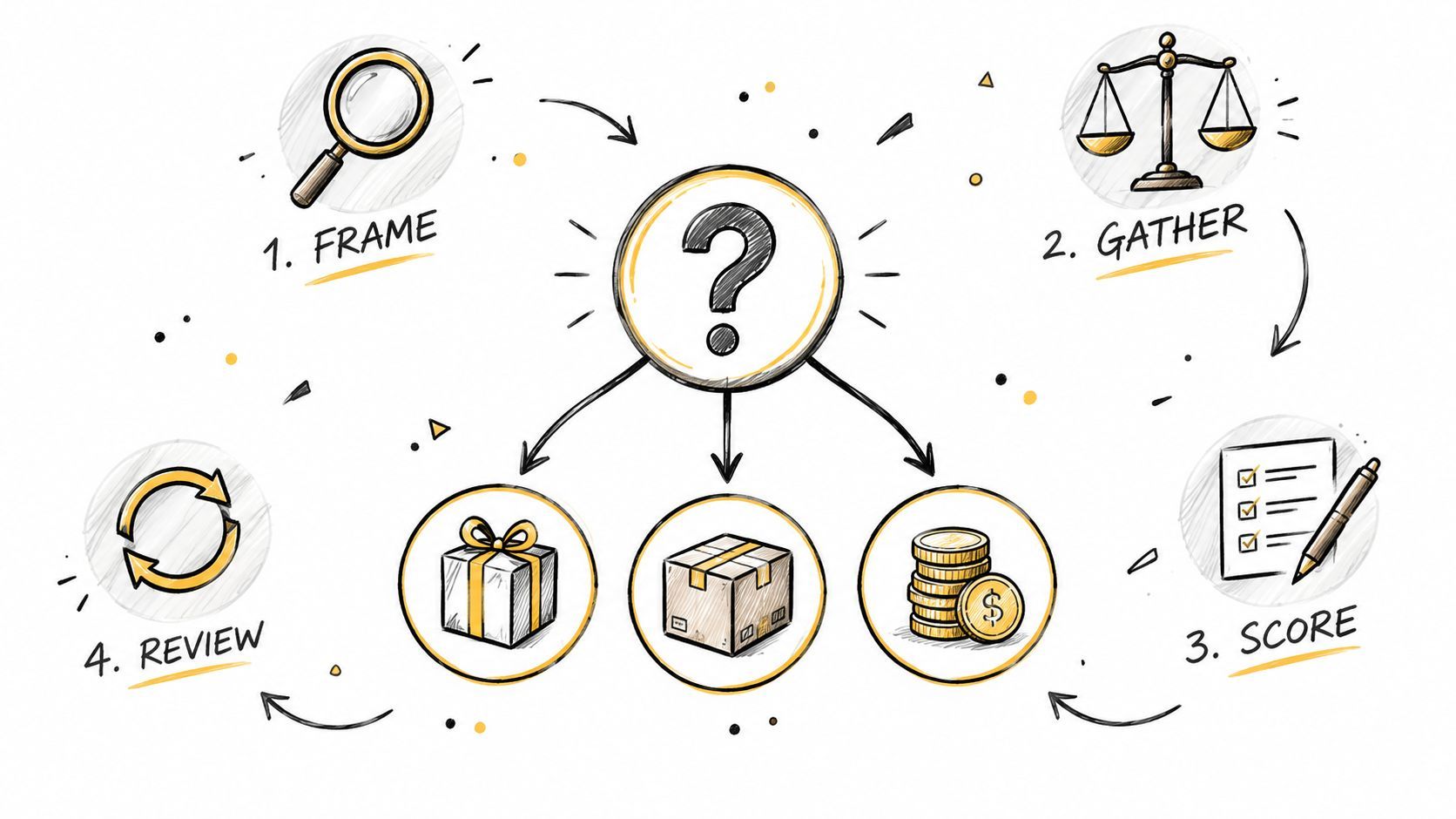
Tape the one-page aid above your desk. It should say: Frame, Gather, Weigh, Decide, Review. That sequence won't remove risk, but it will make hidden assumptions easier to challenge before they become fulfillment costs.
PledgeBox offers a free-to-send backer survey and charges only 3% of upsell revenue if there's any, making it a practical option to evaluate when your framework prioritizes configurable surveys, add-ons, and post-campaign offers. Visit PledgeBox to review the pledge manager workflow and decide whether it fits your reward and fulfillment plan.
PledgeBox
The All-in-One Toolkit to Launch, Manage & Scale Your Kickstarter / Indiegogo Campaign