 PledgeBox
Data Privacy Best Practices for Crowdfunding Creators
Learn data privacy best practices for crowdfunding creators — from consent and minimization to GDPR, storage, and secure erasure workflows.
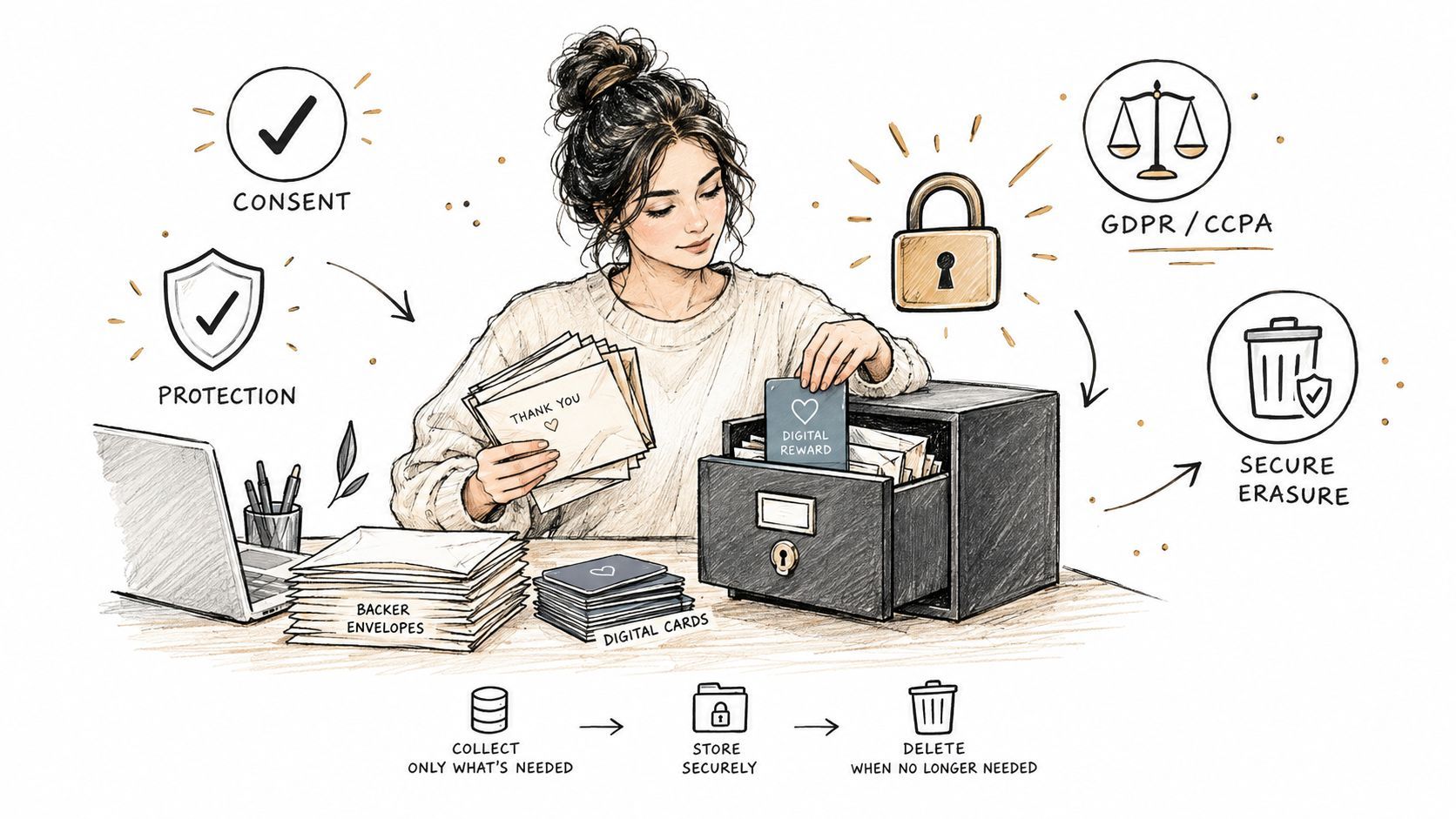
Learn data privacy best practices for crowdfunding creators — from consent and minimization to GDPR, storage, and secure erasure workflows.
Your campaign has funded, the celebration is over, and now the fulfillment spreadsheet is growing faster than expected. Backer names, email addresses, delivery details, tax information, survey answers, and order changes are arriving from several places. A privacy mistake at this stage can expose people who trusted you with the information needed to receive a reward.
For crowdfunding creators, data privacy best practices aren't limited to legal notices or technical settings. They shape how you design surveys, choose a pledge manager, share files with vendors, handle late pledges, and decide what gets deleted after delivery. The right approach protects backers while making your own operations easier to manage.
The post-campaign period creates a different kind of responsibility. During the campaign, your main goal is to build attention and collect pledges. After funding, you need accurate information to send the right reward to the right person, often while coordinating manufacturers, fulfillment partners, shipping services, tax handling, and customer support.
That creates a practical temptation: keep everything in one large spreadsheet, export it to every supplier, and save old copies “just in case.” Each additional copy increases the number of places where information can be misplaced, forwarded, downloaded, or accessed by someone who no longer needs it. A backer's address might be necessary for delivery, but it isn't automatically necessary for marketing, product analytics, or future launches.
Trust is part of the product you deliver. A useful resource on the connection between privacy concerns and customer trust is IT Cloud Global's discussion of how privacy concerns affect customer relationships. For a creator, the lesson is straightforward: a backer may forgive a delayed reward more easily than careless handling of personal information.
A breach can expose addresses and contact details. An accidental email can reveal the identities of backers who expected privacy. A vendor export can remain in an unattended folder long after fulfillment ends. An over-permissioned team account can allow someone to download more information than their role requires.
These problems also damage your ability to communicate. Backers may question future surveys, unsubscribe from legitimate updates, or avoid another campaign. You then spend time explaining what happened instead of coordinating production and delivery.
Privacy-first fulfillment means each piece of information has a clear job. You collect only what the reward requires, show it only to the people who need it, transmit it through controlled tools, and remove it when the operational purpose ends.
That mindset leads to practical decisions:
The rest of the process becomes easier when privacy starts at the moment data enters your workflow.
Think of backer information as a set of documents in a locked filing cabinet. Encryption protects the cabinet while information travels across a network and while it sits in storage. That protection matters, but the cabinet still needs rules about who receives a key.
NIST and Microsoft both emphasize pairing encryption with strict, identity-based access controls because encryption doesn't stop an authorized but overprivileged user from accessing and exporting plaintext after decryption. Microsoft's security benchmark also recommends controlling cryptographic keys with managed identities and just-in-time administrative access, which narrows the window for key theft and limits lateral movement after an administrator account is compromised. See the Microsoft Cloud Security Benchmark guidance on data protection for the technical foundation.
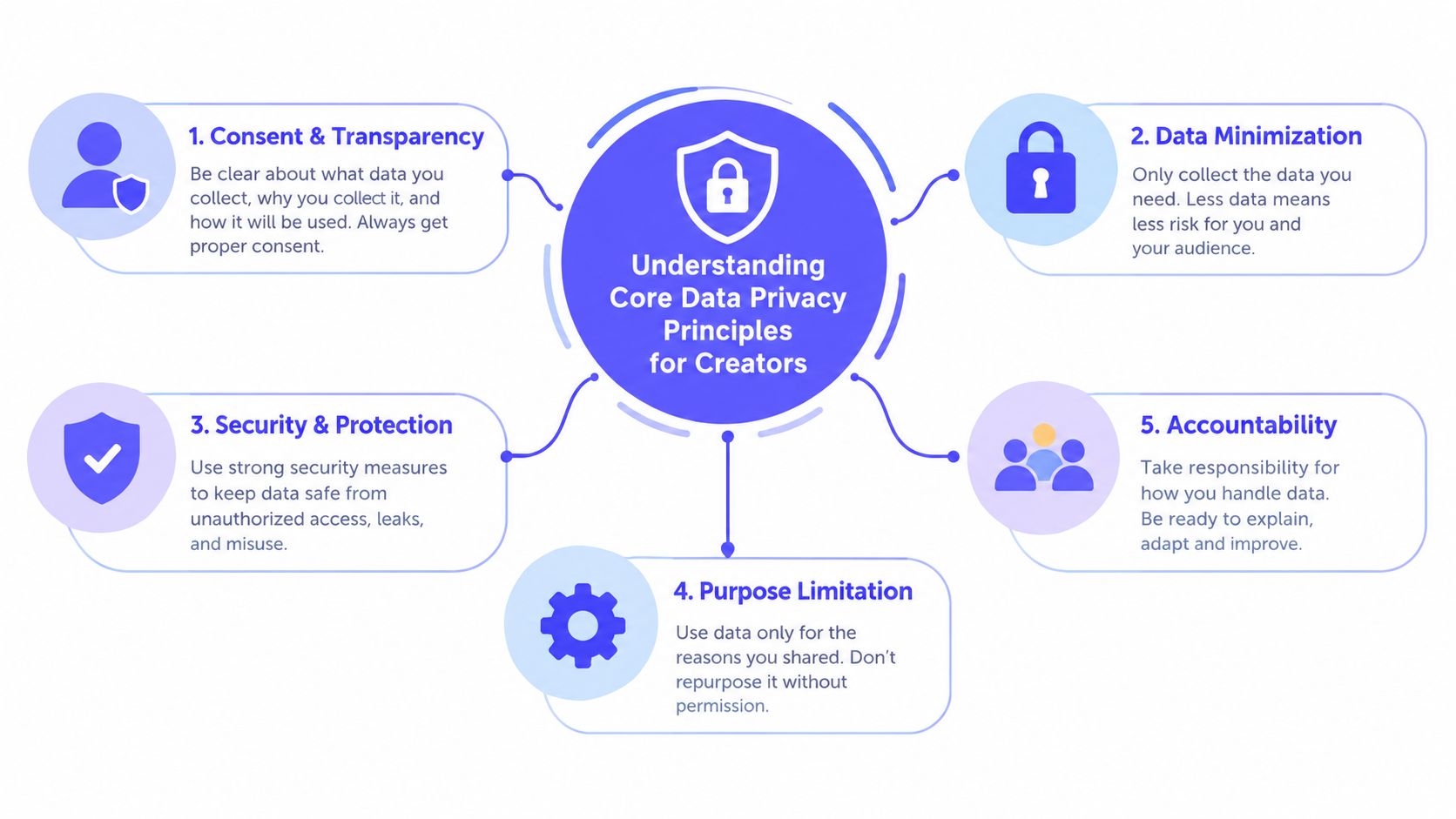
Data minimization and selective disclosure work together. NIST describes minimization as a way to reduce privacy risk at the source, because every additional retained field can increase breach impact, retention obligations, and the possibility of downstream misuse. Its privacy framework also highlights granular administration of personally identifiable information, including deletion and selective disclosure, as a core capability.
A practical analogy helps. If a warehouse worker needs a destination label, give them the destination label. Don't give them the customer's marketing history, survey comments, or unrelated order records. Encryption protects the label during transfer, while access controls and selective disclosure determine who can see it in the first place.
For a creator, privacy isn't a single switch in a dashboard. It's a chain of choices about collection, access, sharing, retention, and deletion.
Watch the embedded walkthrough for another explanation of how these principles fit together.
The safest backer field is often the field you never collect. Before adding a question to a survey, name the operational task it supports. If you can't explain the task in plain language, remove the question or make it optional.
A reward shipment may need a recipient name, delivery address, country, and contact details for carrier issues. It may need a size or color selection. It usually doesn't need a birth date, unrelated demographic profile, personal interests, or a copy of an identity document unless a clearly defined legal or operational requirement makes that information necessary.
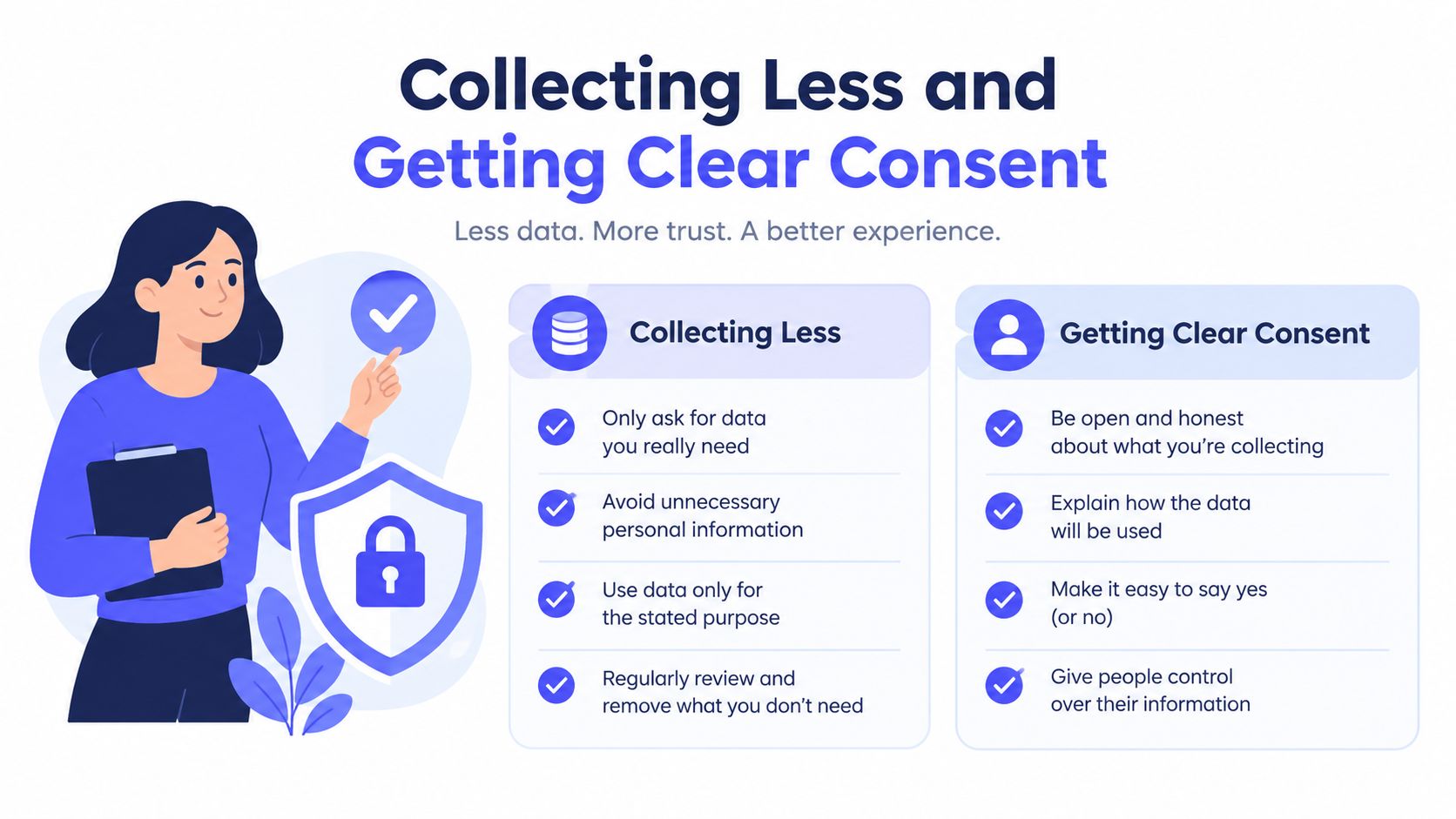
Ask four questions before publishing a survey:
Consent should match the purpose. Don't combine shipping permission, marketing permission, and third-party sharing into one vague checkbox. A backer should be able to understand that their address will be used for delivery, that tax information may support tax handling, and that promotional email is a separate choice.
Practical rule: A consent box should answer what you collect, why you collect it, who receives it, and how the backer can change their mind.
Use plain labels such as “Delivery address for this reward” rather than “Personal information processing.” Explain whether a fulfillment partner receives the address. If you plan to use an email address for a future launch, request marketing consent separately and provide a simple withdrawal method.
The same discipline applies to add-ons. An upsell can create a legitimate reason to collect an extra product choice or quantity, but it doesn't justify gathering unrelated information. Keep the add-on record connected to the order, not to a broad profile that follows the backer indefinitely.
NIST's privacy guidance supports this prevention-first approach. Collecting only what you need and destroying it when it is no longer needed lowers exposure before a breach or access mistake occurs. It also reduces the burden on your team, because there are fewer fields to explain, secure, verify, export, and delete.
Once a backer submits a survey, your responsibility shifts from asking the right questions to protecting the answers. Start by mapping where the information goes. A typical workflow may include the pledge platform, a survey or pledge manager, a payment processor, a shipping tool, a tax workflow, a manufacturer, and a support inbox.
Each handoff deserves a reason. If a vendor needs a shipping address, provide the shipping address through a controlled export or integration. Avoid sending a full campaign database when a narrower file will do.
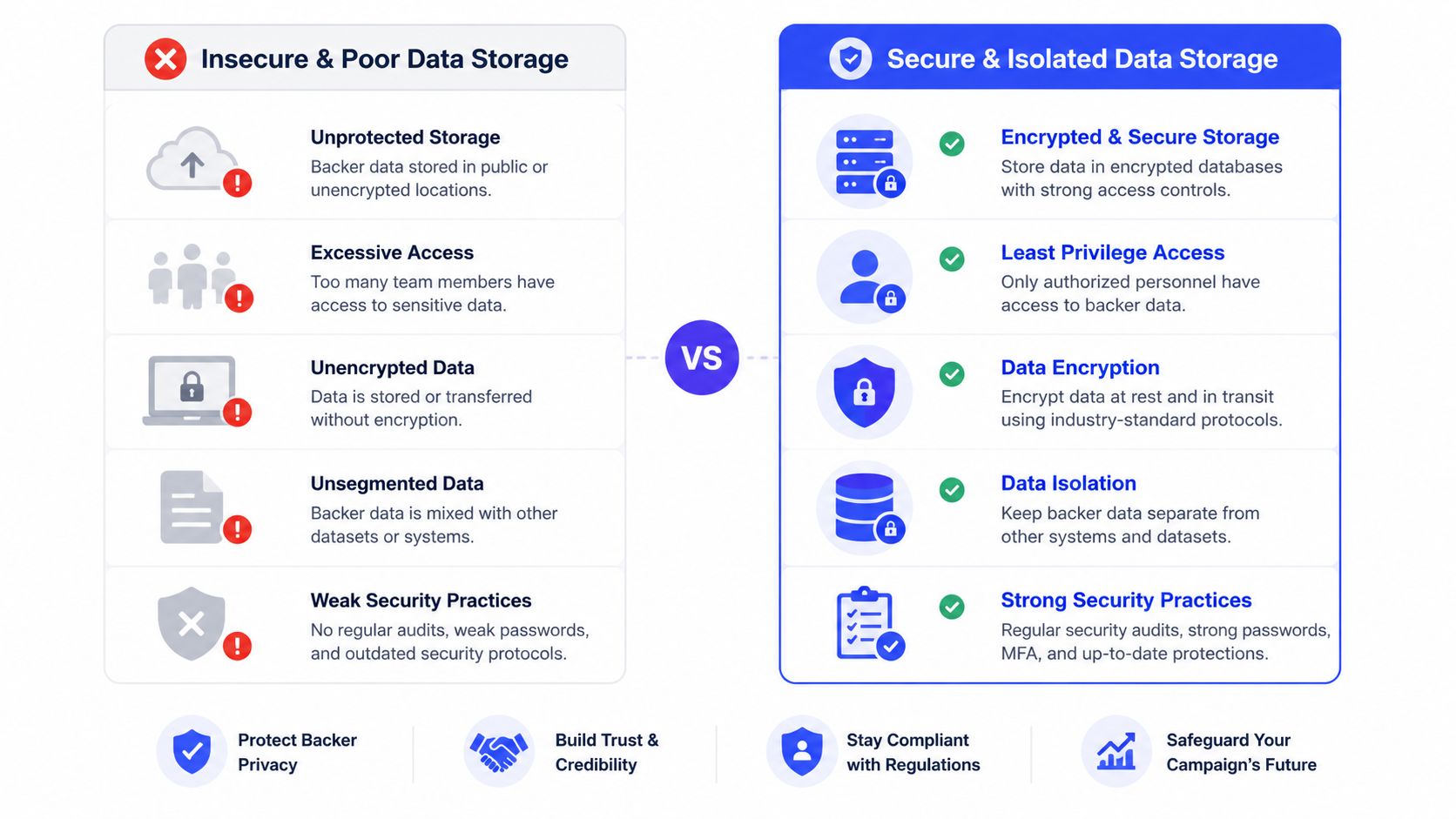
Encrypt sensitive data in transit and at rest. That reduces exposure to interception while information moves and to storage compromise when it sits in a database or file store. Encryption alone isn't sufficient, because a person with legitimate access may still export decrypted information.
Use identity-based permissions instead. Your fulfillment coordinator may need address and order details, while a marketing collaborator may need only consented email segments. Review administrator access, remove accounts when contractors finish, and avoid shared logins that make accountability impossible.
Key management deserves the same care. Microsoft recommends managed identities and just-in-time administrative access for cryptographic keys, which can reduce the period in which an attacker can exploit a privileged account. For a small team, the practical equivalent is to limit who can administer the platform and to grant increased access only when the task requires it.
The marketplace versus storefront distinction clarifies an important choice. A centralized marketplace can provide convenience through a shared ecosystem, while a more customizable storefront model can give a creator greater control over the customer experience and campaign data.
A neutral industry comparison from PledgeBox summarizes the positioning this way: Kickstarter's Pledge Manager is like Amazon, while PledgeBox's pledge manager is like Shopify, reflecting the difference between a centralized marketplace-style ecosystem and a more customizable creator-owned storefront model. The analogy isn't a security verdict. It helps you ask who controls the workflow, how campaigns are separated, what vendor access exists, and how easily you can remove one project's data.
Review a provider's documentation for:
For a practical checklist, consult PledgeBox's data security best practices.
Creators often treat privacy law as a problem for large companies. That approach fails as soon as a campaign serves people in different regions and sends their information to outside service providers. You need a clear record of what you collect, why you process it, where it travels, and how a backer can exercise their rights.
GDPR and CCPA aren't identical. GDPR generally requires you to identify a lawful basis for processing personal data and provide transparent information to people in the European Economic Area. CCPA focuses on California residents' rights to know about collected information, request deletion, and opt out of the sale of personal information where applicable.
| Requirement | GDPR | CCPA |
|---|---|---|
| Transparency | Explain processing purposes, legal basis, recipients, retention, and rights. | Explain categories of personal information collected, purposes, and relevant disclosures. |
| Access | Provide access to personal data and information about its processing. | Provide information about collected personal information and its use or disclosure. |
| Deletion | Support erasure requests, subject to applicable exceptions. | Support deletion requests, subject to applicable exceptions. |
| Marketing choices | Use an appropriate lawful basis and honor withdrawal where consent is used. | Provide applicable opt-out choices and honor them. |
| International transfers | Assess transfer mechanisms and associated risks. | Review disclosures, service-provider arrangements, and applicable transfer obligations. |
A creator may act as the party deciding why and how backer information is processed, even when a platform stores or transmits it. That makes vendor contracts and privacy notices important. Your notice should identify the campaign fulfillment purpose, explain service-provider sharing, and distinguish necessary operational messages from optional marketing.
The global environment is also changing. Current guidance increasingly addresses AI governance, access to non-personal data under the EU Data Act, fair terms in business-to-business data contracts, cloud switching, and international transfer risk. Consumer expectations are strained as well. A 2025 survey reports that 42% of global consumers say they always or often read cookie banners, 77% don't fully understand how their data is collected and used, and 59% are uncomfortable with their data being used to train AI. These figures appear in Chambers' 2026 data protection and privacy practice guide.
For a creator-friendly overview, taap.bio's guide to data protection for creators can help you organize the basics. You can also use this GDPR requirements checklist for crowdfunding workflows as a practical review aid. Platform fees don't replace these duties. Whether a service charges upfront or only after revenue, you still need to understand how it handles personal data.
Deletion becomes difficult when nobody decides what should be retained and why. A backer may change an address, request a replacement, ask about tax, or join a late-pledge window. Those operational needs don't mean you should keep every historical copy forever.
Create a retention map before fulfillment begins. Separate records by purpose rather than treating the whole campaign database as one object.
A deletion request needs identity verification, especially when a shared email address or household account is involved. Confirm what the person wants removed, identify records connected to the request, document any information you must retain, and explain the result in clear language.
The main pledge manager isn't the only place to check. Look at downloaded CSV files, vendor portals, cloud drives, email attachments, customer support tools, local machines, and duplicate spreadsheets. Ask suppliers to confirm deletion or return of data when their work is complete, according to your agreement and applicable obligations.
Automated reminders can make this routine manageable. Set review points for survey closure, shipment completion, and the end of support operations. A one-click erasure feature can reduce manual errors, but it doesn't remove the need to understand connected systems and vendor copies.
If something goes wrong, use a written data breach response plan for crowdfunding teams. It should identify who investigates, who preserves evidence, who contacts vendors, who communicates with backers, and who evaluates notification duties.
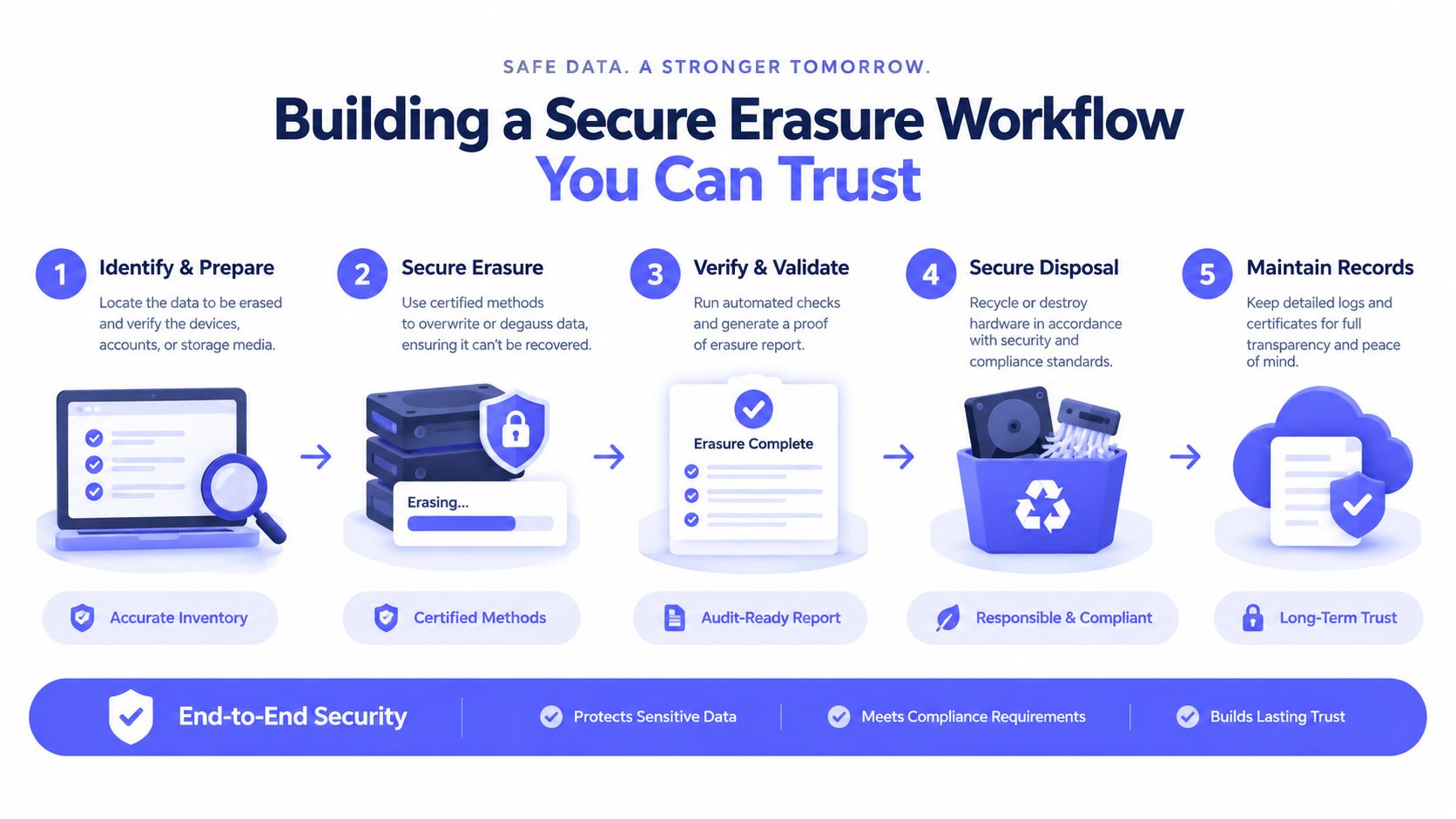
Privacy works best as a routine, not a document you read once before publishing a campaign. Add a short review to your launch checklist, then repeat it when surveys open, fulfillment starts, vendors change, and support winds down.
Start with the simplest controls your team will use:
A privacy routine should also account for revenue. Add-on sales and late pledges can increase the amount of information you process, so every new offer should pass the same minimization and consent tests as the original reward. More options don't require a larger permanent profile.
For creators comparing post-campaign tools, PledgeBox is free to send the backer survey and only charges 3% of upsell revenue if there's any, according to its cost recovery strategies explanation. That model is presented as having no upfront cost and applying only when extra funds come through survey add-ons. Its campaign workflow includes branded surveys, shipping and tax collection, add-on handling, vendor exports, privacy-focused data isolation, and one-click erasure, so you can evaluate those controls alongside pricing.
A clear privacy message can strengthen the fulfillment experience. Tell backers what you need, explain how you protect it, and provide a direct route for corrections or deletion requests. People don't expect perfection, but they do expect you to handle their information deliberately.
If you want a crowdfunding workflow that combines backer surveys, fulfillment data handling, add-ons, and privacy-focused controls, visit PledgeBox. Use it to design a more contained post-campaign process, limit unnecessary data sharing, and give your team a clearer path from survey collection through secure erasure.
PledgeBox
The All-in-One Toolkit to Launch, Manage & Scale Your Kickstarter / Indiegogo Campaign