 PledgeBox
Cross Sell Opportunities for Crowdfunding Creators
Unlock cross sell opportunities for crowdfunding creators with practical tactics, timing, pricing, and pledge manager workflows built for higher ROI.
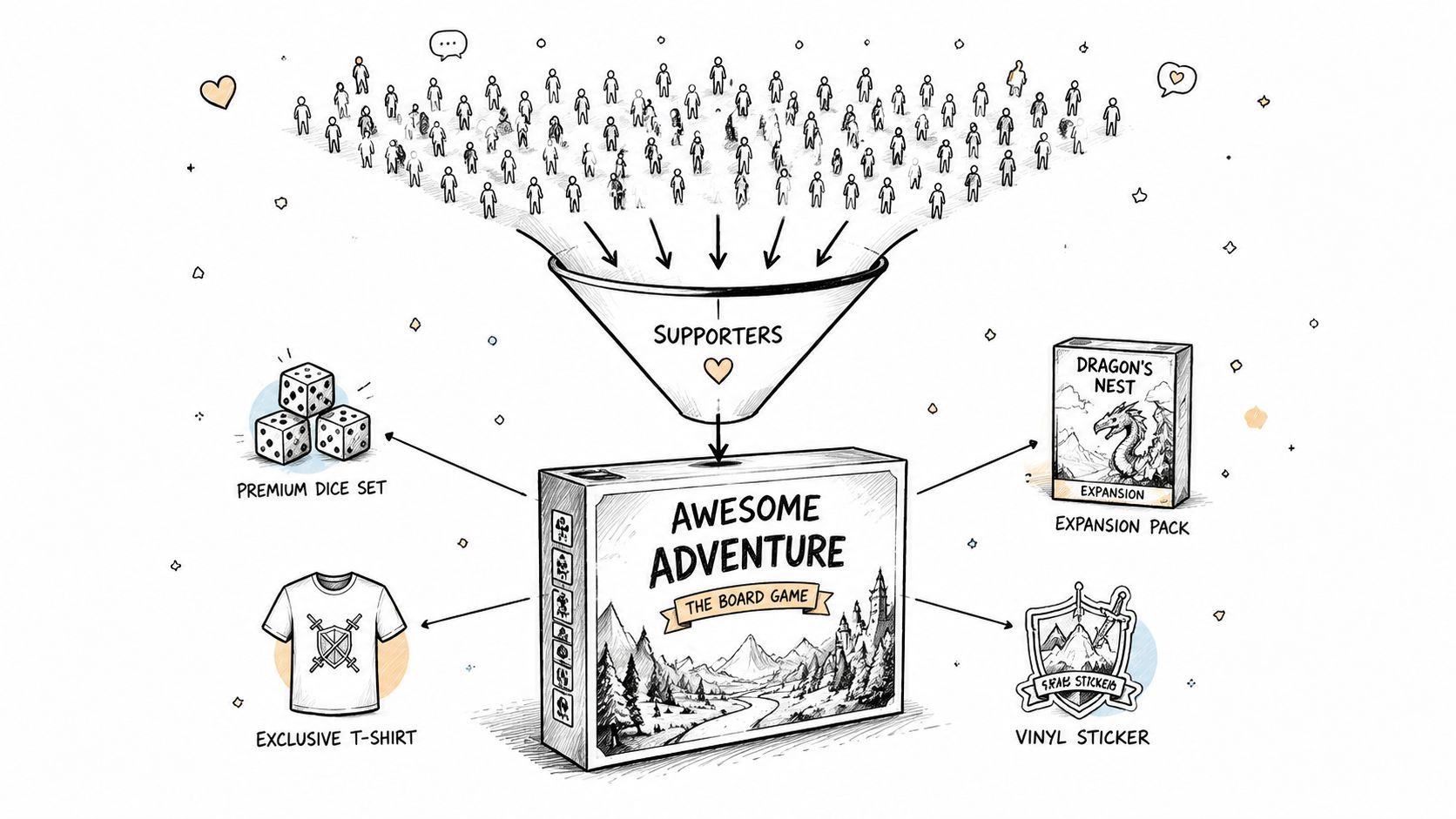
Unlock cross sell opportunities for crowdfunding creators with practical tactics, timing, pricing, and pledge manager workflows built for higher ROI.
A board game creator watches her funding goal clear while 1,200 backers are still on the campaign page. The celebration lasts about five minutes. Then the operational questions arrive: How many people would add the card pack? Should the deluxe upgrade appear now or in the survey? Can an accessory ship in the same carton without creating a fulfillment problem?
That moment captures the value of cross sell opportunities in crowdfunding. You aren't trying to persuade a stranger to buy something unrelated. You're presenting a relevant additional product to someone who has already shown interest in the main reward. Done well, the offer increases backer value. Done carelessly, it creates margin pressure, confusing choices, and fulfillment work that wasn't in the original plan.
The timing matters more than most creators expect. Pre-launch, the useful offer may be a founder bundle. During the campaign, it may be an upgrade or a time-boxed add-on. In the pledge manager, the survey can become the strongest conversion moment. After the campaign, a focused store can serve backers who missed the original window. Teams that want to strengthen the audience pipeline before making those offers can also review grow organic reach strategies from Kraken Socials.
Cross-selling means offering a related product that improves or completes the buyer's original purchase. For a tabletop campaign, that could be an extra faction pack, metal coins, sleeves, upgraded miniatures, a storage insert, or a second copy for game nights. The core pledge remains the main purchase. The cross-sell answers the next practical question, “What else will help me get more from this?”
A creator usually notices the opportunity in a simple sequence. A backer chooses the standard edition, studies the reward tiers, and confirms the pledge. The creator then offers one relevant addition, with a clear price, a clear benefit, and no ambiguity about whether it changes the original reward. That distinction matters because cross-selling complements the purchase, while an upgrade replaces it with a higher-value version.
Crowdfunding gives you several moments to make that recommendation:
These windows shouldn't compete. A subscriber who sees a founder bundle before launch can later receive a compatible accessory in the pledge manager. A backer who declines an upgrade during the campaign can still receive a lower-pressure recommendation during survey completion.
The revenue case is meaningful. Independent ecommerce reporting places effective cross-selling at 10% to 30% of total ecommerce revenue, while a 2026 summary citing Salesforce data from 150 million shopping sessions says recommendation-click visits represented 7% of traffic but generated 26% of revenue. The same reporting found recommendation-engaged visits had a 10.3% higher average order value overall, rising to 15.2% on tablets. These figures come from ecommerce, not a promise for crowdfunding, but they illustrate why a small share of highly engaged sessions can matter disproportionately. The ecommerce recommendation and cross-sell reporting provides the underlying context.
Crowdfunding adds complications that ordinary ecommerce doesn't always carry. Every extra SKU can affect packing, customs documentation, carton dimensions, inventory counts, and customer support. A bundle that looks attractive in a campaign update may become expensive if it requires a separate pick-and-pack path.
Operational rule: Never approve an add-on because it sounds exciting. Approve it only after you know its margin, inventory source, packaging path, and delivery promise.
The difference between a weak attach rate and a strong one usually comes from relevance and timing, not from adding more products. A creator with three compatible offers and clean fulfillment often outperforms a creator with a crowded catalog.
A coffee shop makes the principle easy to see. A barista who remembers your usual order and suggests a pastry is speaking to someone who is already present, paying attention, and trusting the recommendation. A billboard on a highway has reach, but the driver may not be interested, may not remember the message, and can't act on it immediately.

A crowdfunding backer who has just pledged resembles the coffee-shop customer more than the highway audience. The backer has selected a project, reviewed the reward, accepted the central proposition, and completed a meaningful action. Their interest is fresh, and the recommendation can be tied directly to the product they chose.
The period immediately after pledge confirmation creates post-purchase intent. The buyer is no longer deciding whether your campaign deserves attention. They've already answered that question. Their next decision concerns completeness, convenience, personalization, or enjoyment.
For a board game, the standard reward may create obvious follow-on needs. A player may want an expansion to increase replayability, sleeves to protect cards, or an insert to make setup easier. The best offer doesn't ask the backer to rethink the purchase. It makes the existing purchase feel more useful.
Creators often make a costly mistake. They treat the cross-sell as a general advertisement and show unrelated products, multiple upgrade paths, and vague benefits. That interrupts the emotional momentum of the pledge and forces the customer to do product research at the wrong time.
The commercial logic is stronger than adding another item to an order. Historical industry summaries report that effective cross-selling can increase revenue by about 20% and profitability by about 30%, and some firms have attributed as much as 35% of total revenue to cross-sell and upsell activity. Those figures describe broader business environments, so creators should use them as strategic context rather than campaign forecasts. The figures and their historical framing are summarized in this cross-sell statistics guide.
Crowdfunding teams also benefit from the economics of an existing relationship. A widely cited scaling benchmark says acquiring a new customer can cost about five times more than retaining one, which helps explain why an already-converted backer can be more efficient to serve than a new prospect. The offer still needs to carry its own fulfillment and payment costs, but the creator isn't starting with cold traffic.
A useful cross-sell doesn't feel like a second sale. It feels like the missing piece of the first one.
The operating implication is straightforward. Plan one connected recommendation system across the campaign page, pledge confirmation, backer survey, and post-campaign store. Each touchpoint should use the buyer's previous choice rather than forcing the same generic pitch on everyone.
Treat the lifecycle as a sequence of decisions, not four unrelated promotions. The running example below is a board game with a core box, a card pack, upgraded components, and an expansion.

Before the campaign opens, your audience is deciding whether to remember you. Give subscribers and Discord members a specific reason to stay engaged, such as a founder bundle, an early accessory reservation, or a premium component pack available with the main pledge.
The offer should be easy to explain in an email and easy to model operationally. If you haven't locked the supplier, unit cost, artwork, and packaging route, don't promote the product as confirmed. A waitlist can capture interest, but it shouldn't create a promise you can't fulfill.
During the campaign, use offers that reinforce the momentum of the project. A stretch-goal-aligned card pack can give backers a reason to increase their pledge. A pledge-level upgrade can work when the difference between editions is visually obvious and the benefits are easy to compare.
Time-boxing can help, but urgency must reflect a real campaign condition. A deadline tied to campaign close is credible. An invented countdown or artificial inventory warning can damage trust, especially when backers discuss the offer publicly.
The survey is where you can present tiered bundles, late pledges, accessory choices, and shipping upgrades after the campaign's main decision has already been made. Backers are already providing addresses and reward details, so a relevant add-on can fit naturally into the same task.
Keep the sequence controlled. Show the recommended accessory first, explain why it fits the selected reward, then offer a clear accept or decline choice. Address-locked shipping upgrades need especially careful wording, because a promise about delivery speed or destination service can create support obligations later.
PledgeBox states that sending the backer survey is free and charges only a 3% fee on upsell revenue if there is any. If no upsells are sold, the survey workflow is free. That pricing makes the survey a practical place to test incremental offers without treating survey delivery itself as a paid event. See the PledgeBox pricing details for the stated fee terms.
After the survey closes, a focused Shopify or PledgeBox-powered store can handle spare inventory, expansions, replacement accessories, and late purchases. The audience is smaller than a public acquisition audience, but the message can be more specific because you know the person's campaign relationship.
Don't let the store become a warehouse clearance page. Organize products around backer needs, such as “complete your collection” or “prepare your copy for regular play.” Post-campaign offers should respect the original fulfillment schedule and clearly separate in-stock products from items tied to future production.
Cross-sell pricing has three jobs. It must protect margin, make the add-on feel proportionate to the core pledge, and give the backer a clear reason to act now rather than later. A discount can help, but discounting every offer trains customers to wait and can make the original price look arbitrary.
Start with the landed cost, not the desired headline. Include manufacturing, packaging, payment fees, pick-and-pack work, replacement risk, and any additional shipping exposure. Then decide whether the offer should be a standalone add-on, a bundle component, or an upgrade path.
“Complete the Set” works when the buyer already owns the core item and the add-on closes an obvious gap. “Maker's Edition” suits upgraded components or behind-the-scenes material. “Buy Two Save” can work for a second copy, but only when the use case is clear, such as gifting or a larger play group.
Avoid naming an offer “Upsell.” Backers care about the result, not your internal revenue category. The copy should explain the benefit in one sentence:
A broader ecommerce product bundling playbook can help creators think through bundle architecture without copying retail tactics that don't fit crowdfunding fulfillment.
Scarcity cues can support a decision when they reflect real constraints. “50 of 200 reserved” is useful only if those quantities are accurate and the reservation process is real. A backer count can provide social proof when it describes a verified campaign milestone, but it shouldn't imply that every backer chose the add-on.
The line between urgency and pressure is operational honesty. A survey deadline, production cutoff, or confirmed inventory limit gives the customer useful information. A fake low-stock message adds anxiety without adding value.
The table below gives practical starting patterns. The discount column is intentionally qualitative because the right amount depends on your costs and fulfillment model.
| Bundle Pattern | Typical Discount vs MSRP | Messaging Trigger | Best Campaign Phase |
|---|---|---|---|
| Complete the Set | Modest bundle saving | “Add the missing card pack to complete your collection.” | Pledge manager |
| Maker's Edition | Value through premium components | “Upgrade the pieces you'll handle every session.” | Live campaign |
| Buy Two Save | Clear multi-copy saving | “Keep one, gift one, or bring a second copy to the table.” | Pre-launch or live campaign |
| Accessory Pairing | Small convenience saving | “Protect and organize the game from day one.” | Pledge manager or post-campaign |
For more detailed pricing decisions, use the bundle pricing strategy guide as a reference point, then validate each offer against your own bill of materials.
A useful benchmark is that average individual cross-sell conversion is often reported at 3% to 8%, personalized cross-sells at 8% to 12%, and “frequently bought together” modules at 10% to 15%. Cross-sell average order value is commonly reported as 15% to 30% higher, so attachment and basket expansion need to be evaluated together. These ecommerce benchmarks are summarized by EcomCalcTools' cross-sell analysis, and they shouldn't be treated as guaranteed crowdfunding results.
The simplest analogy is Amazon versus Shopify. Kickstarter's pledge manager is like Amazon, a marketplace environment where the platform controls much of the customer and transaction experience. PledgeBox's pledge manager is like Shopify, a merchant-oriented system where the creator gets more control over the storefront, offer presentation, and operational data.
The fee distinction matters. Kickstarter says its pledge manager has no upfront cost, but it deducts a 5% platform fee from payments made inside the pledge manager, excluding taxes, plus a variable Stripe processing fee of roughly 3% to 5% on the full payment. The platform documents those terms in its pledge manager fee guidance.
PledgeBox is free to send the backer survey and charges only 3% of upsell revenue if there's any. If no upsells are sold, the survey workflow is free. That means the economic comparison depends on what you're collecting inside the manager, whether the transaction includes the original pledge, and how much control you need over add-ons.
Consider a campaign with $100,000 in campaign funds and $25,000 in cross-sells. The $25,000 is the relevant cross-sell pool for comparing incremental revenue fees, but the final result depends on payment routing and the exact transactions collected.
Under PledgeBox's stated model, a 3% fee on $25,000 in upsell revenue would be $750. The survey itself carries no charge when no upsells are sold. Under Kickstarter's documented stack, the platform fee on $25,000 would be $1,250, before applying the variable Stripe processing fee. The processing charge could vary because Kickstarter describes it as roughly 3% to 5% on the full payment, and creators should model the actual transaction flow rather than assume the same base.
| Factor | Kickstarter Pledge Manager | PledgeBox |
|---|---|---|
| Survey or manager access | No upfront cost | Free to send the backer survey |
| Upsell fee | Kickstarter's usual fees apply to payments in the manager | 3% of upsell revenue if there are upsells |
| Platform fee stated in the source | 5%, excluding taxes | 3% on upsell revenue |
| Payment processing | Variable Stripe fee, roughly 3% to 5% on the full payment | Depends on the payment setup and transaction flow |
| Merchant experience | Native Kickstarter environment | Shopify-like pledge manager experience |
| Best fit | Creators prioritizing a native marketplace workflow | Creators needing more control over add-ons and survey operations |
The practical difference isn't only the fee. A Shopify-like workflow can support branded upsell pages, dynamic cart editing, multi-currency checkout, and add-on analytics dashboards. Those controls are useful when a campaign has several reward combinations, late backers, or fulfillment-sensitive products.
For a fuller feature comparison, review the PledgeBox and Kickstarter pledge manager differences before choosing the workflow. Make the decision with a spreadsheet that includes fees, tax handling, payment processing, SKU complexity, and export requirements.
A cross-sell program needs a measurement layer before it needs more products. Start with three KPIs: attach rate, average order value lift, and incremental revenue per backer.
Attach rate is the share of eligible backers who purchase at least one add-on. Calculate it by dividing add-on purchasers by eligible backers exposed to the offer. Keep the denominator consistent. If one report includes only backers who opened the survey and another includes every campaign backer, the comparison won't tell you much.
AOV lift compares the average order value for backers who accept an add-on with the relevant baseline, usually the average order value for the core reward group. Incremental revenue per backer divides total cross-sell revenue by the eligible backer count. This final measure keeps a high-converting, low-value accessory from looking better than a slightly less popular bundle that generates more revenue per customer.

The pledge survey creates a natural testing window. In the first 48 hours after the survey opens, test one meaningful variable at a time, such as bundle wording, product order, image treatment, or discount depth. Keep the audience split consistent and record exposure, acceptance, revenue, refunds, and support contacts.
Don't declare a winner from a handful of purchases. You need enough observations for the result to be directionally useful, and the required sample depends on your audience size and baseline behavior. If the difference is small, record it as inconclusive rather than turning noise into a permanent pricing rule.
Use a simple experiment log:
A campaign-performance framework can help you keep these measures alongside broader campaign results. The PledgeBox campaign performance metrics guide is relevant when you build that reporting habit.
Measurement discipline: A higher attach rate isn't automatically better if the offer creates refunds, shipping errors, or support volume that erases its margin.
In B2B portfolios, directional benchmarks place decided-only cross-sell conversion around 30% to 60%, falling to 25% to 45% for enterprise or complex add-ons, with “no decision” ideally kept at or below 25%. The main lesson for crowdfunding is not to transplant those figures. It's to reduce implementation friction through transparent bundles, clear ROI, credible integration, and fewer operational questions. The benchmark context comes from this cross-sell conversion analysis.
A creator should be able to inspect the campaign workspace and answer one question at each phase: Is the next offer ready to sell and ready to fulfill?

The two most common misses are predictable. Teams push a cross-sell before the pledge-manager catalog is finalized, or they accept post-campaign orders without reconciling them against the original fulfillment PO. Both mistakes turn a revenue opportunity into a purchasing and support problem.
PledgeBox gives crowdfunding creators a way to send the backer survey for free and charges only 3% of upsell revenue when there are upsells, while supporting add-ons, reward upgrades, late backer pre-orders, and fulfillment-focused exports. Visit PledgeBox to configure the survey workflow, map your cross-sell catalog, and turn post-campaign intent into an operationally controlled revenue channel.
PledgeBox
The All-in-One Toolkit to Launch, Manage & Scale Your Kickstarter / Indiegogo Campaign