 PledgeBox
Mastering Conversion Funnel Optimization on Kickstarter
Boost Kickstarter revenue with conversion funnel optimization. Map stages, track KPIs, and test strategies from pre-launch to fulfillment.
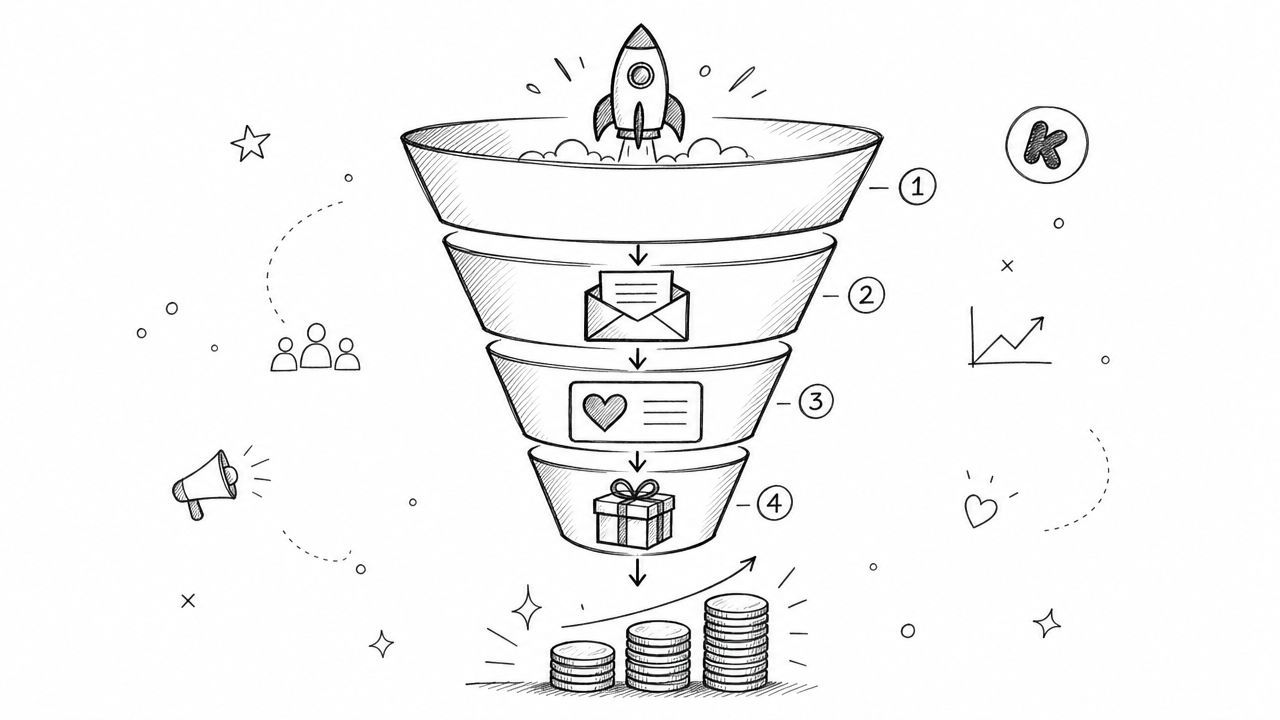
Boost Kickstarter revenue with conversion funnel optimization. Map stages, track KPIs, and test strategies from pre-launch to fulfillment.
Most creators relax when the campaign timer hits zero. Then the harder part starts. You still need to collect surveys, confirm addresses, charge shipping, handle taxes, recover missed responses, and present add-ons without creating backer frustration.
That entire path is your conversion funnel. Not just the campaign page. Not just the pledge button. If you only optimize the campaign page, you leave money sitting in the post-campaign workflow where a lot of margin is won or lost.
As a working rule, crowdfunding teams should treat every handoff as a conversion event. A visitor becomes an email lead. A lead becomes a backer. A backer completes a survey. A survey turns into paid shipping, add-ons, late pledges, and ultimately successful fulfillment. Teams that manage those transitions deliberately usually protect more revenue and create fewer operational problems later.
A campaign doesn't end at funding. It changes form.
For a creator, the visible public funnel is only the front half. The private funnel starts right after the campaign closes, when backers have to finish the work they thought was already done. That's where many projects lose momentum. People delay surveys. Payment methods fail. Shipping feels confusing. Add-ons get ignored because the offer is buried in a clumsy flow.

Generic ecommerce advice usually treats the sale as the finish line. Crowdfunding is different. The "sale" often lands before the buyer has finalized product selection, shipping details, taxes, or add-ons. In practical terms, that means your real funnel stretches across the whole lifecycle.
That matters because conversion funnel optimization is built around stage-by-stage performance, not just the final result. VWO notes that overall sales funnels typically convert between 3% and 10%, and cites a global average ecommerce purchase conversion rate of 3.17%. For crowdfunding operators, the useful lesson isn't to chase a single benchmark. It's to understand that small improvements at each step can materially change total revenue.
Practical rule: A cleaner survey flow often does more for profitability than another round of campaign-page edits after launch.
A creator can lose value long before fulfillment begins:
Each leak affects the next one. If fewer people complete surveys, you have less clean fulfillment data. If your shipping step causes hesitation, some backers never reach the upsell screen. If reminder timing is poor, you spend more time manually chasing responses.
The strongest crowdfunding teams stop treating launch day as the center of the universe. They think like lifecycle marketers and operators at the same time. They ask where intent is strongest, where friction is highest, and which step affects both cash flow and delivery readiness.
That shift changes how you judge success. A big funding total can hide a weak backend. A modest campaign with strong survey completion, disciplined shipping collection, and well-placed add-ons can be healthier than a flashy campaign that creates cleanup work for months.
Before you optimize anything, map the actual steps backers take. Not the version in your head. Not the version in your deck. The actual path, in order, with one clear conversion event per step.

Intent gets captured before Kickstarter or Indiegogo traffic becomes expensive or chaotic.
Typical stages look like this:
The key conversion here isn't "interest." It's a specific action, usually an email signup or reservation. If you don't define that event clearly, your pre-launch numbers become vanity metrics.
Once the campaign is live, the funnel gets more compressed and emotional. People move fast, but they also hesitate fast.
A useful campaign map often includes:
If you're sending traffic from different sources, separate them. Paid traffic, organic traffic, email traffic, and creator-community traffic behave differently. If you blend them together, you can miss the bottleneck.
Funnel counts only matter when each step happened in sequence for the same user.
That sequencing point matters a lot in crowdfunding. Count explains that rigorous funnel analysis requires ordered event tracking, because the numbers are only meaningful when the same user completed the prior step in sequence. That's especially relevant for surveys and upsells, where a broken form or payment step can suppress both conversion and trust.
This is the part most creators under-map, even though it directly affects profit and fulfillment readiness.
A practical post-campaign map looks like this:
| Stage | What counts as conversion |
|---|---|
| Backer imported | Backer record available in your pledge workflow |
| Survey opened | Backer clicks into survey portal |
| Survey completed | Reward choices, address, and required fields submitted |
| Shipping or tax paid | Payment collected successfully |
| Add-on offer viewed | Upsell screen reached |
| Add-on purchased | Extra item or upgrade paid |
| Order finalized | Backer is fulfillment-ready |
You can expand this if your product is complex. Board game publishers may need add-on selection, wave shipping decisions, and region-based fulfillment choices. Gadget creators may need accessory bundles, VAT collection, or address validation checks before locking orders.
A creator who came from your warm email list doesn't behave like someone who clicked a broad social ad. A backer who pledged at a premium tier doesn't behave like someone who chose the entry tier. Segment those paths.
Use segments such as:
If you skip segmentation, you'll end up fixing the wrong step.
Once the funnel is mapped, the dashboard should stay simple. Most creators don't need more metrics. They need the right metrics in the right order.
Userflow's guidance on funnel analysis emphasizes three core KPIs: conversion rate, drop-off rate, and average time in funnel. That's a strong framework for crowdfunding because it forces you to inspect movement between stages instead of staring at a funding total and guessing what happened.
Start with one primary KPI per stage, then add one diagnostic metric if needed.
A practical formula mindset helps. Measure each transition, not just the endpoint. If 1,000 people hit the page and 200 sign up, that's one conversion rate. If 200 leads click through and 40 pledge, that's another. If 40 backers receive surveys and only some complete them, that's a separate funnel stage with its own operational impact.
| Funnel Stage | KPI | Formula | Example Target |
|---|---|---|---|
| Pre-launch | Landing page conversion rate | Email signups / landing page visitors | Improve over your current baseline |
| Campaign | Pledge rate | Backers / campaign page visitors | Improve over your current baseline |
| Post-campaign survey | Survey completion rate | Completed surveys / surveys sent | Reduce backer non-response |
| Shipping collection | Payment completion rate | Paid shipping orders / payment prompts sent | Reduce failed or abandoned payments |
| Upsell flow | Upsell conversion rate | Upsell purchases / upsell viewers | Increase add-on attachment |
| Full lifecycle | Average time in funnel | Time from first step to target step | Shorten delays where possible |
If you need a concrete setup reference for conversion tracking, this guide on how to set up conversions is useful for defining events and keeping measurement tied to real steps.
The most common mistake is tracking only campaign performance. The second most common mistake is measuring the right thing at the wrong level.
A few examples:
Track the transition, not just the total. That's where the bottleneck usually shows itself.
This is less glamorous than testing headlines, but it matters more. One person should own the funnel view across pre-launch, live campaign, and post-campaign operations. If marketing owns one dashboard, operations owns another, and fulfillment owns a spreadsheet, nobody sees the full leak path.
Good conversion funnel optimization is rarely blocked by lack of tools. It's usually blocked by fragmented responsibility.
After you map the funnel, you'll usually find several ugly steps at once. That's normal. A weak pre-launch page, a soft campaign page, and a clunky survey can all coexist. The mistake is trying to fix everything in the same sprint.

Bloomreach makes an important point about funnel work: the real question isn't just how to reduce drop-off, but which drop-off is worth fixing. That distinction is even more important in crowdfunding because not every stage has the same economic value.
A creator might see a large drop-off on a pre-launch landing page and a smaller drop-off during shipping collection. The smaller one can still be more valuable to fix if it blocks payment, fulfillment readiness, or access to add-ons.
Use a rough matrix before you queue any test:
High impact, low effort
Rewrite unclear survey copy. Reorder fields. Make shipping charges visible earlier. Tighten reminder email timing.
High impact, high effort
Rebuild a broken checkout step. Redesign a multi-tier survey logic flow. Change how regional tax or shipping options are calculated and displayed.
Low impact, low effort
Adjust button labels. Improve image order on an add-on page. Clarify reward naming.
Ignore low-impact, high-effort work unless it solves a known operational pain that keeps surfacing.
A practical companion resource is this guide on reducing cart abandonment, especially for payment-heavy survey and add-on flows.
A short walkthrough can help frame how to think about funnel prioritization in practice:
Percentages can mislead. A big percentage drop in a low-value stage may matter less than a smaller drop where buyers are already committed.
Ask these questions:
A survey step that blocks shipping payment often deserves priority over a prettier pre-launch page.
Don't overreact to tiny samples. Count's guidance recommends waiting until each funnel stage has about 100 conversions before drawing conclusions, because smaller samples can produce unstable conversion-rate estimates, as noted in the earlier Count source.
That's a useful restraint for creators who tend to redesign flows based on a handful of complaints or a weekend of volatile data.
Good conversion funnel optimization isn't a redesign project. It's an operating habit. Unbounce frames it as a loop: map the funnel, find the largest drop-off points, test one bottleneck at a time, and measure both immediate lift and downstream revenue impact. That's exactly how crowdfunding teams should work.
At the front of the funnel, keep tests narrow and observable.
Try experiments like:
For traffic growth, creators also need steady discoverability outside paid channels. If you're building long-term acquisition alongside launch campaigns, a resource on performance-focused SEO can help frame how search and conversion work together instead of as separate projects.
Specialized tooling matters because the post-campaign funnel isn't a generic checkout.
Test areas that usually move the most:
Survey structure
Put required selections first. Delay optional questions. Remove anything that creates uncertainty.
Shipping and tax clarity
Show charges cleanly, with no surprise jump late in the flow. If a backer doesn't understand why they're paying, abandonment goes up fast.
Upsell sequencing
Don't dump every add-on at once. Start with the most relevant accessory, expansion, or bundle.
Reminder logic
Send reminders based on action state. Someone who opened but didn't finish needs a different message from someone who never clicked.
Kickstarter's native pledge manager is a bit like Amazon. It gives you a standard buying flow, but limited control over how the experience is merchandised. A dedicated pledge manager is more like Shopify. You get more room to shape the customer journey, tailor the survey, control the upsell path, and manage the operational handoff with fewer workarounds.
Used carefully, PledgeBox fits that more customizable model. It handles branded backer surveys, shipping-fee and VAT/tax collection, subscription management, add-on upsells, and late-backer pre-orders. For creators evaluating cost risk, it's also straightforward: sending the backer survey is free, and it charges 3% of upsell revenue only if there is any.
A few patterns show up repeatedly.
What tends to work:
What usually fails:
The best post-campaign funnel feels boring to the backer. That's usually a sign it works.
Most creators put their energy into getting funded. That's understandable. But a funded campaign with a weak backer follow-up process can still underperform financially and operationally.
Amplitude highlights a major gap in funnel thinking: most content treats the funnel as ending at purchase, even though for Kickstarter and Indiegogo creators the highest-value optimization often happens after the campaign ends. That's the right lens for crowdfunding because the post-campaign phase is where revenue quality gets decided.

A backer who hasn't completed a survey isn't fulfillment-ready. A backer who doesn't pay shipping or tax may delay your logistics. A backer who never sees the right add-on offer is a missed revenue opportunity.
That changes how experienced teams think about margin. They don't only ask how to get more backers. They ask how to increase profit per backer after the campaign closes, while reducing support load and delivery errors.
The post-campaign funnel usually improves when creators focus on a short list of levers:
If you're building that extended purchase path, this guide to the Kickstarter late pledge process is a practical reference.
Creators sometimes frame post-campaign systems as admin work. Backers don't experience them that way. They experience them as product confidence. A smooth survey says you're organized. Clear shipping collection says you're transparent. Clean reminder flows say you respect their time.
That trust matters beyond one project. It affects support volume, refund friction, comment sentiment, and whether people come back for the next launch.
Crowdfunding doesn't have one finish line. It has a handoff. Teams that optimize that handoff usually protect more revenue and ship with less chaos.
If you're looking for one system to manage that full lifecycle, PledgeBox gives creators tools for pre-launch capture, campaign analytics, branded backer surveys, shipping and tax collection, add-on upsells, late pledges, and fulfillment handoff in one place. For post-campaign work specifically, the backer survey is free to send, and the platform only charges 3% on upsell revenue if any upsell happens.
PledgeBox
The All-in-One Toolkit to Launch, Manage & Scale Your Kickstarter / Indiegogo Campaign