 PledgeBox
What Is Data Segmentation in Crowdfunding Campaigns
Learn what is data segmentation and how crowdfunding creators use it to split backers into groups that drive higher ROI, smarter surveys, and stronger upsells.
Learn what is data segmentation and how crowdfunding creators use it to split backers into groups that drive higher ROI, smarter surveys, and stronger upsells.
Data segmentation is the practice of dividing backers or operational data into smaller groups that share a meaningful trait, and 77% of marketing ROI comes from segmented, targeted, and triggered campaigns. In a crowdfunding campaign, that might mean sending different survey questions to a board-game backer in Germany, a hardware backer in the United States, and a supporter who added a premium accessory.
You may be facing the opposite situation right now. Your campaign has attracted people with different reward tiers, shipping destinations, interests, and levels of engagement, but your next email treats everyone the same. The message may be accurate, yet it still feels irrelevant to much of the audience.
Segmentation fixes that mismatch. It connects pre-launch audience capture, campaign updates, backer surveys, email automation, upsells, and fulfillment so each group receives the information or offer that fits its situation. A useful way to think about it is simple: you aren't treating your backers as one crowd. You're organizing distinct relationships so your team can serve them more accurately.
Suppose a creator sends one update to every backer. The email asks people to confirm shipping details, promotes a deluxe add-on, and explains a regional tax change. A backer who already completed the survey sees an unnecessary reminder, someone in a country unaffected by the tax change gets irrelevant information, and a basic-tier supporter receives an offer designed for premium buyers.
Data segmentation means dividing that audience or its operational records into smaller groups that share a meaningful trait. The trait might be a reward tier, region, purchase intent, referral source, survey status, or previous add-on activity. The broader marketing definition describes segmentation as dividing a market into groups with shared demographic, geographic, psychographic, or behavioral characteristics, which is the same basic logic a creator applies to backer operations through this explanation of market segmentation.
Segmentation isn't a separate exercise reserved for a marketing report. It becomes useful wherever your campaign needs different people to receive different treatment.
The mental model matters. A large backer list isn't one audience just because it lives in one database. It contains smaller groups with different needs, deadlines, and commercial potential. A well-designed segment gives your team a clear rule for deciding who receives a message, which survey path appears, or how an order moves into fulfillment.
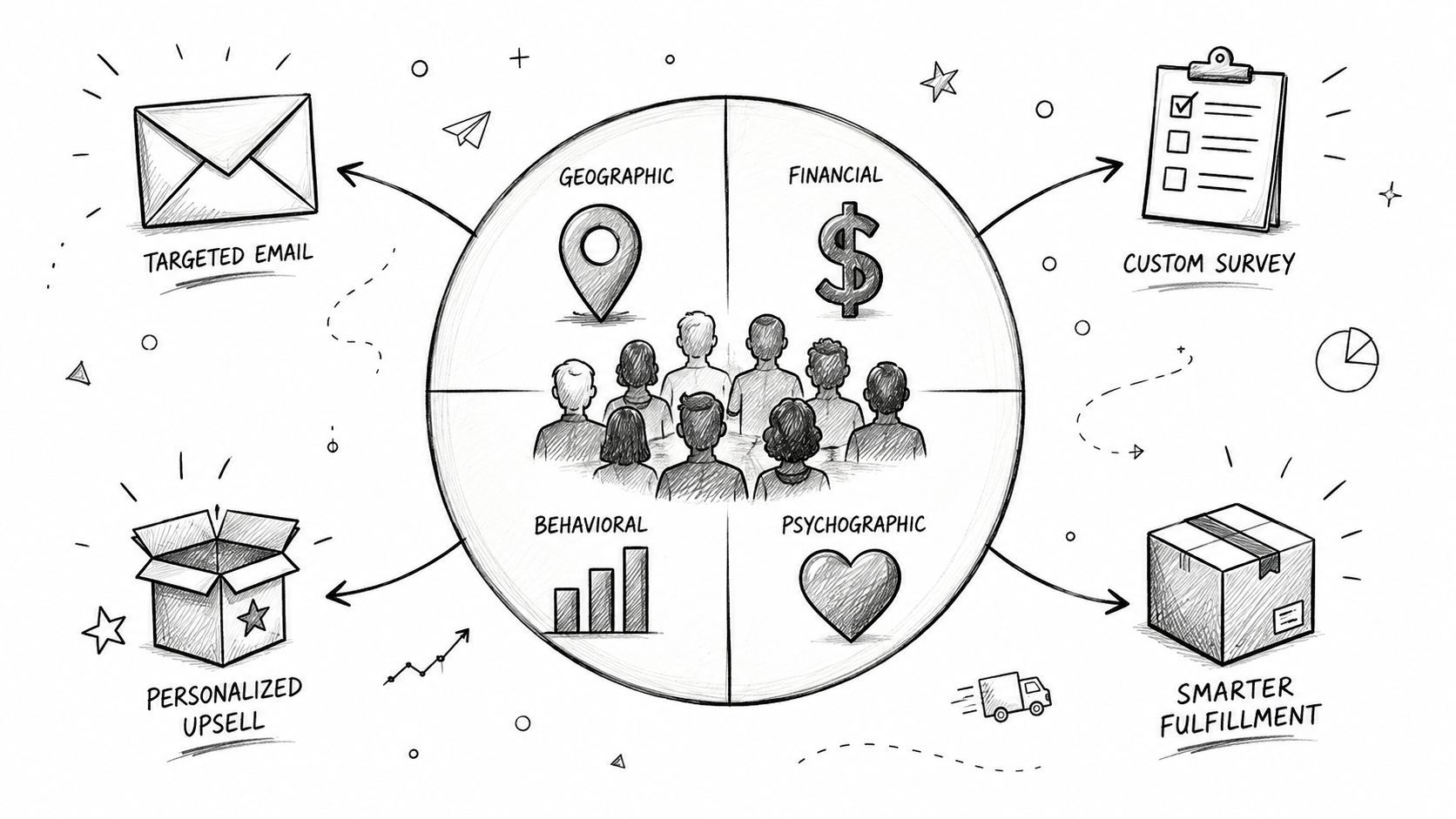
Most campaign segmentation starts with four familiar criteria. They overlap, but each answers a different question about the person behind the pledge.
Demographic segmentation describes characteristics such as age, household type, or other audience attributes. A board-game creator might distinguish family-focused buyers from adult hobbyists, while a hardware creator might separate individual enthusiasts from teams buying for professional use. Use these traits carefully, and only when they affect the offer or experience.
Geographic segmentation organizes people by location. A backer in the United Kingdom may need a different tax or shipping path from a backer in Canada, while a supporter in a remote region may require a different delivery option. Geography can also guide regional reward variants, customs messaging, address validation, and fulfillment exports.

Behavioral segmentation uses actions rather than descriptions. You might group backers by pledge amount, reward tier, referral source, add-on history, survey completion, or response speed. Someone who opened several product emails but didn't pledge may need a late-pledge invitation, while someone who already bought an accessory shouldn't receive the same accessory promotion.
Psychographic segmentation focuses on motivations, values, interests, and preferences. Two people can buy the same reward for very different reasons. One may care about sustainability, another about collecting limited editions, and a third about using the product with their family. Their messages can be more persuasive when they reflect those motivations.
The strongest groups often combine criteria. For example, a creator could build a segment of high-value European backers who bought add-ons previously and respond to sustainability-focused messaging. That combination is more useful than a broad label such as “European backers” because it connects location, value, behavior, and motivation to a specific operational decision.
Segmentation earns its place by improving how efficiently a creator uses existing campaign activity. A targeted message can address a backer's actual situation, while a generic message forces every reader to sort through information that may not apply.
A 2025 industry summary reports that 77% of marketing ROI comes from segmented, targeted, and triggered campaigns, and that non-targeted campaigns have a 50% lower click-through rate than segmented campaigns. The same summary reports that only 4% of companies use segmentation for growth, while 42% of marketers don't segment at all. These figures come from segmentation performance data.

The opportunity isn't limited to advertising. A campaign team can apply the same principle to operational messages:
Two practical indicators make the effect easier to manage. Survey completion shows whether the right people are receiving the right instructions at the right time. Upsell conversion shows whether an offer matches the reward, interests, or previous actions of the recipient.
Segmentation doesn't automatically create revenue. Poor boundaries, stale records, or irrelevant assumptions can make a message feel even less trustworthy. But a thoughtful system helps your existing emails, surveys, and fulfillment work reach the people most likely to act, instead of increasing volume for everyone.
Consider a creator launching a modular desk accessory with several reward options. Before launch, the creator tags subscribers by the page or partner that brought them in and records whether they showed interest in the standard product, premium materials, or accessory bundle.
During the campaign, those groups receive different updates. People interested in the premium version get information about materials and availability. Subscribers who haven't pledged but continue engaging with campaign content receive a reminder focused on the product benefit they previously explored. Existing backers receive updates connected to their selected tier rather than a general sales pitch.
After funding, the survey uses the pledge and location data already collected. A backer in one region may need tax information, another may need a different shipping method, and a bundle buyer may need to confirm accessory choices. The survey shouldn't ask every person every question if the stored data already determines which path applies.
Survey status creates another important segment. People who haven't responded receive reminders, while completed records move toward address review and fulfillment preparation. Guidance on improving survey response rates can help creators connect message timing and clarity to completion behavior.
Email automation then turns those conditions into actions. A non-responder receives a completion reminder. A high-value backer may receive a relevant add-on invitation. An engaged subscriber who missed the campaign can receive a late-pledge message. For a broader set of actionable segmentation tactics, creators can compare practical ways to define and activate audience groups.

Upsells are the natural commercial layer. A supporter who selected the base reward can see a compatible accessory, while someone who already owns the complete bundle can be excluded. Fulfillment tests the whole structure through shipping logic, address validation, order grouping, and vendor exports.
Segmentation is therefore one continuous workflow, not five disconnected tactics. Every new action, such as a tier change, address update, survey response, or add-on purchase, should update the group that controls the next step.
A pledge manager determines whether your segments remain useful after the campaign ends. PledgeBox's published comparison frames Kickstarter's system as an “Amazon” model and PledgeBox-style pledge management as a “Shopify” model. The comparison describes a basic one-time backer survey on one side, and a more dynamic post-campaign flow on the other, where backers can update addresses, add items later, and pay shipping based on actual weight, items, and location. You can review the full pledge manager comparison for that distinction.
The Amazon-style model is familiar and straightforward. It works like a completed order followed by a fixed information request. Once a backer submits details, changes can become difficult, and shipping estimates need to be handled early.
The Shopify-style model treats the post-campaign phase more like a flexible storefront. Backers can return, update relevant details, add products, and receive shipping treatment that reflects the order as it exists at that point.
| Capability | Amazon-style, rigid | Shopify-style, dynamic |
|---|---|---|
| Survey flow | Basic one-time collection | Adaptable post-campaign flow |
| Address changes | More difficult after submission | Backers can update addresses |
| Add-ons | Limited after the initial response | Items can be added later |
| Shipping | Estimated earlier | Collected according to weight, items, and location |
| Segmentation | Mostly fixed order groups | Groups can change as backers act |
A dynamic workflow doesn't have to require upfront survey spending. PledgeBox is free to send the backer survey and only charges 3% of upsell revenue if there are any upsells. If the survey generates no upsell revenue, the survey is free. That makes the cost structure easy to connect to segmentation: creators can organize survey paths and offers without paying a fee just for sending the survey.
Creators comparing operational models can also use this guide on how to select the right pledge manager. The right choice depends on how often backers change orders, how complex shipping is, and whether the post-campaign phase needs to function as a living storefront rather than a one-time form.
Backer groups are only the visible layer. In analytics workflows, segmentation can also mean partitioning a dataset into coherent subgroups so models can train or evaluate on more homogeneous samples. The quality of those groups depends on feature engineering, including feature selection, transformation, and extraction, which can reduce redundancy and dimensionality while improving computational efficiency and reliability, as explained in this research on segmentation and feature engineering.
For a creator, the practical example might be a prediction system that distinguishes likely add-on buyers from people who only need fulfillment reminders. The model shouldn't treat every interaction as equally meaningful. Survey completion, reward selection, previous purchases, and engagement history may provide more useful signals than a broad label such as “backer.”
Security and access governance create another layer. Data can be separated by sensitivity, use case, and required authority, allowing a team to apply different controls to different portions of the campaign records. Sensitive fields can be isolated behind additional authentication and authorization rules, which helps reduce blast radius and supports least-privilege access, according to this overview of data segmentation for security.
That distinction matters because a survey may contain shipping addresses, tax or VAT details, and payment-related information. A fulfillment vendor may need delivery fields, while a marketing contractor may only need a non-sensitive audience label. Giving both people the same unrestricted dataset creates unnecessary exposure.
Practical rule: Segmenting data should answer three questions, not one: who belongs in the group, what action does the group support, and who is allowed to see its underlying fields?
Data segmentation therefore structures more than email delivery. It shapes analytics quality, access permissions, automation rules, and the reliability of decisions made as a campaign grows.
Segmentation becomes risky when the rules are vague. A backer can accidentally belong to multiple groups, a reward tier can change after the original pledge, or an old shipping region can remain attached after an address update. Static buckets often fail when a campaign keeps changing.
Recent coverage of Akamai's 2025 segmentation study identifies network complexity as a top-three barrier for 44% of respondents, reports that only 39% had strong visibility across segmented assets, and says 32% cited performance or business-disruption concerns. Those findings are summarized in this report on practical data segmentation barriers. The lesson for creators is operational: a segment is useful only when the team can understand, update, and monitor it.
Define the rule before creating the segment. “High-value backer” should have a clear business meaning, even if the rule uses qualitative judgment rather than an arbitrary threshold. Decide whether a person can belong to several groups, which segment wins when rules conflict, and what event removes someone from an audience.
Refresh the data after meaningful actions. A completed survey should remove a backer from reminder automation. A new add-on should update the order group. An address change should trigger another validation step rather than leaving fulfillment dependent on an old record.

Personalization doesn't remove governance responsibilities. Modern guidance emphasizes separating sensitive data, assigning different access rules, and maintaining privacy controls within each segment, especially when teams use behavioral or transactional information. This privacy-focused guide to customer data segmentation addresses that tension directly.
Use a short operational checklist:
The objective isn't to avoid segmentation. It's to make every segment understandable, current, and proportionate to the decision it supports.
A creator reviewing a second campaign should be able to recognize where each backer came from, what they wanted, and which actions they completed. Build that record before launch by capturing source, interest, and intent. Later survey and email workflows can then use the context directly, rather than reconstructing it after funding.
Design the survey around decisions the campaign must make. A backer who selected a regional reward should receive the shipping questions for that region. A bundle buyer should see the correct confirmation fields. Someone who completed the survey should leave the reminder audience automatically.
Campaign activity should update the segment controlling the next action. An add-on purchase changes the offer a person should see. A pledge adjustment changes fulfillment requirements. A new address changes shipping validation, while a completed response changes communication status.
Email automation should respond to those updates instead of depending on one-time exports. Fulfillment needs the same discipline. Shipping groups, vendor files, and address checks are more useful when they use current records, reducing corrections caused by stale filters.
A free survey model lets creators test dynamic workflows without upfront cost, so the next campaign starts with clean segments.
Segmentation turns a campaign database into a sequence of useful decisions. Each decision becomes more accurate when the next segment reflects what the backer did.
The answer to what is data segmentation is broader than “groups of customers.” In crowdfunding, it is a continuing system that matches pre-launch capture, survey paths, email automation, offers, fulfillment, and access controls to the people and records involved. Build the structure before launch, refresh it after meaningful actions, and carry the operating habit into the next campaign.
Use PledgeBox to send a backer survey for free, organize responses and orders into operational segments, and charge only 3% when an upsell generates revenue. Visit PledgeBox to plan a segmented post-campaign workflow for your next crowdfunding launch.
PledgeBox
The All-in-One Toolkit to Launch, Manage & Scale Your Kickstarter / Indiegogo Campaign