 PledgeBox
The Best Shipping Software For Small Business And Creators
Discover the best shipping software for small business. Our guide compares top solutions for e-commerce and crowdfunding to help you streamline fulfillment.
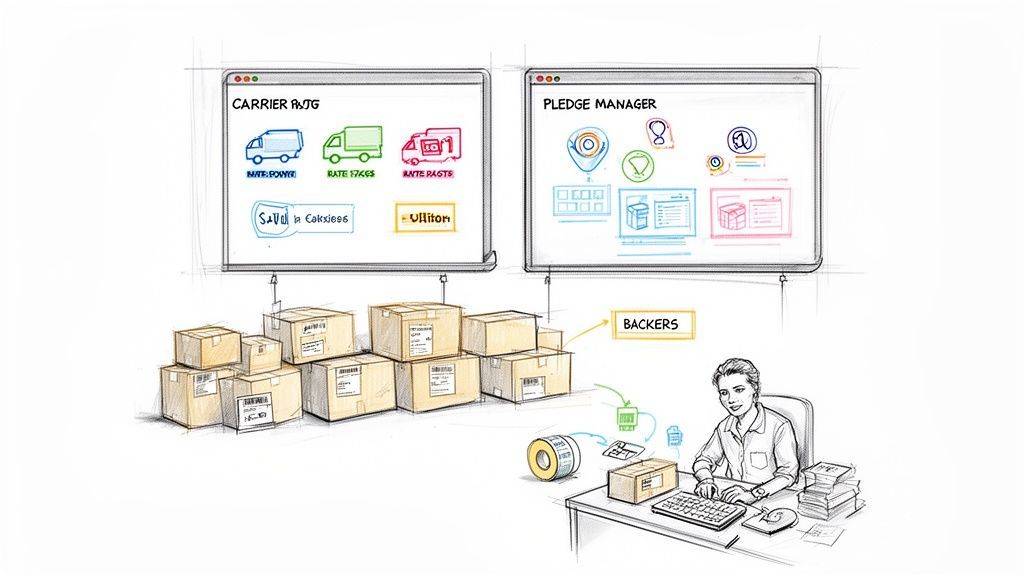
Discover the best shipping software for small business. Our guide compares top solutions for e-commerce and crowdfunding to help you streamline fulfillment.
Picking the best shipping software for a small business isn’t just about printing labels. It’s about finding a platform that saves you precious time, cuts down on costs, and grows right alongside your business. The right tool does more than the basics—it offers smart automation, gives you access to discounted shipping rates, and plugs directly into your sales channels, turning a logistical headache into a real competitive edge.

For any small e-commerce brand or crowdfunding creator, shipping is the last, critical touchpoint with your customer. But it’s also where things can get messy, fast. Think about the manual grind: copying and pasting addresses, comparing carrier rates one by one, and hand-typing customs forms. It’s not just tedious; it's a huge drain on your most valuable asset—your time.
Worse yet, doing things by hand is a recipe for expensive mistakes. One wrong number in a zip code can mean a returned package, an unhappy customer, and paying for shipping twice. As your orders pile up, these little slip-ups can turn into a full-blown fulfillment nightmare that hurts your brand’s reputation. This is exactly why dedicated shipping software is a must-have.
Getting the right software in place flips your shipping process from a reactive chore to a smooth, automated system. By connecting directly to your online store or marketplace, these platforms pull in your orders automatically, which pretty much eliminates the risk of human error. They also unlock discounted shipping rates you could never get on your own, putting money back in your pocket with every single order.
Here’s what you stand to gain:
If you’re a crowdfunding creator, your shipping challenges are a bit different. A platform like Kickstarter is fantastic for raising money and finding backers. But once your campaign clock runs out, its job is pretty much done. It doesn’t give you the tools you need to handle the complicated post-campaign phase.
Think of Kickstarter like Amazon—a massive marketplace to sell your idea. A pledge manager like PledgeBox, on the other hand, is like Shopify—a customizable backend where you manage your customers, collect final details, and drive additional revenue after the initial sale.
This difference is everything. A pledge manager is built specifically for tasks that generic shipping software can’t touch. It handles sending out detailed backer surveys, calculating tricky shipping fees and VAT for international backers, and even letting you run upsells to boost your final revenue. In fact, PledgeBox is free to send the backer survey and only charges 3% of upsell revenue if there is any, making it a no-risk way to gather all your fulfillment data and increase your campaign’s profitability.

Diving into the world of shipping software, you quickly learn that one size definitely does not fit all. The best shipping software for a small business really boils down to your sales model. Are you running a straightforward e-commerce shop, or are you navigating the wild, wonderful world of crowdfunding fulfillment?
The trick is to look at each option through a practical lens. How well does it integrate with carriers? Is the pricing clear and fair? Most importantly, how quickly can it help you get packages out the door?
For most new businesses, the decision comes down to cost. That’s where powerful, free tools have completely changed the game, offering a no-risk way for startups and solo creators to manage shipping without getting locked into a monthly subscription.
Rollo Ship has made a name for itself as a go-to for businesses just finding their footing. Its biggest draw is the price tag: it’s completely free. You only pay for the postage you buy, making it a dream for managing cash flow when every single dollar matters.
But "free" doesn't mean basic. Rollo Ship provides serious value by giving you immediate access to deeply discounted shipping rates. When logistics costs can make or break your profit margins, this is a huge win right out of the gate.
Rollo Ship is a perfect example of how the market has shifted to meet the real needs of small businesses. By ditching subscription fees, it tears down the barrier to entry, letting new entrepreneurs use professional-grade shipping tools from day one.
The e-commerce boom has only accelerated the need for these kinds of tools. In 2023, the shipping software market saw North America lead the charge, driven by a retail sector swamped with online orders. For small sellers, this meant finding tools to automate order imports and label printing to slash manual errors. A solid free option like Rollo Ship gives you up to 90% off USPS rates and 85% off UPS with zero subscriptions. You can dig deeper into these market trends in the latest shipping software industry analysis.
Once your business starts to grow, so does the complexity. Managing orders from one store is one thing, but juggling inventory and shipping across Amazon, eBay, and your Shopify store? That’s a whole different beast. This is exactly where a platform like ShipStation comes into its own.
ShipStation is built for integration. Think of it as a central command center for your entire e-commerce operation, pulling orders from all your sales channels into one clean dashboard. This is absolutely critical for preventing overselling and keeping your fulfillment process consistent, no matter where the order came from.
Its true power, though, is in automation. You can create rules that automatically assign carriers, choose specific packaging, or tag orders with custom labels. That level of control is a massive time-saver and frees up the mental space you need to focus on growing the business.
ShipStation runs on a subscription model, but for businesses operating at scale, the investment almost always pays for itself in efficiency gains and fewer costly errors. For a more comprehensive look, one founder's guide on the best shipping software for small business offers some great practical comparisons.
Crowdfunding fulfillment brings its own unique set of headaches that most shipping platforms just aren't built to handle. It’s not just about shipping a product; it’s about collecting vital backer info before you can even think about a shipping label. This is the world of pledge managers, and PledgeBox is a master of the craft.
The difference is fundamental. ShipStation pulls in completed orders, but PledgeBox is designed to finalize them. It lets you send detailed surveys to your backers to confirm their reward choices, collect addresses, and—most importantly—calculate the exact shipping and VAT for people all over the globe.
Remember our earlier analogy? If Kickstarter is like Amazon where the first transaction happens, PledgeBox is like Shopify. It’s the backend you control, giving you the power to manage your relationship with backers and, critically, increase your funding total.
This happens through its killer upsell feature. As backers fill out their surveys, they can buy add-ons or upgrade their pledge, directly boosting your campaign revenue. That’s not a side feature; it’s a core part of the PledgeBox model and a massive advantage over standard tools.
The pricing is also perfectly aligned with a creator's journey. It’s completely free to send surveys to all your backers. PledgeBox only takes a small 3% fee on funds raised through successful upsells. It’s a performance-based model, meaning no upfront costs—the platform only makes money when you do.
When you're weighing your options, sometimes a quick side-by-side view is all you need. This table breaks down the core differences between our top contenders to help you see where each one fits.
| Software | Primary Use Case | Pricing Model | Key Feature Highlight | Best For |
|---|---|---|---|---|
| Rollo Ship | Free, discounted shipping | Pay-per-label | No subscription fees with deep carrier discounts | Startups and low-volume sellers. |
| ShipStation | Multi-channel order management | Monthly subscription | Centralized hub with powerful automation rules | E-commerce businesses selling on multiple platforms. |
| PledgeBox | Post-campaign pledge management | 3% fee on upsells | Backer surveys with built-in upsell features | Crowdfunding creators managing backers and fulfillment. |
Ultimately, choosing the right tool starts with understanding your business model. For traditional e-commerce, Rollo Ship and ShipStation provide clear paths for starting lean and scaling smart. But for a crowdfunding creator, a specialized tool like PledgeBox isn’t just a nice-to-have—it’s a crucial part of a successful campaign.

Standard shipping platforms are built for a simple, one-off transaction: a customer buys a product, and the business ships it. Simple enough. But crowdfunding is a completely different beast. Your campaign doesn't end when the funding clock stops—that’s just the beginning of a complex fulfillment journey that generic shipping software simply isn't designed to handle.
This is where a dedicated pledge manager becomes non-negotiable. It's a specialized tool built from the ground up to solve the unique problems that pop up after a successful campaign, turning what could be logistical chaos into a controlled, profitable process.
The single biggest headache for creators is collecting accurate, final information from hundreds or even thousands of backers. A typical e-commerce order already has a locked-in address and product choice. A crowdfunding pledge, on the other hand, is more of a promise that needs to be finalized.
A pledge manager’s main job is to send out customized backer surveys. These are far more than simple forms; they are powerful tools built to:
This structured data collection is the bedrock of a smooth fulfillment operation, killing the guesswork and endless manual data entry that cripples so many first-time creators.
Here's the real game-changer: pledge managers don't just organize your data, they can actually generate new revenue after your campaign has ended. Think of Kickstarter like Amazon and a pledge manager as your own Shopify store. Kickstarter is the marketplace where the first transaction happened, but a platform like PledgeBox gives you a customizable back-end to keep that customer relationship going.
PledgeBox functions like your post-campaign Shopify store. It's not just for collecting data; it's a strategic space where you can offer add-ons, upgrades, and late pledges, directly increasing your campaign's total funding.
This upsell functionality is woven seamlessly into the survey process. As backers confirm their details, they see opportunities to buy related products or upgrade their pledge. This simple step can give your profitability a serious boost.
Better yet, with PledgeBox, it is completely free to send the backer survey. The platform only takes a small 3% fee on the new revenue you generate from these upsells, making it a performance-based tool with zero upfront risk.
One of the most common—and expensive—fulfillment mistakes is shipping to a bad address. A single returned package can mean you pay for shipping three times (out, back, and out again), not to mention the hit your reputation takes with that backer.
PledgeBox tackles this head-on with its Google Maps-powered address validation. This feature automatically checks and standardizes addresses as backers type them, flagging potential errors in real-time. It stops typos and formatting issues from becoming expensive delivery failures later on.
Finally, a pledge manager simplifies the last critical step: handing off data to your fulfillment partner. Instead of wrestling with messy spreadsheets, you get clean, pre-formatted reports that your 3PL or warehouse can easily import. This protects data integrity and speeds up the entire shipping process.
If you want to dive deeper into the selection process, our guide on how to select the right pledge manager offers more detailed insights.
Picking the right shipping software is about more than just printing labels. It's about finding a partner that kills the tedious work, saves you real money, and keeps your customers or backers happy. This isn't just a list of functions; think of it as your essential checklist for any platform you're considering.
The right tool can transform your fulfillment process from a post-campaign nightmare into a well-oiled machine. It should give you the power to manage orders smoothly, whether you're handling ten a day or staring down a mountain of a thousand after a huge launch.
First things first: connecting with multiple carriers is non-negotiable. Putting all your eggs in one basket with a single shipping provider is both risky and expensive. With multi-carrier integration, you can see real-time rates from companies like USPS, UPS, and DHL all in one place, instantly.
This is called rate shopping, and it's your best defense for protecting your profit margins. It lets you pick the cheapest or fastest option for every single package, making sure you never overpay. The smarter systems even let you set rules to automate this choice based on things like package weight or where it's headed.
Let's be honest, manual data entry is a soul-crushing time-sink and the #1 cause of expensive shipping mistakes. Your software has to automate the entire label creation process by pulling order data straight from your e-commerce store or pledge manager. This should also include generating packing slips and, for international shipments, the dreaded customs forms.
Automated tracking is just as crucial. The platform should:
For any growing business—and especially for crowdfunding creators—orders come in waves. The ability to process orders in batches is a lifesaver, letting you print hundreds of labels at once. This feature turns what could be a week's worth of manual work into a single afternoon's task.
Another must-have is solid address validation. Good software checks every address against official databases as it's entered, catching typos and formatting mistakes before a package ever goes out the door. This one simple step saves you from the headache and cost of returned shipments. You can learn more about how delivery destinations affect your bottom line when you calculate shipping costs for your business.
A key differentiator in this space is the business model itself. While many tools operate on subscriptions, some platforms align their success with yours. For instance, in crowdfunding, PledgeBox functions like a post-campaign Shopify store, offering mission-critical survey and upsell tools. It’s free to send your backer survey, with a simple 3% fee only applied to new funds you raise from add-ons.
Looking ahead, the industry is clearly shifting away from fixed monthly costs. The most forward-thinking shipping apps are dropping subscriptions for pay-as-you-go models. This lets creators scale up without getting hit by another recurring bill, which is huge as shipping costs continue to climb. New tools like AI-powered carrier selection and multi-carrier strategies are becoming the norm, helping you spread risk and slash costs with real-time rate shopping. You can find out more about innovations in shipping apps for small businesses on CeoTodayMagazine.com.
Choosing the right tools is only half the battle. Getting them to talk to each other is what turns fulfillment from a chaotic mess into an error-proof machine. Your pledge manager and your shipping software need to have a flawless connection—it means faster shipping, happier backers, and far fewer expensive mistakes.
It all starts with clean data. The goal is to get accurate order and address information from your pledge manager directly into your shipping software or third-party logistics (3PL) partner's system. This handoff is where so many campaigns get stuck, bogged down by manual data entry that just invites human error.
The ideal workflow has zero manual steps. Instead of copying and pasting hundreds of addresses from a clunky spreadsheet, your pledge manager should give you pre-formatted reports that are ready to go. Platforms like PledgeBox were built for exactly this, offering direct vendor exports designed to be foolproof.
This integration is everything. When your data is clean and correctly formatted from the start, you can import it directly and batch-print hundreds of shipping labels in minutes. This is a game-changer for speeding up your entire fulfillment timeline.
It helps to think of a pledge manager like PledgeBox as your post-campaign Shopify store, while Kickstarter is more like Amazon. PledgeBox gives you the back-end control needed to organize and export clean, fulfillment-ready data—something a marketplace like Kickstarter just isn't designed for.
This automated handoff doesn't just save time; it protects your data's integrity. Every time you manually touch the data, you risk a typo that could send a package to the wrong state. By creating a direct data pipeline, you slash that risk and make sure rewards get to your backers correctly on the first try.
New trends are making this integration even more powerful. Warehouse automation that connects with top shipping software is bringing down costs for small businesses, enabling 24/7 operations that cut labor needs by 30-50%. It also minimizes reshipment errors that can eat up to 15% of your revenue. According to a report on 2026 shipping trends on DCLCorp.com, this is becoming a huge competitive advantage.
For PledgeBox users, the workflow is simple: collect VAT and validate addresses with Google Maps right in your survey, then export that clean data to an automated system for instant label generation and tracking.
By building a solid bridge between your backer management and shipping platforms, you create a system that’s repeatable and scalable. Whether you're working with a 3PL or printing labels in your garage, this workflow ensures you can handle any order volume. If you're getting ready to work with a logistics partner, check out our guide on finding the right crowdfunding fulfillment services.
Choosing the best shipping software for a small business isn’t about finding a single magic bullet. It’s about building the right stack for your specific needs. A creator launching their very first project has a completely different set of problems to solve than a veteran publisher juggling thousands of international orders.
The key is to match your tools to your project’s scale and complexity. To get practical, let's walk through a few common scenarios. Each one represents a different stage of a creator's journey, demanding a unique mix of pledge management and shipping tools. This approach helps you build a workflow that’s both smart and cost-effective.
If you're a new creator with a low-volume campaign, cash flow is everything, and simplicity is your best friend. Your main goal is to get backer info right the first time and ship rewards without getting tangled up in pricey monthly subscriptions.
The perfect strategy here is to pair a powerful pledge manager with a free shipping platform. Start with PledgeBox, which lets you run your campaign's backend on a performance-based model. It's free to send the backer survey and only charges 3% of any upsell revenue, which is a huge relief when you’re protecting your initial funds.
Once your data is clean and addresses are validated, you can export it directly into a free shipping tool like Rollo Ship. This gives you immediate access to discounted postage and label printing with zero overhead.
It's helpful to think of your tools in stages. Kickstarter is your marketplace, like an Amazon. After that, PledgeBox becomes your post-campaign Shopify, where you manage backer relationships and boost your revenue before fulfillment even starts.
An established board game publisher has a whole different beast to tackle. We're talking thousands of international backers, complex reward tiers, and fulfillment that might happen in phases. For them, it’s all about efficiency at scale and making sure the data is bulletproof.
Their workflow still kicks off with PledgeBox to manage surveys, charge for shipping, and handle tricky VAT calculations—its detailed reporting is a lifesaver here. Once all the data is locked in, they can generate pre-formatted export files designed specifically for a full-service third-party logistics (3PL) partner. This ensures a clean, error-free handoff for global distribution.
And when it comes to maximizing their own online sales, publishers using shipping software on platforms like Shopify also need to get serious about Shopify product image optimization to make their products stand out.
This diagram shows the basic flow from data export to import and finally to shipping.

As you can see, a successful strategy really boils down to a clean handoff of data between your management and shipping platforms.
Once your campaign is funded, the real work begins. Moving from pledges to packages can feel daunting, and many creators have the same questions when they hit this stage. Let's break down some of the most common ones about shipping software for crowdfunding.
Technically, yes, but it will create more problems than it solves. Standard shipping software is great for printing labels for simple e-commerce orders. That’s about it.
These generic tools are not built to handle the unique messiness of a post-crowdfunding campaign. They can't manage custom backer surveys, track add-ons, or calculate final shipping fees based on a dozen different variables. You need a bridge between your campaign and your shipping station, and that's where a pledge manager comes in.
The way you budget really depends on the software's pricing model. Some traditional platforms charge a monthly subscription, which can be tough to swallow when you're managing a tight post-campaign budget.
A much friendlier approach for creators is a performance-based model, where the software’s cost is tied directly to your success.
Think of the Kickstarter and PledgeBox relationship this way: Kickstarter is like Amazon, a marketplace for the initial transaction. A pledge manager like PledgeBox is like your own Shopify store, giving you a customizable backend to manage backers and drive post-campaign revenue.
This is exactly why so many creators turn to PledgeBox. It’s free to send the backer survey and only charges 3% of upsell revenue if there's any. This model means zero upfront cost, so the platform only earns money when you do. It's a true partnership.
Trying to manage international shipping and taxes manually is a recipe for disaster. It’s one of the biggest sources of headaches, delays, and frustrated backers.
The best way to tackle this is with a modern pledge manager that automates the entire process. These platforms can calculate and collect the correct VAT and taxes right in the backer survey. They also generate the necessary customs forms automatically, taking the guesswork out of a notoriously complex part of fulfillment. This ensures your rewards actually reach your backers without getting held up at the border.
Ready to make your post-campaign fulfillment a whole lot easier and even boost your revenue? With powerful survey tools and a completely risk-free pricing model, PledgeBox gives you the essential toolkit every creator needs. Learn more and get started for free today!
PledgeBox
The All-in-One Toolkit to Launch, Manage & Scale Your Kickstarter / Indiegogo Campaign