 PledgeBox
A Creator's Guide to Crowdfunding Fulfillment Services
Unlock the secrets to post-campaign success with our guide to crowdfunding fulfillment services. Learn how to navigate shipping, costs, and backer surveys.
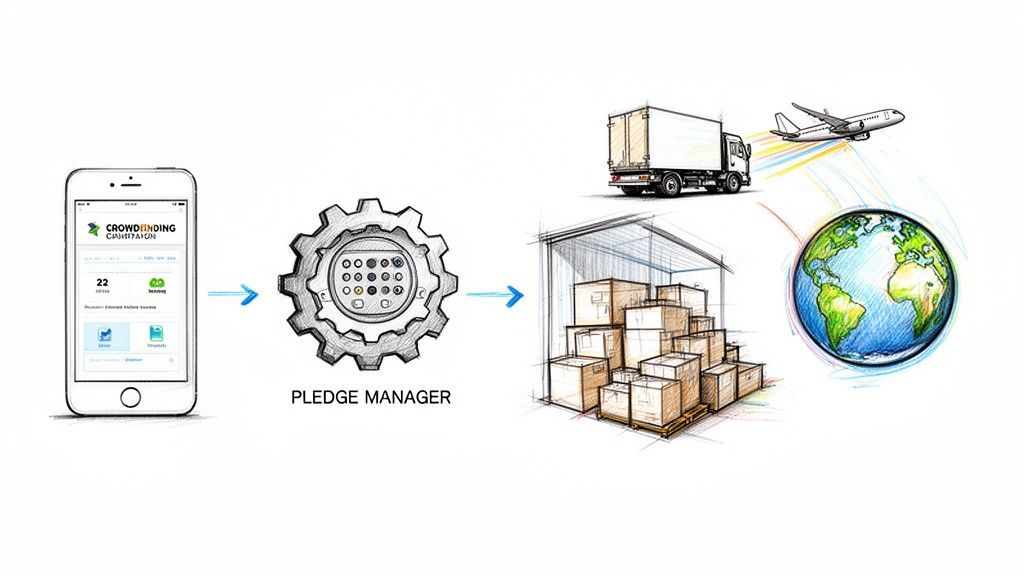
Unlock the secrets to post-campaign success with our guide to crowdfunding fulfillment services. Learn how to navigate shipping, costs, and backer surveys.
Congratulations, your campaign is funded! The celebration is amazing, but it doesn't take long for a huge question to pop up: how are you going to get your product into the hands of thousands of excited backers? This is where crowdfunding fulfillment services step in, becoming your most important partner in turning those campaign promises into delivered rewards.
That incredible feeling of hitting your funding goal? That's just the start line. The real work begins now, and this is the part of the journey that separates the wildly successful projects from the cautionary tales.
A lot of creators think the hardest part is over, but the path from a funded campaign to a delivered product is paved with logistical landmines. This is exactly why specialized fulfillment services exist.
Think of it this way: platforms like Kickstarter and Indiegogo are the marketplaces where you make the sale. They give you the stage to attract backers and collect pledges. But for everything that comes after the campaign, you need a powerful back-office command center—your very own "Shopify" for crowdfunding.
This is where a solid pledge manager becomes the engine of your whole operation. A tool like PledgeBox gives you total control over the post-campaign chaos. It’s where you’ll manage all your backer information, collect their shipping details, and even bring in some extra revenue through upsells.
For example, PledgeBox is free to send your backer surveys and only charges a 3% fee on any funds raised through upsells. This makes it a totally risk-free way to get all your data organized before you hand it off for fulfillment.
By mastering this post-campaign phase, you do more than just ship a product; you build trust, foster a loyal community, and set the stage for future success. A smooth fulfillment experience is often the single most important factor in a backer’s overall satisfaction.
Once your data is clean and organized, you pass it to your fulfillment partner. They're the ones who handle the physical side of things: warehousing your inventory, picking and packing each order, and figuring out the complex world of global shipping.
Understanding how to successfully fulfill backer rewards is non-negotiable for keeping momentum and your community happy. Without that seamless link between your pledge manager and your fulfillment service, you’re just asking for delays, mistakes, and frustrated backers—the very people who brought your dream to life in the first place.
Once your campaign is funded, the real work begins. That abstract idea of "fulfillment" suddenly turns into a series of very real, concrete steps. This journey, from a backer's pledge to a package arriving at their door, is what crowdfunding fulfillment services are all about. When it’s done right, it’s a smooth, professional experience for everyone who believed in you.
The whole thing kicks off the second your campaign ends, starting with the most important part: collecting information. You can't ship anything if you don't know where it's going or which color a backer wants. This is why a solid pledge manager is the command center of your entire fulfillment operation.
The very first thing you’ll do post-campaign is send out backer surveys. These aren't just simple questionnaires; they're your primary tool for gathering all the critical details you need. Through these surveys, you'll:
Think of it like this: if Kickstarter is the storefront where the initial sale happened, a pledge manager like PledgeBox is your control panel for everything that comes next. It puts you in the driver's seat for the entire post-campaign process.
This is where things can get really interesting for creators. For example, PledgeBox lets you send powerful, branded backer surveys for free and only charges a 3% fee on funds raised from post-campaign upsells. That means no upfront costs, and the platform only succeeds when you do. It's a smart, effective way to get started.
This infographic gives you a bird's-eye view of the entire flow, from the campaign's launch to the final delivery.
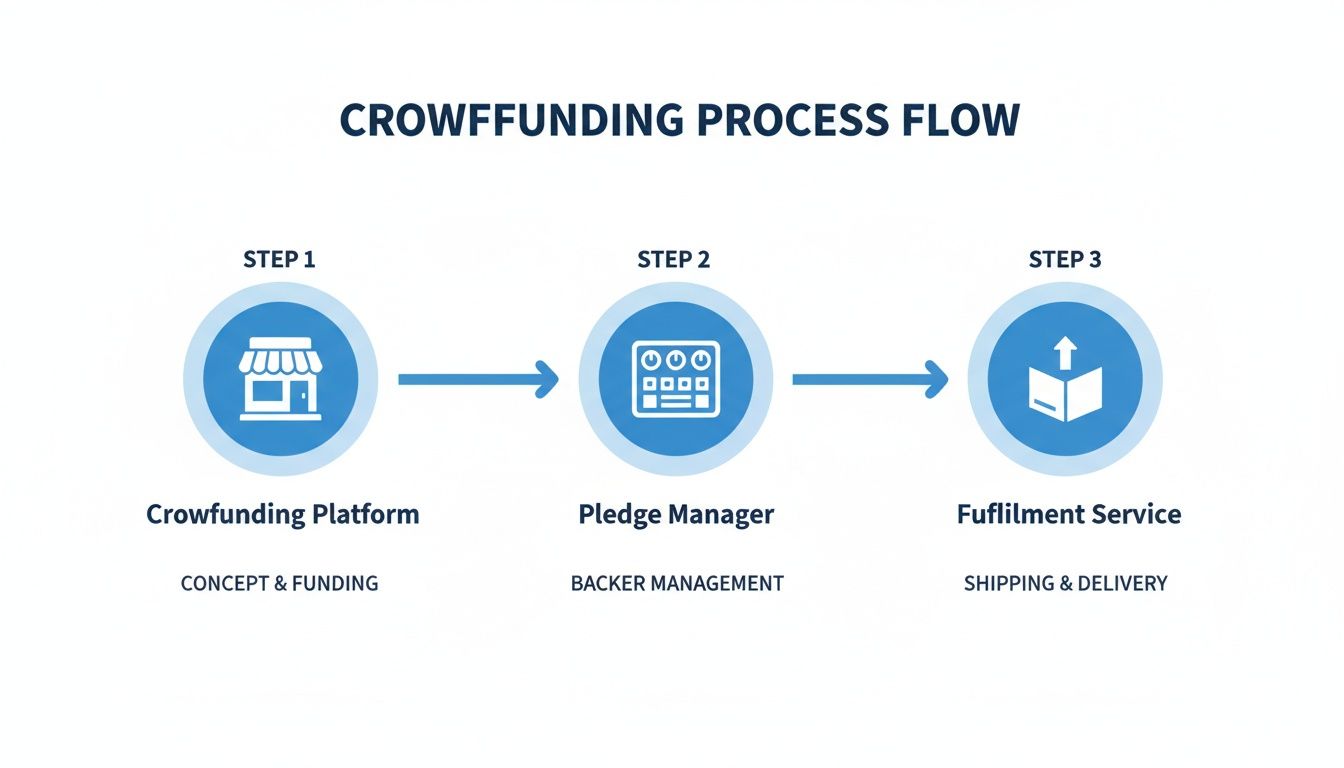
As you can see, the pledge manager is that crucial link between your campaign data and the real-world logistics of your fulfillment partner.
Once the survey responses start rolling in, the next job is to whip that data into shape for your fulfillment partner. This is more than just exporting a spreadsheet. You're calculating final shipping fees, dealing with regional taxes like VAT, and creating a master list of every unique order combination (SKU).
A pledge manager handles all this heavy lifting for you, sidestepping the manual errors that can turn shipping into a nightmare. Once all the data is collected and locked, it’s exported and sent over to your fulfillment center.
While you're busy with surveys, your actual products need to make their way to the warehouse. This means handling things like freight shipping and inventory receiving. Your fulfillment partner will take delivery of your products, count everything to make sure it all arrived safely, and get it stored in their facility. For first-timers, figuring out https://pledgebox.com/post/5-steps-to-booking-freight-to-your-crowdfunding-fulfillment-center is a huge help for a pain-free handoff.
This is where the magic happens—literally. Your fulfillment team takes the order data you sent over and starts the physical process of getting rewards out the door.
At the end of the day, understanding shipping logistics is what makes or breaks a successful delivery. The final piece of the puzzle is tracking. As soon as packages are shipped, tracking numbers are generated and sent back to your pledge manager, which then automatically updates your backers. Now, they can watch their reward make its way to their doorstep.
Choosing a logistics provider isn't like picking just any vendor; you’re entrusting them with the physical delivery of your campaign's promise. The success of this final, critical phase rests entirely on their expertise. The hard truth is that not all third-party logistics (3PL) companies are built to handle the unique, often chaotic nature of a crowdfunding project.
The wrong choice can be a complete disaster. We’ve all heard the horror stories, and the stats back them up—a staggering 9% of platforms like Kickstarter fail to deliver full rewards. This isn't a small hiccup; it costs creators millions in refunds and destroys the reputation they worked so hard to build. Most of these failures boil down to address errors, complex reward variants (where a single backer might choose from 5-12 different items), and wildly underestimated shipping costs. You can dive deeper into these crowdfunding fulfillment challenges and see their real-world impact.
This is why you need more than just a warehouse. You need a specialist who gets the rhythm of crowdfunding.
Your first and most important filter should be proven experience with Kickstarter and Indiegogo campaigns. A general eCommerce fulfillment center is used to a steady, predictable flow of orders. A crowdfunding campaign is the polar opposite—it's a massive, one-time surge of thousands of unique orders that all need to ship at the same time.
It’s the difference between a marathon runner and a sprinter. A crowdfunding specialist understands this reality and is prepared for it. They know how to handle:
Choosing a general 3PL for a crowdfunding project is like asking a chef who specializes in fine dining to cater a food truck festival for 10,000 people. They might be great at what they normally do, but they’re not equipped for the specific chaos you’re about to unleash.
To get a clearer picture, let's compare the two side-by-side.
| Feature | General eCommerce 3PL | Crowdfunding Fulfillment Specialist |
|---|---|---|
| Order Flow | Steady, daily orders | Massive, single surge of orders |
| Order Complexity | Low (1-3 SKUs per order) | High (Multi-item rewards, add-ons) |
| Kitting & Assembly | Basic; often an extra service | Core competency; built for complexity |
| Data Intake | Standard eCommerce platform APIs | Direct integration with pledge managers |
| Shipping Timeline | Ongoing | All at once within a specific window |
| Backer Communication | Minimal; standard tracking emails | Integrated; understands community needs |
As you can see, while both manage logistics, their focus and capabilities are worlds apart. The specialist is built from the ground up to handle the exact storm a crowdfunding creator faces.
Your fulfillment partner is only as good as the data you give them. Manually exporting and emailing spreadsheets is a recipe for disaster—it’s how you get incorrect addresses, wrong orders, and massive delays. That's why seamless integration with your pledge manager is a must-have, not a nice-to-have.
A direct connection between a fulfillment service and your pledge manager automates the entire flow of information. It securely transfers backer addresses, reward selections, and add-on details without a human ever touching a CSV file. This single capability eliminates the number one cause of fulfillment errors.
Think of the pledge manager and fulfillment service as two sides of the same coin. The pledge manager organizes the "who" and "what," while the fulfillment service handles the "where" and "how." A broken link between them means a broken promise to your backers.
This is where you see the power of using a pledge manager that acts as your central command hub. For example, PledgeBox is free to send the backer survey and only charges 3% on upsells, allowing you to collect and organize pristine data without any upfront costs. You can then export this clean data directly to your fulfillment partner, ensuring a smooth, error-free handoff.
Unless your campaign was restricted to a single country, you will be shipping globally. And let me tell you, international logistics is a minefield. You’re dealing with customs forms, duties, taxes (VAT/GST), and restricted items that change from one border to the next.
A partner with deep international shipping expertise will:
Choosing a partner without this knowledge is a huge gamble. It can result in packages being returned, destroyed by customs, or your backers getting hit with unexpected and expensive import fees. This is one of the fastest ways to destroy the goodwill you spent months, or even years, building.
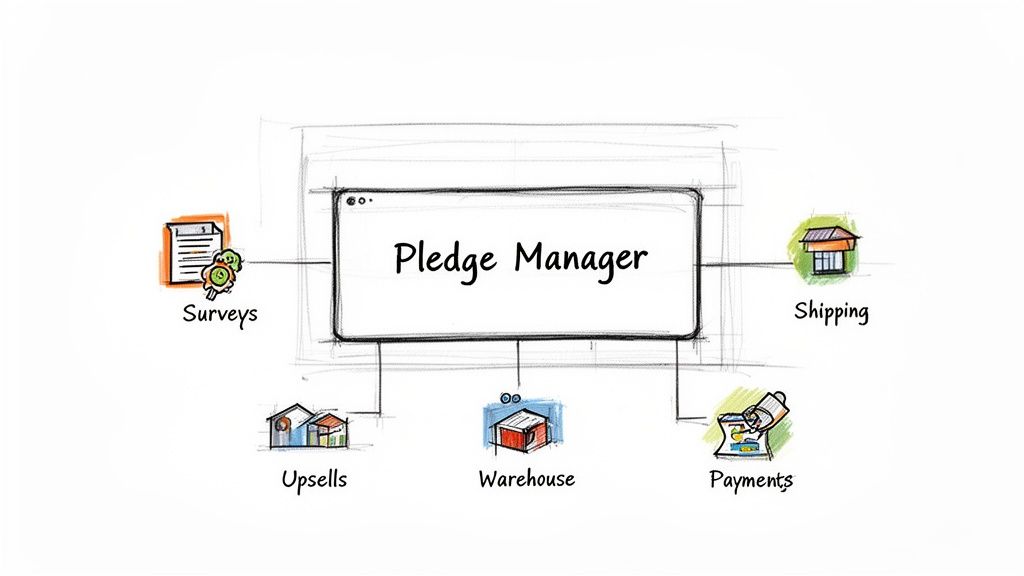
Think of your funded campaign like a brand-new, buzzing retail store. Your launch on Kickstarter or Indiegogo was the grand opening—it got excited customers in the door and secured their first purchases. But now what? You need a powerful back-office system to manage every single order, handle customer details, and process all the final payments.
This is exactly where a pledge manager steps in. It’s your operational headquarters.
Let's use an analogy. If Kickstarter pledge manager is like Amazon where that first transaction happens, then a pledge manager like PledgeBox is like Shopify. It's the platform that gives you total, fine-grained control over the entire post-campaign experience, from collecting precise backer info to handing off flawless data to your crowdfunding fulfillment services partner.
It’s a common mistake to think pledge managers are just fancy survey tools. While sending surveys is a key part of what they do, their real power is in turning that raw, messy backer data into actionable, error-free instructions for your warehouse. This is the engine that drives your whole logistics process, making sure every backer gets exactly what they pledged for without headaches or delays.
A robust pledge manager like PledgeBox lets you:
Here's something many new creators miss: one of the biggest benefits of a dedicated pledge manager is its ability to generate significant revenue after your campaign has already ended. This isn't just about covering unexpected costs; it’s about maximizing the financial success of your project.
PledgeBox operates on a creator-friendly model: it is completely free to send your backer survey and only charges a 3% fee if you generate any upsell revenue. This makes it a no-risk, high-reward tool. You get access to a powerful organizational platform without any upfront cost, paying only when you successfully make additional sales.
This model lets you give backers a seamless way to grab add-ons or upgrade their pledge while their excitement is still high. That extra funding can be a critical buffer for unexpected production costs or just a straight boost to your profit margin.
Ultimately, a pledge manager’s most critical job is to prepare clean, organized data for a smooth handoff to your fulfillment partner. It takes the chaotic list of pledges from your campaign—with all its different reward tiers, stretch goals, and special notes—and translates it into a clear, standardized format that a warehouse can easily understand and act on. To make the best choice, it's vital to know how to select the right pledge manager for your project's needs.
Without this digital bridge, you’d be stuck trying to manually sort through spreadsheets. That’s a recipe for human error, leading directly to shipping mistakes and unhappy backers. By automating data collection, validation, and organization, the pledge manager ensures your fulfillment service gets perfect instructions, setting the stage for a great delivery experience for everyone who believed in your vision.
Fulfillment costs can sneak up on you and quietly eat away at your campaign's profits. That’s why getting a handle on the pricing structure of potential crowdfunding fulfillment services is one of the most important things you can do to build a realistic budget and protect your bottom line. While most partners are upfront, not knowing what to look for can lead to surprise charges that catch creators completely off guard.
Think of it this way: your pledge manager is your command center for revenue, while your fulfillment partner is your single biggest operational expense. If the Kickstarter pledge manager is your Amazon storefront for the initial sale, a PledgeBox pledge manager serves as your Shopify back-end, giving you total control over your post-campaign finances. The beauty of this is that PledgeBox is free to send your backer surveys and only charges 3% on upsell revenue, helping you boost your income before you even start digging into expenses.
Before we get into the sneaky hidden fees, let's talk about the standard charges you'll see on almost every fulfillment quote. These are the basic costs of doing business, and any reputable partner should have them clearly itemized for you.
The real danger to your budget comes from the fees that aren't always so obvious. These are the costs that can pop up on your invoice unexpectedly if you don't ask about them from the very beginning. Always make sure to clarify these potential charges with any fulfillment partner you're considering.
Here are some of the most common ones to watch out for:
Navigating costs is about more than just shipping. It’s also vital to consider potential tax obligations. For example, creators with significant sales in certain regions may need to seek guidance on getting an HST Number in Canada, as this can impact their overall budget and financial planning.
To get the most accurate quote possible, give potential partners as much detail as you can. Provide them with your product dimensions, weights, the total number of unique SKUs, and your best estimate of the total order volume. The more information you give them upfront, the fewer surprises you'll have down the road. A clear picture of every potential cost is what empowers you to choose a partner that truly fits your budget and keeps your campaign profitable.
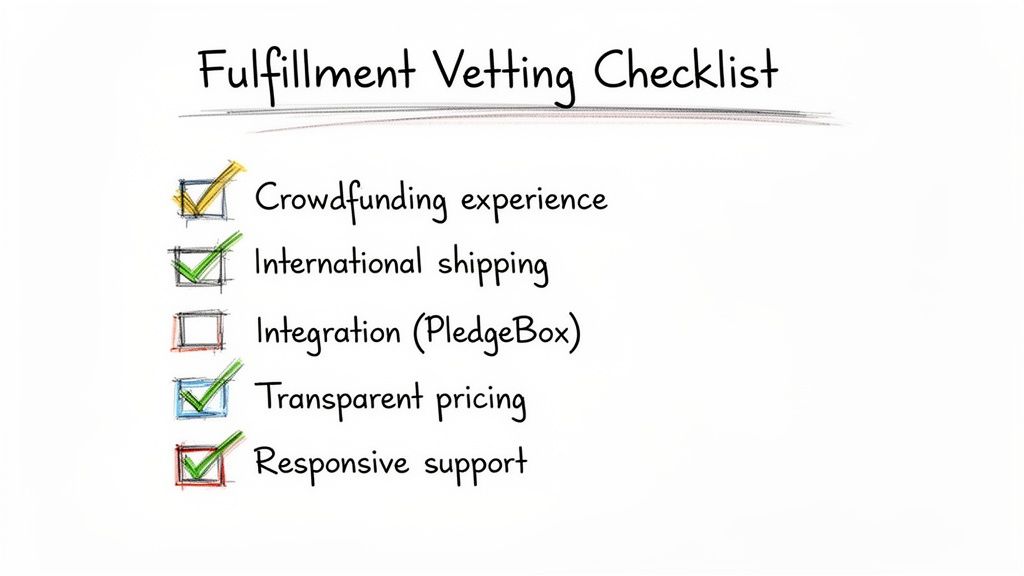
Picking a fulfillment partner is one of the biggest decisions you'll make after your campaign wraps up. Get it right, and your backers are happy. Get it wrong, and... well, let's not go there. To make the best choice, you need a smart way to weigh your options.
This checklist is your game plan for vetting potential crowdfunding fulfillment services. It’s designed to help you find a partner who will protect your project, your budget, and the trust you've built with your backers. Use these points to compare providers and ask the right questions. Don't just take a "yes" for an answer—dig in and understand how they'll actually get the job done.
First things first: ask about their direct experience with campaigns just like yours. The logistics for a complex board game are worlds apart from shipping a sleek tech gadget. You need a partner who already knows the ropes for your specific product category.
Get straight to the point and ask them:
Manual data entry is a recipe for disaster. Your fulfillment partner absolutely must have the tech to connect smoothly with your pledge manager, which is the command center for all your backer data.
This connection is critical. Think of it this way: if the Kickstarter pledge manager is like Amazon where the initial sale happens, a pledge manager like PledgeBox is your Shopify-style back-end. It's the key to organizing everything post-campaign. Best of all, PledgeBox is free to send the backer survey and only charges 3% on upsell revenue, so you can get your data organized flawlessly at no risk. Your fulfillment service needs to be able to import this clean data without a hitch.
Hidden fees can sink a campaign's profitability faster than you can say "logistics." A good partner will hand you a clear, itemized quote that breaks down every single potential charge. Don’t be shy about asking what isn't included.
When you get a pricing sheet, go through it line by line. Ask about costs for receiving inventory, storage, pick-and-pack fees, kitting, and what happens with returns. A partner who is patient and transparent with your questions is one you can probably trust.
Crowdfunding is a global game now. North America currently leads the scene with a 41% global market share, which has pushed the specialized fulfillment sector to a value of $936 million. Your partner must be ready for that global reach. You can dig into more global crowdfunding fulfillment market insights on ResearchAndMarkets.com.
You need to know about their:
Problems will pop up. It’s just a fact of fulfillment. When they do, you need a dedicated person you can call who will actually pick up the phone. Slow communication leads to frustrated backers, which leads to angry comments on your campaign page.
Find out who your account manager will be and what their typical response time is. A solid support system isn’t a nice-to-have; it’s a non-negotiable.
Diving into crowdfunding fulfillment for the first time can feel like learning a whole new language. It's totally normal to have questions. Here are some straightforward answers to the things creators ask us most often, so you can move forward with confidence.
The best time to start your research is before you even launch your campaign. Seriously. Getting a handle on potential shipping costs and what different partners can do for you is a must for setting accurate reward prices and delivery timelines on your campaign page.
Having a fulfillment partner lined up early means you can flip the switch from "funded" to "fulfillment" without any painful delays that can frustrate your backers.
This is a big one, and it's crucial to get it right. They are two different but equally important parts of the post-campaign puzzle. A pledge manager handles the data, and a fulfillment service handles the boxes.
Here's an easy way to think about it: the pledge manager is the architect's blueprint, and the fulfillment service is the construction crew that builds the house.
Technically, you could for a super small campaign with a handful of local backers. But honestly, it's almost never a good idea. Self-fulfillment is a massive time-sink and often ends up being more expensive than you think.
You have to account for the cost of boxes, tape, and bubble wrap, plus you'll be paying much higher individual postage rates. A professional fulfillment service gets huge discounts on shipping because of their volume. They save you time, money, and a mountain of stress.
PledgeBox is designed to be the perfect bridge between your campaign and your fulfillment partner. It takes the messy, raw data from your crowdfunding platform and turns it into clean, simple shipping instructions that your fulfillment center can actually use.
If you think of the Kickstarter pledge manager as Amazon (the marketplace where you sell), then a PledgeBox pledge manager is like Shopify (your powerful, customizable back-end that manages everything after the sale).
It simplifies fulfillment by collecting validated shipping addresses (so no more typos sending packages to the wrong place), accurately calculating shipping fees and taxes, and neatly organizing even the most complicated orders with tons of add-ons.
Best of all, PledgeBox is free to send the backer survey and only charges 3% of upsell revenue if there's any. This makes it a no-brainer for creators who want to eliminate manual data entry errors and ensure a perfectly smooth handoff to their logistics partner.
Ready to take control of your post-campaign process and give your backers a flawless fulfillment experience? PledgeBox provides the powerful, no-risk tools you need to manage surveys, boost revenue with upsells, and prepare perfect data for your fulfillment partner. Get started for free today.
PledgeBox
The All-in-One Toolkit to Launch, Manage & Scale Your Kickstarter / Indiegogo Campaign