 PledgeBox
Build Your 3D Printed Warehouse for Crowdfunding
Discover how a 3D printed warehouse transforms crowdfunding fulfillment. Learn to cut costs, scale production, and streamline operations with PledgeBox.
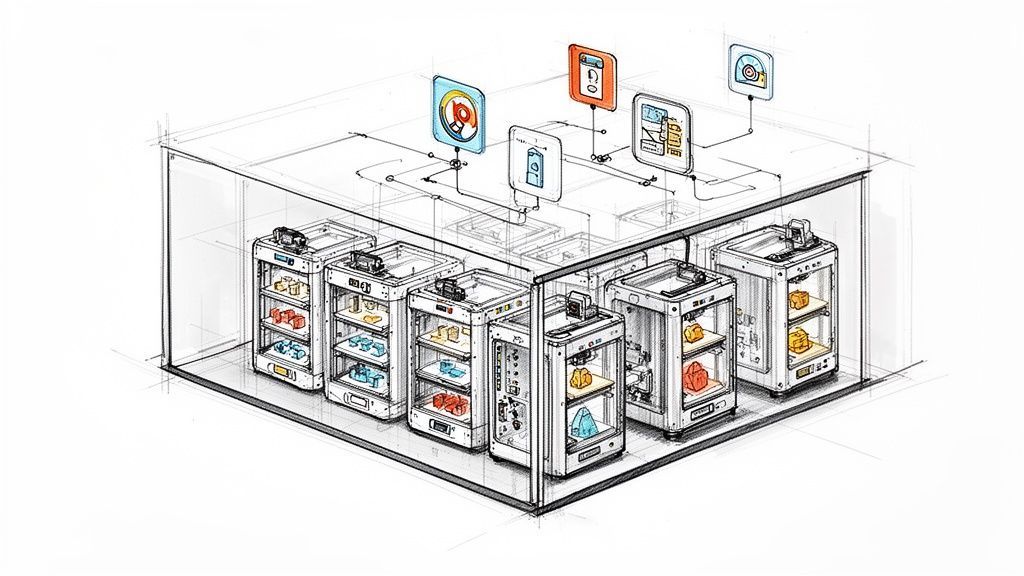
Discover how a 3D printed warehouse transforms crowdfunding fulfillment. Learn to cut costs, scale production, and streamline operations with PledgeBox.
That moment your Kickstarter campaign hits its goal is pure magic.But that exhilarating rush is quickly followed by a massive, nerve-wracking question: how am I going to actually make and ship all of this?
The traditional path—sinking cash into inventory and renting warehouse space—is a recipe for stress and can drain your funds before you even start. This is where a 3D printed warehouse comes in. Think of it not as a physical building, but as a flexible strategy where a network of 3D printers becomes your personal, on-demand factory.

Getting funded is just the starting line. Now you face the real marathon: production and fulfillment. The old-school manufacturing model is a startup's nightmare. You’re forced to pay for expensive molds, commit to producing thousands of units upfront, and then pay to store them, all while hoping your sales projections were spot-on. It's a huge gamble.
A 3D printed warehouse completely flips that script. It’s a "just-in-time" approach where you produce items only after they're ordered, scaling your production perfectly to match your final backer count. This turns fulfillment from a capital-intensive headache into a streamlined, cost-effective process that grows right alongside your success.
This flexible model is possible because additive manufacturing is booming. The global 3D printing market is on track to hit $28-34 billion by 2026, with an estimated 4.5 million printers shipping in 2025 alone.
Here's the key part for creators: 85% of these are affordable desktop machines under $1,000. The barrier to entry has never been lower, giving hardware creators a clear path to scale from a single prototype to full-scale production.
But making things on-demand is only half the battle. You still need a way to manage all those backers, collect their final shipping details, and maybe even offer them some cool extras. This is where a dedicated pledge manager becomes your best friend.
If Kickstarter is the "Amazon" for that first pledge, think of a pledge manager like PledgeBox as your own "Shopify"—it's where you build customer relationships and run your business after the campaign ends.
Even with an on-demand model, a smooth physical workflow is key. For any facility you set up, optimizing your logistics from the start pays off. Considering elements like efficient loading docks with modern high-speed doors for warehouses can seriously improve your entire operational chain.
PledgeBox lets you connect directly with backers post-campaign. You can send out surveys to lock in addresses, calculate exact shipping fees, and offer exciting upsells—like premium materials or custom colors—that you can then produce on demand.
Best of all, PledgeBox is free to send the backer survey and only charges 3% of the upsell if there's any. This guide will walk you through exactly how to combine the power of a 3D printed warehouse with PledgeBox to keep your backers happy and make your project as profitable as possible.
When you hear the term “3D printed warehouse,” your mind might jump to a giant printer building a massive structure from the ground up. While that technology is actually making huge strides, it’s not what we mean in the context of crowdfunding fulfillment. Think of it less as a physical building and more as a modern strategy for production and logistics. It’s like having a factory on-demand, powered by a network of 3D printers ready to go when you are.
This concept isn’t a one-size-fits-all setup; it's a flexible approach that you can adapt to your project. For a crowdfunding creator, a 3D printed warehouse might look like one of these setups:
The main idea here is a powerful shift away from holding a static, pre-made inventory. You’re moving to a dynamic, “just-in-time” system that creates exactly what you need, when you need it, based on your campaign's final backer numbers.
This approach lets you start small and scale up almost infinitely, without the massive upfront investment that traditional manufacturing and warehousing demand. For a solo creator or a small team, this turns a huge logistical headache into a major competitive advantage. You completely sidestep the risk of overproduction and dead stock—two problems that can easily sink a project before it even gets off the ground.
While we're talking about this production strategy, it's worth noting that large-scale 3D printing is also disrupting the actual construction industry. The 3D printing construction market is projected to be worth $3.34 billion in 2026 and is expected to explode to $15.29 billion by 2031. On-site printing already makes up 67.10% of this sector, with incredible projects like a 20,000 m² school in Qatar showing just what's possible today. You can explore more about how 3D printing is changing the construction industry and its performance in this detailed analysis.
The real magic of a 3D printed warehouse happens when you connect it with smart backer management. Think of your Kickstarter campaign as the storefront where backers make their initial pledge—it's a lot like Amazon. But after the campaign, you need a pledge manager, which acts more like your own dedicated Shopify store for sorting out all the post-campaign details.
A pledge manager like PledgeBox is where you turn pledges into real production orders. It’s your command center for talking with backers, confirming their choices, and collecting the critical data that feeds directly into your on-demand manufacturing process.
With a pledge manager, you can see exactly which reward variations are most popular, letting you prioritize your print queue and manage production efficiently. This is also the perfect opportunity to offer exciting upsells, like premium materials or exclusive add-ons. Because you're producing on-demand, you have zero risk in offering these extra options.
This is where the business model gets really good for creators. PledgeBox is free to send the backer survey and only charges 3% of the upsell if there's any, making it a risk-free way to boost your project's funding and profit long after the campaign has ended.
Let's talk numbers. Deciding between a 3D printed warehouse and old-school manufacturing like injection molding is one of the biggest financial calls you'll make. The right answer really boils down to your campaign’s specifics—how many units you need, how complex your product is, and how fast you need to get rewards into your backers’ hands.
If you’re doing a small production run or offering a ton of custom options, 3D printing is almost always the way to go. You get to skip the massive upfront cost of creating molds, which can run into thousands of dollars and just don't make sense for small batches. It also gives you the freedom to tweak designs on the fly based on backer feedback, without it costing you a dime.
But as your order volume grows, the math starts to change. With 3D printing, the cost-per-unit stays pretty consistent. Injection molding, on the other hand, has that big initial hurdle (the mold cost), but the price per item plummets as you start churning out thousands of them. The trick is figuring out your "crossover point"—the exact moment one method becomes cheaper than the other.
This infographic shows just how fast the 3D printing market is blowing up, highlighting its growing size and how much of it is happening on-site.  What this really means is that the tools and services needed to run a 3D printed warehouse are better and more available than ever, making it a seriously solid choice for creators.
Cost is a huge piece of the puzzle, but quality is everything. Modern industrial 3D printers can produce some amazingly precise parts, but keeping that quality consistent across a huge batch of prints takes serious discipline. One poorly calibrated printer or a bad spool of filament can lead to hundreds of junk parts, causing delays and blowing up your budget.
Think about how a giant like Coca-Cola handles its supply chain. They force their suppliers to get certified and only let them buy from an approved list. This guarantees every can of Coke tastes the same, no matter where it's made. You need to bring that same level of rigor to your 3D printing partners. We dive deeper into this in our guide on getting started with 3D printing for Kickstarter.
A solid QA process is your defense against inconsistency. It should cover everything from the moment raw materials arrive to the final post-processing steps before an item is packed for shipping.
And if you’re thinking about setting up your own print farm, don't forget to factor in the ongoing annual maintenance contract costs for the space. That includes everything from keeping the printers running to managing the facility itself.
Here’s a practical checklist to build a QA system you can count on:

Your production partner is just as critical to your campaign's success as your product design. Whether you set up a small in-house print farm or outsource to a professional service, the partner you choose directly impacts product quality, delivery speed, and your budget. This means careful vetting isn’t just a good idea—it’s essential.
Choosing the right partner gives you the reliable production backbone needed for a smooth fulfillment process. A poor choice, on the other hand, can lead to catastrophic delays, unhappy backers, and a damaged reputation. Let’s walk through how to find and evaluate a partner that can truly deliver on their promises.
One of the first big decisions you'll face is whether to work with a single, large 3D printing service or a distributed network of smaller, independent printers. Each path has its own distinct pros and cons.
A hybrid approach can also work wonders. You might use a primary, high-quality vendor for the bulk of your orders and have a few smaller printers on standby for overflow or urgent requests. To get a better handle on the initial steps, you might be interested in our guide on how to start manufacturing for Kickstarter campaigns.
When you start talking to potential partners, you need to ask the right questions. Don't be shy about digging into the details of their operations. A good partner will be transparent and happy to give you the information you need.
Your vetting process is your first line of defense against production disasters. It's how you verify a partner's claims and ensure they can handle the pressure of a real crowdfunding fulfillment cycle.
Before you even think about signing a contract, you need to get some key questions answered. The table below outlines what to ask and, more importantly, why it matters for your campaign.
| Category | Key Question | Why It Matters |
|---|---|---|
| Print Quality | Can you provide a sample print of my product? | This is the only way to truly assess their print quality, surface finish, and dimensional accuracy for your specific design. A generic demo piece won't cut it. |
| Materials | What is your material range and who are your suppliers? | You need to confirm they can source and print with your required materials and ensure consistency from one spool to the next. |
| Capacity | Do you have the machine capacity to meet my volume and timeline? | Be upfront about your projected order volume. You need a direct "yes" or "no" to know if they can handle your project without sacrificing quality for speed. |
| Quality Control | What is your Quality Assurance (QA) protocol for large batches? | A strong QA system (like first-article inspections and a clear process for failed prints) is a sign of a professional operation that can handle scale. |
| Failure Policy | What happens when a print fails? Who absorbs the cost? | No print farm has a 100% success rate. A transparent policy on reprints and waste tells you a lot about their reliability and business practices. |
This checklist is your starting point. A trustworthy partner will have clear, confident answers for every one of these questions. If they seem evasive or unprepared, that's a major red flag that they might not be ready to handle the demands of your successful campaign.

Having a wildly successful campaign is a creator's dream. But that dream can quickly turn into a logistical nightmare. How do you actually scale up production from 100 units to 10,000 without everything falling apart?
This is where your pledge manager becomes the brain of your 3D printed warehouse. It connects your backer data directly to physical production, turning pledges into real, shippable products.
A simple way to think about it is that Kickstarter is your storefront—fantastic for attracting backers and closing the initial sale. A dedicated pledge manager like PledgeBox, however, is your back office. This is where you manage complex orders, build real relationships, and bring in serious post-campaign revenue. It’s the engine room of your entire operation.
Once the confetti settles on your campaign, the real work begins. You have a list of backers, but that’s not the same as having actionable production data. The first job for your pledge manager is to bridge that gap.
With a 3D printed warehouse, the data from your backer survey is everything. It transforms raw pledges into a precise production queue. For instance, knowing that 72% of backers chose "midnight black" while only 28% picked "classic white" lets you schedule your print queues and order materials with pinpoint accuracy.
You're no longer guessing. You're using real-time data from your actual backers to drive every single decision. This "just-in-time" approach is the heart of an efficient, on-demand fulfillment strategy.
One of the best parts of using a pledge manager is the power to offer upsells and add-ons. When paired with a 3D printed warehouse, this becomes a zero-risk way to dramatically increase your total funding. Since you produce items on demand, you can offer an almost endless catalog of extras without ever worrying about unsold stock.
Your post-campaign survey isn't just for collecting shipping addresses; it’s your second chance to sell. It's the perfect moment to present backers with exclusive add-ons they can't get anywhere else, manufactured just for them.
This is your chance to get creative and offer cool options that weren't practical during the main campaign.
This strategy is incredibly effective for boosting your project’s bottom line, and the financial model is built to help creators succeed.
When you're picking a post-campaign tool, the cost structure matters—a lot. This is an area where PledgeBox really shines. The platform is completely free to send the backer survey.
You only pay a small fee on the extra money you make. PledgeBox charges just 3% on the upsell if there's any, and that's it. This means you can tap into this powerful revenue stream with absolutely zero upfront cost or financial risk.
If you don't sell any add-ons, you don't pay a dime. It's a purely performance-based tool that aligns perfectly with a creator’s goals, letting you grow your funding and scale production without the stress.
Okay, so you have your production plan. Now for the most important part: connecting your backer data to your 3D printed warehouse. This is where a dedicated tool like PledgeBox comes in, transforming a mountain of messy backer info into a clean, simple production schedule.
Think of it this way: your Kickstarter campaign was the storefront where backers made their initial pledge. PledgeBox acts as your back-office, the place where you handle all the post-campaign details—managing your new community, gathering essential information, and even driving extra sales. This connection is what makes on-demand manufacturing so powerful.
Getting started is surprisingly fast. You simply export your backer list from Kickstarter and import it straight into PledgeBox. Within minutes, you’re ready to send out a simple, mobile-friendly survey to all your backers.
This survey is your direct line to the data that will fuel your 3D printed warehouse. It’s where you’ll:
Once your backers start filling out their surveys, the real magic begins. PledgeBox crunches the numbers and generates detailed reports that tell you exactly what needs to be made. You can download these reports and send them directly to your 3D printing partner or your own internal print farm, giving them a perfect production order based on actual demand. No more, no less.
After your partner prints and ships the rewards, the process comes full circle. You just upload the tracking numbers back into PledgeBox, and the system automatically fires off shipping notifications to each backer. They'll know exactly when their reward is on the way, keeping them in the loop from start to finish. To see how this bridges the gap between your campaign and final delivery, check out our guide on what PledgeBox is.
This creates a closed-loop system where everything is tracked in one place. It gives you—and your backers—a single source of truth for the entire fulfillment process, from the initial survey to the final delivery confirmation.
This is what turns a collection of 3D printers into a smart, responsive fulfillment engine.
Best of all, you can get started without any risk. PledgeBox is completely free to send the backer survey. We only charge a small 3% fee on the upsell revenue you generate through add-ons. If you don't sell any extras, you don't pay a dime. It's a powerful, cost-effective way to manage the final, most crucial stage of your campaign.
Diving into the world of a 3D printed warehouse is a big step, and it’s totally normal to have questions. It’s a different way of thinking about production, so let's walk through some of the most common concerns we hear from crowdfunding creators.
Getting the details right is what separates a good strategy from a great one.
Not at all. In fact, this model is perfect for solo creators and small teams just starting out. You can literally begin with a single desktop 3D printer and then tap into a professional print service as your backer count climbs.
The term "warehouse" is more about the on-demand production strategy than a physical building you have to own or rent. With desktop printers becoming so affordable, it's one of the most accessible ways for a new creator to get their project made and shipped.
This is where a pledge manager like PledgeBox becomes your best friend. Trying to manage this manually is a recipe for disaster. A pledge manager automates the entire complex process, starting with collecting accurate, final shipping addresses from every single backer.
Even better, it calculates and charges real-time shipping rates and handles VAT or sales tax based on each backer’s location. This is a critical step. Without it, you could easily see your hard-earned profits eaten up by unexpected shipping and tax bills after your campaign has already ended.
Your pledge manager survey is the perfect place for this. Once the campaign is over, you can use PledgeBox to offer backers choices like different colors or materials. You can also introduce exclusive add-ons that weren't even part of the main campaign.
Because you’re producing on-demand with 3D printing, you can offer a huge variety of these upsells with zero inventory risk. If a backer decides they want that premium color, you just print it for them. Simple as that.
The real power comes from the business model. To use an analogy, the Kickstarter pledge manager is like Amazon, but the PledgeBox pledge manager is like Shopify, where you build your business post-campaign. PledgeBox is free to send the backer survey and only charges 3% of the upsell if there's any, making it a powerful and risk-free tool for increasing your total funding.
This approach gives you a simple way to expand your product line and seriously boost your project's bottom line.
Ready to streamline your fulfillment and boost your campaign's revenue? PledgeBox makes it easy to manage backers, collect shipping fees, and sell more with on-demand upsells. Get started for free today and see how our all-in-one toolkit can help your project succeed.
PledgeBox
The All-in-One Toolkit to Launch, Manage & Scale Your Kickstarter / Indiegogo Campaign