 PledgeBox
Kickstarter Brandon Sanderson: the kickstarter brandon sanderson Blueprint
Discover the kickstarter brandon sanderson blueprint for creators: build a loyal community, master fulfillment, and boost revenue with actionable strategies.
Discover the kickstarter brandon sanderson blueprint for creators: build a loyal community, master fulfillment, and boost revenue with actionable strategies.
When people talk about the Kickstarter Brandon Sanderson phenomenon, they’re really talking about his 2022 campaign, "Surprise! Four Secret Novels." This wasn't just another book launch; it was a record-shattering event that completely rewrote the rules for how creators can connect directly with their fans. By raising an incredible $41 million, it became the most-funded project in Kickstarter's history and proved that a loyal, engaged community is the single most valuable asset a creator can have.

In March 2022, the crowdfunding world was turned on its head. Best-selling fantasy author Brandon Sanderson launched a Kickstarter with a simple but audacious premise: he had secretly written four brand-new novels during the pandemic and wanted to ship them straight to his readers. What happened next was a masterclass in community-building and direct-to-fan sales.
This "Year of Sanderson" campaign didn't just hit its goal—it blew past every record that stood in its way. It showed everyone that the bond between a creator and their audience could completely bypass traditional publishers and gatekeepers, generating a level of support nobody thought was possible. For countless aspiring creators, this was a lightbulb moment.
The numbers behind this campaign are just wild. Sanderson's 2022 "Secret Project" Kickstarter pulled in a jaw-dropping $41,756,818 from 185,341 backers by the time it closed on March 31, 2022. The initial $1 million goal was met in a matter of hours, and within three days, it had already soared past $20 million.
But this wasn't some fluke. Sanderson had spent years building trust with his audience through transparent communication and genuine engagement. He showed other creators that a loyal following isn't just an email list—it's a community ready and willing to invest in a vision they believe in. If you're curious how this stacks up against other massive campaigns, check out our article on the highest-funded Kickstarters.
To give a clearer picture of his consistent success, here's a look at his major campaigns over the years.
The "Year of Sanderson" was the peak of a mountain built on years of successful projects. Each campaign taught his team valuable lessons and strengthened the bond with his community, paving the way for the next bigger success.
| Campaign Name | Year | Funding Goal | Amount Raised | Number of Backers |
|---|---|---|---|---|
| The Way of Kings 10th Anniversary Leatherbound | 2020 | $250,000 | $6,788,517 | 29,778 |
| Surprise! Four Secret Novels | 2022 | $1,000,000 | $41,756,818 | 185,341 |
| Words of Radiance 10th Anniversary Leatherbound | 2023 | $250,000 | $9,403,241 | 35,468 |
As you can see, his audience's willingness to support him grew exponentially. This wasn't just about selling books; it was about delivering premium experiences that fans were excited to be a part of.
Pulling off a project of this magnitude hinges on what happens after the campaign ends. This is where backer management tools, or pledge managers, become absolutely critical. To understand the difference between Kickstarter’s built-in tools and a dedicated platform, a simple analogy helps.
The core lesson from the Kickstarter Brandon Sanderson success is crystal clear: a direct-to-fan model, built on trust and consistent value, can outperform traditional systems by an order of magnitude. But to make it work, you need the right tools to manage the logistics.
That's where the business model of a tool like PledgeBox comes in handy. It's free to send your backer survey and only charges 3% of any upsell revenue you generate. This structure means you can streamline your entire fulfillment process and even boost your funding total without any upfront cost—a zero-risk, high-reward choice for any creator.

The incredible success of the Kickstarter Brandon Sanderson campaign didn't just happen. It was the payoff from more than a decade of intentionally building a deep relationship with his readers. This wasn't about marketing gimmicks; it was about genuine community, built on a foundation of trust and total transparency.
For years, Sanderson used his website, newsletters, and direct interactions to pull back the curtain on his work. He’d share incredibly detailed progress reports on his novels, talk about the business of publishing, and even post his annual "State of the Sanderson" updates to map out his plans. That level of openness turned passive readers into a dedicated army of fans who felt like they had a real stake in his success.
The big lesson here? Treat your followers like partners on your journey, not just a list of potential buyers. Sanderson didn't just build an email list; he cultivated a worldwide fandom that felt like an extension of his own team. That’s a powerful mindset shift for any creator.
So, when he announced the "Four Secret Novels," his community didn't see it as another product launch. To them, it was an exciting new chapter in a story they were already a part of. To build a community that can fund big dreams, you have to nail your community building strategies. The goal is to make your launch feel less like a start date and more like a can't-miss cultural event for your audience.
This approach demands consistent, authentic engagement long before you even dream of launching. It means sharing the behind-the-scenes moments, answering questions directly, and celebrating every little win with your audience.
The good news is that modern tools make it easier than ever to follow Sanderson's community-first playbook. A huge part of a successful Kickstarter today is the momentum you build before you launch. This pre-launch window is your chance to capture interest, prove your idea has legs, and guarantee a flood of pledges on day one.
Think about these essential pre-launch steps:
By the time you hit "launch," you shouldn’t be searching for backers—you should be activating a community that’s been waiting for the green light.
The most successful crowdfunding campaigns are often funded by a pre-existing community. Building that audience beforehand turns the launch into a celebration, not a sales pitch, driving the early momentum needed to attract new backers.
This strategy completely flips the script on a typical campaign. Instead of a slow, nerve-wracking start, you get a powerful launch day that can trip Kickstarter's algorithms and get your project in front of thousands of new people. The Kickstarter Brandon Sanderson campaign proved that when you invest in your community, they will invest back in you tenfold—and turn your creative dreams into a funded reality.
Once the confetti settles and the funding total is locked in, the real work begins. For a campaign on the scale of the Kickstarter Brandon Sanderson phenomenon, raising $41.7 million from 185,341 backers wasn't the finish line; it was the starting pistol for a logistical marathon. This is where your post-campaign command center—the pledge manager—becomes the most important tool in your arsenal.
The choice of which tool to use is absolutely critical. To really get it, think of it like setting up an online store right after a massively successful product announcement.
One path is using Kickstarter's built-in survey tool. This is like selling your products on a huge marketplace like Amazon. It's standardized and gets the job done for simple projects, but its functionality is basic, leaving little room for customization or handling complexity.
The other option is a dedicated pledge manager like PledgeBox. This is like launching your own powerful Shopify store. You get complete control over the entire post-campaign experience, creating a custom, branded home for your backers while handling all the messy logistics and even opening up new ways to raise funds.
This difference becomes massive for big, complicated projects. When you’re dealing with things like:
A basic survey tool just can't keep up. The Sanderson team, having learned from previous campaigns like The Way of Kings leatherbound, knew that a powerful system was non-negotiable to prevent a logistical nightmare. For anyone trying to figure this out, our guide on how to select the right pledge manager breaks it all down.
For many creators, the thought of paying for another service after giving Kickstarter its cut can be a tough pill to swallow. This is where the business model of a pledge manager really matters. Many platforms charge upfront fees, per-backer fees, or a percentage of your total campaign funds.
PledgeBox works on a totally different model, one that’s built to help creators, not just take a slice of the pie.
A key advantage of PledgeBox is its pricing structure. It is completely free to send your backer survey to all your backers. The platform only charges a small 3% fee on upsell revenue—that is, money generated from add-ons backers purchase after the campaign.
This model makes it a zero-risk, high-reward decision. You get access to a powerful suite of tools for fulfillment without any upfront cost. If you don't sell any add-ons, using the platform to collect addresses and manage pledges costs you absolutely nothing. If you do, you're only paying a tiny fraction of new money you wouldn't have earned otherwise.
This kind of financial model is a game-changer for creators of all sizes. For a small, first-time creator, it removes the financial barrier to using professional-grade tools. For a massive campaign like Brandon Sanderson's, it provides a powerful engine to boost the final funding total while making sure every backer's order is handled perfectly.
The big lesson from the Kickstarter Brandon Sanderson experience is that true success depends on planning for what comes after the campaign funds. By choosing a post-campaign command center that offers both logistical power and a creator-first business model, you can turn the chaos of fulfillment into a smooth, profitable, and successful operation.
The moment a massive Kickstarter campaign like Brandon Sanderson's wraps up, the real challenge begins. Raising $41.7 million is an incredible achievement, but actually delivering physical rewards to nearly 200,000 backers around the world? That’s an entirely different beast. This is the fulfillment phase, a massive logistical puzzle where one small mistake can snowball into a costly mess and break the trust you've built with your community.
For the Kickstarter Brandon Sanderson campaign, this meant shipping hundreds of thousands of books and swag boxes over an entire year. That kind of scale requires a fulfillment plan with almost military precision. Luckily, Sanderson’s team wasn't flying blind. They had a secret weapon: a full-scale dress rehearsal.
Two years before the record-breaking Secret Projects campaign, Sanderson's team launched The Way of Kings 10th Anniversary Leatherbound Kickstarter. It was a smash hit on its own, raising nearly $6.8 million. But its real value was as a live test run. It gave them a chance to build and fine-tune the exact logistical muscles they would need for a much, much bigger project.
They learned firsthand about the headaches of collecting accurate shipping fees, managing international addresses, and juggling multiple fulfillment partners. This 2020 campaign was crucial for getting them comfortable with the immense amount of data involved in self-publishing. As one analysis notes, this direct-to-fan approach completely reshaped their strategy, as detailed in what Brandon Sanderson’s Kickstarter success reveals.
That experience laid the foundation for the "Year of Sanderson." They learned that modern tools weren't just a nice-to-have; they were absolutely essential to pulling it off.
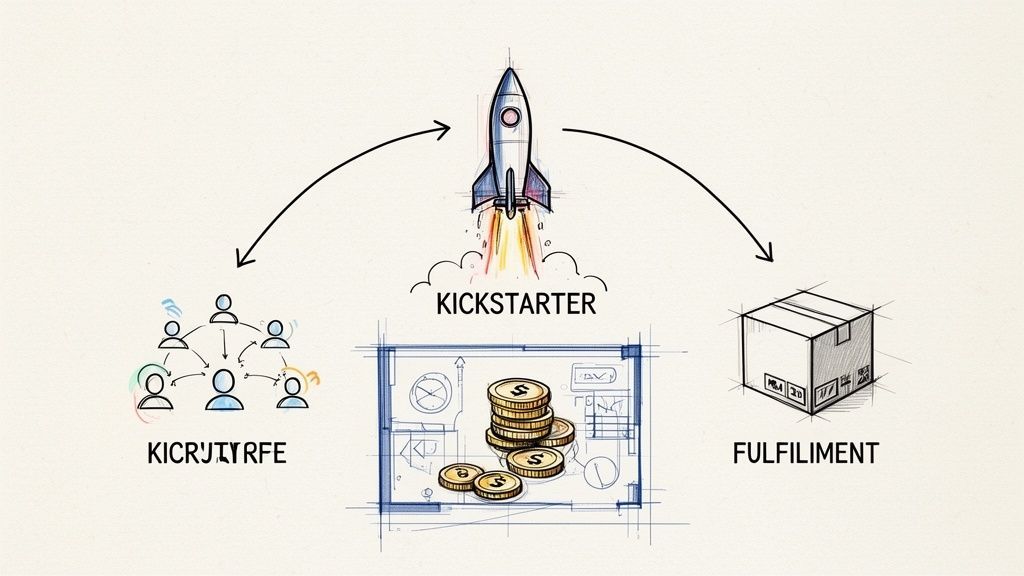
This diagram shows the key steps in a modern crowdfunding fulfillment process and highlights where a pledge manager comes into play.

As you can see, moving from Kickstarter's basic survey to a powerful pledge manager like PledgeBox creates a dedicated, customizable storefront experience for your backers.
The lessons from the Kickstarter Brandon Sanderson campaigns give us a clear blueprint for any creator shipping physical rewards. It all comes down to a few core components that automate work, prevent errors, and keep your backers in the loop.
Think of it this way: Kickstarter’s pledge manager is like a basic order form on a marketplace like Amazon. A pledge manager like PledgeBox, on the other hand, is the full e-commerce backend for your campaign—the difference between a basic checkout and a robust system like Shopify.
Better yet, PledgeBox is free to send your backer survey. We only take a small 3% fee on any revenue you make from upsells, which makes professional-grade tools accessible to every creator.
One of the most critical lessons from large-scale projects is the importance of accurate data. An incorrect address for one backer is an annoyance; for 10,000 backers, it's a financial and logistical nightmare.
To sidestep this, modern fulfillment relies on integrated features that are no longer luxuries but standard practice for any serious project:
Ultimately, the fulfillment success of the Kickstarter Brandon Sanderson campaign wasn't magic. It was the direct result of smart planning, learning from experience, and using the right tools to manage an incredibly complex operation from the initial pledge all the way to the final package.
For experienced creators, the end of a Kickstarter campaign isn't the finish line—it’s the start of a whole new phase. A wildly successful project like the Kickstarter Brandon Sanderson campaign doesn't just stop when the timer runs out. It shifts gears. A smart post-campaign strategy can add a significant chunk to your total funds, turning that 30-day rush into a longer-term revenue stream.
The secret is tapping into the excitement of your backers. These are people who have already bought into your vision and are emotionally invested in what you're making. This makes them the perfect audience for exclusive merchandise, signed editions, or cool add-ons, especially when offered in a simple, clean survey experience. This is exactly where a dedicated pledge manager makes all the difference.
While Kickstarter’s basic survey does the job of collecting addresses, a real pledge manager turns that simple form into a full-blown branded storefront. Think of it this way:
This dedicated storefront is where you can really see your earnings grow. By offering compelling add-ons—anything from small enamel pins to big-ticket items like art books—you give your biggest fans another chance to show their support.
To really see what's at stake, let's compare what a standard platform manager gives you versus a dedicated tool like PledgeBox. The difference in what you can do for your revenue and logistics becomes obvious pretty quickly.
| Feature | Standard Kickstarter Manager | PledgeBox Pledge Manager |
|---|---|---|
| Upsell Storefront | Not available. Surveys are for data collection only. | Fully customizable storefront to sell add-ons and drive extra revenue. |
| Late Pledges | Not supported. You lose anyone who missed the campaign. | Create a pre-order store to capture sales from latecomers. |
| Address Validation | Basic text fields. Prone to typos and errors. | Google Maps-powered validation to reduce shipping errors and costs. |
| Cost Structure | Included in Kickstarter's platform fee. | Free to send surveys. Only a 3% fee on upsell revenue. |
That last point is a game-changer. The PledgeBox model is built to be completely risk-free for creators. You get professional-grade tools to manage fulfillment and increase your funding, but you only pay a small 3% fee on the new money you raise from add-ons. If you don't happen to sell any upsells, the service costs you absolutely nothing to manage all your backers.
Beyond upselling to your existing community, there’s a massive opportunity with fans who missed the campaign window. A pledge manager lets you set up a "late pledge" or pre-order store. This storefront essentially keeps your campaign alive, capturing sales from people who found your project a day too late or just couldn't pledge at the time.
For a project with the kind of visibility the Kickstarter Brandon Sanderson campaign had, a late pledge store could generate a huge amount of extra revenue. It stretches a 30-day funding event into a months-long sales period, making sure no potential supporter gets left behind. When you combine powerful upsell features with a late pledge store, you can dramatically increase your final funding total long after the Kickstarter clock has stopped ticking.
When Brandon Sanderson launched his record-breaking Kickstarter, it wasn't just a big win for one author. It sent a shockwave through the entire creator economy, coining what many now call the 'Sanderson Effect.' At its heart, this was a powerful, real-world demonstration that a direct-to-fan model can not only compete with but completely outperform traditional industry gatekeepers.
This effect has inspired creators of all kinds—from board game designers to indie filmmakers—to rethink how they bring their work into the world. It’s a fundamental shift in mindset. Instead of chasing publishers, studios, or investors, creators are waking up to the power they can build by mobilizing their own communities. This approach doesn't just cut out the middleman to maximize revenue; it builds a far more authentic connection with the audience. Fans stop being simple consumers and become true partners in the creative journey.
The impact on crowdfunding was immediate and clear. Sanderson’s success fueled a 21.7% rise in funded publishing projects on Kickstarter from 2022-2024, and some in the industry even called 2023 the 'Year of Sanderson.' It proved that audiences in major markets like the US and UK are eager to support creators directly. You can read more about how this campaign reshaped crowdfunding benchmarks.
This shift in publishing isn’t happening in a vacuum. To see how these dynamics are playing out elsewhere, just look at Michael J. Sullivan's insights on self-publishing earnings versus traditional deals. Much like Sanderson, Sullivan shows how independent creators can gain far more financial control and creative freedom by taking the direct route.
It’s easy to look at a $41 million campaign and write it off as a unicorn—a perfect storm of celebrity and timing that you could never replicate. But thinking that way misses the real lesson here. Sanderson’s success wasn't a magic trick. It was the result of a deliberate, long-term strategy built over years of genuine community engagement, total transparency with his fans, and consistently delivering on his promises.
Sanderson's campaign is not an unrepeatable anomaly but a proven blueprint. The underlying principles—building a loyal community, offering genuine value, and managing logistics with the right tools—are scalable and adaptable for creators at any level.
When you boil it down, the Sanderson Effect isn't really about raising tens of millions of dollars. It’s about understanding that the most valuable asset you have is the direct line to your audience. When you put that community-first mindset into practice and back it up with a smart strategy and the right tools, you can turn your creative passion into a sustainable, independent career—powered by the very people who believe in your work the most.
Seeing a campaign like the Kickstarter Brandon Sanderson project raise $41 million is a huge source of inspiration. But it can also feel a little out of reach, leaving many creators wondering if there are any real lessons for those of us who aren't world-famous authors.
Let's break down some of the most common questions and get to the core strategies that you can actually use for your own projects, no matter the size.
While hitting a $41 million funding goal is an outlier, the foundational strategy behind it is something any creator can copy. Sanderson’s success wasn't just a stroke of luck; it was the payoff from years of building a dedicated community before the campaign ever went live.
The real lesson here is to stop worrying about the final number and focus on genuine engagement. A creator with 1,000 true fans who trust them is in a much stronger launch position than someone with 100,000 followers who barely pay attention. This approach—building your community first—works for everyone, turning even a small, dedicated audience into a powerful engine on launch day.
A pledge manager is your post-campaign command center. It’s a tool that lets you gather shipping addresses, handle complex global shipping and tax calculations, and, most importantly, give backers a chance to buy add-ons or upgrade their pledges. It takes the basic post-campaign survey and turns it into a powerful tool for fulfillment and extra revenue.
Think of it this way: Kickstarter's pledge manager is like an Amazon marketplace—it's rigid and one-size-fits-all. A dedicated pledge manager like PledgeBox is more like your own Shopify store, giving you full control. Critically, PledgeBox is free for sending your backer survey and only charges a 3% fee on funds you raise from upsells. This model means you get all the power to prevent logistical headaches and boost your funding without any upfront risk.
Every creator needs to budget for platform fees. For Kickstarter, this typically breaks down into two parts: a 5% platform fee on the total funds raised, plus payment processing fees that usually land somewhere between 3% and 5%.
On a massive campaign like Sanderson's, that meant over $2 million went to platform fees. But even with those costs, the creator still keeps around 90% of the revenue. That’s a far better deal than traditional publishing or retail, and it's exactly why so many creators are choosing this direct-to-fan model for the financial control and audience connection it offers.
Ready to apply these lessons to your own campaign? PledgeBox provides the all-in-one toolkit to manage your backers, handle fulfillment, and boost your revenue with a powerful, risk-free pledge manager. Find out how you can streamline your next project.
PledgeBox
The All-in-One Toolkit to Launch, Manage & Scale Your Kickstarter / Indiegogo Campaign