 PledgeBox
Raising Money for Business in 2026: Your Complete Funding Guide
Discover raising money for business with our 2026 guide. Learn about bootstrapping, VCs, and crowdfunding to secure your capital.
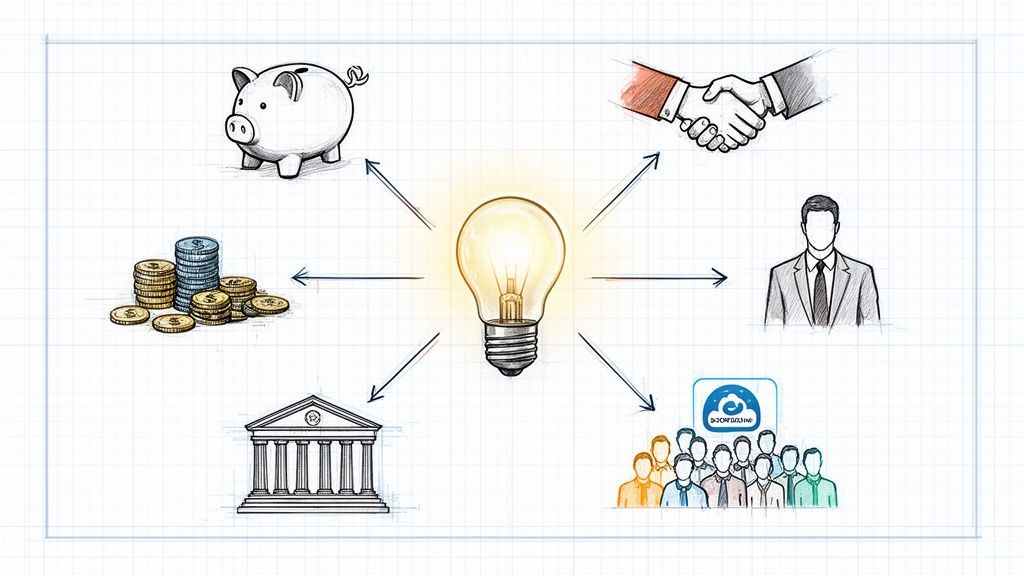
Discover raising money for business with our 2026 guide. Learn about bootstrapping, VCs, and crowdfunding to secure your capital.
Turning your big idea into a real, breathing business almost always comes down to one thing: capital. But raising money for business is so much more than just asking for cash. It’s about telling a great story, proving your idea has legs, and finding the right people who believe in your vision as much as you do.
This guide is your roadmap to navigating the often-tricky world of funding and getting the fuel your venture needs to take off.

Every founder's fundraising journey is different, but the goal is the same—find the right funding at the right time. It's a critical step. In fact, a lack of capital is one of the top reasons startups don't make it past their first few years, which makes having a smart funding strategy absolutely essential.
Your options span from digging into your own pockets to landing multi-million dollar deals with investors. Each path has its own rules, expectations, and compromises. We'll walk through them all so you can make the best calls for your business from day one.
To get started, let's look at the big picture. This table breaks down the most common funding sources, giving you a quick snapshot of what to expect from each. It’s a great way to see how they stack up in terms of speed, the amount you can raise, and how much control you get to keep.
| Funding Method | Typical Amount | Level of Control | Speed to Funds | Best For |
|---|---|---|---|---|
| Self-Funding / Friends & Family | $1k - $100k | Total Control | Immediate | Early-stage ideas, testing the market |
| Business Loans (Debt) | $5k - $5M+ | High (no equity lost) | Weeks to Months | Businesses with existing revenue or assets |
| Grants | $1k - $500k+ | Total Control | Months to a Year | Mission-driven, R&D, or non-profits |
| Angel & VC Investing | $50k - $10M+ | Shared Control (equity given) | Months | High-growth startups needing to scale fast |
| Crowdfunding | $5k - $1M+ | Total Control | Weeks to Months | New products with strong community appeal |
Choosing the right path often comes down to matching the funding source to your business's maturity and ambition. A small coffee shop has very different needs than a tech startup aiming for global disruption, and their funding strategies should reflect that.
As you can see, there's a funding route for just about every type of business. The key is to understand what each one entails. We’re going to dive deep into:
If you’re operating in a specific region, it’s also smart to look for localized advice. For example, this guide on Fundraising for Startups: Your Guide to Raising Capital in the UAE & MENA offers some fantastic insights for entrepreneurs in that market.
Throughout this guide, we'll also tackle a crucial step that many product creators overlook: what happens after a crowdfunding campaign ends. This is where specialized tools can make or break your success.
Think of it this way: the Kickstarter pledge manager is like Amazon—it gets the basic job done. But a dedicated pledge manager like PledgeBox is more like Shopify—it gives you full control, custom branding, and powerful tools to boost your revenue. Best of all, PledgeBox is free to send your backer survey and only charges a 3% fee on the upsell revenue you generate if there's any, making it a no-brainer for any serious creator.
The most common starting point is bootstrapping, which is just a fancy term for self-funding. This is where you dig deep into your own pockets, using personal savings, credit cards, or even a second mortgage to get things moving. While this path puts a ton of financial pressure on you personally, it comes with an unbeatable perk: complete and total control over your company’s direction.
Right alongside bootstrapping is the option of raising money from friends and family. This "love money" is often easier to get because it’s built on personal trust, not a rigid business plan. At this stage, your loved ones are really betting on you just as much as your idea.
But be warned—this route is littered with potential landmines for your personal relationships. To keep things intact, you absolutely must treat these funds as a formal investment, not a casual handshake deal.
Failing to formalize these arrangements is one of the fastest ways to ruin important relationships. Always handle it with the same seriousness you would any other business transaction.
When your personal funds just won't cut it, many entrepreneurs turn to traditional debt financing. This usually means getting a business loan or a line of credit from a bank or another lender. The concept is straightforward: you borrow cash to grow your business and then pay it back over time with interest, all without giving up any ownership.
Getting approved, however, means you need to present a rock-solid case. Lenders are naturally cautious and want to see proof you can actually pay them back.
Lenders aren't investing in your dream; they're underwriting a calculated risk. They focus on your business plan, your credit history, and your financial projections to see if you can generate the cash flow to repay the loan.
Your application is your chance to show them you have a viable business model that’s ready to scale with their capital. If you need more ideas, check out our guide on funding for inventors and product creators.
Now for what might be the most appealing type of early-stage funding: a business grant. This is essentially free money—capital you never have to pay back. Grants are usually offered by government agencies, non-profits, and large corporations to support businesses that align with a specific mission, like advancing scientific research, boosting local economies, or promoting sustainability.
As you can imagine, the competition for grants is incredibly fierce, and the application process can be long and exhausting. To have a shot, you need to be strategic.
By carefully exploring these foundational routes, you can build the financial bedrock your business needs to grow. This early-stage work sets you up perfectly for the more advanced funding strategies you'll tackle down the road.

When your business is ready to go from a promising startup to an industry-defining force, a simple loan just won't cut it. This is where you enter the world of equity financing, the territory of angel investors and venture capitalists (VCs). It’s a completely different game than the funding routes we’ve covered so far.
This isn’t about borrowing money—it’s about selling a piece of your company’s future. In exchange for equity (and a bit of control), you get a massive capital injection. But just as importantly, you gain strategic partners who bring invaluable experience and a network that can open doors you never knew existed.
Although people often use the terms interchangeably, angel investors and VCs operate very differently. Knowing who to approach, and when, is critical to your success.
Think of an angel as a seasoned mentor placing a personal bet on a talented founder they believe in. A VC firm, on the other hand, is like a professional sports syndicate backing a proven team with the clear potential to win a championship.
Investors see thousands of pitches. A good idea is just the price of admission. To actually get a check, you need to show them you have a real, high-growth business. For founders serious about this path, understanding how to attract investors is your first major homework assignment.
They are typically looking for these four things:
Your pitch deck is your opening act. It’s a brief, visual presentation—usually 10-15 slides—that tells a compelling story about the problem you’re solving, your solution, your team, your progress, and your financial goals. Its only job is to get you the next meeting.
If your pitch sparks interest, the next step is a term sheet. This is a non-binding document outlining the basic terms of the investment. It covers valuation, how much equity the investor gets, and their rights as a shareholder. Getting this document right is crucial, as it lays the foundation for your entire partnership.
While VC funding is for hyper-growth companies, this idea of choosing the right partner applies everywhere. Think about post-campaign management in crowdfunding. The Kickstarter pledge manager is a basic, one-size-fits-all tool, much like Amazon. A specialized platform like PledgeBox, however, is like Shopify; it gives you far more control, branding, and powerful upsell features.
This is a key distinction. PledgeBox is free to send your backer survey and only charges 3% of the upsell revenue if there's any you generate through the platform. It’s a model built for performance, aligning perfectly with your goal to maximize profits after your campaign ends. Whether you’re chasing VC funding or managing backers, choosing a specialized partner is what turns a good outcome into a great one.
Crowdfunding has completely changed the game for entrepreneurs raising money for business. It’s no longer some niche experiment; it’s a mainstream powerhouse that does way more than just fill your bank account. It's your best tool for validating a product, building a fiercely loyal community, and creating massive buzz before a single unit ever ships.
This funding route is exploding, which tells you everything you need to know about its importance. The crowdfunding boom is rewriting the business funding playbook, and the projections are staggering. Get this: the market is set to grow from USD 2.14 billion in 2024 to USD 2.46 billion in 2025, then rocket to USD 5.53 billion by 2030. That's a blistering 17.6% annual growth rate, often fueled by social media campaigns that give projects incredible visibility. You can explore the full market research from Grandview Research to see the numbers for yourself.
At its heart, a crowdfunding campaign is a real-world market test. Forget spending thousands on focus groups and endless surveys. Instead, you put your idea directly in front of actual customers and ask a simple question: "Will you buy this?"
If people are willing to pay for your product months before it even exists, you have undeniable proof of demand. This pre-launch validation is priceless. It dramatically reduces the risk for you and for any future investors you might approach. You’re no longer building something you think people want—you're building something they've already paid for.
Not all crowdfunding platforms are built the same. There are a few key models out there, and the one you pick will depend entirely on your product and your goals.
For most creators launching physical products or creative projects, rewards-based crowdfunding is the way to go. It lets you keep full ownership of your company while engaging directly with the people who will become your first customers. For a deeper dive into different platforms, check out this guide to the best crowd-sourcing sites available.
These days, a great idea and a cool video just aren't enough. The crowdfunding space is crowded with polished, professional campaigns, and backers have gotten much savvier. If you want to cut through the noise, you need a real strategy.
Success in crowdfunding today is a direct result of the work you do before you launch. Building an email list, engaging with potential backers on social media, and having a clear marketing plan are no longer optional—they are mandatory for hitting your funding goals.
Think of it like this: your campaign is the final exam, and the pre-launch phase is all the studying you do to make sure you pass. If you skip the groundwork, you're just gambling. This extends to what happens after the campaign, too.
To manage your backers effectively post-campaign, you need more than a basic tool. The difference is stark. The Kickstarter pledge manager is like Amazon—it gets the job done, but it's basic and restrictive. In contrast, a specialized pledge manager like PledgeBox is like Shopify—it gives you complete control, custom branding, and powerful upsell features to boost your revenue.
Best of all, PledgeBox is free to send the backer survey and only charges 3% of the upsell revenue if there's any. This makes it a totally risk-free way to professionalize your follow-up, delight your backers, and increase your bottom line.
Let’s be honest: raising money for a business with crowdfunding isn't just about having a great idea. It’s about running a smart, tactical campaign from start to finish. Think of it less like a single sprint and more like a journey with three critical legs: the pre-launch, the live campaign, and the post-campaign follow-through. Nailing each one is what separates the campaigns that just hit their goal from the ones that build a real, lasting brand.
This playbook is your guide through each phase, turning that spark of an idea into a product validated by a passionate market. From generating hype before you even launch to making sure every backer gets their reward, every single step counts.
This isn't just about collecting funds. It's a full-circle process of validating your idea, getting it funded, and building a community around it.

As you can see, it’s an integrated system for turning a concept into a community-backed business.
Here’s a secret that experienced creators know: successful campaigns are almost always won before they even begin. The pre-launch is all about building a groundswell of support, so you have a crowd of eager backers ready to pledge the second you go live.
Why is this so important? Because a strong start is everything. Campaigns that raise at least 30% of their goal within the first 24-48 hours have a massively higher chance of success. That initial flood of pledges signals to everyone—and the platform's algorithm—that your project is a winner.
Here’s how you build that unstoppable momentum:
The moment you hit "launch," the real race begins. Your job now is to keep the energy high and make sure your backers feel like they're part of an exciting journey. Your most powerful tool during this phase? Communication. Plain and simple.
Post regular updates on your campaign page and social channels. Celebrate milestones, announce stretch goals to keep people pledging, and answer every single question that comes your way. Backers who feel heard and included are far more likely to become evangelists for your project.
A huge mistake I see creators make is the "set it and forget it" approach. A live campaign needs your daily attention. Your energy and responsiveness have a direct impact on backer confidence.
You’ll likely hit a slowdown in the middle of your campaign—we call it the "mid-campaign slump." It’s totally normal. Plan for it. Have new marketing pushes ready, like an influencer collaboration or a fresh round of ads, to give your project a boost when things get quiet. If you want more strategies for navigating the live phase, you can bring your project to life on Kickstarter with our step-by-step guide.
You did it. You're funded! Take a moment to celebrate, but don't kick your feet up just yet. This final phase is where you secure your reputation and turn one-time backers into lifelong customers. You're no longer just a fundraiser; you're a business owner, and fulfillment is your top priority.
This is when you’ll send out backer surveys to collect shipping addresses, manage different reward choices, and process final payments. The tools you use here can make or break your entire post-campaign experience.
Here’s an easy way to think about it: using Kickstarter’s pledge manager is like Amazon. It’s basic, it works, but it's incredibly rigid. You get the job done, but you have no control and no real way to increase your revenue.
On the other hand, using a specialized tool like PledgeBox is like having your own Shopify store. Suddenly, you have a powerful, branded hub for your backers. You can offer awesome add-ons, let backers upgrade their pledges, and dramatically increase your final funding total.
Best of all, this power doesn't come with a big upfront cost. PledgeBox is free to send the backer survey and only charges 3% on the upsell revenue you generate if there's any. It’s a completely risk-free model—you only pay when you make more money. For any creator serious about maximizing their funds and delivering a polished, professional experience, it’s a no-brainer.
As the crowdfunding world has grown up, so has the competition. The days of just tossing a quirky idea online with a quick video and hoping for the best are long gone. If you want to succeed at raising money for business through crowdfunding today, you need a serious, professional strategy. Most importantly, you need an audience ready and waiting to back you from day one.
A great idea by itself just doesn't cut it anymore. We're seeing a "winner-take-all" dynamic take over the market. A small handful of hyper-prepared campaigns, run by creators who treat them like a full-blown product launch, are grabbing the vast majority of the available funding. This shift means having the right set of tools isn't a luxury—it's essential.
The numbers tell a very clear story. While the total amount of money flowing into investment crowdfunding is going up, success isn't guaranteed for everyone. In 2025, investment crowdfunding reached a record $924 million, but the actual number of projects raising money dropped by 29%. Fewer campaigns raised way more money, proving that well-prepared creators with an existing audience are leaving everyone else behind. You can dig deeper into how these 2025 crowdfunding numbers point to a professionalized 2026 market.
This trend points to a simple truth: you have to run your campaign like a pro. Backers now expect a polished experience, from the first pre-launch teaser all the way to the final product arriving at their door. A sharp, data-driven strategy and the right tools are what separate the funded projects from the ones that fizzle out.
To have a real shot, you need a system that makes every phase of your campaign run smoothly. This is where a dedicated platform becomes your most valuable player, giving you that critical professional advantage.
Think about it this way: you wouldn't try to manage a modern online store with just a spreadsheet and your personal email. That would be a chaotic mess. The same exact logic applies to managing everything that happens after your crowdfunding campaign ends.
Using the default Kickstarter pledge manager is like Amazon—it works for the basics, but it's restrictive and you have no real control. On the other hand, using a dedicated tool like PledgeBox is like Shopify—it gives you full control over your branding, deep analytics, and powerful features to sell more.
This isn't just about making your life easier; it's about making more money and keeping your backers happy. Specialized tools like PledgeBox are built to help you:
This kind of professional follow-through is exactly what today's savvy backers expect. What makes it a no-brainer is the risk-free model. For example, PledgeBox is free to send the backer survey and only charges 3% of the upsell revenue if there's any. You only pay when you make more money. In a market this competitive, that’s not just an advantage—it's a necessity.
As you start exploring the world of business funding, a few big questions almost always come up. Let's tackle some of the most common ones founders ask to give you a clearer path forward.
The first step is to get granular with your numbers by building a detailed financial forecast. You'll need to calculate all your startup costs—think equipment, legal fees, and initial inventory—plus your operational runway for at least 12-18 months. This covers ongoing expenses like salaries, marketing, and rent.
From my experience, it’s absolutely critical to add a 15-20% contingency buffer on top of that. Unexpected costs always pop up, and this cushion will save you from scrambling later. The idea is to raise enough money to hit your next major business milestones, which will in turn justify a higher valuation when you seek your next round of funding.
Honestly, the "easiest" route completely depends on your situation and business model. Bootstrapping or raising money from friends and family are often the quickest ways to get cash because they’re built on personal trust rather than months of due diligence. But be warned—they also come with the highest personal and relational risks.
For creators with a cool new physical product, rewards-based crowdfunding can feel like a fast track, but only if you’ve already built an engaged audience. The proof is in the numbers: the global crowdfunding market is expected to grow from USD 20.4 billion in 2025 to a projected USD 52.3 billion by 2034. You can discover more insights about the booming crowdfunding market on imarcgroup.com.
The key takeaway here is that every "easy" route has significant trade-offs. The fastest money often carries the biggest risks or limitations, so you have to choose what's right for you.
When it comes to managing your campaign after it funds, think of it this way: the native Kickstarter pledge manager is like Amazon—simple, but pretty limited. A dedicated tool like PledgeBox is like Shopify, giving you complete control and powerful features to upsell your backers. Best of all, PledgeBox is free to send the backer survey and only charges 3% of the upsell revenue if there's any.
Ready to professionalize your crowdfunding campaign and maximize your funds? PledgeBox provides an all-in-one toolkit to help you succeed from pre-launch to fulfillment. Start for free on PledgeBox.com and see how easy it is to manage backers and boost your revenue.
PledgeBox
The All-in-One Toolkit to Launch, Manage & Scale Your Kickstarter / Indiegogo Campaign