 PledgeBox
What Is Average Order Value and How Do You Supercharge It?
Unlock your campaign's full potential. Learn what is average order value, how to calculate it, and proven strategies to boost it with a pledge manager.
Unlock your campaign's full potential. Learn what is average order value, how to calculate it, and proven strategies to boost it with a pledge manager.
Average Order Value, or AOV, is simply the average amount of money each backer spends during your crowdfunding campaign. It’s a key metric you get by dividing your total funds raised by your total number of backers. A higher AOV means you're squeezing more value out of every single supporter.

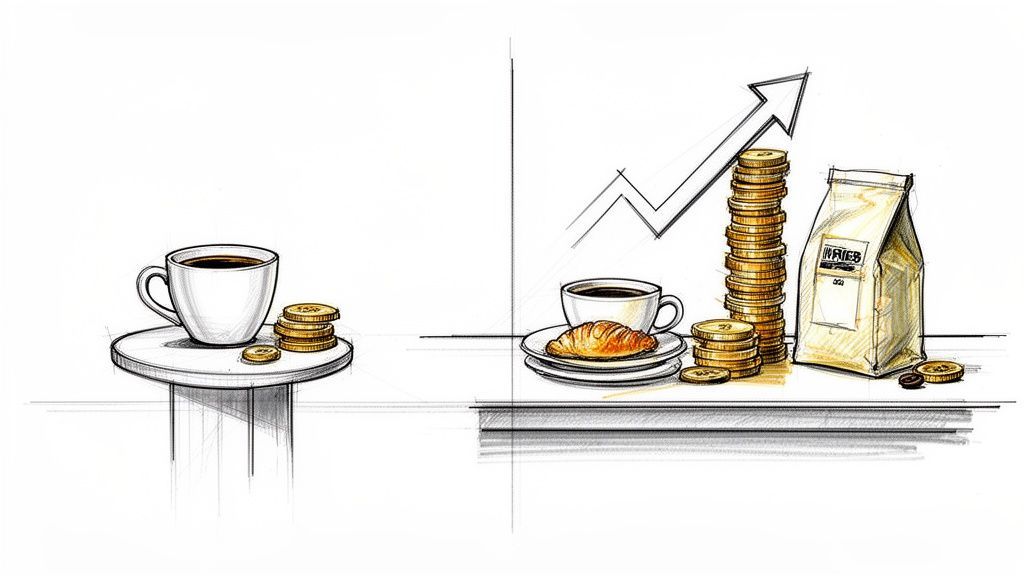
Imagine your Kickstarter campaign is a bustling new coffee shop. You could serve 100 people who only buy a small coffee, or you could serve 50 who each grab a coffee, a pastry, and buy a bag of beans to take home. That’s AOV in action—it’s the financial difference between those two scenarios.
A higher AOV is a powerful lever for profitability. It means you can raise more funds without the constant, grinding pressure of finding brand-new backers. This has a direct impact on your bottom line, making your campaign more sustainable and, ultimately, more successful.
Focusing on AOV lets you make smarter decisions that improve your campaign's financial health. It moves the conversation from "how many backers do we have?" to "how much value are we giving each backer?" That shift in mindset is critical for long-term growth.
AOV is more than just a number; it’s a reflection of your campaign's ability to engage backers and offer them compelling value beyond their initial pledge. It reveals opportunities to improve profitability without blowing your budget on customer acquisition.
Let’s break it down into a quick-glance table.
| Concept | What It Means for Your Campaign |
|---|---|
| The Formula | Total Funds Raised ÷ Total Backers = AOV |
| Financial Health | A higher AOV means each backer is more valuable, boosting profitability. |
| Strategic Focus | Shifts your attention from acquiring more backers to increasing each backer's pledge. |
| Long-Term Growth | High-AOV backers are often more invested and more likely to return for future campaigns. |
Understanding how AOV feeds into bigger metrics like customer lifetime value is essential. A backer who spends more from the get-go is often more invested in your project and more likely to stick around for your next big idea.
So, how do you actually influence this number? Your secret weapon is a post-campaign pledge manager. After the main event on Kickstarter or Indiegogo ends, these tools create a shop-like experience where backers can finalize their pledge, pay for shipping, and—most importantly—shop for add-ons.
This is your golden opportunity to boost AOV. A platform like PledgeBox is built for this exact purpose. It allows you to send backer surveys for free and only charges a simple 3% fee on any new funds raised from upsells. It’s a completely risk-free model that gives you every incentive to offer cool add-ons and watch your funding total climb.

Alright, now that you know what AOV is, let's get our hands dirty and actually calculate it. The good news? It's surprisingly simple. You only need two numbers from your campaign to figure it out.
The math itself is easy, but getting the data right is what really counts. Nail this, and you'll have a crystal-clear benchmark for how your campaign is performing and a solid baseline for improving next time.
The formula is just your total revenue divided by your total number of backers. That's it. This tells you the average amount each person spent to support your project.
Average Order Value (AOV) = Total Campaign Revenue ÷ Total Number of Backers
So, what counts as "Total Campaign Revenue"? It’s absolutely critical to include every single dollar a backer commits. This isn't just their initial pledge. You need to count:
Taking this all-in approach gives you the true picture of what each backer actually spent. Whether you’re selling a simple enamel pin or a massive board game with a dozen expansions, the logic is the same.
Let's run through a couple of real-world examples to see how this plays out.
Example 1: The Enamel Pin Campaign Imagine you just wrapped up a campaign for a new enamel pin. Here are your final numbers:
Just plug those into the formula: $5,000 ÷ 200 Backers = $25 AOV Simple. This means that, on average, every person who backed your project spent $25.
Example 2: The Complex Board Game Campaign Now, let’s look at a bigger project—a board game with multiple expansions and cosmetic add-ons. The numbers are larger, but the math is identical.
Let's calculate: $150,000 ÷ 1,500 Backers = $100 AOV Even with all those different pledge levels and options, the core metric is clear: the average backer contributed $100 to make your game a reality.
While you could definitely track this in a spreadsheet, a modern pledge manager automates the entire process. Think of it this way: Kickstarter is like the big marketplace where you find your backers, much like Amazon. A pledge manager like PledgeBox is like your own personal storefront, similar to Shopify—it's a controlled space where you can manage those backers and, more importantly, upsell them after the campaign ends.
PledgeBox gives you a real-time AOV dashboard and provides the tools you need to boost that number. The best part? PledgeBox is free to send the backer survey and only charges 3% on any successful upsells, making it a completely risk-free way to maximize your final funding total.
Hitting your funding goal feels amazing, but that celebration can sometimes hide a nasty surprise lurking just beneath the surface. A low Average Order Value (AOV), even with a huge backer count, can quietly eat away at your campaign's profits, leaving you with way less cash than you anticipated.
Let’s look at two hypothetical crowdfunding campaigns that both hit the same $50,000 funding goal. From the outside, they look like twin successes, but digging into their AOV reveals a totally different reality.
Let's imagine Campaign A focused on getting as many backers as possible, while Campaign B focused on getting higher pledges from fewer people.
Campaign A: The Volume Game
Campaign B: The Value Game
Campaign A scraped its way to the goal with a high volume of small pledges. Campaign B got there with half the backers, each spending twice as much. This is where the quiet danger of a low AOV starts to show its teeth.
Every single campaign has costs, but a low AOV makes you incredibly vulnerable to them. Let's break down why Campaign A is in a much shakier financial spot, despite raising the same amount of money.
Manufacturing Costs: Campaign A has to produce 1,000 units of its main product. Campaign B only needs to make 500. While the per-unit cost might drop a little with a larger order, the total manufacturing invoice for Campaign A will be significantly higher.
Platform Fees: Crowdfunding platforms usually take a percentage of the total funds plus a small fee for every single pledge. With double the transactions, Campaign A will pay way more in those per-pledge processing fees, shaving off precious margin from each backer.
Fulfillment and Shipping: This is the big one. It's often the single biggest profit killer for creators. Campaign A is now on the hook for packing and shipping 1,000 individual packages. That means 1,000 boxes, 1,000 shipping labels, and 1,000 postage payments. Campaign B literally cuts these fulfillment costs in half.
Customer Service Load: More backers always means more questions. Campaign A has doubled its chances of dealing with support tickets, address changes, and shipping inquiries. That’s a huge operational headache that costs you time and money.
The core lesson here is that a low AOV amplifies every single one of your operational costs. Each new backer adds an expense, and if their pledge value is too low, those costs can quickly swallow your profits whole, leaving you with very little to show for all your hard work. Understanding what is average order value isn't just about making more money—it's about protecting your bottom line and building a business that can last.
Knowing your AOV is one thing, but actually increasing it is where the real money is made. This is your game plan for bumping up that number, especially in the post-campaign phase. Trust me, that's where the magic happens.
After the whirlwind of your Kickstarter or Indiegogo campaign wraps up, your backers are in a totally different headspace. They've already bought into your vision, so they're relaxed and open to new ideas. This is the perfect window to show them some valuable extras that make their original pledge even better. A good pledge manager is your best friend here.
Upselling is simply the art of offering backers something extra that perfectly complements what they already pledged for. This isn't about being a pushy salesperson; it's about offering genuine value they might have missed during the campaign chaos. And the pledge manager survey is the perfect spot to do it.
Let's say a comic book creator just funded a new graphic novel. During the survey, they could offer an exclusive variant cover or a slick set of character art prints as an add-on. A huge chunk of backers, already hyped about the project, will happily toss those into their cart. A simple add-on strategy like this can easily boost a campaign's total funding by 10-20%.
Bundles are all about grouping several products together, usually with a small discount, to encourage a bigger purchase. This works so well because it simplifies the decision-making for your backers and makes them feel like they're getting a fantastic deal.
Think about a board game campaign. Instead of just selling the base game, you could create a few different bundles:
These tiered options give backers a clear path to upgrade their pledge to a higher-value package, which directly pushes up the AOV for your whole campaign. You can get more great ideas by checking out proven tips for using upsell features.
Let’s be honest, nobody likes paying for shipping. You can use this to your advantage by offering free shipping for backers who spend over a certain amount. It’s a simple nudge that encourages people to add just one more thing to their cart to hit that magic number.
The trick is to set your free shipping minimum just a little above your current AOV. If your average backer spends $45, try setting the free shipping threshold at $60. They'll be far more likely to grab a $15 add-on to save $10 on shipping—and that's more money going directly to your project.
Ignoring these AOV-boosting strategies can be risky. This diagram shows exactly how a low AOV can sink your campaign's finances.

As you can see, a low AOV directly shrinks your profit margins, bloats your operational costs, and just flat-out creates more work for you.
Right now, the global average order value in e-commerce is around $144, which is a 30% jump since 2019. This tells us that people are more than willing to place larger orders to get more value and save on things like shipping. For crowdfunding creators, this is a massive opportunity. It shows that using post-campaign pledge manager strategies is exactly what backers are looking for.
Think of Kickstarter as the giant marketplace, like Amazon, where you find your audience. A pledge manager like PledgeBox is your personal storefront, more like Shopify, where you get to control the entire experience and get the most value out of every single backer you worked so hard to win.
Using a tool built for this is a no-brainer. With a platform like PledgeBox, sending your backer survey is completely free. They only take a simple 3% fee on the upsell revenue you generate. It's a powerful, risk-free way to put all of these AOV-boosting strategies into action.

Here's a simple way to think about it. Your crowdfunding campaign on a platform like Kickstarter is like Amazon—a massive, crowded marketplace great for getting discovered and proving your concept. It gets your project in front of a huge audience, but you have very little say over what happens after someone pledges.
A pledge manager like PledgeBox, on the other hand, is your own personal Shopify store. It’s a space you completely control, where you can design the entire backer experience after the campaign clock stops ticking. This “storefront” creates a relaxed, no-pressure environment for you to offer more value and, in turn, drive up your AOV.
This is where the magic really happens—moving backers from the high-energy, countdown-driven campaign to a calm, shop-like survey experience. They're no longer in a rush. Instead, they’re excited about your project and much more open to browsing extra items that can make their original pledge even better.
Your pledge manager is the bridge between a one-time pledge and a full-fledged shopping experience. It converts campaign momentum into measurable, post-campaign revenue by giving backers more ways to support you.
This dedicated environment lets you roll out smart, targeted strategies that just aren’t possible on the main campaign page. You can guide backers through a carefully designed flow, gently encouraging them to add more to their order and transforming a basic pledge into a much larger purchase. To really dig into this, you can learn more about the importance of pledge managers in Kickstarter projects and see why so many successful creators depend on them.
A platform like PledgeBox isn’t just a survey tool; it's an AOV engine, packed with features built specifically to maximize your final funding total.
Here are a few key features that drive growth:
Best of all, this system is built on a powerful, risk-free model. With PledgeBox, it’s completely free to send your backer survey. The platform only takes a small 3% fee on the new funds you raise through upsells. This means PledgeBox only succeeds when you do, making it a true partner in growing your average order value.
Your Average Order Value (AOV) isn't just a number you calculate once and forget about. Think of it as a living metric that tells you the story of your campaign’s health and how well your post-campaign strategy is working. If you only look at it one time, you're leaving a goldmine of insights on the table.
To really get a feel for its impact, you need to track it at a few key moments. First, measure your AOV right after the campaign ends to set your baseline. Then, measure it again after you've sent your pledge manager surveys and backers have snapped up some add-ons. Finally, check it one last time after your late pledges close. This timeline gives you a crystal-clear picture of the financial boost from your post-campaign efforts.
The real magic happens when you start segmenting your AOV data. This is where you uncover hidden patterns in backer behavior. Instead of just staring at one big average, break it down to answer some really important questions.
Answering questions like these shows you exactly what’s working and what isn't. You might just find out that your newsletter subscribers are your most valuable audience, which tells you exactly where to invest more effort for your next project.
Tracking AOV is how you prove the ROI of your post-campaign efforts. It turns assumptions into hard data, enabling you to make smarter, more profitable decisions for every future campaign you launch.
This whole process is practically effortless with the built-in dashboards you find in modern pledge managers. Here’s a good way to think about it: Kickstarter is like Amazon, a massive marketplace where people discover you. PledgeBox is like Shopify—it’s your personal storefront designed to maximize the value from each backer. PledgeBox gives you the analytics to track these segments automatically. And remember, PledgeBox is free to send the backer survey and only charges 3% on the upsell revenue it helps you generate.
To get a complete look at your marketing performance and find even more ways to improve metrics like AOV, it's worth doing a comprehensive digital marketing audit. You can also dive into other crucial metrics to evaluate for a crowdfunding campaign to get an even clearer picture of your success.
Let's clear up some of the most frequent questions creators have about Average Order Value. We'll give you straight, simple answers so you can move forward with confidence.
There’s no magic number here. AOV can swing wildly depending on the product category. For a big, complex board game, an AOV of $100 might be phenomenal. But for an art book project, $40 could be a smashing success.
The best way to gauge this is to look at similar successful projects in your niche to get a benchmark. More importantly, your real goal should be to beat your own AOV from the last campaign. That's the truest measure of growth.
Yes, absolutely. AOV is all about measuring the total revenue you get from each backer. Since you collect shipping fees as part of that total, including them gives you the most accurate and complete picture of what a backer actually spends.
This is another area where a pledge manager really helps, making it easy to collect and track all those funds correctly after the campaign wraps up.
You can definitely nudge your AOV up during the live campaign with things like stretch goals and attractive pledge tiers. But the biggest opportunity to boost it comes after the campaign is over.
Using a pledge manager creates a relaxed, store-like environment where backers feel comfortable adding items they might have overlooked in the campaign frenzy.
Think of it this way: Kickstarter is like Amazon—a massive, busy marketplace where people discover you. A pledge manager like PledgeBox is more like your own personal Shopify store. You control the experience, and it's the perfect place to grow your AOV. This post-campaign window is where the real magic happens.
Ready to boost your campaign’s profitability? PledgeBox makes it simple. It's free to send your backer survey, and we only charge a small 3% fee on the upsell revenue you generate. Get started with PledgeBox today.
PledgeBox
The All-in-One Toolkit to Launch, Manage & Scale Your Kickstarter / Indiegogo Campaign