 PledgeBox
Boost with stretch goals kickstarter: A proven plan for campaigns
Discover how to plan, market, and fulfill stretch goals kickstarter to boost backer momentum and funding.
Discover how to plan, market, and fulfill stretch goals kickstarter to boost backer momentum and funding.
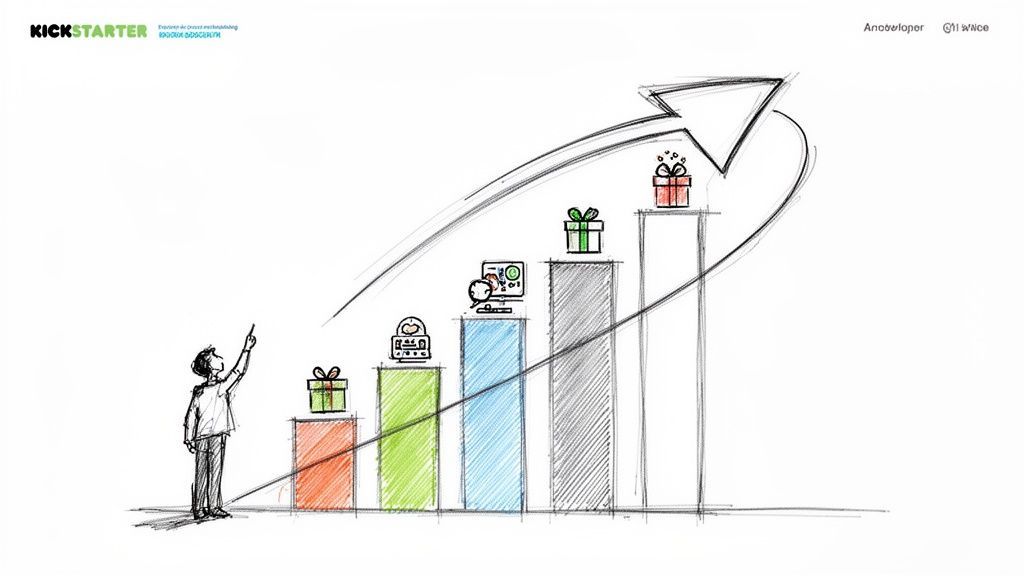
So, what exactly are stretch goals on Kickstarter? Think of them as bonus funding targets you set after you've hit your main campaign goal. Hitting these new milestones unlocks extra features, cool upgrades, or brand-new rewards for every single backer.
They’re a brilliant way to keep the energy high, get your backers more involved, and, of course, raise a lot more money. A well-played stretch goal strategy can be the difference between a successful campaign and one that absolutely smashes records.

Hitting your funding goal is an amazing feeling, but honestly, that's where the real fun begins. After the initial excitement of launch day, most campaigns hit a slow patch often called the "mid-campaign slump." This is the exact moment when a smart stretch goals Kickstarter plan becomes your secret weapon.
Stretch goals inject a fresh dose of energy into your campaign, giving backers a new, shared target to shoot for. Suddenly, your passive supporters become your most passionate promoters, sharing the project everywhere to help unlock that next awesome reward.
At their heart, stretch goals tap into some powerful human motivators. They create a real sense of community and shared purpose. Backers aren't just buying something; they feel like part of a team pushing toward a common objective. Each time a goal is unlocked, it delivers a little jolt of excitement and celebrates what the community achieved together.
The legendary Exploding Kittens campaign is a masterclass in this. Their initial goal was just $10,000, but their cleverly revealed stretch goals created an unstoppable tidal wave of pledges. People weren't just pre-ordering a card game—they were joining a movement to make it bigger and better for everyone.
By framing more funding as a group effort to improve the final product, you shift the dynamic from a simple purchase to a shared adventure. This builds a kind of loyalty and excitement that money just can't buy.
While the obvious goal is to raise more money, the ripple effects of a good stretch goal plan go way beyond the final pledge total. Let's look at the strategic impact.
| The Strategic Impact of Well-Planned Stretch Goals | | :--- | :--- | | Benefit | Impact on Your Campaign | Key Takeaway | | Sustain Momentum | Gives everyone a reason to stay hyped long after they first pledged, avoiding the dreaded mid-campaign slump. | Keeps your campaign story fresh and provides constant "good news" to share. | | Encourage Social Sharing | When an amazing upgrade is just a few backers away, your community turns into a powerful marketing engine. | People are more motivated to share when they see a direct, tangible benefit for themselves and others. | | Build Community | Working together to hit targets strengthens the bond between you and your backers, creating true fans. | Transforms backers from one-time customers into a loyal following for future projects. |
This powerful tool comes with a huge responsibility: you have to plan everything meticulously. Each unlocked reward adds another layer of complexity to your fulfillment process. If you miscalculate production costs or timelines, your runaway success can quickly turn into a logistical nightmare. That's why mapping out your rewards and your post-campaign plan is non-negotiable from day one.
This is where the right tools become critical. After the campaign ends, you're left with the complex job of tracking who gets what. A simple way to think about it is that the Kickstarter pledge manager is like Amazon—a standardized marketplace—whereas a dedicated tool like PledgeBox is like Shopify, giving you your own branded storefront and far more control.
Better yet, PledgeBox is free to send the backer survey and only charges 3% of upsell if there's any. This is a super cost-effective way to manage all that complexity without it eating into your hard-earned campaign funds.
The best stretch goals Kickstarter campaigns have aren't just random freebies. They're smart, thoughtful rewards that feel like a natural—and exciting—extension of the product you’ve already created. A generic sticker or a low-effort PDF isn't going to build the momentum you need.
Remember, your backers are here because they believe in your vision. Your stretch goals should honor that by deepening their investment and making the product they already love even better.
The goal is to create a value ladder. Every unlocked goal should feel like a genuine win, making backers excited to help you hit the next milestone. This takes a bit of creativity, balancing what's desirable for them with what's actually deliverable for you.
First things first, let's move past the obvious ideas and think about what truly adds value to your project. You want every backer, from the day-one supporter to the last-minute pledger, to feel like they’re getting an even better deal as the campaign grows.
Stuck for ideas? Here are a few categories that consistently work well:
A great stretch goal doesn't just add something—it adds the right thing. It should feel like an integral part of the product's journey, not a tacked-on afterthought.
Once you have a list of killer ideas, it's time for a reality check. A common trap creators fall into is offering stretch goals that sound amazing but become a logistical and financial nightmare during fulfillment. Every single new item adds weight, complexity, and cost. If you don't account for this, you could wipe out your profit margins or, even worse, delay the entire project.
Getting a handle on the principles behind effective business reward programs can really sharpen your strategy here. It helps you think more clearly about incentives, what backers perceive as valuable, and how to build loyalty that lasts long after the campaign.
A huge part of this is managing all these moving parts after the campaign funds. Kickstarter's built-in survey tool gets the basic job done, but it’s a bit like a generic Amazon checkout—it works, but it’s not very flexible. If you have multiple stretch goals and add-ons, you'll feel the limitations pretty quickly.
This is where a dedicated pledge manager like PledgeBox comes in and makes a world of difference. Think of it less like Amazon and more like Shopify—your own personal storefront for your campaign. You get full control over the post-campaign experience, which makes managing complex orders so much easier. You can dig deeper into crafting desirable incentives by checking out our guide on 6 key strategies for offering rewards your backers will love.
Here’s the best part: PledgeBox is free to send the backer survey and only charges 3% of upsell if there's any. This model lets you offer more complex rewards and add-ons without worrying about high platform fees eating into your budget, ensuring your awesome stretch goals actually stay profitable.
Guesswork is the enemy of a successful campaign. When it comes to your stretch goals Kickstarter funding tiers, you can't just throw darts at a board and hope for the best. It needs to be a calculated process based on real numbers. An ambitious goal can build incredible hype, but an unachievable one will absolutely kill your momentum. You need targets that are both exciting and grounded in reality.
The first step is to get radically honest about your costs. Every single reward, no matter how small, has a price tag. You have to calculate the precise cost of goods sold (COGS) for every stretch goal you’re even thinking about. And I don't just mean the manufacturing cost—I mean everything.
I’ve seen too many creators get tripped up by hidden expenses. Think about these:
Once you have the total cost per unit for a stretch goal, multiply it by your estimated number of backers. This gives you the true cost of unlocking that reward. Your funding tier for that goal must cover this total cost plus Kickstarter's fees (around 5%) and payment processing fees (another 3-5%).
Your stretch goal funding target isn't just the cost of the reward. It's the total cost to produce and deliver that reward to every single backer, plus platform fees, with a little buffer for unexpected issues. Ignoring this is a fast track to losing money on a "successful" campaign.
This simple flow is key: brainstorm cool ideas, filter them based on cost and feasibility, and then validate the final choices against your backer projections.

Stick to this process, and you’ll be creating rewards that are not just desirable but also financially sound. You won't risk sinking your own project.
Most campaigns set dollar-based goals, like "Unlock at $50,000." It's simple, and everyone gets it. But there’s another, often more powerful, way: tying stretch goals to your backer count (e.g., "Unlock with 1,000 backers").
A backer-count strategy completely changes the dynamic. It's not about asking existing backers to pledge more; it's about encouraging everyone to bring new people into the fold. It feels more collaborative and less transactional, turning your audience into a genuine marketing force.
Just look at the results. For their Treasure Chest campaign, Stonemaier Games unlocked rewards at milestones like every 50 backers. This helped them fully fund $25,000 in just 2 hours and raise a whopping $40,709 on launch day from organic buzz alone. Their tiny $700 ad spend brought in 85 new backers and $5,034—that's a 700% return on investment. You can read all about it on their blog covering the Treasure Chest Kickstarter campaign.
Managing all these moving parts after the campaign ends is where a lot of creators stumble. Kickstarter's native survey tool is fine for simple projects, but when you're juggling multiple stretch goals, add-ons, and shipping variations, you need way more control.
This is where a specialized pledge manager becomes your best friend. A great way to think about it is that the Kickstarter pledge manager is like Amazon, but a tool like PledgeBox is like your own private Shopify store. It lets you create detailed, branded surveys that can handle any level of complexity.
Here's the kicker: PledgeBox is free to send the backer survey and only charges a 3% fee on any funds you raise through upsells. This model is a massive win for creators. It means you can accurately collect backer choices, manage complex shipping fees, and offer last-minute add-ons without high platform fees eating into your core funding. That control is what makes your data-driven stretch goal strategy profitable from start to finish.

Even the most incredible stretch goals Kickstarter rewards are worthless if no one knows about them. Your announcement strategy is every bit as important as the goals themselves. It’s all about building and maintaining momentum, especially during that notorious mid-campaign slowdown.
You can't just drop all your goals on day one. That’s a surefire way to overwhelm backers and leave yourself with nothing new to talk about. A phased reveal keeps the energy high, turning your campaign into an ongoing story with exciting new chapters.
Timing is everything. From my experience, you need to announce your first one or two stretch goals right at launch. This shows potential backers you have a road map for success and gives them an immediate target to aim for beyond just the initial funding goal. It’s a powerful way to signal that you’re prepared to grow.
Then, you've got to hold some goals back. The moment your campaign starts to lose steam—and trust me, it will—is the perfect time to unveil a new, highly anticipated goal. This creates a fresh wave of excitement and gives your community a reason to start sharing the project all over again.
Here’s a timeline that works wonders:
Your campaign page is your home base, but the real marketing action happens everywhere else. Use your Kickstarter updates, social media channels, and email list to create a coordinated promotional push every time you announce or hit a goal.
An engaging Kickstarter update is your most direct line to your backers, so make them feel like insiders. Share behind-the-scenes details about the new reward and thank them for making it possible. For social media, create eye-catching graphics and short, shareable videos that clearly explain the new goal and how close you are to unlocking it. If you want to go deeper, we have a complete guide covering essential marketing for Kickstarter that can help you amplify your message.
The best stretch goal announcements don't just state a new funding target. They tell a story about how the community's support is making an already great product even better.
Let’s be honest, a static list of goals is boring. A dynamic, visual tracker on your campaign page? That’s exciting. Create a graphic that you update regularly, showing which goals have been unlocked and how far you are from the next one. Seeing that progress bar inch closer to its target is incredibly motivating for backers.
This visual proof of progress serves as a constant, powerful call to action right on your main page. Every new backer who visits can instantly see the campaign's momentum and all the extra value they stand to gain.
This early momentum is statistically crucial. Analysis from tabletop game campaigns shows that 81% of projects that raise over 20% of their goal in the first phase go on to fully fund. This statistic is a huge contrast to the overall Kickstarter success rate, where only 41.98% of all projects succeed. For creators, using tools to build a pre-launch audience and plan for post-campaign upsells can replicate that vital early surge, turning a strong start into a near-guaranteed success. You can explore more about these powerful campaign dynamics from insights on tabletop game funding.
Managing the fulfillment of all these extra rewards is where many creators stumble. The Kickstarter pledge manager is like Amazon—functional, but very limited. A dedicated pledge manager like PledgeBox is like Shopify, giving you your own personal storefront and complete control over the post-campaign experience. This is absolutely vital when you have multiple unlocked rewards to track.
Crucially, PledgeBox is free to send the backer survey and only charges 3% of upsell revenue if there's any. This lets you handle complex fulfillment, gather precise backer information, and even offer more add-ons without eating into your campaign funds.

The confetti has settled, the campaign is funded, and you've had a moment to celebrate. But now, the real work begins. Fulfillment is easily the most critical—and complex—part of any Kickstarter project. If you've run a successful stretch goals Kickstarter campaign, that complexity has just multiplied.
Suddenly, you’re not just sending out one product. You're managing a complicated puzzle of different rewards, add-ons, and shipping destinations for hundreds or even thousands of individual backers. Keeping track of who gets what, collecting accurate addresses, and managing shipping costs can quickly spiral into a logistical nightmare if you aren't prepared.
Let’s be honest: Kickstarter’s built-in survey system is functional, but only for the most basic projects. If you're shipping a single item with no variations, it might just get the job done. But the moment you introduce multiple unlocked rewards and optional add-ons, you’ll hit a wall. Fast.
Trying to manage this intricate process through a basic survey tool is like trying to run a bustling online store with nothing but a spreadsheet and an email account. It's manual, prone to human error, and incredibly time-consuming. You need a system that's actually built for this.
This is where a dedicated pledge manager becomes an indispensable part of your toolkit. Think of it as the mission control for your entire post-campaign operation, handling everything from reward selection and address collection to final shipping logistics.
Here's an analogy I like to use: the Kickstarter pledge manager is like Amazon—a standardized, one-size-fits-all marketplace. A dedicated pledge manager like PledgeBox, on the other hand, is more like Shopify. It gives you your own branded storefront where you have complete control over the backer experience.
This level of control is exactly what you need to handle the complexities of a successful stretch goal campaign. You can:
A pledge manager transforms fulfillment from a chaotic, reactive mess into a structured, proactive system. It gives you the control and flexibility needed to deliver on every promise you made, ensuring a smooth and professional experience for your backers.
Managing fulfillment costs is just as important as managing your production budget. The wrong tool can eat into your profits with high fees, which is the last thing you want after a hard-fought campaign. This is where the PledgeBox model offers a distinct advantage for creators.
Here's the most important thing to know: PledgeBox is free to send the backer survey and only charges 3% of upsell revenue if there's any. This means you get access to a powerful, full-featured fulfillment tool with zero upfront cost. You don't pay per backer or a percentage of the total funds you raised on Kickstarter.
This model directly aligns with your success. You can efficiently manage all the complexities introduced by your stretch goals—like confirming rewards and collecting shipping info—at no cost to your campaign funds. The fee only applies to the extra money you make through the platform's upsell features.
For many creators, the additional revenue generated from these last-minute add-ons far outweighs the small fee. If you’re interested in a deeper dive, you can learn more about the importance of a pledge manager in Kickstarter projects and how it can secure your campaign's success. This approach protects your core funding, empowers you to handle complexity, and gives you a powerful tool to increase your final profit margin.
Let's be honest, theory is great, but nothing beats learning from the battlefield. Seeing how a stretch goals Kickstarter strategy actually plays out for other creators is one of the most powerful tools you have. It’s where you see the tiny decisions that separate a runaway success from a fulfillment nightmare.
By digging into campaigns that both crushed it and stumbled, we can pull out the real-world insights you need to build a strategy that’s not just ambitious, but bulletproof.
Even the most brilliant campaigns can get derailed by a few common, and totally avoidable, missteps. The biggest one? Underestimating costs. A creator gets excited about adding a cool enamel pin or a custom box sleeve, but they only calculate the per-unit cost from the factory.
They completely forget about the added shipping weight, the extra bubble wrap, and the hours of labor it takes to assemble everything. Suddenly, a profitable campaign is a money-losing headache.
Another classic trap is "feature creep." This is what happens when you let backer suggestions pull your project in a million different directions. While engaging your community is essential, you have to stay in the driver's seat. Adding too much complexity can delay production and water down the quality of your core product.
Finally, you can’t overlook clear communication. If your backers are confused about what’s been unlocked or what the next goal even is, you lose all momentum. Vague updates or a messy visual tracker on your page will kill the excitement fast.
On the flip side, some campaigns get it so right they become crowdfunding legends. There’s no better example than Exploding Kittens. Their entire approach was a masterclass in building unstoppable viral hype through one unlock after another.
They didn't just post a list of goals. They turned the campaign into a game, revealing new challenges and rewards as the community smashed each target. This created a powerful narrative; backers weren't just buying a product, they were joining an event. They were glued to the page, waiting to see what hilarious new card their combined effort would unleash.
This simple shift transformed passive backers into an army of evangelists who shared the project like crazy.
The results were staggering. The Exploding Kittens card game launched with a humble $10,000 goal and blew past it in just 8 minutes. By the time the campaign ended, they had raised over $8.7 million from more than 219,382 backers. Data shows the average successful campaign hits 640.1% of its goal, and in the games category—which leads Kickstarter with $2.63 billion pledged—stretch goals are the not-so-secret weapon. You can check out more Kickstarter funding success rates on Statista.
Key Takeaway: A winning stretch goal strategy isn't just a list of funding targets. It's a story that builds suspense, rewards your community, and makes every single backer feel like a hero on the journey.
Beyond just the stretch goals, the most successful creators also apply proven startup marketing strategies to make sure their campaign and brand have staying power long after the funding ends.
The massive gap between a well-planned campaign and a messy one really shines a light on the need for both foresight and the right tools. The chaos of managing thousands of backers, each with their own unique combination of rewards and add-ons, is where many creators drop the ball. This is exactly when a powerful pledge manager becomes absolutely essential.
Here’s a simple way to think about it: the Kickstarter pledge manager is like Amazon—it’s a standardized marketplace with very little flexibility. A dedicated pledge manager like PledgeBox, on the other hand, is like Shopify—it’s your own private, branded storefront where you have total control over the entire post-campaign experience.
This control is what lets you manage the complexities that come with a successful campaign. You can send out detailed surveys that capture every backer's specific choices, automatically calculate tricky shipping fees, and handle regional taxes without pulling your hair out.
Best of all, you can put this system in place without digging into your funds. PledgeBox is free to send the backer survey and only charges a 3% fee on upsell revenue if there's any. This model protects your budget while giving you a platform to run fulfillment like a pro and even boost your final earnings with last-minute add-ons. It's the operational backbone that makes sure your success story has a happy ending.
Even after laying out the perfect plan, you're bound to have a few nagging questions. It’s totally normal. Here are some quick, no-fluff answers to the most common things creators ask about their stretch goals Kickstarter strategy.
First off, don't panic. It happens more often than you think, and it's perfectly fine. If your campaign gets funded but falls short of a stretch goal, backers simply don't get that specific unlock.
The most important thing here is communication. As long as you’ve been upfront about which funding targets unlock which goodies, your backers will get it. It’s not a failure; it’s just part of the crowdfunding journey. Your main focus should always be on delivering your core project and any of the goals you did manage to hit.
There’s no magic number, but here’s a tip from experience: always plan for more than you think you’ll need. You should have your first one or two goals ready to show off the second your campaign goes live. But what about after that?
I always recommend having a roadmap of at least 3-5 goals planned out, with another 2-3 ideas fully costed and waiting in the wings. This way, if your campaign suddenly takes off, you won't be scrambling. Being over-prepared lets you react to funding spikes and strategically drop new goals to fight off that dreaded mid-campaign slump.
Timing is everything. Announcing your goals at the right moment can keep the energy high from start to finish. Show your first couple of goals right at launch to prove you’ve got a plan. After that, hold your cards and play them at just the right time.
A huge mistake I see creators make is revealing all their stretch goals on day one. It kills the suspense and leaves you with nothing new to announce when things get quiet. A slow, phased reveal is almost always the better play for building and sustaining hype.
Once you start unlocking multiple goals and offering add-ons, that trusty spreadsheet is going to become your worst enemy. It’s time to call in the pros. This is where a dedicated pledge manager becomes an absolute lifesaver.
Here’s an easy way to think about it: the Kickstarter pledge manager is like Amazon—it’s standardized and pretty rigid. A tool like PledgeBox, on the other hand, is your own private storefront, more like Shopify. It gives you total control. You can send out detailed surveys, confirm every backer’s choices, collect accurate shipping fees, and even handle complex VAT calculations.
The best part? PledgeBox is free to send the backer survey and only charges a 3% fee on any upsell revenue you generate. This model lets you manage all that post-campaign complexity like a seasoned pro without eating into your hard-earned funds.
Ready to manage your backer rewards and upsells with ease? With PledgeBox, you get a powerful, creator-friendly toolkit that simplifies fulfillment and boosts your revenue. Start for free and see how it works.
PledgeBox
The All-in-One Toolkit to Launch, Manage & Scale Your Kickstarter / Indiegogo Campaign