 PledgeBox
Crowdfunder's Guide to Tabletop Game Boards
Crowdfunding creators: Your 2026 guide to tabletop game boards. Learn materials, manufacturing, file prep, shipping, and PledgeBox integration.
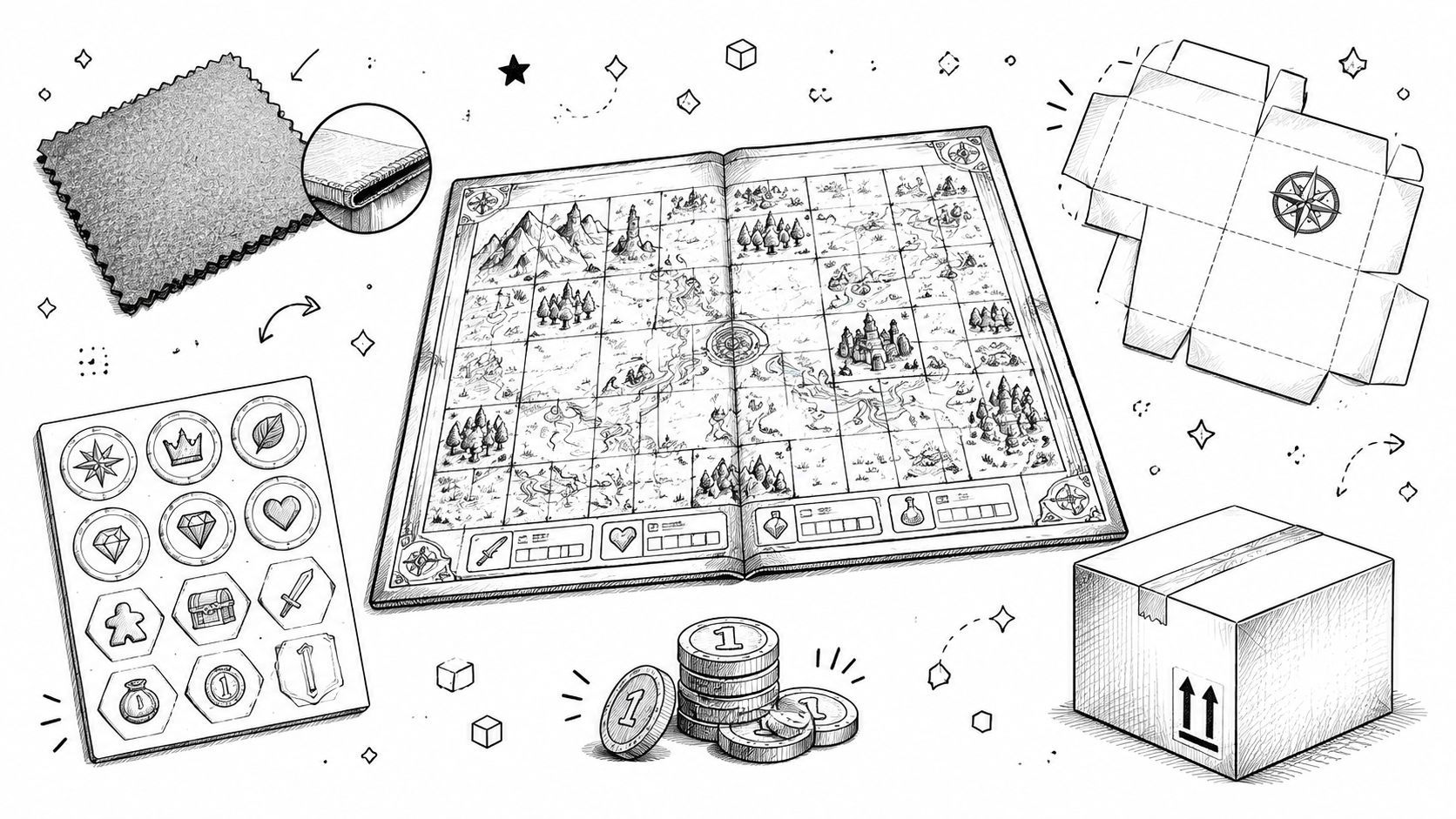
Crowdfunding creators: Your 2026 guide to tabletop game boards. Learn materials, manufacturing, file prep, shipping, and PledgeBox integration.
You've finished the prototype. The rules work, the turns flow, and playtesters finally stop asking whether the game is too long. Then the hard part starts. The board has to become a manufactured object that folds properly, fits the box, survives freight, looks good under indoor lighting, and still makes financial sense once shipping and post-campaign handling kick in.
That's where many first-time creators get blindsided. A tabletop game board isn't just art on thick paper. It's a production decision, a logistics decision, and later, a pledge management decision. If you get the board wrong, you don't just get an ugly component. You get damaged margins, backer complaints, packaging changes, and fulfillment problems that show up months after the campaign ends.
That matters because this isn't a tiny niche. The global playing cards and board games market was valued at USD 19.90 billion in 2024 and is projected to reach USD 31.93 billion by 2030, with board games accounting for 73.4% of market revenue in 2024, according to Grand View Research's playing cards and board games market analysis. If you're launching a board game on crowdfunding, you're stepping into a large commercial category. Backers will judge the physical product against everything else they've bought in that market.
Many first-time creators reach this stage with a polished prototype, a promising campaign page, and a quiet assumption that the board spec can wait until a manufacturer asks for files. That delay gets expensive fast. The board decision affects how your game photographs during the campaign, how it nests inside the box, how much the carton weighs, what your pledge manager has to charge for shipping, and how many margin problems show up after funding closes.
A board is one of the few components that can force changes across the whole product. Increase the footprint and you may need a larger box. Increase the thickness and you may change freight weight, carton count, and pick-and-pack fees. Choose a premium format too early and you can end up selling a campaign favorite that becomes hard to fulfill profitably.

From a production standpoint, the board starts a chain reaction that reaches far past gameplay. A larger folding board can improve readability and table presence, but it can also push you into a bigger box, more void fill, higher dimensional shipping charges, and stricter carton packing limits. A neoprene mat may look like an easy premium upgrade, yet it changes how the game rolls, packs, stores, and ships. A modular punchboard layout can save space in one area and create new risks in setup friction, fit tolerance, and pre-press alignment.
I tell new creators to ask one question early. What does this board choice do to the box and the fulfillment quote? If the answer is unclear, the spec is not ready.
That same discipline matters during crowdfunding. Backers judge value from prototype photos and campaign renders, but your actual costs arrive later, during freight booking, pledge collection, and warehouse intake. If your board format changes after the campaign, your shipping tables, add-on logic, and carton assumptions often have to change with it.
The board has to succeed at four different jobs during the project lifecycle:
That last point gets missed often. Creators spend weeks refining art and almost no time checking how one board upgrade changes SKU count, carton density, or regional postage bands. The same practical mindset applies outside games too. Anyone who has priced packaging for home moves has seen how small size changes affect material choice, handling, and shipping cost.
If you are still turning concept sketches into something manufacturers and backers can evaluate, PledgeBox's guide to crafting your crowdfunding prototype gives a useful production starting point before you lock the board spec.
Your board format should come from how the game is played, how the game is packed, and how much production complexity you can tolerate. Creators often reverse that order and choose whatever looks most premium in photos. That's expensive.
A folding mounted board is the standard choice for many modern tabletop game boards. It uses printed paper mounted to rigid board, then wrapped and folded along scored seams. It gives a strong retail feel and a familiar unboxing experience. The downside is hinge engineering. If the panel count, fold direction, or art placement is wrong, the board can crack visually or feel awkward in play.
A non-folding mounted board works well when the game uses smaller individual area boards, faction boards, or room tiles that need to stay flat. These feel sturdy and can be attractive in the box, but they consume space fast. They also create more edges that can scuff.
A neoprene mat creates a different kind of premium feel. It lies nicely once relaxed and makes card pickup easier. It's less ideal when you need crisp folds, compact packing, or a low-cost base edition. It can also shift your product identity from classic board game to accessory-heavy premium package.
A punchboard system is often the most flexible if your design supports modularity. It can combine board sections, tokens, and setup variety in one print run. But if players have to assemble the main play area every game, convenience drops. A game that feels smooth in the prototype can feel fiddly in the final product.
| Board Type | Typical Cost | Durability | Portability | Best For |
|---|---|---|---|---|
| Folding mounted board | Higher | Strong if hinges are well designed | Good once folded into box size | Main central game board |
| Non-folding mounted board | Medium to higher | Strong, with fewer fold concerns | Lower for larger pieces | Player boards, scenario boards, map tiles |
| Neoprene mat | Varies by size and finish | Good in use, but needs careful packing | Rolls well, less box-efficient in some setups | Premium editions, playmats, deluxe add-ons |
| Punchboard | Often efficient for multi-part layouts | Good, depends on use pattern | High before punch-out, moderate after | Modular maps, sector tiles, hybrid component sets |
What works is matching board construction to use frequency. A main board that gets opened every session usually benefits from a mounted format with clean folds and clear icon spacing. What doesn't work is using the same construction logic for every component because the sample looked nice.
Use these trade-offs when deciding:
A board that looks expensive in a campaign image can still be the wrong board if it slows setup, wastes box volume, or creates fulfillment headaches.
There's also a practical prototyping benefit in thinking about storage early. If you need to mock packing behavior before your final sample arrives, suppliers that specialize in packaging for home moves can be useful for sourcing plain cardboard cartons and test materials for rough fit checks.
A good-looking board file can still fail at pre-press. Factories don't manufacture intent. They manufacture the files and specifications you send.
Manufacturers typically require a detailed specification sheet and print-ready files in PDF with images at about 300 dpi, CMYK color, and properly placed bleed and trim lines to reduce proofing errors and prevent costly reprints, as outlined in this board game manufacturing guide from BookPrintingChina.
Your specification sheet should spell out quantities, materials, finishes, and special handling notes. Don't assume the factory will infer anything from the artwork. If the board has a linen finish, wrapped edges, foil elements, or unusual fold behavior, state it.
For print files, keep these basics locked down:
A separate dieline or factory template matters just as much as the artwork. A board can print beautifully and still fail if fold locations cut through labels, regions, or scoring assumptions.
If your campaign assets are still in development, PledgeBox has a practical article on graphics for crowdfunding campaigns that pairs well with manufacturer-facing prep.
Many creators design tabletop game boards as if players always have a large dedicated gaming table. Most don't. They play on dining tables, café tables, classroom desks, and temporary setups with drinks, phones, and player aids already occupying space.
That changes how a board should be designed. Table presence isn't just whether the board looks impressive. It's whether the board remains readable and playable under realistic constraints.
If players have to push discard piles onto the rulebook or place tokens off-board because the layout sprawls too far, the problem isn't aesthetics. It's usability.
Test the board in bad conditions, not ideal ones:
A board that fits real tables gets played more often. That affects reviews, replayability, and whether backers feel the product belongs in everyday life.
The factory process gets easier once you stop treating it like a black box. Your board moves through a series of approvals, and each approval either removes risk or delays production if you weren't specific enough.

MOQ, or minimum order quantity, is where many budgets stop being theoretical. A factory may be willing to produce your game only above a certain quantity, or may price it in a way that makes low quantities impractical. That affects your funding goal, your per-unit economics, and how much margin remains after freight and fulfillment.
For first-time creators, the mistake is building a campaign page around a beautiful component spec before confirming whether the factory can produce that exact combination at a viable order size. Deluxe boards, custom trays, and unusual materials can all make your initial assumptions wrong.
Ask factories for quotes that separate board construction choices clearly. You want to know what changed when the price changed.
The pre-production copy, often shortened to PPC, is the checkpoint that matters most. It's a digitally printed full copy used to verify fit, print accuracy, and assembly before the mass run. According to the cited production guidance, PPC lead times are commonly 2–4 weeks, while mass production is often 8–12 weeks, as discussed in this manufacturing timeline source.
That means your schedule needs room for review, revision, and re-approval if something is off. If your board has custom plastic or metal components interacting with it, that complexity can stretch timelines further.
Before approving a PPC, inspect the board for these issues:
Later in the process, logistics becomes its own discipline. If you need a broader operational primer, Snappycrate's piece on mastering e-commerce logistics is a helpful overview for thinking beyond the print run itself.
A quick visual reference for the broader production flow can help when you're briefing collaborators or updating backers:
The board doesn't just affect gameplay. It affects nearly every fulfillment cost that comes after manufacturing.
A larger board usually means a larger folded footprint. That pushes the box outward, which changes carton packing, pallet density, warehouse slotting, and last-mile shipping pricing. Even when the board itself seems like a small cost increase, the packaging chain around it can become materially more expensive.
The first place is the master carton. If your board forces a box size increase, fewer units fit per outer carton. That can reduce packing efficiency and increase the amount of dead space you're paying to move and store.
The second place is protective packaging. Bigger or heavier boards can require stronger cartons, corner protection, or better internal fit to avoid transit damage. If the board is mounted and sits near the top or bottom of the box, it may need more support than you expected.
The third place is pick, pack, and postage. Fulfillment providers don't care that the extra volume came from a dramatic map reveal. They care about parcel dimensions, weight bands, and handling complexity.
A board decision made for visual impact can become a shipping surcharge months later.
You don't need perfect forecasting at the concept stage, but you do need discipline. Build your cost model around the full packed product, not the isolated board.
Check these before final approval:
If you're trying to estimate dimensional impact before locking rates, a cubic calculator for shipping can help you model how box decisions ripple into fulfillment planning.
A campaign funds. Backers are happy. Then board problems surface.
The version list that looked manageable on the campaign page now has to become clean survey logic, accurate shipping charges, factory-ready quantities, and fulfillment exports with no ambiguity. If your board comes in standard, deluxe, language-specific, or add-on formats, every physical decision you made earlier now affects margin and error rate.

Boards create complexity faster than many first-time creators expect. A folded mounted board is one SKU. A neoprene mat is another. A bilingual printed board may need its own production count, carton allocation, and fulfillment mapping. Add retailer pledges or region-specific bundles, and a spreadsheet starts breaking down.
I treat the pledge manager as an extension of manufacturing planning. If the survey cannot distinguish the exact board configuration, the factory forecast gets fuzzy, and fulfillment inherits the confusion later.
A solid setup should handle a few practical jobs:
That last point matters more than it seems. Warehouses do not want to interpret campaign language. They need a file that says what goes in each box.
Kickstarter's pledge manager works more like a marketplace checkout. A dedicated pledge manager works more like a store and operations tool built around your product logic.
That difference shows up fast with board games. You may need separate shipping zones, tax collection, address checks, late pledge handling, upgrade paths, and add-ons that affect both manufacturing quantities and pick-pack rules. A basic confirmation flow can collect money. It often does not give you enough control to prevent board-related mistakes downstream.
One option in this category is PledgeBox. For tabletop creators, it offers surveys, add-ons, shipping fee collection, VAT or tax handling, and fulfillment exports. It's also free to send the backer survey and only charges 3% of upsell if there's any. That pricing model can work well if your board strategy includes optional upgrades, because the software cost tracks with added revenue instead of showing up as another fixed line item before surveys close.
The practical question is simple. Can your post-campaign setup tell you, with no manual cleanup, how many standard boards to print, how many deluxe upgrades to charge and ship, and how many exceptions your fulfillment partner will have to touch by hand? If the answer is no, your board workflow is still incomplete.
The expensive mistakes usually happen right before approval. Everyone is tired, the files look finished, and the temptation is to move the project forward because the campaign is already public and backers are waiting. Slow down here.

Run this check before you approve production:
Approve the board only when the product, packaging, and fulfillment model all agree with each other.
A well-made board does more than present the game. It keeps the entire campaign honest. It tells the truth about your cost structure, your shipping plan, and the promises you made to backers.
If you're preparing a board game campaign and need a cleaner post-campaign handoff, PledgeBox can be part of the workflow for surveys, shipping collection, add-ons, and fulfillment exports. For tabletop creators, that becomes useful once board choices start affecting reward variants, parcel sizing, and upgrade offers.
PledgeBox
The All-in-One Toolkit to Launch, Manage & Scale Your Kickstarter / Indiegogo Campaign