 PledgeBox
Shipping Tracking Number Guide for Crowdfunding Backers
Learn what a shipping tracking number means, how to follow your crowdfunding pledge delivery, and what to do when the scan looks wrong.
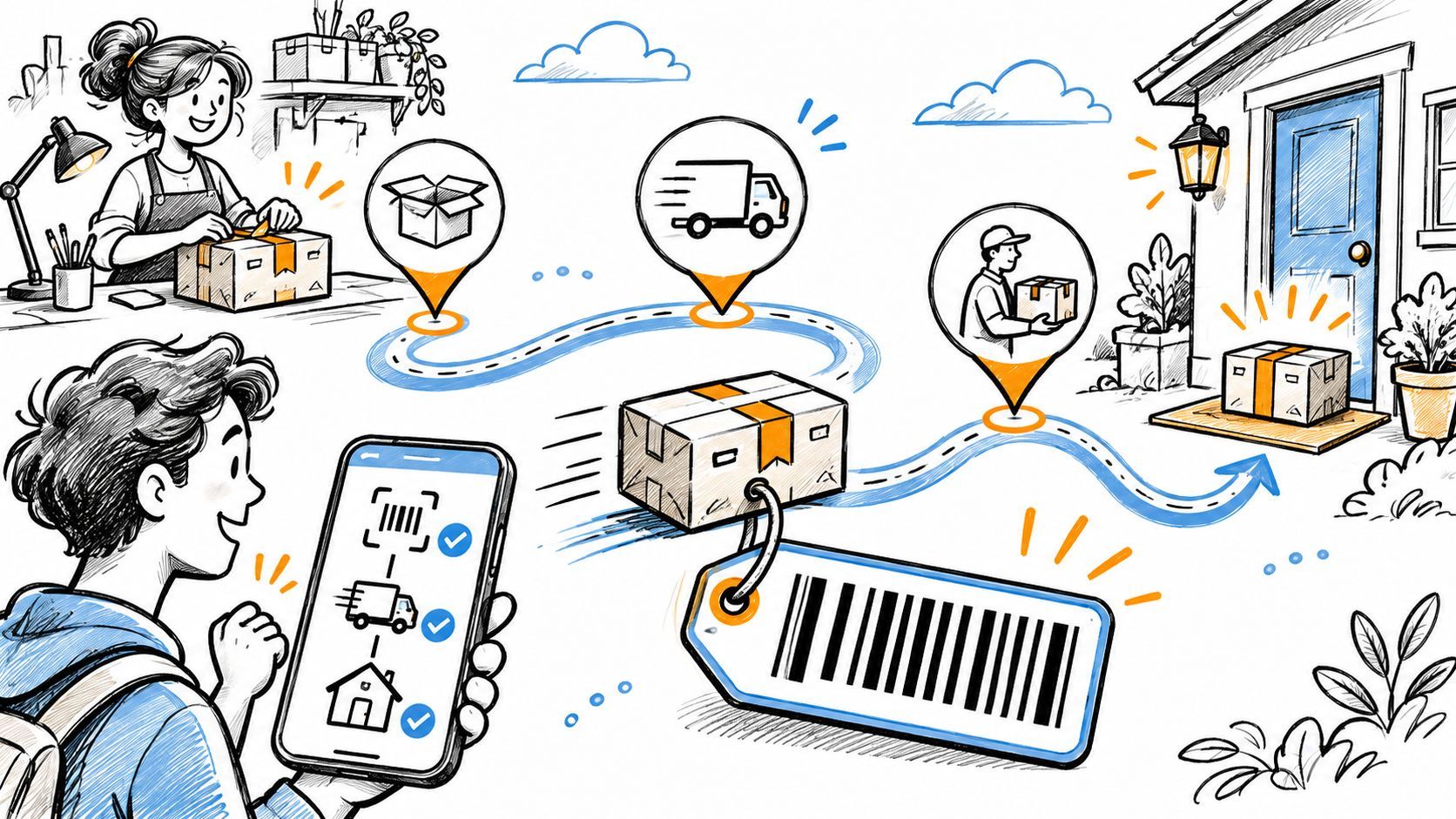
Learn what a shipping tracking number means, how to follow your crowdfunding pledge delivery, and what to do when the scan looks wrong.
You've done everything the campaign asked. The survey is submitted, the address matches your confirmation email, the add-on is paid, and the reward is somewhere between a factory floor and your front door. Then a shipping email arrives with a code you didn't choose, and you paste it into a carrier site expecting a straight answer.
What the page gives you is narrower than that. A scan records that a parcel moved through a point in a network. It doesn't record that a person received it, that the box was intact, or that it went to the right door. Confusing those two things is where most backer frustration starts, and it's where this guide begins.
A shipping tracking number is the code a carrier assigns to one physical parcel so its scanners and sorting systems can identify that parcel at every handoff. It belongs to the box, not to your pledge.
Think of a license plate. The plate doesn't tell you who owns the car or what's in the boot, but anyone with access to the records can trace where the vehicle has been and when. A shipping tracking number points to a movement history the same way: location events, timestamps, and a status, nothing about the contents.
Your order number is a separate record. It identifies your pledge inside the creator's system, covering what you bought, what you paid, and which address you confirmed. A carrier can't look up your order number, and a creator can't read carrier scans from it. When a backer writes "order #4417, where is it?", the creator has to cross-reference a shipping record that holds a different identifier entirely.
For international mail, that identifier follows a shared structure. The Universal Postal Union's S10 standard defines a 13-character identifier built from service-related characters, an eight-digit serial number, a check digit, and a two-letter country code. The standard was first introduced on 18 April 1996 and has been revised repeatedly, including a revised 13-character specification in June 2009 and a later version adopted on 10 May 2011, as the UPU technical standards version history sets out. The check digit does more work than it looks like: it catches most single-character typing errors before a wrong number gets pasted into a carrier site.
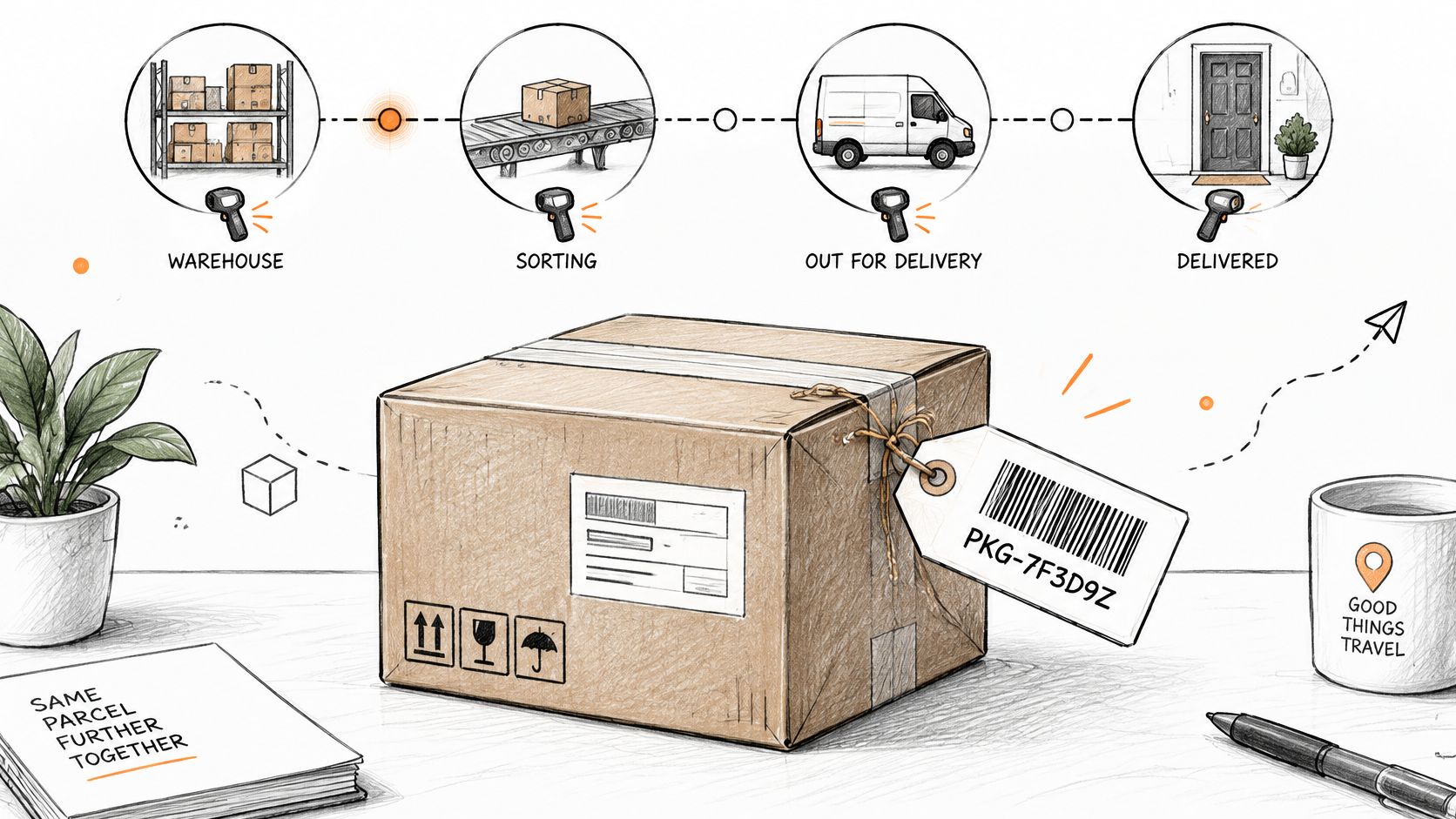
Domestic carriers use their own formats, so the shape of the code tells you which system to search. Retailers that ship time-critical goods usually publish this up front, which is why a page like Grad Store's shipping details for graduation regalia names carriers and dispatch windows together, so buyers know where to look before anything moves.
Practical rule: Letters at both ends usually mean an international postal item. All digits usually means a domestic carrier. Either way, copy the code from the shipping email, not from the survey confirmation.
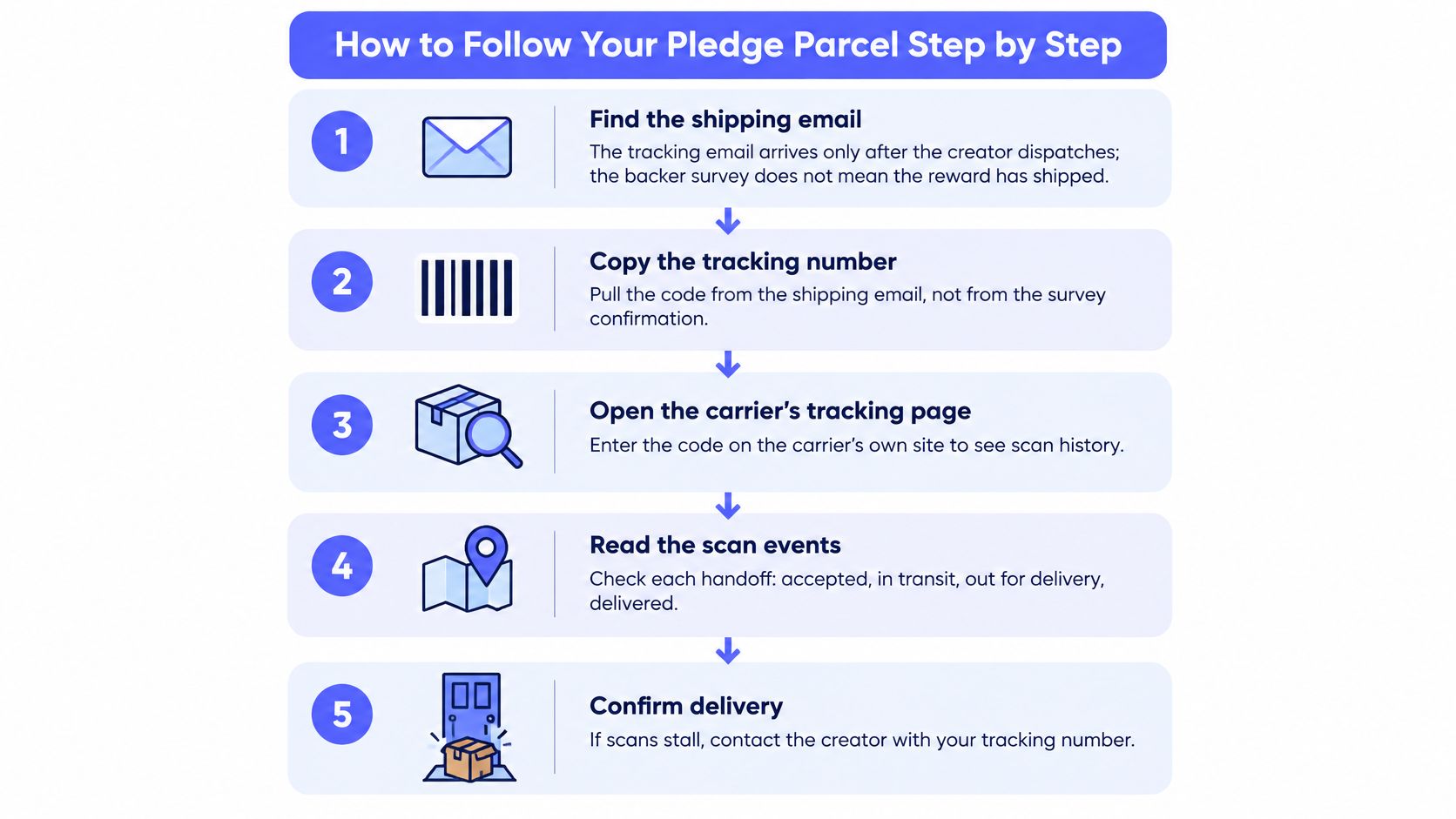
The tracking email arrives only after the creator dispatches, and nothing you do in the survey makes it arrive sooner. A completed survey does not mean the reward has shipped. It means your address and choices are recorded and your order is queued for fulfillment.
Here's the sequence laid out end to end.
Tracking messages are a favourite disguise for phishing, for one reason: they arrive when you're already waiting and already primed to click a link. The message borrows a familiar anxiety and asks you to resolve it fast.
A genuine tracking email has predictable properties. The sender domain matches the carrier it names, every link resolves to that carrier's own site, and nothing is demanded before the parcel can move. Payment requests for a "release fee", a "customs hold", or a small redelivery charge don't belong in a first-contact tracking message.
Run this check before you click anything.
If the sender, the link destination, and the carrier's own record don't all agree, trust the carrier's record and ignore the message. Two out of three agreeing is still a scam.
Creators face a mirrored problem, because scams and spam that attach to a crowdfunding campaign often copy the campaign's branding and timing. Naming the carrier and the sending address in a campaign update is a cheap defence: backers know what a real message looks like before one arrives.
Scans generally arrive in a fixed order, and each one answers a different question. Label created means a record exists. Accepted means the carrier has the box. In transit means it's moving between facilities. Out for delivery means it's on a vehicle. Delivered means the carrier closed the job. An exception scan is the branch that needs a phone call rather than patience.
| Status | What it means | What the backer should do |
|---|---|---|
| Label created | Shipper generated a label; carrier may not hold the parcel yet | Wait a few days before worrying about the number |
| Accepted | Carrier scanned the parcel at a facility | Expect regular movement scans |
| In transit | Parcel moves between sorting facilities | Watch for steady progress |
| Out for delivery | Parcel is on the final delivery vehicle | Be available or check for a pickup option |
| Delivered | Carrier recorded a delivery scan | Check the doorstep, neighbours and proof of delivery |
| Exception or delay | Scan shows an address, customs or handling problem | Contact the creator with the number and details |
The number isn't loose text. USPS's Intelligent Mail package barcode generally follows the GS1-128 specification and carries variable-length tracking and routing data for automated parcel equipment, and USPS documentation describes a 20-digit tracking-code component alongside facility, processing, scan-time and destination-routing fields, per the USPS Domestic Mail Manual chapter 204. That's the mechanical reason leading zeros and exact spacing matter: the identifier feeds a scanner, and a mangled version produces either no record or the wrong one.
Notifications are only useful when they follow a real event. Sending an alert at label creation builds an expectation the parcel can't meet, which is why sensible setups fire on acceptance, movement, out for delivery, and delivery. Backers clearly want that detail: 63% of U.S. consumers said full visibility throughout the delivery process was essential, according to Sifted's 2025 consumer survey.
If a number still sits at label created roughly a week after the creator announced dispatch, say so. It usually means the parcel never entered the network, and the creator can chase the warehouse before the trail goes cold. A delivered scan, meanwhile, closes the carrier's process, not yours.
Two shipping emails for one pledge ID looks like an error. It usually isn't. A pledge is one order, but fulfillment moves physical units, and those units don't always travel together: a game box ships separately from an accessory pack, a replacement leaves on its own after a damage report, or a regional warehouse handles part of the run.
GS1's Serialized Shipping Container Code explains the logic. It's an 18-digit identifier for a case, pallet, parcel, or other transport unit, typically encoded in a GS1-128 barcode, and it ties the scanned package to its own electronic records such as advance shipping notices and transport data, as GS1 US describes the SSCC. Unit-level identity, not order-level identity.
Say a backer receives two numbers under one order ID. The item list in the survey is the key: if the pledge included a core reward and a separate add-on, the lighter of the two boxes is probably the add-on, and its scan history will usually show a shorter journey. Compare the declared weights on the carrier page when the record provides them, and read the contents against what each number delivered.
Good tracking records look like this: one record per parcel, with the parent order ID kept alongside it, plus carrier, service level, ship date, destination country, and package sequence. That structure is what stops the most common failure in multi-parcel pledges, where an entire order gets marked delivered because one of three boxes arrived.
Count the shipping emails, count the boxes on the doorstep, and track each number on its own. A pledge is complete when every parcel in it has landed, not when the first one does.
A delivered scan is the point where most guides stop and most backers start worrying. Delivery confirmation records what a carrier's driver did, and theft, misdelivery, and unsafe drop locations all happen after that moment. Recent U.S. research estimates that 47.7 million adults experienced package theft in the past year, representing approximately $7.7 billion in losses, and 37% said theft concerns had made them hesitate before placing an online order, according to Security.org's package theft report.
| Symptom | Likely cause | Fix |
|---|---|---|
| No scan after dispatch was announced | Parcel not yet handed to the carrier, or only a label exists | Ask the creator to confirm the dispatch date and carrier |
| Scan stuck at one facility | Sorting delay or misrouting | Wait the usual transit window, then ask the carrier to trace |
| Address exception on the scan | Incomplete or incorrect address | Check whether the address can still be corrected, then contact the creator |
| Delivered, but the parcel is missing | Theft, misdelivery or wrong drop location | Check proof of delivery, ask neighbours, open a carrier investigation |
| Delivered, but the wrong box arrived | Parcel mix-up between backers | Photograph the label and contents, then contact the creator |
Work through the evidence in order, because each step narrows the cause. Check the proof-of-delivery record for a photo, a signature, or GPS coordinates where the carrier provides them. Ask everyone in the household and the immediate neighbours, since a driver who hands a parcel to a neighbour often logs it as delivered. Then open a carrier investigation rather than waiting for the parcel to reappear.
Keep that claim separate from an ordinary late shipment. A delay is a timeline question; a missing parcel is an evidence question, and mixing them in one message slows both.
Treat theft, loss, misdelivery, and carrier delay as four different cases. Each needs different evidence, and a creator can only escalate the one you've actually got.
High-value hardware and limited-edition collectibles are the hardest to replace, which is why the evidence pack matters more there: photos of the label, the tracking number, the delivery scan, and the dates. Backers contact the project creator about rewards, delivery, shipping charges or refund requests, so the creator is the person who needs that material. The dos and don'ts of fulfilling backer rewards covers the same discipline from the campaign side.
Tracking gets sold as a prevention tool, and it isn't one. In a 2026 U.S. survey, 88% of online consumers said they monitor packages while in transit and 43% request delivery alerts, yet separate 2026 U.K. research found that 52% of households regularly had parcels left outside when nobody was home, 70% would rather miss a delivery than risk theft, and 69% were concerned about unattended doorstep delivery, as Capital One Shopping's package theft statistics report. More notifications raise awareness without securing the doorstep. A precise arrival window still leaves you unable to be there.
Signature service suits expensive rewards, because someone has to accept the parcel. Pickup points and lockers suit backers who travel or live in buildings where deliveries get left in a lobby. Safe-place instructions help only where the carrier honours them and the spot is sheltered. Address correction handles a move, and delayed dispatch handles a trip that overlaps the ship date. Each option carries a cost that varies by carrier and country, so check the current price list rather than assuming it's included.
What all of these need is a decision made before dispatch, not after a failed delivery. That starts with the address itself, and the checks in this guide to collecting a valid shipping address catch the formatting and completeness problems that later appear as an address exception scan.
PledgeBox sends the backer survey free and charges 3% of add-on or upsell sales made through the survey, if any, so collecting addresses and product choices costs nothing when no extra payment is involved. It works differently from Kickstarter's Pledge Manager, which handles pledge, survey, address, tax and payment inside the platform, much like Amazon, and applies its normal payment charges to money collected there, per Kickstarter's Pledge Manager guide. PledgeBox works more like Shopify, where the creator configures the offers and keeps control of the backer experience.
One timing detail matters more than backers expect: Kickstarter's survey can be sent only once, so every fulfillment question has to be in it before launch, as its guide to building your backer survey explains. Whatever tool a creator uses, the sequence should be the same: confirm the address, capture a delivery preference, and agree how a missed delivery gets escalated, all before the first label is printed.
PledgeBox turns that last step into a single workflow: upload courier codes and shipping tracking codes in bulk through Tools, Shipping info, and it emails the right backers automatically while marking those orders as shipped and locked. Backers get a mobile-friendly portal with their tracking in one place, and you get fewer "where is my reward" messages during the busiest week of fulfillment. Create a free survey and see how it handles your next reward batch at PledgeBox.
PledgeBox
The All-in-One Toolkit to Launch, Manage & Scale Your Kickstarter / Indiegogo Campaign