 PledgeBox
Pre Order Websites: A Creator's Guide to Launch Success
Learn how to use pre order websites to fund your project. This guide covers setup, best practices, and how tools like PledgeBox streamline success for creators.
Learn how to use pre order websites to fund your project. This guide covers setup, best practices, and how tools like PledgeBox streamline success for creators.
The funding goal hits, the comments fill with congratulations, and for a day or two you feel like you made it. Then the campaign ends and the work shows up all at once. You export backer data, open a spreadsheet, and realize you still need to collect addresses, confirm reward choices, charge shipping, handle VAT or tax, offer add-ons, answer messages, and somehow keep late buyers from slipping away.
That’s the point where many first-time creators make a costly mistake. They treat post-campaign operations like admin work. It isn’t. It’s your first real store, your first fulfillment system, and your first test as an operator.
Most creators expect stress during the campaign. Fewer expect the post-campaign phase to feel harder than launch week.
A funded campaign leaves you with a messy middle. Some backers changed their minds about rewards. Some entered old addresses. Some want extra add-ons. Others missed the campaign and now want in. If you handle all of that with email threads, spreadsheets, and a generic form tool, you’ll create manual work exactly when you need structure.
I’ve seen this pattern often enough that the warning is simple. The campaign platform got you funded, but it usually won’t carry you cleanly into fulfillment. You need a system that behaves like a proper post-campaign store, not a static questionnaire.
Practical rule: The moment your campaign funds, stop thinking only about surveys. Start thinking about order management.
A dedicated pre order website gives you one place to do the jobs that matter after funding:
The creators who stay calm after funding aren’t less busy. They just move from chaos to workflow faster.
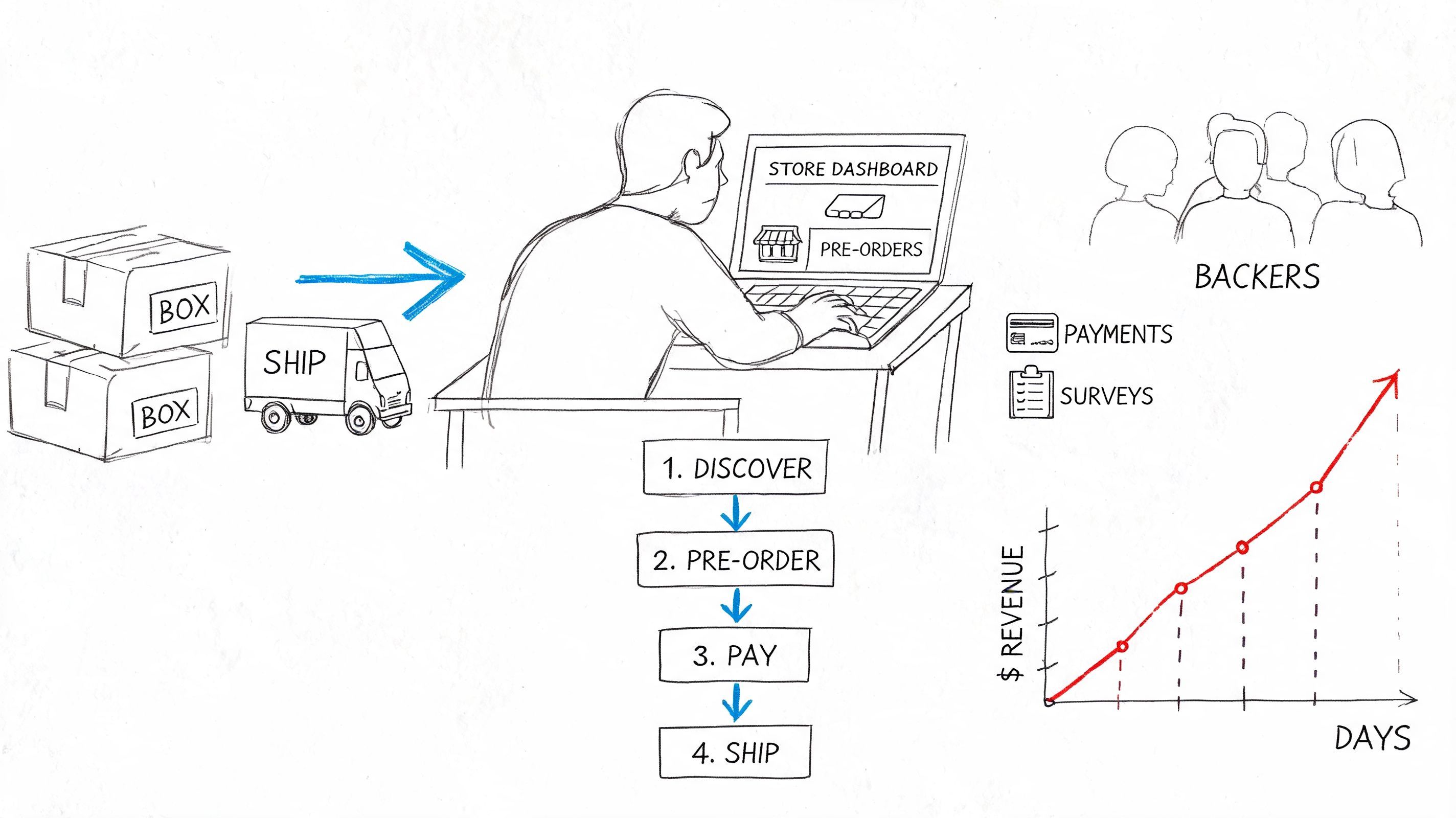
In crowdfunding, pre order websites are not just pages where strangers can buy after the campaign. They’re the operational layer between funding and fulfillment. They collect missing information from backers, turn add-ons into trackable orders, and give late buyers a path to purchase without forcing you to rebuild everything from scratch.
The easiest way to understand the difference is this. Kickstarter’s native tools are like Amazon. You get reach and a familiar environment, but the setup is rigid, the branding is limited, and the customer journey isn’t really yours. A dedicated pledge manager is more like Shopify. You control the storefront, the upsell flow, the add-on logic, and the backer experience.
For creators, that distinction matters. A marketplace-style workflow helps you finish a transaction. A store-style workflow helps you run a business after the campaign.

A basic survey asks a few questions and stores the answers. That sounds fine until your campaign has reward variants, region-based shipping, add-ons with limited stock, and backers who want to update their order later.
At that point, a plain survey becomes a dead end.
A dedicated post-campaign storefront does more than ask for an address. It can:
| Function | Basic survey | Dedicated pre-order website |
|---|---|---|
| Reward confirmation | Limited | Structured and trackable |
| Add-on sales | Clumsy | Built into checkout flow |
| Late backer sales | Usually separate | Integrated into same system |
| Shipping collection | Manual or partial | Centralized |
| Branding | Minimal | Custom storefront feel |
That’s why the better way to describe a pledge manager is this: it’s a customizable pre-order website for your campaign after funding.
If you want to see how that storefront model works in practice, the PledgeBox pre-order marketplace shows the idea more clearly than a plain survey ever will.
Your campaign closes on Friday. By Monday, inbox questions start stacking up. One backer wants to switch colors, another missed an add-on, three need address changes, and someone asks if they can still buy after the campaign ended.
A basic survey was never built for that job.

After funding, creators usually focus on manufacturing. Fair enough. But the post-campaign window is also where a lot of extra revenue is won or lost.
A survey collects answers. A pre-order website collects orders.
That difference shows up fast. Backers who already trust the project are far more likely to add accessories, upgrade tiers, or grab an extra copy if the process feels like checkout instead of admin work. If they have to reply to an email, wait for a manual invoice, or guess what is still available, many will drop off.
This is why I treat a post-campaign tool as a sales system, not a form. Kickstarter gives you the marketplace exposure. Your pledge manager needs to act more like your own store. The restrictive version is closer to Amazon. Useful, but boxed in. A customizable tool works more like Shopify, where you control the buying flow, the offer structure, and the post-campaign experience. A proper crowdfunding pledge manager for post-campaign sales and fulfillment gives you that control.
Late backers are rarely the problem. The problem is giving them a clumsy path to buy.
If someone discovers your project after the campaign, they should see a polished storefront with current pricing, clear delivery expectations, and the same add-ons available to funded backers when appropriate. Email threads and manual PayPal requests create edge cases you will have to clean up later. Pricing gets inconsistent. Records go missing. Support volume rises.
A late backer store should feel like a normal purchase flow, not a workaround.
The operational side is where creators feel the pain.
A survey does not handle change well. Orders change. People move. Shipping prices shift. Some backers want to add items after they submit. Others need to correct VAT details or split part of an order. Once you start managing those requests in spreadsheets, every manual fix creates another chance to ship the wrong item or charge the wrong amount.
A dedicated pre-order website keeps those actions inside one system:
The checkout experience also affects completion rates. If you want a useful reference on diagnosing friction in the checkout funnel, the same principles apply here. Fewer confusing steps and clearer payment prompts usually mean fewer abandoned orders and fewer support tickets.
Backers notice when the process is organized. They finish faster, ask fewer rescue questions, and trust your delivery timeline more because the system looks intentional.
If your post-campaign workflow depends on exported CSVs, inbox searches, and apology emails, the issue is not backer behavior. The issue is the tool.
A good post-campaign setup doesn’t need to feel technical to the backer. It does need to be technically sound underneath. If the tool you choose can’t separate pre-orders from regular stock, manage payment timing, and produce clean shipping data, you’ll feel the weakness later when manufacturing and fulfillment start moving.

Pre-order payments are different from normal e-commerce purchases. You’re often collecting shipping later, charging for add-ons after the campaign, or timing charges around production milestones.
That means your system should support secure payment collection and clear status updates. It should also make it obvious to the backer what has been paid, what is still due, and what happens next.
Creators run into trouble when they treat pre-orders like normal inventory. A post-campaign store needs its own order states and tracking logic, so you can distinguish what has been promised from what is physically on hand.
For small-batch hardware launches, using pre-orders for demand forecasting can improve production planning accuracy by 20-30%, which helps reduce overstock risk by aligning manufacturing with committed orders, according to Mailchimp’s preorders resource.
A workable setup usually includes:
Many creators blame low completion on weak demand when the underlying issue is checkout friction. If backers abandon during shipping confirmation or address entry, your survey completion rate drops and support volume rises.
If you need a practical lens for spotting that friction, Tagada has a useful guide on diagnosing friction in the checkout funnel. It’s relevant because post-campaign stores fail for the same reasons normal checkouts fail. Too many steps, unclear costs, weak mobile flow, and too much manual correction.
You should be able to send reminders automatically, lock surveys when needed, and export shipment-ready data without copy-pasting from multiple files.
Use this checklist when evaluating tools:
If you’re comparing systems specifically built for this phase, the crowdfunding pledge manager overview is a useful reference point for what those features typically include.
After funding ends, the work changes shape. You stop selling the campaign and start running a small commerce operation. Orders need to stay tied to pledge levels, add-ons need to attach to the right backer, shipping needs to be collected correctly, and fulfillment files need to come out clean enough for a warehouse to use without manual repair.
A good pledge manager should reduce that operational load, not shift it into new spreadsheets.

With PledgeBox, the post-campaign flow becomes a branded storefront that also handles pledge management. Existing backers can confirm rewards, choose variants, add extras, and pay remaining balances in one place. Late backers can buy through the same system instead of being handled through side invoices, DMs, or a second store you have to reconcile later.
That storefront model matters in practice. It keeps backer updates, order changes, and new sales inside one system, which is far easier to manage when manufacturing timelines shift or you need to reopen address collection for a limited window.
The pricing model also suits early-stage campaigns. PledgeBox is free to send the backer survey and only charges 3% of upsell if there’s any. For first-time creators, that lowers the risk of adding another software bill before post-campaign revenue starts coming in.
The value shows up in the boring parts that eat hours:
If a tool saves you from one giant spreadsheet but creates five smaller ones, it hasn’t solved the problem.
Small errors create real cost. A missing apartment number becomes a returned parcel. An unpaid shipping balance delays a shipment. A duplicate order turns into a support ticket and a refund review.
Using PCI-compliant payment gateways with manual capture methods for pre-orders can cut fraud exposure by 35% through 3DS validation. Google Maps address validation at the survey stage can also reduce returned shipments by as much as 15%, according to Imaginary Cloud’s book pre-sale website write-up.
That is the operational case for using a dedicated system. Post-campaign problems rarely come from one dramatic mistake. They usually come from dozens of small avoidable ones that pile up during surveys, payment collection, and export prep.
Here’s a short product walkthrough that helps make the workflow concrete:
Post-campaign work rarely moves in a straight line. You collect surveys, sell add-ons, answer production questions, lock addresses, export batches, and often keep selling to late buyers while the first wave is still being prepared.
A rigid survey tool struggles with that. A storefront-based pledge manager handles it better because the system is built for changing orders, staged collection, and continued sales.
For a first-time creator, that difference is practical, not theoretical. You get more control over branding, buyer flow, and post-campaign revenue, while keeping fulfillment data organized enough to hand off without a last-minute spreadsheet rescue.
The most dangerous post-campaign mistakes don’t look dramatic when they start. They look small, reasonable, and temporary. That’s why creators fall into them.
A creator estimates shipping early, leaves too much uncertainty in the survey stage, and hopes the numbers will work out later. Then carrier quotes shift, packaging assumptions change, and region-specific fees show up. If you haven’t built a structured collection process for shipping and taxes, you end up paying the difference yourself or going back to backers with a messy correction.
The fix is dull but effective. Lock down shipping logic before surveys go live, test edge cases, and make sure every reward path maps cleanly to a shipping rule.
Many creators still talk about delays as if they’re only a communication issue. They’re not. Delays become cash-flow problems, support problems, and sometimes refund problems.
A 2023 analysis found that 15% of crowdfunded hardware projects were delayed by more than six months, and 9% faced significant backer disputes that could lead to refund rates of 20-50%, according to Practical Ecommerce’s discussion of the risks around pre-orders.
Backers can forgive a delay. They rarely forgive silence, confusion, or moving deadlines.
Some tools look simple because they leave the hard parts to you. They’ll collect basic responses, but they won’t help much with address validation, payment reconciliation, support workflows, or vendor-ready exports.
That usually means your team becomes the integration layer.
Watch for these warning signs:
Creators often write update language that feels optimistic but leaves too much room for interpretation. “We expect shipping soon” sounds harmless. It creates trouble when backers infer a promise you didn’t intend to make.
Use narrower language. State what is finished, what is pending, what can still change, and when the next confirmed update will land. Clear status language lowers support volume because people don’t need to guess what’s happening.
The week after funding, creators usually check one number over and over: total revenue. It matters, but it does not tell you whether your pre-order website is working. A funded campaign can still slide into messy fulfillment if too many backers stall, add-ons do not convert, or your order data stays incomplete.
Treat this phase like store management, not survey cleanup. Kickstarter gives you marketplace-level visibility. A dedicated post-campaign store gives you operating metrics you can act on.
Start with a short dashboard you can review every few days:
If you want a broader framework for deciding which of these are health metrics versus vanity metrics, Ecommerce Boost's performance guide is a useful reference.
A weak metric does not always mean the offer is bad. Sometimes the issue is timing, page structure, or shipping friction.
For example, tabletop campaigns often see strong add-on interest but more order friction because backers are choosing expansions, language editions, sleeves, and regional shipping options at the same time. That is one reason creators in complex categories benefit from studying a dedicated guide to pre-orders for board game campaigns. The same operational patterns show up in hardware, collectibles, and apparel bundles.
Pre-order conversion also varies by audience warmth. Returning backers who already trust the project behave differently from cold traffic hitting your store link from a late update or paid ad. Use benchmarks carefully. Internal trend lines matter more than chasing a generic conversion target.
The practical question is not whether a number is up or down. The useful question is what operational problem that number is exposing.
| Metric | If it’s weak | Usual cause |
|---|---|---|
| Survey completion | Backers start but do not finish | Too many steps, unclear instructions, or poor mobile flow |
| Paid order rate | Orders remain open or partially complete | Shipping charges arrive late, payment retries fail, or reminders are inconsistent |
| Upsell conversion | Add-ons get viewed but not added | Offer fit is weak, bundles are confusing, or pricing is off |
| Average order value | Revenue grows slowly despite traffic | Cross-sells are too generic or shown at the wrong point in the flow |
| Late backer revenue | Store traffic does not turn into sales | Updates are weak, landing pages are unclear, or the store opens without momentum |
| Fulfillment accuracy | Too many manual corrections before export | Address issues, duplicate records, or bad reward mapping |
One more rule from experience. If a metric looks bad, check the workflow before you rewrite the marketing. A lot of post-campaign problems come from store setup, not lack of demand.
That is the primary advantage of treating your pledge manager like a pre-order website. You are not just collecting responses. You are running a store with measurable conversion, order quality, and fulfillment readiness.
The creators who handle post-campaign work well usually make one mental shift early. They stop treating fulfillment as cleanup and start treating it as a business phase.
That’s why pre order websites matter. They give you a controlled environment to collect data, earn additional revenue, reduce errors, and build a better direct relationship with backers. The survey is only one part of that. The core value is the store, the workflow, and the operational discipline behind it.
The Amazon versus Shopify comparison still holds. Marketplace tools help you launch inside someone else’s structure. A dedicated post-campaign storefront gives you more ownership over what happens next. That’s especially useful for categories with lots of variants and shipping complexity, such as hardware and tabletop. If you’re selling in that space, this guide to pre-orders for board game campaigns is worth reading because the operational lessons transfer well.
And once you move into actual delivery, your logistics choices matter just as much as your software. Teams that need a wider view of warehouse and shipping execution can learn from resources on reliable fulfillment for dropshippers, especially around handoff quality and vendor coordination.
Treat the end of your campaign as the start of your store. That’s when creators stop reacting and start operating.
If you need a post-campaign system that works like a customizable storefront instead of a basic survey, PledgeBox is built for that phase. It lets creators send backer surveys for free and only charges 3% on upsell revenue if upsells happen, which makes it a practical option for teams that want to collect shipping, manage add-ons, and keep late backer sales organized without adding upfront software cost.
PledgeBox
The All-in-One Toolkit to Launch, Manage & Scale Your Kickstarter / Indiegogo Campaign