 PledgeBox
Anatomy of the Kingdom Death Kickstarter Phenomenon
Uncover the secrets behind the Kingdom Death Kickstarter. Learn from its record-breaking success, fulfillment challenges, and post-campaign strategies.
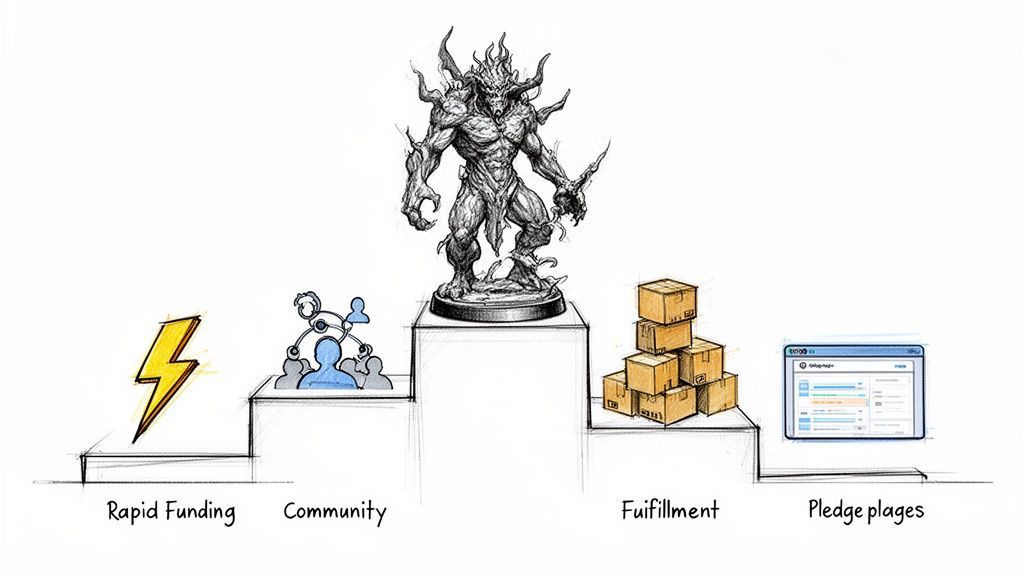
Uncover the secrets behind the Kingdom Death Kickstarter. Learn from its record-breaking success, fulfillment challenges, and post-campaign strategies.
In the world of crowdfunding, some campaigns don’t just succeed—they become legends. The Kingdom Death Kickstarter is one of those stories, a project that didn't just break records but completely rewrote the rulebook for what a niche tabletop game could achieve.
Its second major campaign, Kingdom Death: Monster 1.5, is still talked about today for its mind-blowing funding speed and the massive logistical nightmare that came right after.
 The story behind the Kingdom Death: Monster 1.5 Kickstarter is a perfect storm of hype, intense demand, and the raw power of a dedicated community. This wasn't just another successful project; it was a defining moment for tabletop gaming that showed just how powerful a well-cared-for fanbase can be.
For creators, it stands as both an incredible source of inspiration and a serious cautionary tale. The campaign didn't just hit its goal. It launched into orbit, completely redefining what anyone thought was possible on the platform.
The initial funding goal of $100,000 wasn't just met—it was vaporized in minutes, setting the stage for one of the most-watched Kickstarter campaigns ever.
Picture this: you launch your project on Black Friday and watch it explode. That's precisely what happened with Adam Poots's Kingdom Death: Monster 1.5. The campaign rocketed to $1 million in just 19 minutes, absolutely smashing the previous crowdfunding record held by Pebble Time.
This lightning-fast start wasn't a fluke. Within the first 24 hours, pledges flew past the $4 million mark. By the time the campaign closed, it had raised a jaw-dropping $12,393,140 from nearly 20,000 backers—a staggering 12,393% over its initial goal. You can check out more on this historic launch in this crowdfunding report on Kingdom Death.
This wasn't just funding; it was a declaration. It proved that a niche, high-end product could inspire a level of loyalty and financial power that rivaled mainstream giants.
Of course, this monumental success created an equally monumental problem. Managing the logistics for almost 20,000 backers—each with complex orders, tons of add-ons, and shipping destinations all over the globe—is an operational nightmare. The campaign's greatest triumph instantly became its biggest obstacle.
This gets to a critical question every successful creator faces: how do you handle the crushing complexity that comes with a runaway hit? After the celebration ends, you're left with a massive fulfillment puzzle that can either solidify your reputation or destroy it.
This is exactly why a dedicated pledge manager is no longer a "nice-to-have" but an absolute necessity. Think of the Kickstarter pledge manager like Amazon—it's great for the initial sale. A tool like PledgeBox, however, is more like Shopify, giving you a powerful back-office to manage orders, customer relationships, upsells, and fulfillment.
Best of all, PledgeBox is free to send your backer survey and only charges a 3% fee on new funds if there are any upsells, making it a risk-free tool for taming the post-campaign chaos.

The numbers behind the Kingdom Death Kickstarter campaigns tell a wild story of pent-up demand and the raw power of a dedicated community. This wasn't just a successful launch; it was a financial explosion that sent shockwaves through the tabletop world. It was undeniable proof that a massive appetite existed for premium, niche gaming experiences.
But that incredible speed wasn't just a vanity metric. It was a giant, flashing warning sign. It signaled that the campaign was on track to become a logistical behemoth, and understanding this velocity is the first step in preparing for the challenges that follow such runaway success.
The campaign’s jaw-dropping momentum was fueled by a perfect storm of factors. First and foremost was the cult-like following built by the original game. Backers from the first campaign, alongside a huge crowd of gamers who had missed out, were primed and ready, creating a tidal wave of day-one support.
This anticipation was cranked to eleven by a red-hot resale market. Original copies of the game were fetching hundreds of dollars on eBay, which built a powerful sense of scarcity and high-stakes value. For new backers, the campaign felt less like a purchase and more like an investment.
The result? A funding curve that looked less like a gradual slope and more like a rocket launch.
The table below breaks down just how quickly the Kingdom Death: Monster 1.5 campaign hit its initial major milestones. It's a clear picture of what "explosive growth" really looks like in crowdfunding.
| Milestone | Time to Reach | Backers at Milestone (Approx.) |
|---|---|---|
| $1,000,000 | 19 minutes | ~1,500 |
| $2,000,000 | 1 hour, 1 minute | ~3,100 |
| $3,000,000 | 4 hours, 10 minutes | ~4,600 |
| $4,000,000 | 21 hours | ~6,200 |
| $5,000,000 | 2 days | ~8,800 |
These numbers aren't just impressive; they're a testament to the community's fierce loyalty and the brand's magnetic pull. The blistering pace, hitting $2.5 million in under 12 hours and unlocking stretch goals almost instantly, set a new standard. You can discover how Kingdom Death hit its first milestones and see just how fast the pledges were rolling in.
When the dust settled, the final numbers were genuinely staggering. The campaign closed with 19,264 backers who had pledged an average of $643 each. That figure is astronomical compared to typical board game projects. It points to a deeply committed, high-value audience willing to invest heavily in a world they believe in.
This eye-watering average pledge wasn't just about buying a game; it was about buying into an entire ecosystem of expansions, intricate miniatures, and exclusive content. For creators, this is a clear sign of an audience primed for post-campaign engagement.
Managing this level of complexity is where many massive campaigns stumble. This is precisely where a dedicated pledge manager becomes non-negotiable. Think of it this way: Kickstarter is like Amazon—a fantastic marketplace for that initial transaction. A tool like PledgeBox, however, is your Shopify—a powerful, dedicated backend for managing customer relationships, collecting final details, and driving more revenue through upsells.
Crucially, PledgeBox is free to send the backer survey and only charges a 3% fee on new revenue if there's any upsell. This model makes it a risk-free, essential tool for turning the chaos of a monster campaign into a controlled, profitable process. A similar strategy was vital for other huge projects, and you can see these principles in action by reading about how the Massive Darkness 2 Kickstarter handled its complexity.
A campaign that raises millions doesn't just happen by accident. The incredible success of the Kingdom Death Kickstarter was built on the back of a passionate, almost fanatical community that creator Adam Poots had masterfully nurtured. The campaign page itself became a live event, a bustling hub of excitement that racked up over 27,000 comments and created its own unstoppable hype.
This wasn't just a transaction; it was a shared experience. Backers weren't just customers—they were a tribe. They swapped theories, celebrated every unlocked stretch goal, and eagerly welcomed newcomers into the fold. It was a masterclass in how an engaged audience can become a creator's most powerful asset.
What really poured gasoline on the fire was the “cult classic” status of the original Kingdom Death: Monster. Before the 1.5 Kickstarter even launched, the first edition of the game was almost impossible to find. Its limited print run meant anyone who missed the boat had to brave the secondary market.
Copies were selling for hundreds of dollars on eBay. This created an intense sense of FOMO (Fear Of Missing Out) and drove the perceived value of the game through the roof. When the reprint campaign was announced, it immediately became a can't-miss event for thousands who had been waiting for their chance.
This history of scarcity was the rocket fuel for the sequel's launch. The Kingdom Death: Monster 1.5 Kickstarter became a monument to backer passion, ultimately closing at an astonishing $12,393,140 from 19,264 supporters. This sequel to the 2012 original—which itself pulled in over $2 million—was a direct response to the insane resale market, where rare copies were fetching $500+. You can explore the full campaign breakdown and see how this community passion translated into record-breaking numbers.
The momentum was staggering. By day 13 alone, the campaign had already drawn 14,098 backers, proving just how ready and waiting this community was.
The lesson from the Kingdom Death Kickstarter is crystal clear: building and looking after a dedicated following is one of the most important things a creator can do. When you're transparent, interact genuinely, and create a shared mission, you can turn passive observers into your project's biggest champions.
An engaged community doesn’t just provide funding; it provides momentum. It creates a groundswell of excitement that can carry a campaign to heights you never thought possible.
But with that passionate support comes a huge responsibility. Once the campaign confetti settles, that same community is looking to you to deliver. This is where the real work begins—shifting from managing hype to executing logistics. Keeping that trust requires a rock-solid plan for what comes next.
If you're thinking about how to build your own loyal base, you can learn more about how community is the key to crowdfunding success in our detailed guide. It’s a vital step in getting ready for the journey ahead.
The confetti settles, the funding total is locked in, and the campaign high-fives finally stop. Then comes the hard part. This is the moment a wildly successful campaign can morph into a fulfillment nightmare, and the Kingdom Death Kickstarter is a masterclass in what that looks like. Even with millions in the bank, the job of actually getting your project into the hands of a global audience is a beast all its own.
The campaign's incredible success created a logistical puzzle of epic proportions. Just think about it: fulfilling complex, customized orders for 19,264 backers scattered across the globe is a task that would make even a seasoned logistics company sweat. The infamous, multi-year fulfillment saga of Kingdom Death: Monster shows just how quickly things can spiral, even for the most well-funded projects.
This wasn't just about shipping a single box. The community's engagement directly fueled the campaign's complexity.

These numbers paint a clear picture: a huge, passionate, and high-spending group of backers. That's amazing for funding, but it also means a far more complicated and demanding fulfillment process on the back end.
The road from a funded project to a delivered product is paved with potential disasters. Many creators get swept up in the excitement of hitting stretch goals and don't fully grasp the post-campaign marathon ahead. The Kingdom Death story is a perfect guide to these challenges.
Here are a few of the most common traps that can derail even the best plans:
The original Kingdom Death: Monster took years to fully deliver, with some parts from the first campaign not arriving until after the second one had already run. It’s a powerful lesson that even with a die-hard community, long delays will test everyone's patience.
Here’s the core problem: the tools built into crowdfunding platforms are for funding, not for management. Once the campaign clock runs out, you’re basically handed a giant spreadsheet and a "good luck." This is where you have to stop thinking like a campaigner and start thinking like an e-commerce operator.
Think of it this way: Kickstarter’s native system is like a fantastic pop-up market. It’s great for attracting a crowd and making the sale. A dedicated pledge manager like PledgeBox, however, is your operational HQ. It’s the backend where you manage your customer relationships, finalize every order, and control the entire post-purchase journey.
This mindset shift is everything. You need a system built for the controlled chaos of post-campaign fulfillment. For any creator planning a launch, figuring out how to successfully fulfill backer rewards needs to be part of your pre-campaign strategy, not an afterthought.
A proper toolset isn't a "nice-to-have" anymore; it's a survival kit. It gives you the framework to accurately collect shipping info, manage all those complicated orders, and handle the nitty-gritty financial details that can easily sink a project. Better yet, PledgeBox is free to send the backer survey and only charges a 3% fee on new revenue if there's any upsell, making it a no-risk way to ensure your dream campaign doesn't become someone else's cautionary tale.
Now that you see just how chaotic things can get after a campaign ends, it’s time to talk about the tool that brings order to that chaos: a pledge manager. For any complex project, and especially for a monster campaign like the Kingdom Death Kickstarter, a pledge manager isn't just a nice-to-have—it's absolutely essential. It’s the bridge between a funded campaign and a fulfilled one.
Trying to manage thousands of orders with a giant spreadsheet is a surefire way to get overwhelmed and make costly mistakes. A pledge manager is how modern creators get ahead of the curve.
The best way to wrap your head around a pledge manager is with an analogy.
Think of Kickstarter as the Amazon of the crowdfunding world. It's a massive, bustling marketplace where you can attract a huge crowd, generate incredible hype, and lock in that all-important initial funding. It’s fantastic at getting people in the door.
A pledge manager like PledgeBox, on the other hand, is like your own personal Shopify store. It’s the powerful backend where you take over after the sale is made. This is your command center for finalizing orders, managing your backers, and even growing your revenue long after the campaign clock runs out.
That's the key difference. Kickstarter brings you the backers; a pledge manager helps you keep them happy and deliver their stuff correctly.
A good pledge manager does a lot more than just organize backer data. It gives you professional-grade tools to streamline your fulfillment and even improve your project's bottom line. It’s all about proactively avoiding the exact problems that have tripped up huge campaigns in the past.
Here’s a look at how a tool like PledgeBox empowers creators:
To really get a handle on the complex logistics of post-campaign delivery, it's also worth looking into different workflow management software options. These tools give you a solid framework for organizing multi-stage projects so no detail gets missed.
Maybe the most convincing reason to use a modern pledge manager is the pricing model. A lot of creators, especially first-timers, get nervous about adding another expense to their budget. This is where PledgeBox really changes the game.
PledgeBox is free to use for sending your backer survey. The platform only charges a small 3% fee on new funds raised from upsells and add-ons sold through the survey.
This model makes it a completely risk-free choice. You get a whole suite of powerful management tools without any upfront cost. If you don’t sell a single add-on, you don't pay a dime. If you do, the fee only comes out of the extra money you wouldn't have made otherwise.
For a campaign on the scale of the Kingdom Death Kickstarter, this approach would have offered massive organizational power without touching a cent of the initial funding. It aligns the pledge manager’s success with the creator’s, turning what could be an expense into a powerful, revenue-generating partner. It’s your secret weapon.
The epic saga of the Kingdom Death Kickstarter is so much more than a wild crowdfunding story. It’s a practical playbook packed with lessons for any creator getting ready to launch. By looking at what they did right—and where they struggled—you can build a smarter strategy for your own campaign.
The real secret is putting these lessons into practice from day one, not just after the funding clock runs out. Thinking ahead about hype, community, and fulfillment is what separates a smooth delivery from a total nightmare. You have to be ready for anything.
Your campaign doesn't begin on launch day; it really starts months earlier. The die-hard community behind Kingdom Death was its single greatest weapon, and it was built through years of genuine connection. Your goal should be to grow that same kind of tribe before you ever ask for a single dollar.
This is about more than just posting a few updates. It means having real, two-way conversations, sharing behind-the-scenes glimpses, and making your earliest supporters feel like they have a stake in the project. An engaged community builds its own hype, and that momentum can push your campaign to incredible heights.
A project's true foundation isn't its funding goal; it's the community you build around it. Treat your earliest supporters like co-creators, and they will become your most powerful advocates.
A strong community also acts as a critical safety net when things inevitably go wrong. Delays happen, especially with massive, multi-year projects like Kingdom Death or Middara. Backers are far more forgiving and patient when they feel personally connected to you and your vision, even when the timeline starts to slip.
The moment your campaign ends, the real work starts. Your brain has to switch immediately from marketing mode to operations mode. If there’s one thing to learn from the Kingdom Death Kickstarter, it’s that a huge funding total doesn’t make fulfillment easy—in fact, it usually makes it much, much harder.
This is where a good pledge manager becomes your most valuable tool. The easiest way to think about it is like this: Kickstarter is the marketplace, like Amazon, where you make the initial sale. But a tool like the PledgeBox pledge manager is your backend e-commerce system, like Shopify, giving you total control after the purchase.
That difference is huge. A dedicated tool like PledgeBox lets you:
Best of all, PledgeBox is free to send your backer survey and only charges a 3% fee on new funds you raise from upsells. This makes it a no-risk way to add a layer of professional control to your post-campaign process.
Beyond the initial crowdfunding buzz, it's also smart to think about the long game. Using solid DTC marketing strategies helps build a sustainable brand well after the campaign is over. A successful Kickstarter is the perfect launchpad, but only if you have the operational tools in place to turn those amazing backers into loyal, long-term customers.
Even with a project as big as the Kingdom Death Kickstarter, creators are often left with more questions than answers. Let's break down some of the common ones and pull out the practical lessons you can apply to your own campaign.
Honestly, it was the perfect storm. The campaign wasn't starting from scratch; it was tapping into a die-hard cult following from the original game. Add in a red-hot resale market that created intense scarcity, and the promise of some of the most detailed miniatures ever made, and you have a recipe for success.
But the real magic was how creator Adam Poots handled community engagement. He turned the campaign page into a living, breathing event that felt like it was happening 24/7. This created a fanatical base that fueled a viral news cycle, pushing the project's reach far beyond the usual tabletop gaming crowd.
If there’s one thing to take away, it's this: getting funded is just the beginning. The Kingdom Death Kickstarter campaigns were hit with massive, multi-year delays. It's a tough but powerful reminder of just how difficult it is to manufacture and ship thousands of complex products to backers all over the world.
This really drives home how critical it is for creators to have a rock-solid logistics plan from day one. You absolutely have to use powerful tools to manage addresses, calculate accurate shipping, and handle taxes. Get it wrong, and you're looking at huge costs and a lot of unhappy backers.
Think of Kickstarter like Amazon—it’s a fantastic marketplace for finding backers. But a pledge manager like PledgeBox is your Shopify; it’s the back-office that gives you total control over orders, customer relationships, and fulfillment after the sale.
A pledge manager gives you back the steering wheel after the campaign clock stops. Kickstarter is amazing for gathering initial pledges, but a dedicated tool like PledgeBox is purpose-built for managing everything that happens next.
It allows you to send out detailed surveys, offer last-minute add-ons (which can seriously boost your funding), and collect the correct shipping fees and VAT. For a project with the sheer complexity of Kingdom Death, a pledge manager would have been a lifesaver for organizing the data across its multiple fulfillment waves.
Best of all, PledgeBox is free to send your backer survey and only charges a 3% fee on new funds you raise from upsells. This makes it a powerful, zero-risk way to get organized, increase your budget, and shield your project from the logistical nightmares that have challenged even the biggest campaigns.
At PledgeBox, we provide an all-in-one toolkit designed to help you run a smooth and successful crowdfunding campaign from pre-launch to fulfillment. Take control of your post-campaign process with PledgeBox today!
PledgeBox
The All-in-One Toolkit to Launch, Manage & Scale Your Kickstarter / Indiegogo Campaign