 PledgeBox
10 Best Sentiment Analysis Tools for Creators in 2026
Discover the top 10 sentiment analysis tools for crowdfunding. Learn how to track backer feedback, monitor social buzz, and refine your campaign strategy.
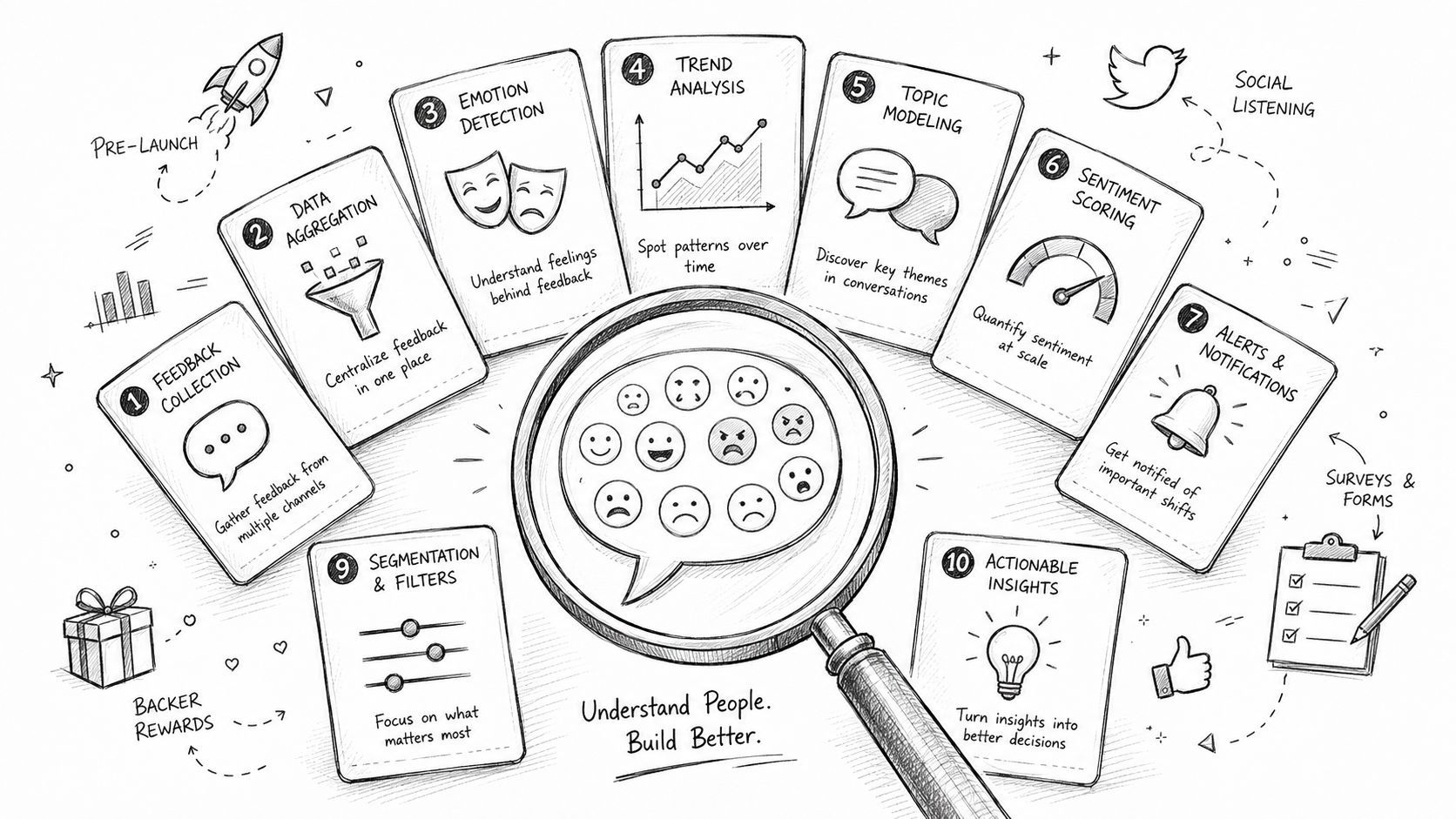
Discover the top 10 sentiment analysis tools for crowdfunding. Learn how to track backer feedback, monitor social buzz, and refine your campaign strategy.
Your crowdfunding campaign is live, the comments are piling up, and the same question keeps coming back in different forms. Which backers are thrilled, which ones are worried about shipping, and which ones are drifting away? Sentiment analysis tools help you sort that out fast by turning reviews, support tickets, survey answers, and social chatter into usable signals, which matches how IBM defines sentiment analysis as sorting tone into positive, negative, or neutral and how Gartner frames it as text analysis across feedback channels IBM, Gartner. For creators, value lies not in abstract analytics, but in knowing what to fix before fulfillment becomes a headache.
If you're building for Kickstarter or Indiegogo, the stage matters. Pre-launch research needs broad listening and theme detection, live campaign monitoring needs real-time alerts, and post-campaign backer feedback needs tools that can handle surveys, support threads, and sentiment drift without guessing at tone. There's also a practical market signal here, the category has scaled from niche text mining into a serious commercial space, with MarketsandMarkets projecting a $9.4 billion market by 2030 from $3.9 billion in 2024, and enterprise use is already widespread in CX workflows, with 63% of enterprise CX teams using automated sentiment analysis in at least one workflow in one 2025 snapshot Stealth Agents research. For a creator, that means the tooling is mature enough to trust, but the trick is matching the right platform to the right campaign stage.
Brandwatch is the strongest fit when you need pre-launch benchmarking and broad public sentiment before your campaign goes live. Its Consumer Research platform is built for large-scale social listening, historical trend analysis, and analyst-grade reporting, so you can compare how people talk about your category, competitors, and your own brand over time Brandwatch.

For crowdfunding, Brandwatch makes sense when you're testing the waters around shipping concerns, feature expectations, or add-on interest long before your page is public. The value is in the historical archive and the ability to create custom classifiers, so you can separate chatter about pledge levels from complaints about fulfillment or VAT, instead of lumping everything into one sentiment score.
Its reporting is also a strong fit for agencies or creators who need stakeholder-ready outputs. If you're trying to brief partners, not just check dashboards, the platform's analyst-focused structure helps.
Practical rule: Use Brandwatch when the question is, “What does this market already believe about my category?” not, “What did one backer mean in this comment?”
The trade-off is price and setup. Brandwatch is enterprise software, so it usually makes sense when you have enough campaign volume, brand risk, or competitive pressure to justify a deeper intelligence layer. If you want a practical companion read on review-driven validation, the logic behind online review analysis aligns well with PledgeBox's guide to using reviews to boost your brand.
Talkwalker is the better pick for live campaign monitoring when you need rapid alerts across many platforms and languages. It covers 30+ social platforms and 150M+ sources in 187 languages, which matters if your backers are spread across regions or if your campaign starts picking up attention outside your home market Talkwalker.
What stands out here is the combination of real-time listening, peak detection, and AI summaries. If your launch gets a sudden wave of attention, Talkwalker helps answer the question creators care about most, what changed and why. That's useful when comments start turning from hype to confusion, especially around stretch goals, delivery windows, or product options.
The platform also supports AI assistant tracking through LLM Insights, which can be useful when your campaign story gets picked up in new ways by media and social posts. Because it offers unlimited users on some plans, it's easier to involve a marketing lead, a community manager, and a fulfillment partner without adding seat anxiety.
If your creator team is small and social isn't your main feedback source, Talkwalker can feel like more platform than you need. But for a campaign that's already spreading beyond your immediate audience, it's one of the strongest real-time listening options on the list.
Sprout Social fits creators who want one system for publishing, engagement, and sentiment, then a deeper listening layer when the campaign starts to scale. The built-in sentiment features in Smart Inbox and Reviews make it practical for day-to-day community work, while the Listening add-on expands the view into larger-volume conversation tracking Sprout Social.
This is the most creator-friendly option if you don't want to stitch together separate tools for scheduling posts, replying to comments, and reviewing audience tone. For a crowdfunding team, that matters because the same person often manages launch posts, backer replies, and social escalation.
The support workflow is a real advantage too. Sprout's integrations with Salesforce and Zendesk let you connect sentiment signals to support handoff, which is useful when backers start asking about refunds, shipping changes, or missing updates. The trade-off is scope. It's strongest on social channels, not on broader web or news monitoring.
Sprout is useful when:
It gets less attractive when your feedback lives outside social. If you're pulling in forum posts, review sites, or multi-language media coverage, an enterprise listening suite will go deeper. For creators who live on Instagram, X, and Facebook comments, though, Sprout remains one of the cleanest operational choices.
Meltwater is a strong choice when you want one view of PR, social, influencer, and news sentiment during a campaign. It consolidates monitoring across multiple channels and offers alerts, configurable dashboards, and API access for teams that need the data to flow into other systems Meltwater.

For crowdfunding creators, this matters most after momentum starts building. A product mention in a blog post, a social thread, or a news roundup can reshape backer expectations quickly. Meltwater is built for that broader exposure layer, so you're not treating social comments as the only signal.
The developer API is especially helpful if your team already has a dashboard or internal reporting stack. You can pipe sentiment and monitoring data outward instead of forcing everyone into one UI. That said, the learning curve is real, and topic configuration takes work if you want precise sentiment concerning what matters to backers.
A useful mental model is this. Brandwatch is often the sharper research tool, while Meltwater is the broader media-monitoring layer when campaign reputation crosses into PR and press. If you're choosing between them, ask whether you need a category baseline or a public coverage hub.
For early-stage creator research, PledgeBox's market research guide before launching fits the same mindset, validate what the market says before you promise the next big thing.
A crowdfunding team usually feels the strain of post-campaign backer feedback analysis after fulfillment starts. Comments arrive through surveys, support chats, reviews, and follow-up emails, and each channel tends to tell a slightly different version of the same story. Qualtrics XM Discover is built to pull that feedback into one place and read sentence-level sentiment and opinion patterns across those touchpoints Qualtrics.
The mess usually shows up fast. One spreadsheet holds survey replies, another inbox fills with support questions, and review exports sit somewhere else entirely. Qualtrics helps organize that spread of feedback and explain the why behind the sentiment, not just the score.
That matters for pledge managers and backer surveys because the same issue can appear in different forms. A shipping complaint may arrive as a negative support ticket, a neutral survey note, and a frustrated social reply. Qualtrics helps surface that as one topic instead of three disconnected signals. The API also gives teams a way to feed feedback intelligence into their own reporting stack.
For creators who want a concrete example of how audience feedback shapes product decisions, this PledgeBox case study on user perception shows the same idea in a real campaign setting.
Practical rule: Use Qualtrics when you care more about backer experience governance than about light social monitoring.
The trade-off is cost and implementation overhead. Smaller creator teams may find it too heavy unless they are managing a complex fulfillment program, a large backer base, or a multi-product catalog. For serious post-campaign analysis, though, it gives you a clear way to turn backer noise into structured insight.
Google Cloud Natural Language API is the right call when you want developer-friendly sentiment analysis inside your own data pipeline rather than a standalone dashboard. It provides document-level sentiment, entity sentiment, classification, and syntax analysis, which makes it useful for processing campaign comments, support messages, or exported survey data Google Cloud Natural Language.
For crowdfunding operators with engineering support, this is an efficient way to build custom analysis around the data you already own. If you want to score backer comments, tag sentiment toward specific entities like shipping or accessories, and then push the output into BI tools, this API gives you a clean path.
The biggest advantage is flexibility. You can combine multiple analyses in a single call, and the pricing model is granular enough to estimate usage carefully. That matters if you're running a lean team and don't want a broad enterprise suite.
The trade-off is obvious. There are no out-of-the-box campaign dashboards, so if you need a ready-made UI for community managers, this won't feel turnkey. It also depends on how your data is collected, since the API can only analyze what you can legally and technically ingest.
For technical teams, though, it's one of the best ways to make sentiment analysis part of a custom creator stack without buying more software than you need.
Amazon Comprehend makes sense if your campaign stack already lives in AWS and you want sentiment analysis as part of the pipeline, not as another tool to log into. It supports standard sentiment, targeted sentiment, entities, key phrases, and language detection, with both real-time and batch modes Amazon Comprehend.
This is a back-end solution more than a front-end product. If your team exports support logs, social data, or survey responses into S3, Lambda, or Glue, Comprehend fits naturally into the workflow. It's especially useful when you want to isolate sentiment around a specific issue, like hardware quality or delivery complaints, instead of scoring the whole comment as one blob.
The pricing structure is another reason AWS teams like it. Per-character metering makes cost estimation more transparent than some enterprise quote-based platforms. But quality can vary by domain slang, so creator-specific jargon and niche community language may need post-processing.
Data pipeline first, dashboard second. That's the right way to think about Comprehend.
If you're running a technical campaign, especially in hardware or tabletop, this can be a smart choice. If you need someone to explain sentiment to a community manager in plain language, a more visual platform will be easier to live with.
Azure AI Language is a strong fit for creators and agencies already inside the Microsoft stack. It offers document and sentence-level sentiment with opinion mining, and it supports both cloud and containerized deployment, which gives teams flexibility in how and where they run analysis Azure AI Language.
This is useful when your team wants to test sentiment on backer feedback without locking everything into one cloud workflow. The container option is especially practical for organizations with data handling concerns or custom infrastructure requirements.
The service also uses a clear metering concept tied to text records, which helps with planning when you're processing survey exports or support archives. The downside is that pricing can still feel opaque without the calculator, and niche creator language may require extra tuning.
For campaign teams, Azure works best when sentiment is just one component in a broader data environment. If your reporting lives in Power BI, Microsoft services, or an Azure-based warehouse, the integration story is smoother than it would be with a standalone social tool.
That flexibility makes Azure a serious option for creator studios and agencies that manage multiple campaigns in parallel. It's less appealing if you want a simple visual product out of the box.
IBM Watson Natural Language Understanding is a solid choice for teams that want sentiment and emotion detection in the same analysis pipeline. It also supports custom models, so if your backer language is specialized, you can tune the output instead of trusting a generic classifier IBM Watson NLU.
The combination of sentiment and emotion matters in crowdfunding because not every negative comment is the same. A backer can be confused, annoyed, or angry, and those signals need different follow-up. IBM's NLU setup is good for scoring comments and tagging emotional intensity without forcing you into a rigid dashboard workflow.
It also has a Lite plan for prototyping, which is handy if you want to test a feedback pipeline before committing to a paid tier. That makes it appealing for creators who are still building their post-campaign workflow and want to validate whether their comments are clean enough for automated analysis.
The trade-off is that custom models add setup complexity. If your team wants immediate, polished reporting, this may feel technical compared with a more creator-focused platform. But if you care about structured scoring and model control, it's a mature option.
Use it when emotion matters as much as polarity. Backer frustration, excitement, and disappointment are not interchangeable signals.
Lexalytics Semantria is the tool I'd look at for niche crowdfunding communities where standard sentiment models miss domain language. It offers REST API access, tunable taxonomies, and options that can move toward on-prem components through the Salience SDK, which gives teams more control over data isolation and classification behavior Lexalytics Semantria.
This matters for tabletop games, specialty hardware, and creator communities with their own jargon. A generic model can misread shorthand, project names, or in-group language, while a tunable taxonomy can handle those terms more cleanly.
Lexalytics has long-standing credibility in CX and voice-of-customer work, and that shows in how much configuration it expects. It's not the fastest route to value, but it's one of the strongest options when you need a more customized NLP layer than a standard cloud service gives you.
The obvious downside is setup. It's enterprise-oriented, quote-based, and best suited to teams with technical support. Still, for creators whose audiences talk in specialized shorthand, that extra tuning can save a lot of bad labeling later.
If your campaign has a vocabulary problem, Lexalytics is worth serious consideration.
| Tool | Core features | Quality ★ | Target 👥 | USP ✨ / 🏆 | Pricing 💰 |
|---|---|---|---|---|---|
| Brandwatch Consumer Research | Enterprise social listening, AI dashboards, deep historical archives, custom classifiers | ★★★★★ | 👥 Analysts, agencies, large campaigns | 🏆 Historical baselining & analyst-grade reporting ✨ | 💰 Quote-based enterprise |
| Talkwalker (Lumen) | Real-time listening, multilingual coverage (187 langs), alerts, peak detection | ★★★★★ | 👥 PR teams, global campaign monitoring | 🏆 Real-time spike detection & broad language coverage ✨ | 💰 Quote-based enterprise |
| Sprout Social (w/ Listening) | Publishing + engagement + sentiment; optional Listening add-on | ★★★★ | 👥 Small–mid marketing teams, social managers | ✨ All-in-one workflow with transparent pricing 🏆 | 💰 Published plans; Listening as paid add-on |
| Meltwater | Social + news + PR monitoring, alerts, dev API, consolidated dashboards | ★★★★ | 👥 PR/marketing teams needing unified coverage | 🏆 Single view for PR + social analytics ✨ | 💰 Quote-based |
| Qualtrics XM Discover | Omnichannel text & speech analytics, sentence-level sentiment, VoC focus | ★★★★★ | 👥 CX/backer insights teams, enterprises | 🏆 Sentence-level explainability for "why" ✨ | 💰 Quote-based enterprise |
| Google Cloud Natural Language API | Doc & entity sentiment, classification, AnnotateText, pay-as-you-go API | ★★★★ | 👥 Dev teams, BI pipelines, custom integrations | ✨ Flexible API + clear metered pricing 🏆 | 💰 Tiered pay-as-you-go (free units) |
| Amazon Comprehend | Standard & Targeted Sentiment, real-time/batch, AWS-native integration | ★★★★ | 👥 AWS-centric engineering teams | ✨ Targeted sentiment + native AWS pipeline support 🏆 | 💰 Metered per characters, free tier |
| Azure AI Language | Document/sentence sentiment, opinion mining, containers & Language Studio | ★★★★ | 👥 Azure shops, containerized deployment needs | ✨ Containers + MS ecosystem integration 🏆 | 💰 Free records/month + per-record billing |
| IBM Watson NLU | Sentiment + emotion detection, custom models, transparent item pricing | ★★★★ | 👥 Prototypers and CX teams | ✨ Emotion analysis & generous Lite plan 🏆 | 💰 Lite for testing, paid tiers thereafter |
| Lexalytics Semantria | REST API, tunable taxonomies, themes, on-prem/SDK options (Salience) | ★★★★ | 👥 Developers, niche/domain projects | ✨ Highly configurable, on-prem for data isolation 🏆 | 💰 Quote-based enterprise |
A sentiment analysis tool only matters if it changes the next decision. For crowdfunding creators, that usually means three jobs, checking pre-launch comments to tighten positioning, tracking live campaign chatter as momentum shifts, and sorting post-campaign survey and support feedback before it turns into friction.
Stage matters more than feature checklists. If you are still validating demand, choose a tool with broad coverage and searchable archives, such as Brandwatch or Meltwater. If the campaign is live and the conversation is moving fast, Talkwalker or Sprout Social can keep you closer to the day-to-day mood of your backers. If you are in fulfillment and feedback is spread across surveys, tickets, and comments, Qualtrics, IBM Watson NLU, or a developer-focused API like Google Cloud Natural Language or Amazon Comprehend gives you more control over how the analysis is handled.
Calibration matters just as much. Modern sentiment systems are better than old keyword rules, but they still miss context, negation, and language that shifts inside creator communities. Treat sentiment as a signal to review, not a verdict to follow. The tools help you ask better questions faster, but your team still has to compare the results with what is occurring in the campaign.
A practical creator stack starts with one question, where is the feedback coming from? Once that is clear, the choice gets easier. A team balancing community management, backer surveys, and fulfillment communication needs a setup that fits the stage it is in, not a generic analytics package that looks impressive in a demo.
PledgeBox fits into that workflow. PledgeBox is free to send the backer survey and only charges 3% of any upsell if there's any, which keeps the post-campaign side of a launch efficient while the feedback stays organized for sentiment review. For creators who want the pledge manager to feel like Shopify while Kickstarter's pledge manager feels more like Amazon, Sentaiment Com's profile on IndieTool points to a creator-first path from survey to upsell to fulfillment without tool sprawl.
PledgeBox
The All-in-One Toolkit to Launch, Manage & Scale Your Kickstarter / Indiegogo Campaign