 PledgeBox
How to Create a Kickstarter From Idea to Launch
Learn how to create a Kickstarter with this comprehensive guide. We cover idea validation, campaign page creation, launch strategies, and fulfillment.

Learn how to create a Kickstarter with this comprehensive guide. We cover idea validation, campaign page creation, launch strategies, and fulfillment.
Learning how to create a Kickstarter that gets funded goes way beyond just having a cool idea. It's a structured process that starts with validation, moves into building an audience before you launch, and finishes with a solid execution plan.
It all boils down to confirming market demand before you sink time and money into production, building a list of people who are genuinely excited to back you on day one, and then managing the post-campaign chaos like a pro.
Launching a winning Kickstarter campaign is a marathon, not a sprint. It’s built on a solid strategy, not just a sudden flash of inspiration. The path from a simple concept to a fully funded product has distinct phases, and each one builds on the last.
If you make a mistake early on—like skipping market validation—you risk a failed campaign, wasted money, and a whole lot of frustration. This blueprint is designed to walk you through the entire lifecycle, step by step.
The process isn't just about making a product; it’s about building a community that believes in it. This community will be your first wave of backers, your biggest cheerleaders, and your best source of feedback.
This flow chart breaks down the core stages you'll go through, from testing your initial idea all the way to launching the campaign.
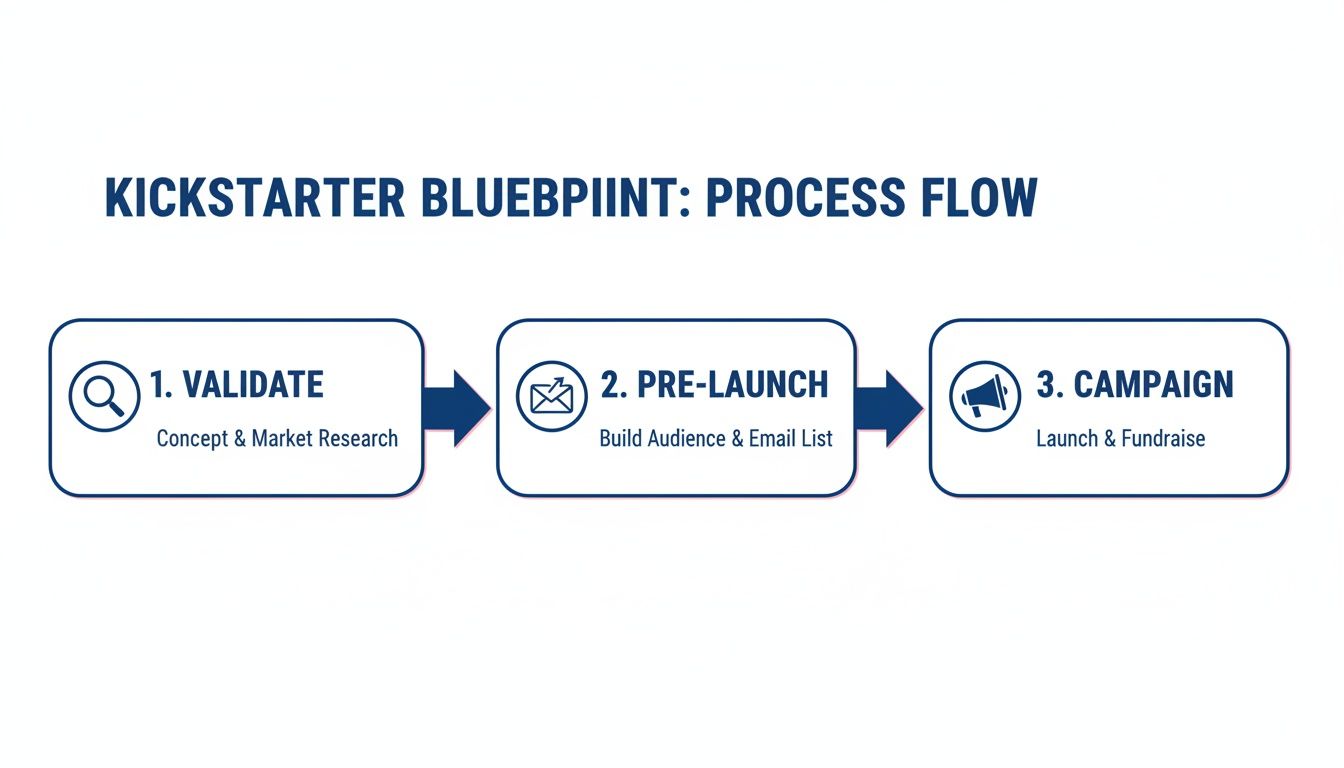
As you can see, the most important work happens long before you ever hit the "launch" button.
Your entire journey can be broken down into four key phases. Nail each one, and you're well on your way to crowdfunding success. A lot of the principles here are similar to what you'd find in an ultimate guide to website planning, where a strong foundation is everything.
To keep everything on track, this simple checklist can act as your high-level guide.
This table breaks down the core objectives and must-do actions for each phase of your campaign, ensuring you don't miss a critical step.
| Campaign Phase | Key Objective | Critical Actions |
|---|---|---|
| Validation | Confirm Market Demand | Conduct competitor research, run test ads, create a simple landing page to collect interest, and gather feedback from potential customers. |
| Pre-Launch | Build an Engaged Audience | Grow an email list of potential backers, create hype on social media, secure early reviews or press, finalize campaign page assets. |
| Live Campaign | Achieve Funding Goal | Drive traffic on launch day, post regular updates, engage with the backer community, manage communications, and push for stretch goals. |
| Post-Campaign | Fulfill Rewards & Build Brand | Send backer surveys, manage pledges and add-ons using a pledge manager, provide production updates, and ship rewards on time. |
Following this roadmap helps you move from one milestone to the next with confidence.
So many creators pour all their energy into getting funded and then completely drop the ball on fulfillment. A messy, disorganized post-campaign phase can ruin your reputation and undo all the goodwill you worked so hard to build.
This is where a dedicated pledge manager becomes your best friend.
Think of Kickstarter's pledge manager like Amazon—it's a standardized marketplace that works for simple transactions. But a pledge manager like PledgeBox is like having your own Shopify store. It gives you total control to customize surveys, handle complex orders, and even make extra money from add-ons.
Best of all, PledgeBox is free to send the backer survey and only charges 3% of upsell revenue if there's any. This no-risk model means you can manage your backers professionally and boost your final funding total without paying anything upfront. It’s an essential tool for turning a one-off campaign into a lasting brand.
A brilliant concept is worthless without an audience ready to fund it. This is where the real work of creating a Kickstarter begins, long before you even think about hitting that 'launch' button. This pre-launch phase is all about confirming that people actually want what you're making and building a community that feels invested in your success from day one.
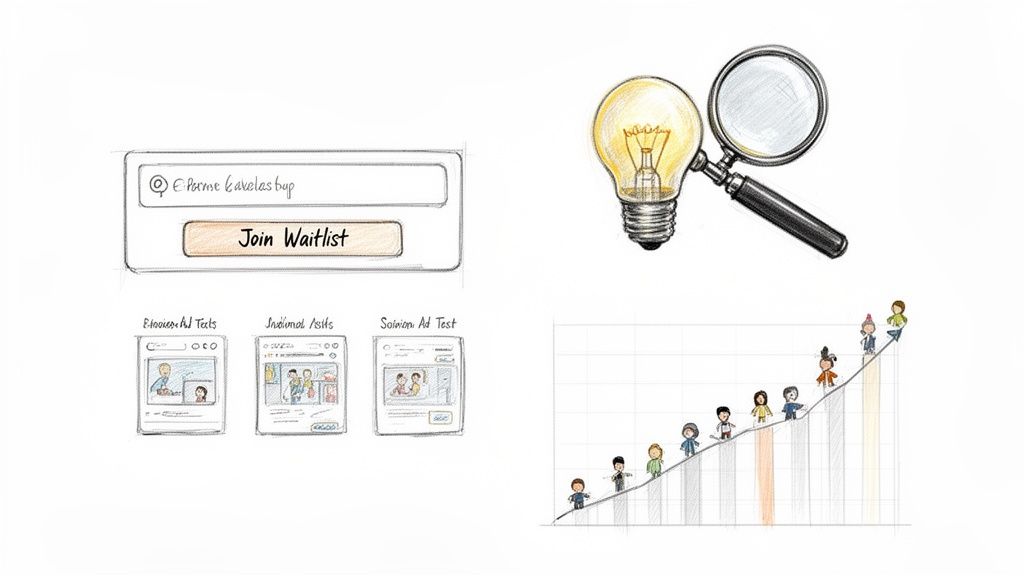
Before you spend a single dollar on prototypes or video production, you have to validate your idea. Validation isn't about asking friends and family if they like your product; it's about getting unbiased, data-driven proof that a market exists for it. If you skip this, you're just gambling.
The goal here is to test your concept with minimal investment. Think of it as a series of small, calculated experiments designed to get a clear signal from your potential customers. A critical first step is figuring out exactly who your product is for. Getting a handle on defining your target market is key to making sure your campaign appeals to the right people.
Here are a few practical methods to get started:
These actions provide cold, hard data. If you can't get people to give you their email address for free, getting them to open their wallets will be nearly impossible.
Once you've confirmed there's interest, your primary focus shifts to one thing: building a powerful email list. This list isn't just a collection of addresses; it's the engine that will drive your campaign's crucial first-day momentum. A strong launch day is essential for catching the eye of Kickstarter's algorithm and getting featured on the platform.
Your goal is to nurture this audience, turning casual interest into genuine excitement. Share behind-the-scenes progress, ask for their input on design choices, and make them feel like insiders. For a deeper dive, check out our guide on how to build a list of potential backers before your Kickstarter campaign launches: https://www.pledgebox.com/post/how-to-build-a-list-of-potential-backers-before-your-kickstarter-campaign-launches. This isn't just about collection; it's about connection.
Think of your email list as your Day One army. These are the people who will fund a significant portion of your goal within the first 24-48 hours, creating the social proof and momentum needed to attract thousands of other backers.
By nailing this validation and audience-building phase, you’ll have a data-backed estimate of your day-one funding potential. This transforms your launch from a hopeful guess into a strategic execution, setting the stage for a knockout campaign.
Your Kickstarter page is everything. It's your digital storefront, your investor pitch, and your origin story all rolled into one powerful sales tool. A great page doesn’t just rattle off features; it tells a story that forges a genuine connection and makes visitors need to click "Back this project."
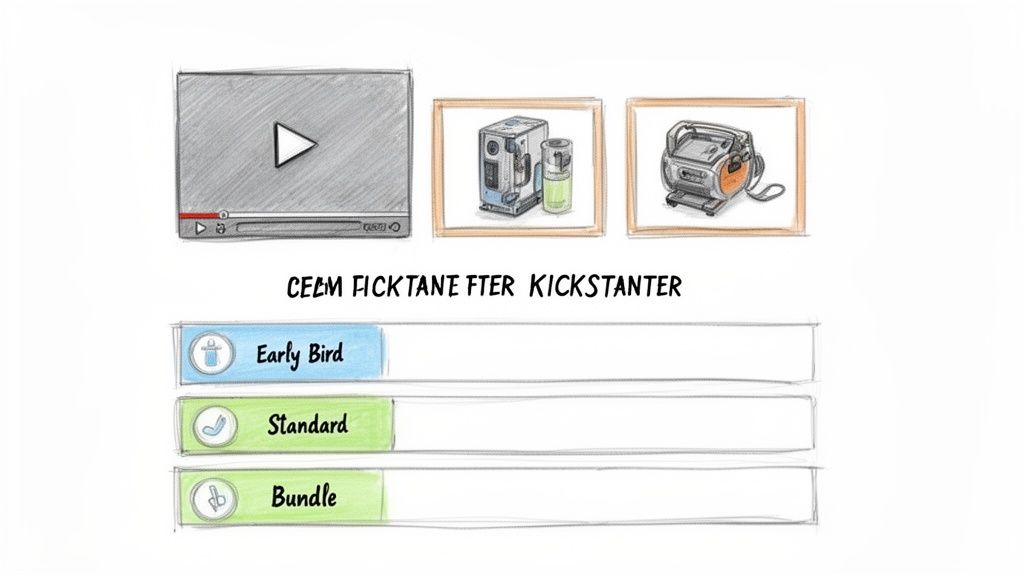
The story you tell is crucial. You have to hook them by explaining the problem your product solves, wow them by showing your solution in action, and win them over by introducing the passionate team bringing it to life. This narrative is the thread that should tie every single element of the page together.
Every killer campaign page I've seen shares a few core ingredients that work together to build trust and excitement. Think of these as the absolute must-haves for your page.
Understanding the odds should be your motivation to get this right. As of early 2024, only 41.98% of all Kickstarter projects get fully funded. But here's the kicker: projects that manage to hit just 20% of their funding goal have an over 80% chance of succeeding. This stat, which you can explore more on Statista, proves how critical a great page is for building that initial momentum.
Your reward tiers are where a casual browser becomes an active backer. The goal is to create a value ladder that tempts people to pledge at higher levels. This isn't just about listing products; it's about crafting offers that feel like a steal.
Start with a low-cost, simple "thank you" tier to get people on board. Then, roll out your main offerings, always including a limited "Early Bird" discount to create urgency on day one. Finally, create bundles and premium packages that pack in a ton of value for a higher pledge.
Let’s say you're launching a smart notebook:
This kind of structure gives everyone an entry point and creates a clear path for your biggest fans to show their support.
One of the most common rookie mistakes is setting a pie-in-the-sky funding goal. Your goal shouldn't be what you hope to make; it must be the absolute bare minimum you need to manufacture your product, cover all fees, and ship every single reward. Aiming too high can scare off potential backers who might think your project is doomed to fail.
Your budget needs to be ironclad. Here’s a quick rundown of what it has to cover:
Add all of that up, and you have your realistic, defensible funding goal. Trust me, it’s much better to set an achievable goal and smash it—then use stretch goals to keep the hype going—than to set a massive target and fall short.
Putting together a winning page takes work. For more hands-on advice on layout and content, check out our deep dive into Kickstarter campaign page design tips. When you combine a powerful story with smart rewards and a realistic goal, you build a campaign that doesn't just ask for pledges—it earns them.
The first 48 hours of your campaign can literally make or break it. All that pre-launch work you did—building your email list and hyping up your project—is about to pay off. A strong start creates a powerful psychological effect, signaling to new visitors that your project is a winner, which in turn encourages even more pledges.
Think of launch day as a meticulously planned sequence of events. The second you go live, your first move is to blast a clear, direct email to your pre-launch list. Announce that you're active and make sure to highlight any limited-time early-bird rewards. This is your core audience, and their immediate support is what gets the funding needle moving right away.
While your email list gets to work, you need to activate your presence in relevant online communities. This isn't about spamming links; it's about authentic engagement. Share your story in subreddits related to your product category, jump into relevant Facebook Groups, and get your own social media channels buzzing.
The goal here is rapid funding. Securing 20-30% of your goal in the first day or two dramatically increases your odds of success. Why? Because it helps trigger Kickstarter's internal algorithms, which could land you on the coveted "Projects We Love" page and seriously boost your organic visibility.
After the initial launch excitement fades, nearly every single campaign hits the dreaded "mid-campaign slump." This is that long, quiet period between the explosive start and the urgent finish where pledges can slow to a crawl. Don't panic. This is completely normal. The key is to have a plan to maintain interest and keep the conversation alive.
This is where campaign updates and stretch goals become your best friends. Post regular, meaningful updates at least once or twice a week. Show behind-the-scenes progress, share a personal story, or reveal a new product feature. Transparency builds trust and keeps your backers feeling involved and excited.
Stretch goals aren't just about raising more money; they are strategic tools for re-energizing your campaign. Announce your first stretch goal the moment you hit your initial funding target to give backers a new, exciting reason to share your project.
For example, if you're funding a board game, a great stretch goal could be upgrading the standard cardboard tokens to premium wooden pieces. It’s a tangible improvement that benefits every single backer and gives them a new collective goal to rally around.
Responding to backer questions and comments isn't a side task—it's a full-time job during your campaign. Quick, helpful, and transparent communication is absolutely essential. I recommend setting up a system to track questions from Kickstarter comments, direct messages, and social media so nothing falls through the cracks. A creator who is proactive and accessible builds immense confidence.
This consistent engagement is how you turn backers into a loyal community. By early 2024, an incredible 23.8 million people had backed projects, and over 8 million of them were repeat backers. You can dig into more of these Kickstarter backer statistics on Statista. Attracting these experienced backers requires you to prove you're a creator who delivers, and that reputation starts with great communication.
As your campaign heads into its final 48 hours, the urgency naturally ramps back up. Send out "last chance" emails, post countdowns on social media, and make one final push to hit any remaining stretch goals. Maintaining this energy from the first day to the very last is how you turn a good launch into a runaway success.
You’re funded—congratulations! The champagne has been popped and the high-fives exchanged, but this is where the real work begins. The post-campaign phase is where a successful project becomes a respected brand, and it all comes down to a smooth fulfillment process.
This is the exact moment a powerful pledge manager becomes your most valuable tool.
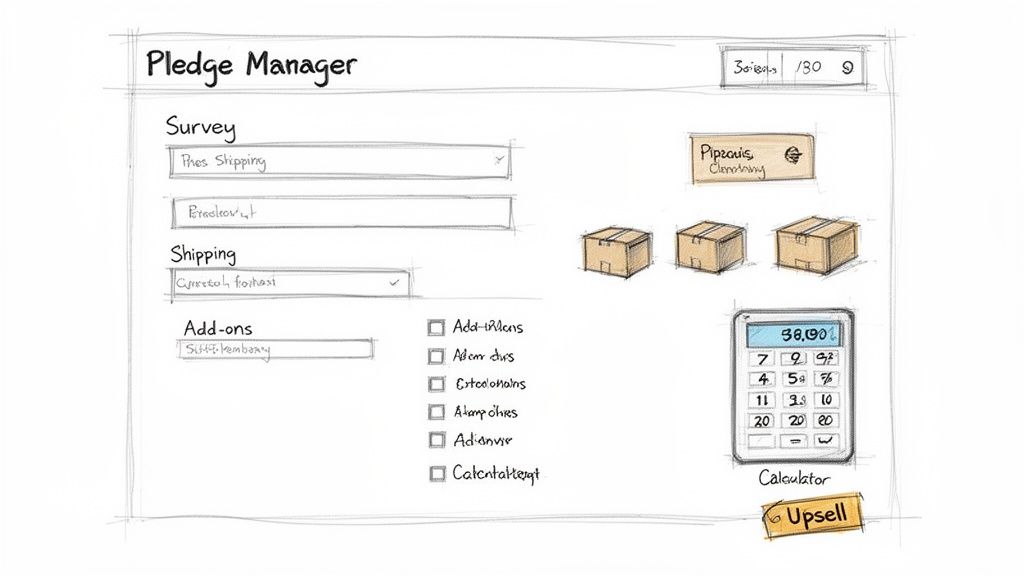
While Kickstarter provides a basic survey tool, it's just not built for projects with any level of complexity. A dedicated pledge manager, on the other hand, is designed to handle the chaos of collecting detailed information, managing thousands of orders, and making sure every backer gets exactly what they pledged for.
To really get the difference, think of it this way: Kickstarter's pledge manager is like Amazon, a massive marketplace with a standardized process. A pledge manager like PledgeBox is like Shopify, giving you a customizable, professional storefront to manage your backers with total precision. Kickstarter gets the basic job done, but PledgeBox gives you the power to create a tailored experience.
With a dedicated tool, you can send detailed surveys to collect shipping addresses, manage complex reward variations (like size, color, or style), and accurately calculate complicated shipping and VAT/tax rates for backers all over the world. This is where Kickstarter's native tool falls short, often leaving creators to untangle logistical nightmares in endless spreadsheets.
To make it crystal clear, here’s a quick look at how the two stack up.
| Feature | Kickstarter's Survey Tool | PledgeBox Pledge Manager |
|---|---|---|
| Add-On Upsells | Not supported. | Fully supported, allowing you to raise more funds post-campaign. |
| Shipping & Tax | Basic collection only. | Advanced calculations for global shipping zones and VAT/tax. |
| Survey Customization | Extremely limited options. | Highly customizable with conditional logic and varied question types. |
| Address Validation | Not available. | Built-in validation to reduce shipping errors and returned packages. |
| Backer Management | Basic list of backers. | Robust CRM-like features to segment, message, and track backers. |
Ultimately, using a professional pledge manager signals to your backers that you are serious about fulfillment. It builds the kind of trust that encourages them to come back and support your future projects.
One of the most powerful features of a pledge manager is the ability to offer add-on upsells. Trust me, many of your backers will be eager to buy more of your products, and the post-campaign survey is the perfect opportunity to let them. This can seriously increase your final revenue, often providing the extra cash you need to cover unexpected production costs.
The best part? PledgeBox is free to send the backer survey and only charges a small 3% fee on the funds you raise through these upsells. This makes it a completely risk-free way to improve your fulfillment process and boost your bottom line. You pay nothing if you don't generate extra sales.
This model removes any financial barrier to using a professional-grade tool. You get to deliver a top-tier experience to your backers without any upfront cost. Keeping them in the loop with automated updates and tracking information seals the deal, turning one-time supporters into repeat customers.
If you're weighing your options, learning how to select the right pledge manager is a crucial step in your post-campaign planning.
Diving into the world of crowdfunding can feel like a lot, especially for the first time. As you get closer to launch, you'll find the same questions popping up over and over. Getting solid answers to these common sticking points can save you a ton of headaches, prevent some rookie mistakes, and give you the confidence you need to nail your campaign.
Let's walk through some of the most frequent questions we hear from new creators. We'll cover everything from setting your funding goal to what happens after your campaign goes live.
This is the big one. Your funding goal isn't just a number you hope to hit—it's your survival number. It needs to be the absolute minimum amount you need to manufacture your product, ship every single reward, and cover all the fees that come with the territory.
If you aim too high, you might scare off potential backers. But if you aim too low, you could end up in a financial hole, unable to fulfill your promises. The only way to find the right number is to build a detailed budget.
Don't forget to include:
A lower, more achievable goal creates momentum much faster and feels less intimidating to those crucial early backers. You can always blow past it and introduce stretch goals once you're safely funded.
For most projects, the sweet spot is 30 days. Time and time again, campaigns running for about a month have a higher success rate than longer ones. It’s just enough time for word to get out, but short enough to create a real sense of urgency that gets people to pledge.
Think about it: the vast majority of pledges come in during the first and last 48 hours of a campaign. A 30-day timeline lets you ride that initial wave of excitement and build toward a big finish without exhausting your audience or spreading your marketing efforts too thin.
Yes, you almost certainly need one. A pledge manager is a tool you use after your campaign to handle all your backer info and fulfillment details. While Kickstarter has a basic survey system, it’s often not enough for projects with even a little bit of complexity.
Here’s an easy way to think about it: Kickstarter's pledge manager is like Amazon, a standardized marketplace, while a tool like PledgeBox is your own customizable post-campaign storefront, like Shopify.
It lets you do so much more. Backers can confirm their shipping addresses, pick variants like color or size, and—most importantly—buy add-ons. Those post-campaign upsells can seriously increase your total funding. A huge plus is that PledgeBox is free to send the backer survey and only charges 3% of the upsell revenue if there's any. This makes it a no-brainer for streamlining your fulfillment and boosting your final numbers.
Some things yes, some things no. You can absolutely edit parts of your campaign page after you go live. Your project story, campaign video, and the FAQ section can all be updated. In fact, keeping this content fresh is a great way to show you're engaged with your community.
However, a few key things are locked in for good once you launch. You cannot change your funding goal or the campaign's duration. You also can't edit any reward tier that at least one person has backed. This is exactly why all that pre-launch planning is so critical.
What you can do is add brand-new reward tiers mid-campaign. This is a fantastic tactic for dropping in a limited-edition item or a new bundle to spark some fresh interest halfway through.
Ready to turn your great idea into a funded reality? PledgeBox offers a complete toolkit to help you build your audience, launch with confidence, and manage your backers with ease. Get started for free today and see how our tools can power your Kickstarter success.
PledgeBox
The All-in-One Toolkit to Launch, Manage & Scale Your Kickstarter / Indiegogo Campaign