 PledgeBox
Facebook Ads for Kickstarter: A Proven Guide to Launch Success
Discover proven tactics for facebook ads for kickstarter, including targeting, creative testing, and optimization to boost your campaign.
Discover proven tactics for facebook ads for kickstarter, including targeting, creative testing, and optimization to boost your campaign.
Using Facebook ads for Kickstarter is a battle-tested way to drive pledges. It all comes down to building a targeted audience before you launch, then hitting them again with ads once the campaign goes live. A winning strategy really boils down to three phases: pre-launch lead gen, live campaign scaling, and post-campaign upselling.
Let’s be honest: smashing your Kickstarter funding goal is rarely a happy accident. It takes a solid playbook, one that uses powerful tools like Facebook Ads to turn casual scrollers into passionate backers.
The whole thing works best when you think of it as a funnel that matches your campaign's lifecycle, not just a one-off ad blast.
This guide will walk you through the entire process, from big-picture strategy down to the nitty-gritty details of building and running your campaigns. We’ll cover how to build momentum before you even go live, scale your ads effectively during the campaign, and—most importantly—how to squeeze every last dollar out of your post-campaign efforts.
Your advertising journey really breaks down into three distinct stages. Get these right, and you're golden.
A key thing to remember is that Kickstarter is a marketplace, a lot like Amazon. It's great for discovery. A pledge manager like PledgeBox, on the other hand, is your own personal storefront, more like Shopify. It gives you direct control for post-campaign sales and communication.
This flowchart shows how each phase builds on the last, creating one seamless strategy from start to finish.
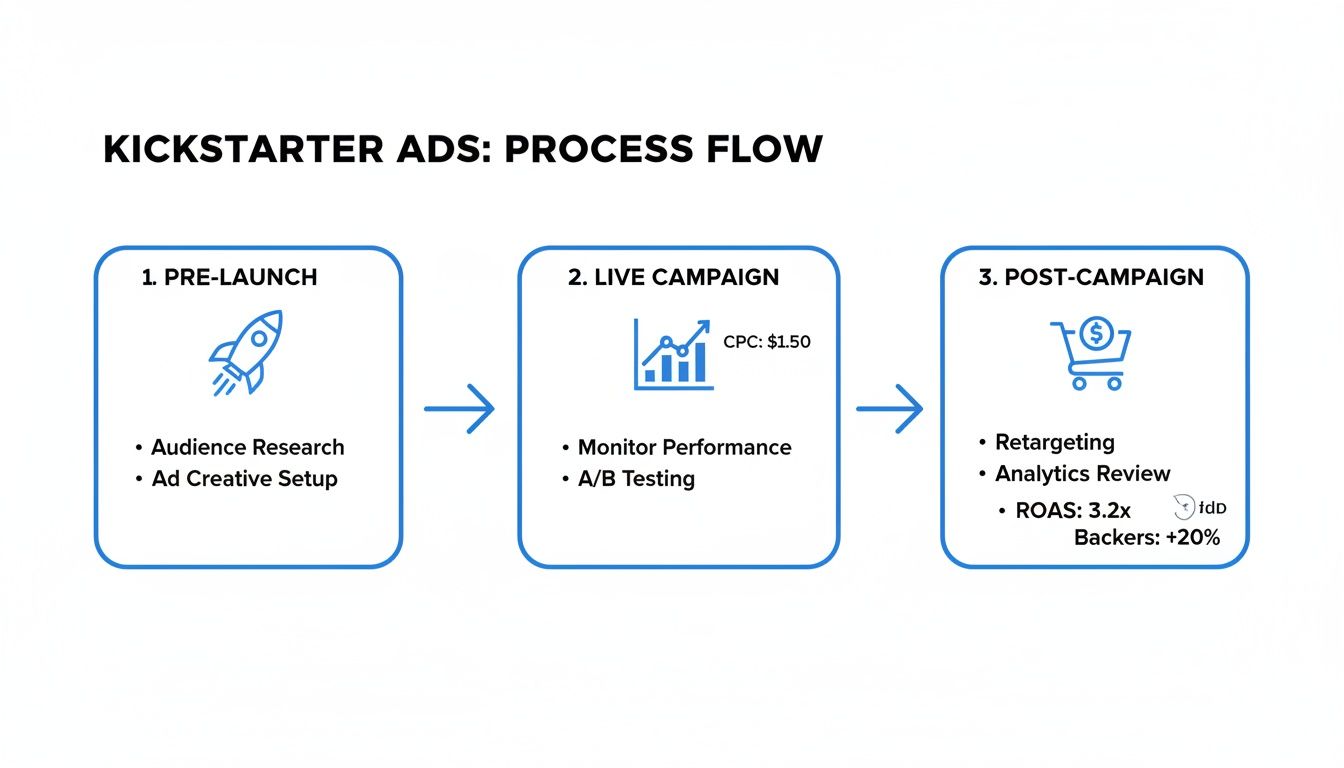
This process makes it clear that successful Facebook ads for Kickstarter aren't just a switch you flip on launch day. It’s a deliberate, multi-stage funnel.
And that post-campaign phase is where tools like PledgeBox become absolutely essential. It’s free to send the backer survey, and they only charge 3% of any upsell revenue you make. That makes it a completely risk-free way to pad your final profits.
A successful Kickstarter campaign is almost always won before it ever goes live. The real work—and the real magic—happens in the pre-launch phase. This is where you methodically build an army of eager, ready-to-pledge backers. It's not about luck; it's about creating your single most valuable asset: a high-intent email list.
Your main tool for this mission is a simple, high-converting pre-launch landing page. This page has one job and one job only: to capture the email addresses of people who are genuinely fired up about your project. Tools like PledgeBox make this incredibly simple, letting you spin up a branded page that builds excitement and collects leads without any fuss.
This email list is the engine for your initial launch momentum. It gives you a direct line of communication to your hottest prospects.
Once your landing page is ready, it's time to drive targeted traffic to it using Facebook ads. For this stage, your campaign objective should be Lead Generation or Conversions (optimized for leads). We are not trying to make sales just yet. The name of the game is acquiring emails at the lowest possible cost per lead (CPL).
Think of this as an investment. Every dollar you spend now builds an audience you can tap into for free (via email) on launch day. This is also your first chance to start "training" the Meta Pixel, feeding it valuable data about the kind of people who are raising their hands for your project.
Here's a helpful analogy: Kickstarter is like a bustling marketplace such as Amazon, fantastic for discovery and traffic. Your pledge manager, like PledgeBox, is your own personal storefront, similar to Shopify. It gives you control, and that control starts by building your own audience before the doors even open.
This pre-launch phase is all about building an asset you own, rather than just renting traffic from Facebook when the campaign is live.
Great pre-launch campaigns hinge on finding the right people from day one. Your targeting doesn't need to be ridiculously complex, but it absolutely needs to be specific. Throwing money at generic audiences will just burn through your budget.
Here are the key audience types to start with:
These strategies are wildly effective. In fact, benchmarks show that Facebook ads can pull in an average conversion rate of 9.21% for Kickstarter-style campaigns. That blows the typical click-through rate of 0.90% out of the water. This incredible performance comes from reaching hyper-targeted audiences who are already primed to be interested in what you're offering.
Using a tool built specifically for crowdfunding creators gives you a huge advantage. PledgeBox, for instance, is much more than just a post-campaign tool. You can use it to build your pre-launch email list and then seamlessly migrate those contacts into your backer management system later.
The process couldn't be more straightforward:
Here's the best part: This entire pre-launch system is powerful and cost-effective. Remember, PledgeBox is free to send the backer survey after your campaign. They only charge 3% of the upsell revenue if there's any, making it a risk-free way to both build your community and boost your final funding total.
The moment your Kickstarter project goes live, your entire advertising strategy needs to do a 180. Forget about collecting cheap email leads—the only thing that matters now is driving real pledges. This is where you cash in on all that pre-launch work, hit your warm audience hard, and then scale out to find new backers who will push you over the finish line. The game has changed, and your ads need to change with it.
This is also where a lot of creators get tripped up. Think of Kickstarter as a massive marketplace, like Amazon. It's incredible for getting initial eyeballs and building a crowd. But for long-term success, you need your own storefront—something more like Shopify, where you own the customer relationship. That’s exactly the role a pledge manager like PledgeBox fills. It hands you the keys to manage, communicate with, and upsell your backers directly.
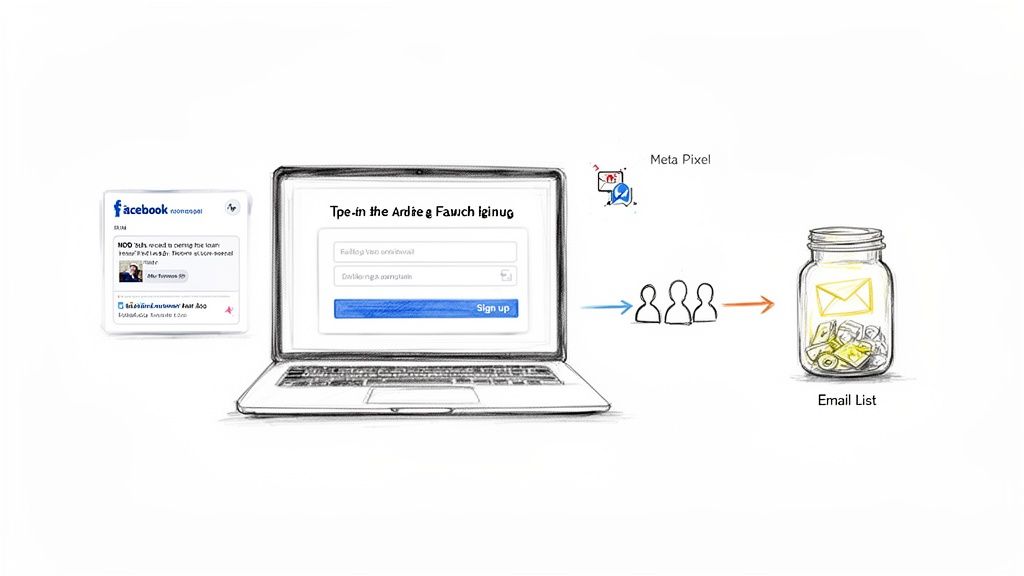
First things first, get your tech right. Double-check that your Meta Pixel is firing correctly on any pre-launch pages you used and that you’re ready to track actual pledges. Your campaign objective has to flip from "Leads" to "Sales", optimizing for a "Purchase" event. This tells Meta's algorithm to stop looking for sign-ups and start hunting for people who are ready to pull out their credit cards.
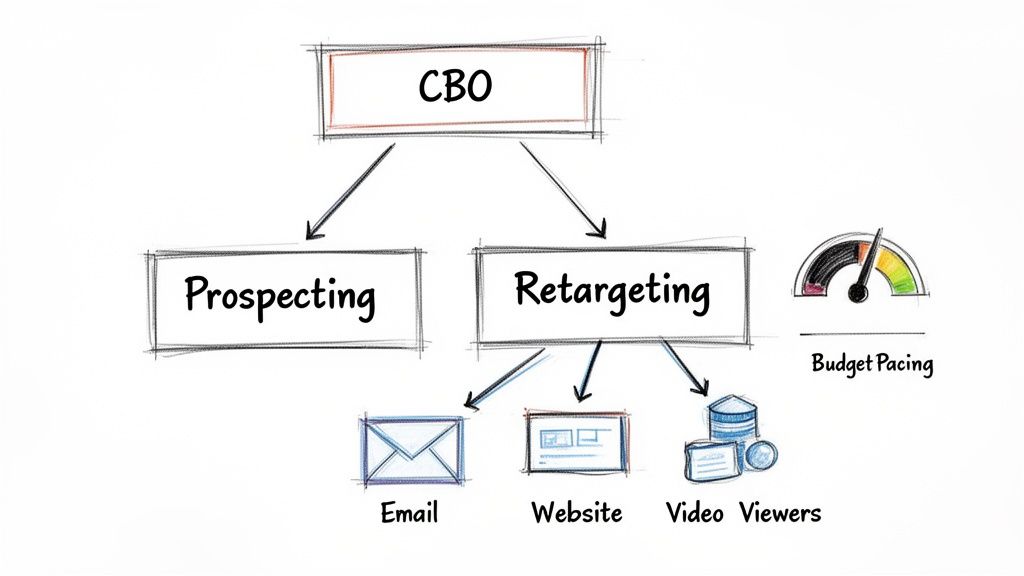
For your campaign structure, I almost always recommend using Campaign Budget Optimization (CBO) at this stage. CBO lets Meta do the heavy lifting by automatically pushing more of your budget toward the best-performing ad sets. If one of your audiences is suddenly converting like crazy, Meta will divert more spend there to maximize your return on ad spend (ROAS) without you having to constantly tweak things manually.
The first 48 hours are everything. All your advertising firepower should be aimed squarely at the people who already know and trust you. These warm audiences are your low-hanging fruit—they’ll provide the initial surge of pledges that creates momentum and social proof, making it easier to attract strangers later on.
Your go-to retargeting groups should include:
The strategy here is simple but incredibly effective: start with the people most likely to back you. For anyone who has shown interest but hasn't pledged yet, this is the perfect time to use retargeting advertising to remind them why they were excited in the first place and close the deal.
Once your warm audience campaigns are humming along and pledges are rolling in, it’s time to find new backers. This is how you scale past your immediate network and power through that dreaded mid-campaign slump. Your best bet is to use the data you've already collected to find more people just like your initial supporters.
Key Cold Audiences to Test:
Here’s a practical example of how you might structure your campaigns to balance both warm and cold audiences, all running under a single CBO budget.
This table illustrates a practical campaign setup, showing how to organize ad sets to target audiences with different levels of awareness during a live campaign.
| Campaign (Objective) | Ad Set 1 (Warm Audience) | Ad Set 2 (Warm Audience) | Ad Set 3 (Cold Audience) | Ad Set 4 (Cold Audience) |
|---|---|---|---|---|
| Sales (CBO) | Retargeting: Pre-launch Email List & Website Visitors | Retargeting: Video Viewers & Social Engagers | Prospecting: Lookalike Audience (1% of Email List) | Prospecting: Interest Targeting (e.g., BoardGameGeek) |
This structure allows Meta's algorithm to automatically find the most efficient conversions, whether they come from your loyal followers or brand-new prospects.
Almost every Kickstarter campaign hits a wall after the initial launch hype dies down and before the final 48-hour frenzy. Your ad spending should anticipate this.
Don't panic and kill your ads when things slow down. Instead, just pace yourself. It's fine to slightly dial back the budget on your cold prospecting campaigns if their ROAS dips, but keep your warm retargeting ads running. You want to stay top-of-mind for anyone still on the fence. Then, plan to ramp up your ad spend significantly in the last two days when urgency becomes your most powerful sales tool.
Throughout all of this, remember the goal isn't just to get funded—it's to set yourself up for a healthy post-campaign business. This brings us back to the Amazon vs. Shopify analogy. Kickstarter gets you the initial sale, but a tool like PledgeBox gives you the platform to build a real brand. It's free to send the backer survey, and they only charge 3% of any upsell revenue you generate. This makes it a completely risk-free way to boost your final profits after the campaign clock runs out.
If your campaign structure and targeting are the engine of your Facebook ads for Kickstarter, then your creative—the ad copy and visuals—is the high-octane fuel. It's easily the most powerful lever you can pull. In the fast-scrolling world of a social media feed, your creative is what has to earn the click that turns into a pledge.
Forget the slick, polished studio shots and generic stock photos. The crowdfunding audience craves authenticity. They aren't just buying a product; they're backing a story, a mission, and a real person. Your ads have to reflect that reality.
I've seen it time and time again: the most successful Kickstarter ads often look less like ads and more like something a friend would post. They feel native to the platform, which helps them break through the "banner blindness" that makes us all ignore overly commercial content.
The numbers back this up. For Kickstarter campaigns, your creative choices in Facebook ads drive about 80% of your success. It's why the top-performing campaigns lean heavily into grassroots content, like user-generated style videos, instead of perfectly polished stock footage. This insight from ad experts really hammers home how authentic visuals connect with potential backers, sparking the curiosity that leads to pledges.
These ads often mimic viral social posts to grab attention, which helps them beat Facebook's already low average 0.90% CTR. Want to see more data on this? Check out this video on how creative choices impact these metrics.
To get that all-important scroll-stop, you need to think visually first. Your image or video is what grabs their attention; your copy is what seals the deal.
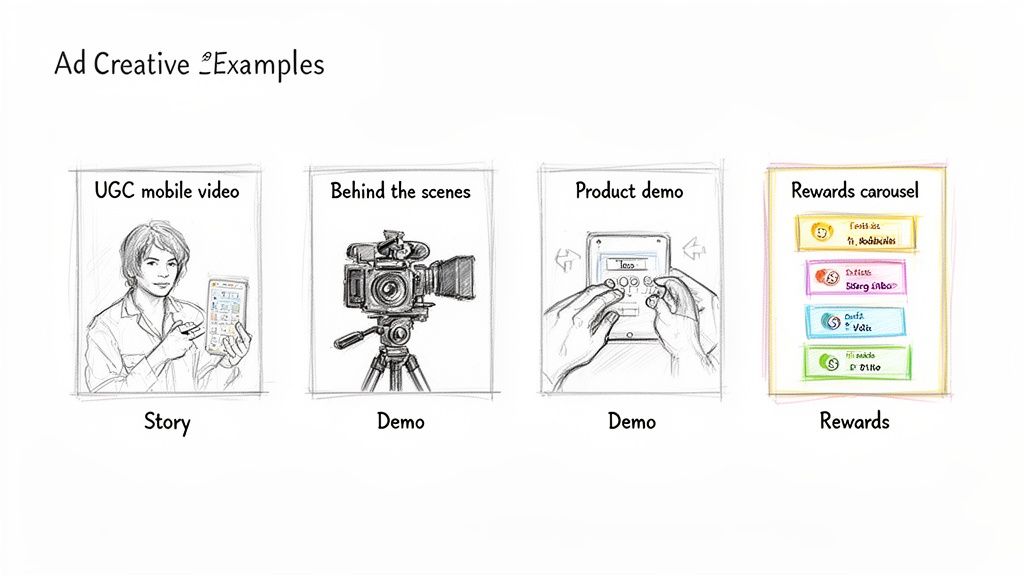
Here are the visual formats that consistently deliver the goods for crowdfunding campaigns:
Your goal with visuals is to build genuine excitement. You're not just selling a gadget or a game; you're inviting people to join you on a creative journey. Authenticity is your most valuable currency.
For a deeper dive, you can learn more about the key factors when creating graphics for crowdfunding campaigns in our dedicated article.
Your ad copy has to tap directly into the crowdfunding mindset. Backers are motivated by more than just a list of features; they're drawn to the story, the mission, and the feeling of being part of something new.
Keep your copy clear, concise, and focused on benefits, not just specs. I always recommend framing your ad copy around these core pillars:
It’s also smart to connect your ads to a strong post-campaign plan. When backers see you have a professional process for fulfillment, it builds massive confidence. You can subtly hint at the smooth experience to come, powered by a pledge manager. The journey doesn't end when they click "pledge," after all.
Having a tool like PledgeBox ready shows you’re thinking about the entire backer experience from day one. And since PledgeBox is free to send the backer survey and only charges 3% of any upsell revenue, it's an easy choice to communicate that you're prepared for what comes next.
When the timer on your Kickstarter campaign hits zero, it’s tempting to celebrate and call it a day. But the end of the campaign isn’t the finish line; it’s actually a new starting point for driving revenue. This is your chance to maximize the value of every single backer you acquired and capture sales from anyone who missed out.
This post-campaign phase is where a powerful pledge manager becomes your secret weapon. It's the difference between simply fulfilling orders and building a profitable, long-term business. Think of it this way: Kickstarter is great for initial discovery (like Amazon), but a pledge manager like PledgeBox acts as your personal storefront (like Shopify), giving you complete control.
Just because someone didn't back your project during the live campaign doesn't mean they aren't interested. Life happens. People get busy, forget, or stumble upon your project on the very last day. This group—engaged but unconverted—is an incredibly valuable audience for a "late pledge" or pre-order campaign.
Using the data your Meta Pixel has been collecting, you can run hyper-targeted ads to these specific groups:
The ad copy for this audience can be simple and direct: "Missed the Kickstarter? It's not too late! Pre-order now." You’ll drive this traffic to a pre-order page, which you can set up in minutes through your pledge manager. This one tactic can add a serious chunk of revenue with minimal ad spend.
Your backer survey is so much more than a logistical tool for collecting shipping addresses. When done right, it becomes your final—and often most profitable—marketing push. This is where the integration between your ad data and a robust pledge manager like PledgeBox really shines, creating an impressive overall return.
Kickstarter's built-in survey is basic; it’s only designed to collect information. That’s a massive missed opportunity. A dedicated pledge manager completely transforms this process.
The core idea is to make the survey an extension of the shopping experience. Backers are already excited about your project; this is the perfect moment to offer them more of what they love.
With PledgeBox, you can create a seamless, branded survey that lets backers confirm their pledge, pay for shipping, and—most importantly—buy add-ons and upgrades. For instance, if someone backed your board game, you could offer them a deluxe component upgrade, a set of painted miniatures, or an expansion pack right inside the survey. For a deeper dive, check out our guide on the essentials of a great Kickstarter post-campaign survey.
Here’s what makes this strategy so powerful for creators: PledgeBox is free to send the backer survey. There are no per-backer fees or setup costs. The platform only charges a small 3% fee on any new revenue you generate from these upsells and add-ons.
This model is a complete no-brainer. It costs you absolutely nothing to implement and provides a direct path to increasing your average backer value. You've already spent the money on Facebook ads for Kickstarter to acquire these backers; the upsell process is how you squeeze every last drop of ROI from that initial investment.
Even a modest conversion rate on add-ons can boost your total funds raised by 10-20%, turning a good campaign into a truly great one. This post-campaign revenue often provides the cushion needed to cover unexpected production costs or simply make your project more profitable. A well-executed ad and survey strategy ensures your hard work pays off long after the funding clock runs out.
Diving into the world of Facebook ads for Kickstarter always stirs up a bunch of questions. Getting straight, practical answers is the only way to protect your budget and give your campaign the best shot at smashing its goal. Let’s tackle some of the most common things creators ask.
A solid rule of thumb is to earmark 10-30% of your total funding goal for your entire marketing push. So, if you're aiming for a $50,000 project, your marketing budget should be somewhere between $5,000 and $15,000, with Facebook ads taking a healthy slice of that pie.
You don't need to go all-in from day one. During the pre-launch phase, a small daily budget of $20-$50 is usually plenty to start building your email list without burning through cash.
The plan should always be to ramp up spending significantly during two key windows: the first 72 hours and the final 48 hours of your live campaign. These are the make-or-break moments when pledge velocity is at its absolute peak.
Ultimately, the most important metric to obsess over is your Return on Ad Spend (ROAS). If you're consistently seeing a 3x ROAS or better, that's a green light to pour as much fuel on the fire as you can comfortably afford.
For any Kickstarter campaign, a 3x ROAS is the benchmark for success. Put simply, this means for every $1 you spend on an ad, you're getting $3 back in pledges.
A 1x ROAS is just breaking even—you get your ad money back, but that’s it. A 2x ROAS feels profitable, but once you subtract Kickstarter fees and production costs, there’s not much left. Hitting 3x or higher is where your ads truly become a powerful engine for both funding and profit.
You have to be in your Ads Manager daily, keeping a close eye on this number. Be ready to scale up the ad sets that are crushing it and immediately pause anything that dips below your target ROAS. No hesitation.
Here's the best way to think about it: Kickstarter is like Amazon. It’s a massive marketplace, fantastic for getting discovered and driving that initial sale.
A pledge manager like PledgeBox, on the other hand, is your own personal Shopify store. It hands you the keys to the customer relationship and opens up a whole new world of revenue after your campaign wraps up.
Kickstarter's built-in survey is incredibly basic; it's designed to do one thing and one thing only: collect shipping info. PledgeBox completely transforms this experience. It lets you build slick, branded surveys that not only grab addresses but also manage complex shipping fees and—most importantly—let you sell upsells and add-ons.
This is basically a risk-free way to juice your total funding amount. PledgeBox is free to send your backer surveys and only takes a 3% fee on any extra money you raise from these post-campaign sales. It turns a boring fulfillment task into one last, highly profitable marketing push.
Ready to streamline your campaign from pre-launch to fulfillment? PledgeBox provides the all-in-one toolkit to build your audience, manage your backers, and maximize your post-campaign revenue.
PledgeBox
The All-in-One Toolkit to Launch, Manage & Scale Your Kickstarter / Indiegogo Campaign