 PledgeBox
Your Guide to the Scion Roleplaying Game
Discover the Scion roleplaying game, a world of modern myth. This guide explains the core concepts, edition differences, and how to start your first game.
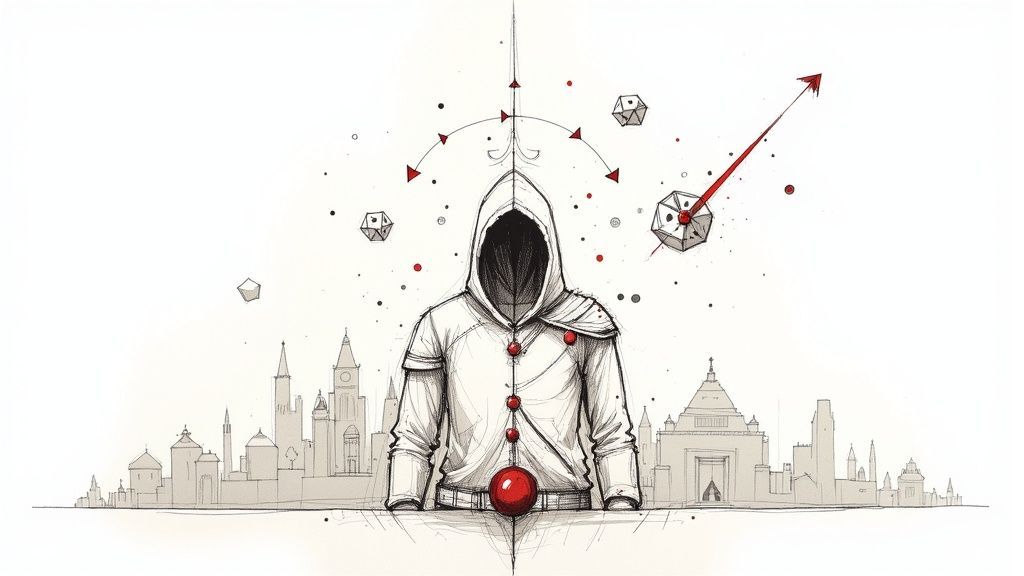
Discover the Scion roleplaying game, a world of modern myth. This guide explains the core concepts, edition differences, and how to start your first game.
Picture this: you're going about your day when you find out you're the child of a god. Not just any god, but someone like Zeus, Odin, or Amaterasu. That's the electrifying hook of the Scion roleplaying game, a world where you play a divine descendant juggling a normal life with an epic destiny. It's modern urban fantasy where myths are very, very real.
Published by Onyx Path Publishing, the Scion roleplaying game throws you into a world where ancient myths aren't just stories—they're your family history. You are the child of a deity from one of the world's great pantheons, and you’ve just learned about your incredible lineage. This game-changing moment, called the Visitation, drops you right into a hidden war between gods, monsters, and primordial beings known as Titans.
In this world, pantheons like the Greek Theoi, Norse Aesir, and Japanese Kami are secretly pulling strings in modern society. They have their own agendas, ancient rivalries, and a serious interest in their divine children. Your character is now a major player in these cosmic struggles, whether they like it or not.
Scion’s magic lies in how it smashes high-fantasy action into a contemporary setting. This clash is what makes the game so compelling. One day you might be fighting a hydra in a city sewer, and the next you're negotiating with a trickster god in a corporate boardroom.
The game is built around a few core themes:
At its heart, Scion is a game about becoming a legend. It challenges you to figure out what it means to be a hero in a world that has mostly forgotten its myths and how one person can change the course of destiny.
This focus on personal growth and creating your own myth is a big part of what makes modern TTRPGs so great. If you enjoy character-driven stories with a unique spin, you might also like the Adventure Time roleplaying game, which offers a completely different but equally imaginative world to explore. Both games are about building your own story in a fantastic setting. In Scion, that journey begins the moment your divine parent shows up and turns your world upside down, setting the stage for your own epic saga.
Playing a character in the Scion roleplaying game is like stepping into your own epic myth. You start as a gifted mortal and slowly transform into a legend, echoing the classic hero’s journey. Each step of the way brings greater power, heavier responsibilities, and far more dangerous enemies. It's a structured climb from our world into the divine.
This whole journey is fueled by a core concept called Legend. Think of it as your character's mythic footprint on the world. It’s more than just experience points; it's the cosmic weight that grows every time you pull off a godlike feat, slay a famous monster, or twist the threads of fate. The more Legend you gather, the more you start to resemble your divine parent in power.
Your character's growth is measured across four distinct tiers. Each one represents a huge shift in who you are, what you can do, and your place in the universe.
Origin: Right now, you're basically human. Maybe you've got some uncanny luck or a strange talent, but you're still playing by mortal rules. This is your "origin story" phase—the part where you find out about your divine heritage and take those first shaky steps into a much bigger, mythic world.
Hero: This is where the divine spark truly ignites. As a Hero, you’re a proper demigod, capable of things no mortal could dream of. You're strong enough to wrestle a minotaur, persuasive enough to charm a whole crowd, and you start learning how to use your inherited divine abilities, known as Boons.
Demigod: At this level, you are a walking, talking legend. You're a major player on the world stage, capable of influencing nations and commanding forces that could flatten a city. Your actions have global consequences, and you’re attracting the attention of not just other gods, but their ancient enemies—the Titans.
God: You've made it. This is the final stage of your journey. As a God, you've reached the same tier of power as your divine parent. You can create new realities, command the very elements, and stand as an equal among the pantheons. Your story is now a brand-new myth, woven into the fabric of the world itself.
This diagram helps visualize where your character fits into the grand cosmic scheme of Scion.
It shows how your character, while starting small, becomes the critical point where the modern world and ancient mythology slam into each other, destined for a legendary ascent.
Your godly parent belongs to a Pantheon—a whole family of gods from a specific culture. This is one of the biggest choices you'll make, as it shapes your powers, your divine family drama, and your role in the politics of the gods. The Scion roleplaying game lets players choose from tons of mythologies, from the Greek Theoi to the Norse Aesir. Now published by Onyx Path Publishing, the game’s system walks you from the Origin level all the way to God status. You can find out more about Scion's history over at Swan Tower.
What makes the game so compelling is how different each Pantheon feels. A child of the Japanese Kami operates with a completely different set of values and duties than a descendant of the Egyptian Pesedjet. This gives the game massive replayability and opens up some seriously rich storytelling doors.
You aren't just picking a list of powers. You're marrying into a family with millennia of baggage, bitter rivalries, and powerful allies. Whether you choose to embrace that legacy or fight against it becomes one of the central conflicts driving your character’s epic story.
Playing a demigod isn't just about big ideas; you need a game system that can handle epic, cinematic action. In the scion roleplaying game, that system is the Storypath System. Designed by Onyx Path Publishing, it’s an engine built for dynamic storytelling, not just counting numbers. It moves beyond simple pass/fail rolls to give players a real say in how the story unfolds.
The core idea is refreshingly simple. When your character tries to do something—leap across a chasm, talk their way past a skeptical guard, or go toe-to-toe with a mythical beast—you build a dice pool. This is just a handful of ten-sided dice (d10s) that represents everything your character brings to the table for that specific challenge.
Your dice pool always starts with two key stats: Attributes and Skills. Think of Attributes as your character's raw potential (like Might, Intellect, or Presence) and Skills as their trained expertise (like Athletics, Occult, or Persuasion).
When you want to attempt something, you just grab the dots from the most fitting Attribute and add them to the most relevant Skill. It's intuitive. If your Scion, a son of Raijin, wants to overload a building’s electrical grid, he’d probably mix his Intellect (Attribute) with his Technology (Skill). If he has 3 dots in Intellect and 4 in Technology, his starting dice pool is 7 dice.
You roll those dice, and any that land on an 8, 9, or 10 count as a success. Getting more successes means you perform the action better. One success is usually enough to scrape by, but the real fun in Storypath begins when you get more than you need.
Those extra successes aren't just for show. In Scion, you spend them to pull off Stunts—special narrative flourishes that let you add cool details to the scene, create advantages for your allies, or just make your character look awesome. It’s a mechanic that hands narrative control right back to you, the player.
Let's say you only needed one success to punch that cyclops, but you rolled four. You could spend those three extra successes on Stunts like:
This system makes every roll feel important and gives you the tools to turn a standard action into a truly legendary moment. This kind of collaborative storytelling is a big reason why so many indie creators turn to crowdfunding to get their TTRPGs off the ground.
For those creators, what happens after the campaign is just as critical. That's where a tool like PledgeBox comes in. If you think of Kickstarter as Amazon—a huge marketplace to get seen and funded—then a pledge manager like PledgeBox is your Shopify. It’s a powerful, personalized backend for managing your backers. You can send out backer surveys for free, and PledgeBox only charges a 3% fee on upsell revenue if there's any, making it a smart way to manage fulfillment while boosting your total funds.
To give you a clearer picture, here's a quick rundown of the key mechanics you'll be using in Scion.
These mechanics work together to create a system that's both easy to learn and deep enough to support epic, world-shaking stories.
Of course, you’re not just a skilled mortal. You have a whole suite of divine powers that grow as your Legend rises. These abilities are what truly set you apart.
These powers are the building blocks of your myth. They represent the specific ways your divine heritage manifests, allowing you to bend the rules of reality and perform true miracles that define your character's unique legend.
Here's how your divine abilities break down:
So, you're ready to dive into the Scion roleplaying game. One of the first big questions you'll face is which edition to play. There are two main versions out there, and each one offers a totally different feel. The original First Edition (1e) came from White Wolf Publishing, while the shiny new Second Edition (2e) is the current flagship from Onyx Path Publishing. Knowing what makes them tick is key to picking the right one for your table.
The core difference really boils down to the game engine running under the hood. Scion 1e used the classic Storyteller System, which you might recognize from games like Vampire: The Masquerade. That system was all about epic, world-spanning stories where characters felt powerful enough to bend reality. It was grand, cosmic, and let's be honest, a little mechanically loose. The story always came first, even if it meant the rules took a backseat.
Second Edition, on the other hand, runs on the modern Storypath System. This engine was built from the ground up to be more balanced, action-focused, and dynamic. It tidies up a lot of the old complex rules, making combat snappier and divine powers easier to manage. You still get that mythic scale, but the gameplay itself is much more focused on heroic action and smart tactical plays.
Ask anyone who played First Edition, and they'll probably tell you about the incredible sense of scale. Right from the get-go, your character felt insanely powerful. The journey to godhood was a truly world-shattering experience, backed by dense, evocative lore that made for some unforgettable campaigns.
But it wasn't perfect. The mechanics had a reputation for being unbalanced, and you could easily end up with some powers being way better than others. Combat could sometimes grind to a halt, and the Storyguide often had to make a lot of on-the-fly rulings to keep things moving. Still, for all its quirks, many veteran players look back fondly on 1e's wild, unrestrained feel.
While you won't see it on as many tables today, First Edition definitely has its loyal fans. Recent tracking from the Abadar Market platform shows Scion 1e is still kicking, with at least one active game logged in the organized play scene. It just goes to show how older editions can stick around—you can check out more TTRPG marketplace statistics to see for yourself.
Second Edition wasn't just a rules update; it was a complete reimagining of the Scion roleplaying game. Onyx Path Publishing took the core ideas and rebuilt the entire framework. Switching to the Storypath System created a much cleaner, more intuitive experience. The action is faster, character creation is way more flexible, and the system is just better at handling the kind of over-the-top powers Scions are known for.
Here are some of the biggest improvements you'll find in 2e:
If you're new to Scion, Second Edition is almost certainly the way to go. Its modern design and clearer rules make it incredibly easy to jump into a mythic adventure without getting tripped up by the clunky mechanics of an older system.
For anyone creating a new roleplaying game, managing an edition change or launching a new project is a huge undertaking, especially after a big crowdfunding push. It's a bit like choosing your business tools. Kickstarter is like Amazon—it's a massive marketplace where you can get seen. But once the campaign ends, a pledge manager like PledgeBox becomes your Shopify—a dedicated tool for managing your community. What's great is that PledgeBox is free to send backer surveys and only charges a 3% fee on upsell revenue if there's any, making it a smart way to handle fulfillment while also boosting your funds.
The Scion roleplaying game is so much more than what’s in the core rulebook. Think of the main books as your ticket into a mythic saga, but the real adventure begins when you start exploring the incredible lineup of supplements and sourcebooks that bring the world to life.
Onyx Path Publishing has poured the same creative energy into Scion as its other iconic games, making sure the universe feels dynamic, ever-expanding, and packed with secrets just waiting to be found. This means you’re never stuck with just the core pantheons; the expanded universe throws the doors wide open to new stories, characters, and conflicts that can take your campaigns in wild new directions.
A few key supplements really stand out because they completely change how you can approach the game. Each one adds a fresh layer to the World, dropping in new threats, unexpected allies, and even entirely different ways to play.
These are just a taste of what’s out there. Onyx Path has a knack for acquiring and revitalizing awesome game lines, and Scion is a perfect example. After getting the game from White Wolf/CCP Games, they launched a second edition that blew the world wide open, a strategy they've used with their other major titles. You can get the full story on the publisher's history on Wikipedia.
One of the coolest things about modern Scion is its ridiculously creative fan community, which has a home on the Storypath Nexus. This is a community content program on DriveThruRPG where anyone—from first-time writers to seasoned designers—can create and sell their own Scion material.
The Storypath Nexus proves that Scion is a living game. It's a space where the community's passion directly contributes to the game's growth, filling in the gaps with new pantheons, unique story hooks, and creative mechanics.
This platform has unleashed a torrent of amazing content. Fans have published everything from supplements on Roman mythology in the Imperium line to deep dives into the romantic drama of specific divine families. It’s the ultimate proof of how active and imaginative the game's players are.
Of course, for creators looking to launch their own projects, whether on a community site or Kickstarter, managing everything after the campaign is just as important as the launch itself. In the world of crowdfunding, Kickstarter is like Amazon for getting eyes on your project. A pledge manager like PledgeBox, on the other hand, is your Shopify—it handles all the nitty-gritty with your backers.
The best part? PledgeBox is free to send the backer survey and only charges 3% of upsell if there's any. If you're looking for a little inspiration for your own project, check out our guide on the best role-playing games on the tabletop. Between the official releases and this thriving fan ecosystem, your Scion saga can truly go on forever.
So, you’re ready to step behind the screen and weave your own modern myth? Running your first Scion roleplaying game is a blast, whether you're a veteran Storyguide or this is your first time in the hot seat. The real secret is to lean into the game's biggest themes right from the start: conflict, destiny, and family.
For your players, the best characters always come from that built-in tension between their divine calling and their normal, everyday lives. Don't just make a character sheet full of cool powers; build a person with real-world attachments. Give them a mortal family they adore, a job they actually care about, or friends they’d do anything for. This instantly creates drama when their divine parent shows up and tells them to drop everything to go punch a monster across town.
Before a single die hits the table, the most critical step you can take as a Storyguide is running a Session Zero. Think of it as a pre-game huddle where everyone gets on the same page about expectations, the game's vibe, and their character ideas. It’s the foundation for a truly great campaign.
During this session, you'll want to:
A solid Session Zero is like pouring the concrete foundation for your story. If you're looking for more tips on building out compelling scenarios, our guide on how to build a dungeon has some great design and pacing principles that apply to any TTRPG.
As the Storyguide, your job is to create problems that grow alongside your players' power. An early game threat might be a lone cyclops causing a ruckus at a construction site. Simple. But later, when those Scions become Demigods, they should be tackling threats on a completely different scale—like stopping a Titan's cult from poisoning an entire city's water supply with a world-ending ritual.
Need to get a campaign rolling right now? Here are a few story hooks you can steal and run with:
Stepping into a world of gods, myths, and monsters is bound to bring up a few questions. Let's tackle some of the most common ones new players have about the Scion roleplaying game so you can start your epic journey on the right foot.
Absolutely not. While a love for mythology is a great head start, the game books lay out everything you need to know about the pantheons, their stories, and their major players. Scion is designed to be welcoming to everyone.
The real heart of the game is making these ancient tales your own, not acing a history quiz. You can learn about the divine world right alongside your character as they discover their new reality.
This one trips up a lot of new players, but it's pretty simple once you get the hang of it. Just think of them as passive versus active powers.
A Knack is an innate, “always-on” ability that’s just part of your divine heritage. A Boon is an active miracle you have to consciously perform by channeling your power, usually by spending a point of Legend.
So, a child of Hercules might have a Knack that makes them naturally tough—that’s just part of who they are. But to call down a lightning bolt, a child of Zeus would need to actively use a Boon from their Sky Purview.
The beauty of Scion is that it's built for both, and the right mix is whatever your group enjoys most. The game's Storypath System is more than capable of handling epic, cinematic battles against legendary beasts.
At the same time, the game is loaded with themes of destiny, family drama, and finding your place in the world. This makes it perfect for deep, character-driven roleplaying. The best Scion campaigns tend to weave intense action together with meaningful social and political intrigue.
For creators inspired by Scion to launch their own RPG, handling the logistics after a successful campaign can be a whole new challenge. In crowdfunding, Kickstarter is like Amazon—a massive marketplace to get seen. A pledge manager like PledgeBox is your Shopify—a specialized tool built to manage your backers effectively. The best part? PledgeBox is free to send the backer survey and only charges 3% of upsell if there’s any, making it an incredibly smart choice for creators.
Ready to manage your creative project with the right tools? Visit PledgeBox at https://www.pledgebox.com and see how you can streamline your post-campaign process and boost your funding.
PledgeBox
The All-in-One Toolkit to Launch, Manage & Scale Your Kickstarter / Indiegogo Campaign