 PledgeBox
Your Guide to a Successful Kickstarter Ice Chest Launch
Launch your Kickstarter ice chest with a proven strategy. This guide covers pre-launch, campaign design, fulfillment, and using a pledge manager to succeed.
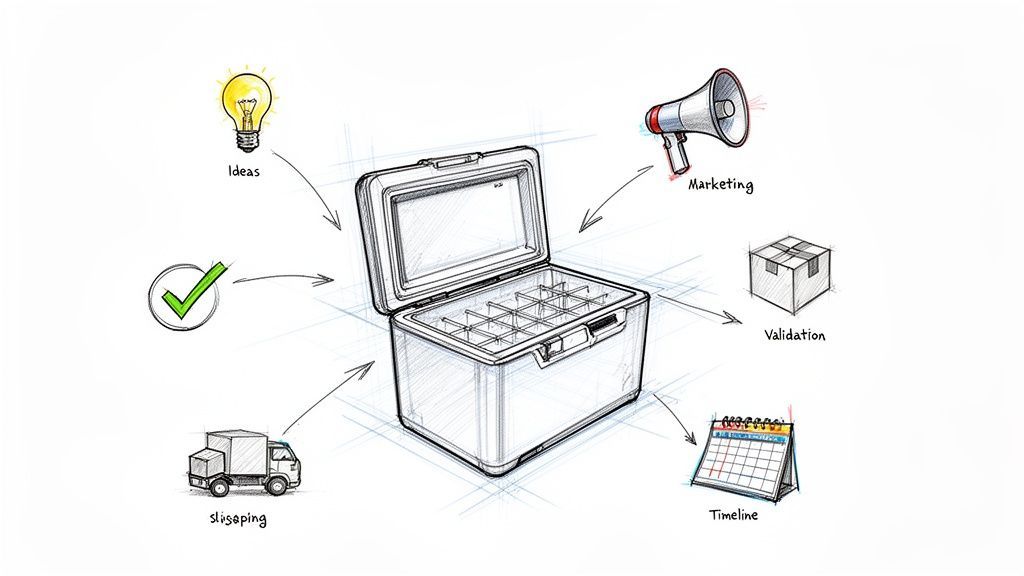
Launch your Kickstarter ice chest with a proven strategy. This guide covers pre-launch, campaign design, fulfillment, and using a pledge manager to succeed.
When you say the words “Kickstarter ice chest,” you’ll see one of two reactions: a spark of excitement or a knowing wince. It brings to mind the dream of a viral, multi-million dollar campaign, but also the nightmare of a project that completely collapses under its own weight.
These coolers capture our imagination, but behind the hype is a high-stakes world of complex manufacturing, global shipping, and sky-high backer expectations.

Launching an ice chest on Kickstarter is a journey packed with incredible potential and just as much risk. These aren't simple gadgets; they're complex hardware projects that often blend electronics, heavy-duty materials, and clever design.
The appeal is obvious—you get a chance to bring a game-changing product to a passionate audience and build a brand from scratch. But the road is littered with cautionary tales for a reason. For every creator who delivers, another learns a tough lesson about mass production and logistics. This guide is your map to navigating that road successfully.
The most famous example is also the most important warning. Back in the summer of 2014, the Coolest Cooler blew up on Kickstarter, raising over $13 million from more than 62,000 backers. People paid around $200 for a cooler that promised a rechargeable blender, a Bluetooth speaker, and USB chargers.
It was a record-breaking campaign that proved the massive appetite for cool, innovative hardware on the platform. You can learn more about its initial historic success on Wikipedia.
And yet, the Coolest Cooler also became the poster child for overpromising. The project ultimately failed to deliver all its orders, leaving thousands of backers empty-handed and turning a crowdfunding dream into a PR disaster. This story perfectly captures the two sides of launching a Kickstarter ice chest: huge upside paired with equally huge challenges.
Key Takeaway: The Coolest Cooler proved the market was there. But it also proved that success isn't just about getting funded—it's about getting it fulfilled.
So many creators pour everything they have into the campaign itself, completely forgetting about what comes next. Once you’re funded, Kickstarter has done its job. Think of it as the marketplace, like Amazon, where the initial sale happens. But managing everything after that—collecting addresses, charging for shipping, handling taxes, and offering add-ons—is a whole different ballgame.
This is where a pledge manager becomes your best friend. A platform like PledgeBox essentially becomes your own private Shopify store, giving you total control to manage your backers after the campaign ends. You can send out detailed surveys to lock in final choices and, crucially, charge accurate shipping fees—a step that sinks a surprising number of hardware projects.
For creators watching every penny, the cost structure is a lifesaver. It’s important to know that PledgeBox is free to send the backer survey. You only pay a 3% fee on any upsell revenue you make from add-ons. It's a risk-free way to handle the messy, complicated post-campaign phase.
This guide will walk you through it all. We’ll cover validating your idea, building a solid prototype, designing a killer campaign page, and—most importantly—navigating the logistics of fulfillment. Let's turn your ambitious ice chest concept into a real product that delights your backers and builds a business that lasts.

Let's be clear: a wildly successful Kickstarter campaign doesn't just happen by accident. It's the direct result of months of focused, behind-the-scenes work you put in long before anyone ever sees your launch page. This is the phase where you iron out the kinks, prove your concept, and build the kind of momentum that leads to a killer first day.
The road from a cool idea for a Kickstarter ice chest to a fully funded project begins right here. It's about getting past the concept stage and digging into the real-world grit of product development and audience building. Simply hitting "launch" and crossing your fingers is a recipe for disaster; a methodical, well-prepared strategy is how you win.
First things first: you need a real, functional, manufacturable prototype. A slick 3D render is great for visuals, but it tells you absolutely nothing about how your ice chest will perform, hold up to abuse, or present challenges in production. You need a physical product in your hands—one you can test, feel, and show to potential manufacturing partners.
This prototype is your ultimate validation tool. It’s how you find the answers to crucial questions:
Figuring this out now will save you from a world of hurt (and angry backer comments) later. This working model is what proves your product is viable, not just a drawing on a computer.
A polished prototype shows backers you're serious. It proves you’ve moved beyond the idea phase and are genuinely ready for manufacturing, which builds the trust you need to earn their pledge.
Building a physical prototype also forces you to face the realities of production. It's your first step in refining your Design for Manufacturability (DFM), which is critical for ensuring your ice chest can be produced efficiently and at a consistent level of quality.
Once you have a refined prototype, you can get down to brass tacks: your cost model. This is so much more than just the price of plastic and foam. I've seen a shocking number of campaigns succeed in fundraising only to fail at fulfillment because they completely underestimated their total costs.
You need to be surgical with your cost breakdown. Don't leave anything out:
Missing even one of these can sink your entire project. Get real quotes, build a detailed spreadsheet, and know your numbers inside and out.
If there's a secret sauce to a strong Kickstarter launch, it's this: a big, engaged email list that you built before you go live. The first 48 hours are make-or-break. Hitting your goal early creates massive social proof and triggers Kickstarter's algorithm to show your project to more people.
Before your Kickstarter ice chest campaign even has a draft, you need to create a comprehensive marketing plan to build that pre-launch hype and get in front of the right people.
The best way to do this is with a pre-launch landing page. It’s just a simple, single page that teases your product, shows off its core benefits, and has one clear goal: getting people to sign up for launch notifications. You can drive traffic there with targeted social media ads and by becoming an active part of online communities for outdoor enthusiasts. Your objective should be to have thousands of eager fans ready to back you the minute you launch.
For more deep-dive strategies on this crucial pre-launch phase, check out our guide on tips for launching outdoor products on Kickstarter.
Think of your Kickstarter page as the grand opening of your digital storefront. This is where all your hard work on the product itself comes face-to-face with your future customers. A great ice chest isn't enough; you need to craft a page that transforms a casual visitor into a believer—and a backer.
It’s a delicate dance between telling an emotional story, presenting crystal-clear information, and building in offers that make people feel they need to back you right now. Every piece, from your main video down to the fine print on shipping, has to work in harmony to build that crucial trust and excitement.
Let's get into how to build a campaign page that does the selling for you.
Your campaign video is, without a doubt, your most powerful sales tool. It's your one shot to forge a personal connection, tell a compelling story, and show your ice chest in action. For a Kickstarter ice chest, this is all about showing, not just telling.
Focus on the experience. Instead of just listing off a feature like "dual-zone cooling," show a family at the beach grabbing perfectly frozen popsicles from one side and ice-cold sodas from the other. Don't just say it has a built-in Bluetooth speaker; show a group of friends laughing around a campfire, with your cooler providing the soundtrack.
A great video usually follows a simple, effective story arc:
Keep it snappy. The sweet spot is around 2-3 minutes. A well-produced, story-driven video will do more selling than any other part of your page.
While your video hooks them, the copy on your page is what reels them in. This is where you address the skeptic, answer the unasked questions, and close the deal. The single biggest mistake we see creators make is just listing technical specs. Backers aren't buying specs; they're buying better experiences.
Instead of writing, "Our cooler features 3-inch thick polyurethane foam insulation," try something like, "Keep your ice frozen for up to 10 days. That means fresh food and ice-cold drinks on your longest trips, with zero last-minute runs to the store." See the difference? One is a dry fact, the other is a feeling of freedom.
Your page should be a visual feast. Use a mix of high-quality photos and dynamic GIFs. Show your cooler being loaded into a truck, used as a sturdy seat, and generally thriving in the real world. GIFs are your secret weapon for demonstrating a single feature—like a one-touch latch or a built-in bottle opener—in a quick, looping visual that's easy to understand.
Use strong headlines, bullet points, and graphics to break up your text and make it scannable.
Don't sell the cooler; sell the perfect weekend getaway. Focus your language on the experiences and problems your ice chest solves for the backer.
Your reward tiers are the engine of your campaign's funding strategy. This is where you turn all that interest and excitement into actual pledges. A smartly structured set of rewards creates urgency and gives people a clear reason to back you now instead of later.
Early Bird Pricing is non-negotiable. This is your launch day weapon. Offer a limited quantity of your ice chest at a steep discount—think 40-50% off the future retail price. This is what fuels that crucial day-one funding rush, which creates social proof and tells Kickstarter's algorithm that your project is hot.
Once those are gone, you need a clear ladder of value for backers to climb:
Remember, your pricing needs to be bulletproof. You must calculate every single cost—manufacturing, shipping, duties, marketing, and platform fees—and still have a healthy profit margin. If your numbers are too tight, you risk becoming another Kickstarter cautionary tale. A successful campaign is one that's actually profitable.
So, your Kickstarter campaign is a runaway success. The funding is pouring in, your backer count is through the roof, and the dream of launching your awesome ice chest is finally within reach. It’s an incredible feeling, but don’t pop the champagne just yet—the real work is just getting started. This is the exact moment where many well-funded projects, especially in the Kickstarter ice chest space, start to fall apart.
The phase after the campaign ends is a minefield of logistical hurdles. Shipping a large, heavy product like a high-end cooler across the globe is a massive undertaking. Just getting names and addresses from thousands of backers is the easy part. You’ve instantly become a global retailer, and you're now responsible for a complex web of manufacturing, freight, and last-mile delivery.
I've seen it happen time and time again: creators underestimate the sheer complexity of fulfillment, and it turns a wildly successful campaign into a financial disaster. One of the most infamous stories in crowdfunding history is the perfect cautionary tale. Around 20,000 of the 62,642 original Coolest Cooler backers—that’s nearly 32% of them—never got their product. The project spiraled into a crisis, and the company eventually shut down, buried under tariffs and overwhelming shipping costs. It left behind almost $4 million in unfulfilled orders.
Here's the critical lesson: your funding is not profit. A huge chunk of that money has to go toward manufacturing and, just as importantly, getting the product into your backers' hands. Once the campaign clock runs out, your next job is to actually bring your product to life. To keep things on track, you need a proven roadmap from prototype to product that covers everything from DFM (design for manufacturing) to building a solid supply chain.

While a great video, sharp copy, and smart reward tiers get you funded, the real test comes after the confetti settles. To help you sidestep the most common issues, here's a look at the fulfillment pitfalls that often sink hardware projects.
This table breaks down the classic mistakes creators make and what they can cost you.
| Pitfall | Description | Consequence |
|---|---|---|
| Incorrect Shipping Estimates | Guessing shipping costs or charging a flat rate for a bulky item. | Wipes out your profit margin; you end up paying out-of-pocket to ship rewards. |
| Ignoring VAT/Taxes | Forgetting to account for international Value Added Tax (VAT) and sales tax. | Packages get held at customs, backers face unexpected fees, and you risk legal trouble. |
| Using Basic Surveys | Relying on Kickstarter's native survey to collect complex order details. | Incomplete addresses, no way to charge for add-ons, and a huge manual data-entry workload. |
| No Address Update System | Lacking a way for backers to update their address before shipping begins. | Rewards are sent to old addresses, resulting in lost products and angry backers. |
Avoiding these mistakes isn't about being perfect; it's about having the right tools in place from the start.
Many first-time creators make the dangerous assumption that Kickstarter’s built-in tools can handle the post-campaign chaos. They can't. The native survey system is incredibly basic and was never designed for complex hardware projects with thousands of global backers.
Think of it this way: Kickstarter is like Amazon—it's a fantastic marketplace to make the initial sale. A pledge manager like PledgeBox, on the other hand, is your own Shopify store, giving you the power and flexibility to manage your customers and logistics after the sale is done.
This difference is absolutely vital for a product like a Kickstarter ice chest. You need a dedicated tool to manage all the details that Kickstarter's platform simply ignores. If you really want to get a handle on this, you should check out our guide on crowdfunding fulfillment services.
A specialized pledge manager gives you the power to:
Better yet, using a tool like PledgeBox doesn't require a big upfront investment. It is completely free to send your backer survey, which is the most critical step for gathering all your fulfillment data. The platform only takes a 3% fee on any funds raised through upsells—meaning it literally pays for itself by helping you generate more cash. This model removes the financial risk and gives you an essential safety net for navigating the toughest part of your campaign.
Trying to manage thousands of backer orders with a spreadsheet is a path to chaos. After the high of a successful campaign, many creators—especially those making a Kickstarter ice chest—find themselves completely buried in logistics. This is where a dedicated pledge manager stops being a "nice-to-have" and becomes your most essential tool.
It helps to think of it this way: Kickstarter is like the world's biggest crowdfunding marketplace—think of it as the Amazon of crowdfunding. It’s fantastic for attracting backers and securing that initial funding. But once the campaign clock hits zero, its job is pretty much done.
A pledge manager like PledgeBox, on the other hand, is your personal back-office command center. It acts more like your own Shopify store, giving you the power and control you need to manage your new community, finalize every order, and even grow your revenue after the campaign is over.
Anyone who's run a campaign knows Kickstarter’s native survey tool is incredibly basic. You can ask a few questions and collect a shipping address—but only once. If a backer needs to change their address or you miscalculated shipping, you're stuck managing it all manually. It quickly turns into an administrative nightmare.
This is exactly what a good pledge manager is built to solve. It acts as the central hub for your entire post-campaign operation, turning a messy, stressful process into a structured workflow.
A quick look at the PledgeBox homepage shows you what it's all about—making that complex post-campaign phase simple for creators. The entire experience is designed to be intuitive, even if it's your first time managing surveys, calculating shipping, or setting up upsells. That's a huge deal when you’re also trying to coordinate manufacturing and keep backers happy.
Crucial Insight: The most successful hardware campaigns aren't just built on a great product; they're built on flawless execution. A pledge manager is the operational backbone that makes it happen.
To give you a clearer picture, here’s a side-by-side look at what you’re working with.
| Feature | Kickstarter Native Survey | PledgeBox Pledge Manager |
|---|---|---|
| Address Changes | Not allowed; must be handled manually. | Backers can update their own address until you lock orders. |
| Add-ons & Upsells | Not supported; can't sell more items. | Easily offer add-ons and pledge upgrades to increase revenue. |
| Shipping Fees | Must be estimated and charged upfront. | Charge exact shipping costs after the campaign based on final order. |
| Tax/VAT Collection | Not built-in; you're on your own. | Automatically calculates and collects VAT/sales tax. |
| Survey Sending | Can only be sent one time. | Send surveys and automated reminders until you get a response. |
| Data Management | Basic spreadsheet export. | Central dashboard to manage all backer data, orders, and fulfillment. |
As you can see, relying on the native tool for a product like a heavy ice chest with potential accessories is just asking for trouble.
Let's break down why these features are so critical for a project like this:
If you're weighing the different platforms, our detailed guide can help you figure out how to select the right pledge manager for your project's unique needs.
Maybe the best part about using a dedicated pledge manager is the business model. It's built to be completely risk-free for creators. When you're launching something as ambitious as an ice chest, cash flow is everything. You can't afford to spend your hard-won funding on software fees.
This is where the model really shines. With a platform like PledgeBox, you get all the core features you need to manage your backers and organize fulfillment without any upfront cost.
It's essential to understand that PledgeBox is free to send the backer survey. This includes collecting addresses, color choices, and all the other details you need. The platform only earns money by taking a 3% fee on any extra funds you raise from upsells.
What does this mean for you? If you only use it to gather survey info and don't sell any add-ons, your cost is $0. If you do successfully upsell your backers on cool accessories, the platform pays for itself out of the new money it helped you make. This model aligns the platform's success directly with yours, making it a true partner for any serious hardware creator.
Taking the plunge on a Kickstarter ice chest is a massive undertaking, and it's only natural to have a lot of questions. Getting straight answers early on can mean the difference between a smooth, successful campaign and one that gets tangled up in problems you never saw coming. Let's walk through the most common questions we hear from creators, giving you the direct insights you need to build a smarter strategy.
This is the big one, and while there's no magic number, you absolutely need a solid budget before you even think about launching. For a serious hardware campaign like an ice chest, expect to spend anywhere from $10,000 to $50,000 or more before your Kickstarter page goes live. Trying to cut corners here is one of the biggest reasons new campaigns fail to get any traction.
So, where does that money go?
Underfunding your pre-launch is like trying to start a fire with wet matches. You have to invest in building that initial spark of interest if you want any hope of a strong launch.
Without a doubt, the most common and devastating mistake is massively underestimating shipping and fulfillment costs. An ice chest isn't a t-shirt; it's a large, heavy, and bulky item, which makes the logistics incredibly complex. So many creators get caught up in the excitement of their funding goal that they forget to calculate what it will actually cost to ship their cooler to every single backer across the globe.
A flat shipping rate might look simple on your campaign page, but it's a financial death trap. The cost to ship an ice chest to someone in your city versus a backer in another country can differ by hundreds of dollars. If you ignore this, you'll wipe out your profit margin.
When you fail to budget correctly for shipping, international tariffs, and regional taxes, you can burn through all your profits. In the worst-case scenario, you're left with a funded project you can't afford to deliver, which leads to total project failure and a ruined reputation.
For a hardware project of this size, the answer is a resounding yes. A pledge manager isn’t a nice-to-have; it's an essential tool for professional campaign management. Trying to run an ice chest campaign using only Kickstarter’s built-in surveys is a recipe for a logistical nightmare.
Think of it this way: Kickstarter is the marketplace where you make the initial sale (like Amazon), but a pledge manager like PledgeBox is your own back-office, giving you the power to manage your customers after the sale (like Shopify).
Here’s why it's so critical for a product like yours:
Best of all, PledgeBox is free to send the initial backer survey, which is the first and most important step to gathering your backer info. The platform only charges a small 3% fee on the upsell revenue you generate, meaning it literally pays for itself by bringing in more funding.
A killer launch day doesn't just happen. It's fueled by an excited audience you've been building for months. Your goal is to have a crowd of people ready and waiting to back your project the moment it goes live. The best way to do this is by building a targeted email list.
First, create a simple but powerful pre-launch landing page. It should tease your ice chest, show off its key features with great visuals, and have one clear call to action: "Sign up for launch notifications."
Then, you need to drive traffic to that page. Run targeted social media ads aimed at users interested in outdoor gear, camping, tailgating, and cool new gadgets. At the same time, become a genuine, helpful member of online forums and communities where your ideal customers hang out. Building an email list with thousands of truly interested people is the single best predictor of a launch day that blows past its goal.
At PledgeBox, we build tools to make your entire crowdfunding journey smoother, from building your pre-launch audience to post-campaign fulfillment. Learn how our all-in-one platform can help you manage your backers, increase your revenue, and deliver on your promises.
PledgeBox
The All-in-One Toolkit to Launch, Manage & Scale Your Kickstarter / Indiegogo Campaign