 PledgeBox
Raise money for idea: A Founder's Guide
Want to raise money for idea? Our founder's guide helps you validate your concept, build an audience, and launch a successful crowdfunding campaign.
Want to raise money for idea? Our founder's guide helps you validate your concept, build an audience, and launch a successful crowdfunding campaign.
So you've got a killer idea, but your bank account isn't quite ready to make it a reality. You're not alone. This guide is your complete playbook for turning that spark of a concept into a fully funded project.
We're going to dive deep into crowdfunding, not just as a way to get cash, but as a strategy to build a loyal community and prove your idea has legs. You'll get the real, actionable steps to go from launch day to shipping your product to happy backers.
This isn't theory—it's what works in the real world.

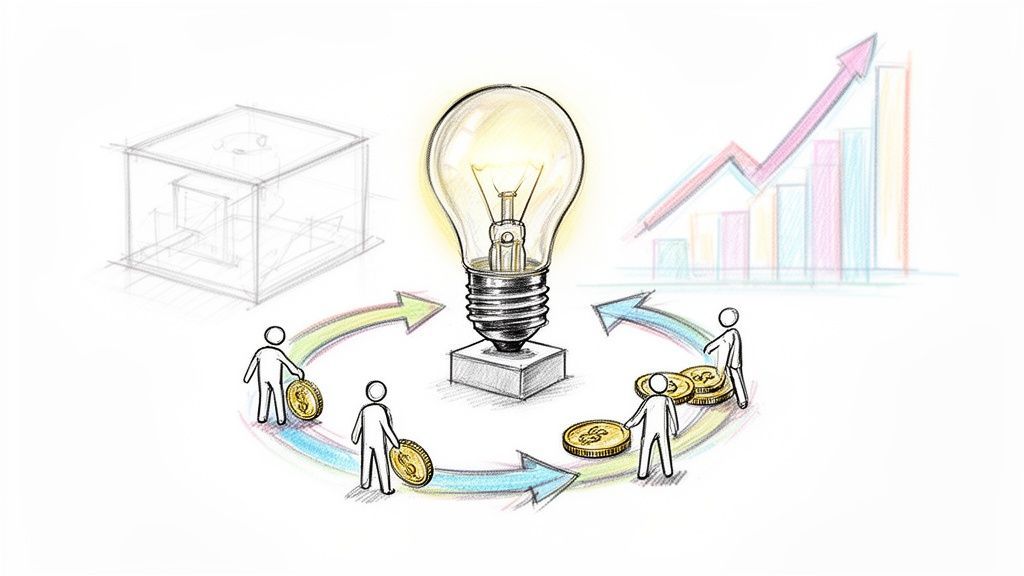
The fundraising journey, at its core, follows a simple path: you shape your idea, you secure the funds, and then you launch.
Every great product started as just an idea. But turning that idea into something people can actually hold or use takes more than passion—it takes capital. For most first-time creators, figuring out how to raise money for an idea feels like the biggest hurdle.
The good news is, you don't need to go begging traditional investors. Modern strategies, especially crowdfunding, let you get funding directly from the people who will actually use your product: your future customers.
Crowdfunding does so much more than just fill your bank account. It’s a powerful way to:
Think of crowdfunding as the ultimate market test. If strangers on the internet are willing to pre-order your product based on a great concept, you know you've got a winner. That kind of validation is priceless.
To help you visualize this process, here’s a quick breakdown of the key stages you’ll go through when crowdfunding your idea.
| Stage | Objective | Key Activities |
|---|---|---|
| Pre-Launch | Build an audience and validate the idea. | Create a landing page, run small ads, gather emails, get feedback from potential backers. |
| Campaign | Raise the target funds and grow the community. | Launch on Kickstarter/Indiegogo, run marketing, post regular updates, engage with backers. |
| Post-Campaign | Fulfill orders and manage backer relationships. | Send backer surveys, manage shipping details, handle upsells, deliver rewards. |
Each stage builds on the last, creating momentum that carries you from a simple idea all the way to a successful product launch.
A successful campaign is all about having a solid plan. It starts long before you hit "launch" and continues well after the funding period ends. We’ll cover everything from building that initial audience to finally shipping your rewards.
One of the most overlooked—and most critical—parts of the journey is what happens after your campaign is funded. This is where a pledge manager becomes your best friend.
Think of Kickstarter as the giant marketplace where people discover your project. A pledge manager like PledgeBox is your own post-campaign command center. It gives you the power to manage your backers, collect crucial shipping information, and even boost your total funding with upsells.
For any creator exploring effective ways of raising money for a business, these tools are a game-changer. The best part? The cost structure is designed to help you succeed. For example, PledgeBox is completely free to send the backer survey and only charges 3% of upsell if there's any.
This model removes the risk and makes it an indispensable tool for turning your funded idea into a smoothly run business.
An idea, no matter how brilliant, is just a thought until you prove people actually want it. Before you can successfully raise money for an idea, you need to show there's a real, paying audience waiting for it. This is where the magic happens—turning idle curiosity into an eager community ready to fund your project on day one.
The best place to start is with a simple landing page. This isn't a full-blown website. Think of it as a digital storefront window: one page with a killer value proposition, some slick concept images, and a single, unmissable call to action like "Join the Waitlist." This page becomes the magnet for all your pre-launch buzz.

This whole process is about starting a conversation, not just hoarding emails. Every single signup is a vote of confidence, proof that your message is hitting the mark. From my experience, this early validation is the single biggest predictor of whether a campaign will sink or swim.
Once your landing page is live, it's time to put your concept to the test with real people. Running small, targeted ad campaigns on platforms like Facebook or Instagram is a surprisingly effective way to gather data. You don't need a massive budget—even $50-$100 can give you incredible insights.
Focus your experiments on a few key areas:
The goal here isn't to rack up thousands of signups overnight. It's about figuring out who your ideal backer is and what language gets them excited. This data is pure gold when you sit down to write your final campaign page.
Getting a list of emails is just the first step. The real work is in turning those subscribers into true believers. Don't just let that list sit there and go cold! You need to send regular, valuable updates. This is a whole strategy in itself, and you can find some great specific actions to build your community before your Kickstarter campaign to get you started.
The people on your pre-launch email list are your most important asset. They are your first backers, your initial source of feedback, and the spark that will ignite your campaign's momentum. Treat them like VIPs, because they are.
Bring them behind the curtain. Share your progress, talk about the challenges, and—most importantly—ask for their opinions. This feedback loop is priceless. Your early fans can help you nail everything from product features to the color options you'll offer.
This direct-to-consumer power is reshaping how products get made. The global crowdfunding market hit a staggering USD 20.4 billion in 2025, and platforms like Kickstarter saw over 650,000 projects launched by early 2026. This isn't a fluke; it's proof that a strong community can bypass traditional hurdles and bring incredible ideas to life. You can dive deeper into the numbers by reading the full crowdfunding market report.
The conversations you have with your early community should directly shape your campaign's structure. You can survey your waitlist to see which reward tiers they're most excited about or what price points feel fair. This takes the guesswork out of building an offer and lets you create something you know people want.
This early engagement also sets you up for success long after the campaign ends. Here's a helpful analogy: the native Kickstarter pledge manager is like Amazon—a closed, one-size-fits-all marketplace. A dedicated pledge manager like PledgeBox is like Shopify—it’s a powerful, customizable toolkit built for you, the creator.
With PledgeBox, sending backer surveys is free, and it only charges 3% of upsell revenue if you decide to offer add-ons. This gives you incredible flexibility to manage backers, offer upgrades, and have your entire fulfillment plan sorted out from the very beginning.
Alright, you've got a validated idea and a community that's excited for what's next. Now it's time to decide how you're going to fund this thing. While traditional routes like angel investors might seem appealing, they're often not the best starting point for a first-time creator.
The smartest way to raise money for an idea today puts you right in front of your future customers.
That's where crowdfunding platforms like Kickstarter and Indiegogo come in. Think of them as more than just a place to collect cash; they are powerful engines for proving your market and growing your audience. This is your chance to show your concept's value not to a few people in a boardroom, but to the thousands who will actually use your product. That direct feedback is priceless.
Going this route turns fundraising from a private pitch into a public celebration, building social proof and powerful momentum with every single pledge.
Your funding goal isn't just a number you pull out of thin air. It's a promise—a calculated contract you make with your backers. Aim too high, and you risk the campaign failing, leaving everyone disappointed. Go too low, and you might not have enough cash to actually make and ship your product.
This is where transparency becomes your greatest asset.
You absolutely must calculate the true cost of bringing your idea to life. Get meticulous and break down every single expense:
Add all that up, and you’ve got your minimum funding goal. This number proves to backers you've done your homework and can be trusted to deliver.
Your reward tiers are the heart of your campaign. They aren't just products for sale; they are invitations for people to join your story at different levels of support. The goal is to create a simple, compelling ladder of value that makes it easy for backers to decide how they want to jump in.
A common mistake I see is offering way too many options. This creates "analysis paralysis," where a confused backer just gives up and leaves. Keep it focused.
The "Super Early Bird" tier is your secret weapon for driving momentum on day one. Offering a deep discount to the first handful of backers creates a powerful sense of urgency. This rewards your most enthusiastic followers and helps rocket your campaign up the platform's discovery rankings.
A solid reward structure usually looks something like this:
Thinking about what happens after you're funded is just as important as the campaign itself. This is where a pledge manager becomes an absolute necessity. So many creators think the built-in Kickstarter tools are enough, but this is a shortcut to major headaches down the line.
Here’s an easy way to think about it: the native Kickstarter pledge manager is like Amazon—it’s a closed system with very limited flexibility. A dedicated pledge manager like PledgeBox, on the other hand, is like Shopify; it gives you a powerful, customizable storefront to manage backers and grow your business. If you are serious about your product, you can explore various options for funding for inventors that go far beyond the initial campaign.
With a real tool, you get control. You can easily collect detailed shipping info, let backers update their addresses, and—most importantly—handle complex orders with different add-ons and options. Best of all, PledgeBox is free to send the backer survey and only charges 3% of upsell if there's any. This risk-free setup allows you to offer valuable upgrades and extras, which can significantly boost your total funds raised long after the campaign is over.

Think of your campaign page as your digital storefront. It’s your one shot to grab a potential backer’s attention and convince them your idea is worth their hard-earned money. When someone lands on your page, you have only seconds to turn their curiosity into commitment. This is where your assets—the video, photos, and words—do the heavy lifting.
Every single element needs to work together to tell a story that makes people feel like they have to be part of your journey. This isn’t about just listing features; it’s about crafting a narrative that builds trust, sparks excitement, and earns their support.
If the page is your storefront, the video is your star salesperson. It’s usually the first thing people engage with, and campaigns with a compelling video raise significantly more money. But this isn't the place for a slick corporate ad. You need a personal, authentic story that connects.
Keep it short—under three minutes—and focus on answering three questions:
Show your prototype in action. Use close-ups. Convey the feeling of using your product. Visual storytelling is infinitely more powerful than a block of text.
Backers can’t hold your product yet, so your visuals have to do the work for them. Grainy, poorly lit photos scream “amateur” and can shatter a backer’s confidence in a heartbeat. You need crisp, professional-quality photos and GIFs that show your idea from every conceivable angle.
Here’s what you should focus on:
These visuals break up your page, making it scannable and engaging. They build a perception of quality and professionalism—critical when you need to raise money for an idea from strangers.
Your campaign page is a visual conversation. Every image and GIF should answer a potential question a backer might have, building a complete picture of your product and its value.
While visuals grab the eye, your words do the heavy lifting of building trust and sealing the deal. Your writing needs to be clear, concise, and full of your brand’s personality. Start strong with a headline and sub-headline that immediately explain what your product is and why it's a game-changer.
Structure the rest of your page logically. Introduce the problem, present your solution and its benefits, then dive into the nitty-gritty details. Use short paragraphs, bullet points, and bold text to make your page easy to skim. Most importantly, be radically transparent.
We're in the age of peer-to-peer trust. In fact, the crowdfunding market is set to explode from USD 20.34 billion in 2025 to USD 44.75 billion by 2030, driven by this very principle. Share your project timeline. Introduce your team with real photos and bios. Be upfront about potential risks and challenges. This builds massive credibility and shows backers you have a real plan. You can discover more about this growth in crowdfunding and see why this is a path worth taking.
The first 48 hours of your campaign are everything. A strong start creates a wave of social proof and signals to the platform’s algorithm that your project is hot, which can lead to features and more visibility. This doesn't happen by accident; it requires a coordinated launch attack.
Your launch plan should be a timed sequence of events:
So, you did it. Your campaign is funded! You’ve managed to raise money for an idea, and your community showed up in a big way. It's a massive milestone, but here's the reality check: the race isn't over. In fact, the real work of fulfilling promises to thousands of backers is just getting started.
This post-campaign phase is a logistical beast, and it’s where a lot of creators, even those with fantastic products, hit a wall. Suddenly you're drowning in spreadsheets, chasing down address errors, and fielding an endless stream of backer questions. But there’s a modern solution that turns all that chaos into a streamlined, revenue-boosting operation: a dedicated pledge manager.
Trying to manage fulfillment with only the built-in tools on Kickstarter or Indiegogo is like trying to run an online store from your DMs. You can make it work, but it’s painfully inefficient and, frankly, leaves money on the table. A powerful pledge manager is your post-campaign command center, built from the ground up for the specific challenges of a crowdfunded project.
It takes the most frustrating parts of the process off your plate, like:
After a successful campaign, great customer engagement is key. As you scale, adopting new technologies can help you manage costs while keeping backers happy. For example, some creators are starting to Unlock Growth with Conversational AI for Customer Engagement to handle common questions and keep their community in the loop.
To really get the difference, let’s use a simple analogy. Think of the native Kickstarter pledge manager as being like Amazon—it’s a closed marketplace with almost no flexibility. It does one job (collecting basic info once) and that's it.
On the other hand, a dedicated tool like PledgeBox is your Shopify. It gives you a powerful, customizable platform to run your post-campaign operations like a proper business. You get total control over the backer experience, from branding your surveys to offering a full catalog of post-campaign products. This is a critical distinction for any creator who sees their project as the launchpad for a real brand, not just a one-and-done campaign.
Using a dedicated pledge manager isn't just about convenience; it's a strategic move. It professionalizes your operation, elevates the backer experience, and opens up new revenue streams that the native platform tools simply can't touch.
And the best part? There’s zero barrier to entry. PledgeBox is completely free to send the backer survey and only charges a small 3% fee on any upsell revenue you make. It's a completely risk-free way to supercharge your post-campaign phase.
This brings us to one of the most powerful features of a pledge manager: the upsell. Your backers are your most passionate customers. They’ve already bought into your vision and put their money where their mouth is. This is the absolute best time to offer them more value.
Right inside your pledge manager survey, you can present backers with a curated menu of add-ons and upgrades. Think about things like:
These small additions can have a massive impact on your average backer value. A $5 or $10 add-on might not sound like a lot, but multiply that across thousands of backers and it can add a huge chunk to your total funds. Often, this extra cash becomes a crucial buffer for those unexpected production or shipping costs that always seem to pop up.
To make the choice even clearer, let's look at a direct comparison between the standard Kickstarter survey and a dedicated tool like PledgeBox.
Understanding the fundamental differences between the native Kickstarter survey tool and a dedicated pledge manager like PledgeBox.
| Feature | Kickstarter's Pledge Manager | PledgeBox's Pledge Manager |
|---|---|---|
| Upsells & Add-ons | Not supported. | Fully supported; boosts total funds. |
| Address Updates | Not allowed; backers can't change their address. | Self-service portal for backers to update. |
| Shipping & Tax | Must be estimated and included in the pledge. | Can be calculated and charged accurately later. |
| Cost Structure | Included in platform fees. | Free for surveys, 3% on upsell revenue. |
At the end of the day, picking the right tool for post-campaign management is just as important as running the campaign itself. It ensures you can deliver on your promises without the headaches, all while maximizing the funds you worked so hard to raise.

So, your campaign clock hit zero. The initial rush is over. But that doesn't mean the funding has to stop. Trust me, a huge number of potential backers will find your project after the campaign officially ends. Learning how to capture that lingering interest is a game-changer for how you raise money for your idea.
This is where a late pledge or pre-order store comes in. By setting one up with a good pledge manager, you create a simple storefront that funnels sales from people who missed the boat. It’s a strategy that does more than just boost your total funds—it’s the first step in turning your one-off campaign into a real, sustainable business.
Think of a late pledge store as an extension of your original campaign. It’s a way for newcomers to get in on the action, usually at a price that’s still a better deal than what your product will eventually sell for at retail.
This steady trickle of new orders can be an absolute lifesaver. It can provide the extra cash you need to cover surprise production hiccups or help you hit a larger manufacturing quantity, which often brings your per-unit costs way down.
The numbers back this up. The crowdfunding market was valued at USD 17.72 billion in 2024 and is expected to climb to USD 31.19 billion by 2032. That's a lot of audience interest that doesn't just disappear overnight. For the creators I see managing fulfillment, tools like PledgeBox are no longer a "nice-to-have" but an absolute necessity. You can learn more about the growing crowdfunding market and see the potential for yourself.
I always tell creators to think of their campaign as the movie premiere and the pre-order store as the extended theatrical run. You've already built the hype; now you're just giving more people a chance to buy a ticket.
Managing late pledges and ongoing pre-orders is where a dedicated pledge manager really earns its keep. Let's go back to that earlier analogy: the built-in Kickstarter pledge manager is like Amazon—a closed system with very little flexibility for you as the seller.
On the other hand, PledgeBox is like Shopify. It gives you your own customizable storefront, putting you in complete control of your post-campaign sales.
With PledgeBox, you can set up a pre-order page in minutes that looks and feels like a natural part of your brand. And the best part? There’s no financial risk. PledgeBox is free to send the backer survey and only charges 3% of upsell if there's any. It's a model built for creators who need to maximize every dollar and keep the entire process as simple as possible.
Jumping into crowdfunding can feel like stepping into a whole new world, and it's natural to have a lot of questions. If you're looking to raise money for an idea for the first time, you're not alone. Here are some of the most common questions we get from creators just like you.
This is the big one, and the honest answer is: it depends. Your funding total is a direct result of your idea's appeal, the audience you build before you launch, and how hard you market your campaign.
While you see headlines about multi-million dollar campaigns, that's not the norm for a first-timer. For a new creator with a great niche product and a solid game plan, a goal in the $10,000 to $50,000 range is often a realistic and achievable target.
Remember, your success is almost entirely determined by the work you do beforehand. Nothing predicts funding potential better than a large, engaged email list.
First, a failed campaign isn't a failure of your idea. Think of it as a powerful, free market research session. It's the market telling you that something needs a tweak—maybe the product itself, your messaging, or your pricing.
This is your chance to gather priceless feedback. Dig into the data. Where did people lose interest? What questions kept popping up? Use that direct feedback to make your next attempt even better. Many incredible products you see today were born from a second or even third campaign after the creator learned some crucial lessons on the first go.
This is a critical one. Kickstarter’s built-in survey tool is, to put it bluntly, very basic. It’s a one-and-done deal—it collects info once, and that's it. It can't handle address changes from backers who move, it won't let you sell add-ons, and it's not designed to accurately collect shipping fees or taxes after the campaign ends. This can turn into a logistical nightmare.
A dedicated pledge manager is a complete post-campaign platform built to handle these exact challenges. It’s the difference between a simple web form and a true command center for your new business.
Here’s a good way to think about it: Kickstarter's native survey tool is like Amazon, a closed marketplace with rigid rules. A dedicated pledge manager like PledgeBox is like Shopify—it’s a powerful, customizable toolkit that lets you run your post-campaign operations like a professional.
With a tool like PledgeBox, you can easily offer upsells, manage complicated international shipping, and give your backers the support they deserve. The best part? PledgeBox is free to send the backer survey and only charges 3% on funds you raise from upsells, making it a risk-free way to boost your funding and make fulfillment a breeze.
Ready to turn your funded project into a smoothly run operation? PledgeBox gives you all the tools you need to manage backers, offer upsells, and handle fulfillment with ease. Learn more and get started for free.
PledgeBox
The All-in-One Toolkit to Launch, Manage & Scale Your Kickstarter / Indiegogo Campaign