 PledgeBox
Kickstarter for Website: Your Ultimate Crowdfunding Guide
Use a Kickstarter for website strategy to build your audience, secure funding, manage backers, and unlock post-campaign revenue for flawless delivery.
Use a Kickstarter for website strategy to build your audience, secure funding, manage backers, and unlock post-campaign revenue for flawless delivery.
So, you're thinking about using Kickstarter for a website or digital product? It’s a fantastic way to get funded, but here's the honest truth: success all comes down to one thing—building an audience before you even think about launching. Your website is more than just a digital brochure; it's the command center for gathering a dedicated community that’s ready to back you on day one.

Long before your Kickstarter campaign clock starts ticking, your website needs to be putting in the work. A successful campaign doesn’t just magically happen at launch. It’s the result of a carefully planned pre-launch phase, with your website right at the heart of it all.
The foundation of this strategy is a dedicated pre-launch landing page. This isn't your full, multi-page site. It’s a single, laser-focused page with one critical mission: to capture email addresses from people who are genuinely excited about what you're building. That email list will become your single most valuable asset.
To get people to hand over their email, your page needs to tell a great story. Don't just show what your project is; explain why it needs to exist. Creator Malachi Ray Rempen, who ran the "Almighty" Kickstarter, found that leading with the "why" helped focus his entire marketing message and forged a much stronger connection with potential backers.
Your pre-launch page should have a few key ingredients:
A classic mistake is just asking for an email without offering anything in return. Instead, give them an incentive. This could be anything from early bird pledge access, a free digital download, or exclusive behind-the-scenes content. This small trade can seriously boost your sign-up rate.
Once you start collecting emails, the real work begins. This pre-launch window is your golden opportunity to nurture that budding audience. Send out regular updates (without being spammy!) to build excitement and, just as importantly, gather feedback.
Share your progress, ask for their opinions on new features, and make your subscribers feel like they're part of the creative journey. This is how you turn a passive email list into an active, engaged community. This level of engagement is a cornerstone of any strong pre-launch strategy. You can learn more about building this kind of momentum in our guide on how to master your Kickstarter pre-launch.
By the time you finally hit that launch button, you won't be starting from a standstill. You’ll have a built-in group of evangelists who are not only ready to pledge but are also excited to spread the word. That initial surge of support is what gets you funded fast and helps you catch the eye of the wider Kickstarter community.
You’ve built your pre-launch community, and the day is finally here. The second you hit that "launch" button on Kickstarter, your website's job completely changes. It’s no longer just a place to collect emails; it becomes your most powerful tool for driving pledges.
Every single visitor to your site needs to be funneled directly to your live campaign page. But just slapping a link on your homepage isn't going to get you there. You need to build an experience that screams urgency and makes backing your project feel like an unmissable event. This is how you weave your website and your live Kickstarter for website campaign into a single, unstoppable force.
Your website needs to become an active funnel, not a passive signpost. The first thing to do is put a big, unmissable banner right at the top of every single page. Use bold, action-focused words like "We're Live! Back Us on Kickstarter Today" to create a real sense of excitement.
Next, embed Kickstarter's own widgets directly onto your homepage. You can show off your funding progress bar and backer count in real-time. Trust me, this kind of social proof is pure gold. When new visitors see those numbers climbing, it creates a powerful fear of missing out and encourages them to jump on board. For a more detailed look at this, our guide on designing a high-conversion Kickstarter landing page has some great advanced strategies.
A killer strategy is to make your website the central hub for all campaign content. Post behind-the-scenes updates on your blog, share any good press you get, and celebrate every funding milestone. Each new post is another reason to email your list and share on social media, creating a constant flow of traffic back to your site, which then points everyone straight to Kickstarter.
While getting your campaign funded is the immediate goal, you also need to be thinking about what happens after it ends. This is where a solid pledge manager becomes your best friend, and it’s important to understand the difference between your options.
Think of it like this: the Kickstarter pledge manager is like Amazon—it's a standardized, one-size-fits-all solution where you're just another seller. A dedicated tool like PledgeBox, on the other hand, is like Shopify. It gives you a fully customizable storefront to control your brand, manage all your backers, and even open up new revenue by offering upsells.
Choosing the right tool is a huge decision. For instance, PledgeBox is free to send the backer survey and only charges 3% of upsell if there's any. This model is basically risk-free. It lets you turn the fulfillment phase from a logistical nightmare into a chance to make more money, all without any upfront cost. It’s all about making that transition from funding to delivery as smooth as possible.
So, your campaign is funded. Congratulations! Pop the champagne, take a deep breath, but don't relax just yet. In many ways, the real work is just beginning. Getting rewards into your backers' hands is a minefield of logistics, and it’s where a lot of promising projects stumble.
This is where you can really shine and build trust with your new community. The secret weapon for a smooth post-campaign experience is a pledge manager. It’s the essential bridge between a successful Kickstarter and happy backers. If you have multiple rewards, international shipping, or any kind of add-ons, a good pledge manager isn't just a nice-to-have; it's a must.
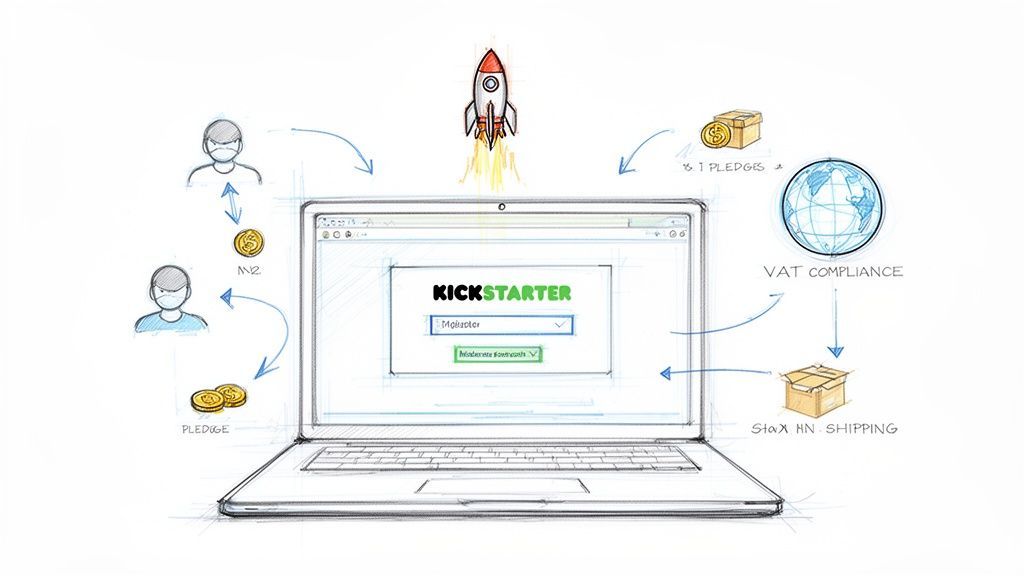
This flow chart shows exactly how a well-integrated website and Kickstarter campaign work together to drive pledges and keep your backers engaged.

As you can see, things like website banners and consistent updates create a clear path that funnels supporters straight to that pledge button, boosting your conversions.
Look, Kickstarter’s built-in survey is fine if your project is incredibly simple—think one reward tier shipping to a single country. But the second you introduce any complexity, like different colors, sizes, or international shipping, it quickly becomes a huge headache.
A dedicated pledge manager takes all that manual work off your plate. It lets you:
When you're thinking about your Kickstarter for website strategy, a helpful comparison comes to mind. Using the Kickstarter pledge manager is like Amazon—it's a one-size-fits-all marketplace where you have very little control.
On the other hand, using a dedicated pledge manager like PledgeBox is like Shopify. You get complete control over your brand, your customer data, and the entire backer experience. You’re not just sending a form; you’re creating a custom portal where backers can confirm pledges, make upgrades, and buy more of your cool stuff.
Post-campaign management is a critical part of your crowdfunding journey, and this is where a specialized tool truly proves its worth. A platform like PledgeBox is trusted by over 8,000+ creators for campaigns totaling more than $50 million since 2019. It’s completely free to send the backer survey and only charges a 3% fee on upsell revenue, making it a risk-free way to boost your project's funding.
This model turns a logistical chore into a real revenue opportunity. For hardware creators especially, who often deal with complicated shipping and VAT across dozens of countries, this is a game-changer. In fact, 5 of the top 10 most-funded Kickstarter campaigns have used PledgeBox to manage their backers.
With over 30% of backers purchasing add-ons post-campaign, the platform has helped creators generate an extra $20 million in revenue. This is how you turn fulfillment from a cost center into a profit booster—a key step in growing from a single Kickstarter project into a full-fledged business.
For a clear walkthrough of the backer experience, check out our guide on how to complete a backer survey in 4 easy steps with PledgeBox.
Picking a pledge manager might seem like a small detail, but it’s a decision that echoes through your entire post-campaign process. It directly affects your project's final profit, your brand's reputation, and whether your backers stick around for the long haul. This is especially true if you’re crowdfunding a digital product or service, where the backer experience is your first real customer touchpoint.
You have two main paths to choose from: stick with Kickstarter's built-in survey tool or bring in a specialized third-party platform.
To put it simply, think of it this way: using the Kickstarter pledge manager is like Amazon. You're a listing in a massive, standardized marketplace. The platform sets the rules, controls the experience, and gives you very little room to make it your own.
On the other hand, using a dedicated pledge manager like PledgeBox is like Shopify. You’re in the driver's seat. You get total control over the branding, you own your customer data, and you design the entire post-campaign journey from start to finish. You’re not just sending a generic form—you’re creating a custom portal that strengthens your brand.
This difference in control is really what separates the two options. When you use a dedicated tool, you’re building a valuable asset for your business. You can design beautiful, on-brand surveys that perfectly match your website's look and feel, which is a game-changer for anyone running a Kickstarter for website launch. This kind of customization makes the whole experience feel professional and cohesive.
You also get the tools to manage complex orders without headaches. Whether you’re offering different software tiers, digital add-ons, or subscription plans, a specialized platform can handle the kind of complexity that a basic survey just can't touch.
The most powerful argument for a tool like PledgeBox is its risk-free model. PledgeBox is free to send the backer survey and only charges 3% of the upsell revenue if there's any. This means you only pay when you make more money, turning a post-campaign necessity into a new revenue opportunity without any upfront cost.
Let's break down what this looks like in practice. The choice you make will define how you handle everything from basic address collection to complex international VAT and revenue-boosting upsells.
Here’s a clear comparison to help you see the difference in what you get.
| Feature | Kickstarter Pledge Manager (Like Amazon) | PledgeBox (Like Shopify) |
|---|---|---|
| Branding & Customization | Minimal; standardized Kickstarter interface. | Fully customizable; branded surveys and portals that match your website. |
| Upsell Potential | None. Surveys are for collecting existing pledge info only. | High; easily offer add-ons and pledge upgrades to increase revenue. |
| Shipping & VAT | Basic address collection. No tools for complex shipping or tax calculation. | Advanced; create complex shipping rules by country/weight and auto-collect VAT. |
| Cost Structure | Free with the Kickstarter platform. | Free for surveys; 3% fee on new revenue generated from upsells. |
| Creator Control | Limited; you operate within Kickstarter's rigid system. | Full control over your data, branding, and the backer experience. |
While Kickstarter’s tool can get the job done for very simple projects, a dedicated pledge manager empowers you to run your post-campaign operations like a true professional. It gives you the tools you need to elevate your brand, delight your backers, and significantly increase your project’s overall funding.

When the clock on your Kickstarter campaign finally hits zero, it’s a huge moment. But that celebration is just the beginning, not the finish line for your revenue. For smart creators, a big chunk of the total funding—often 10-30% or more—actually rolls in after the campaign is officially over.
This post-campaign window is a golden opportunity. You can turn a one-time crowdfunding event into a real, sustainable business. The two most powerful ways to do this are through upsell funnels and late pledge stores.
Your backers have already voted with their wallets. They believe in your project. This makes it the perfect time to offer them exclusive add-ons and upgrades that make their pledge even better. This all happens within your backer survey, which is where a powerful pledge manager really shines.
Instead of just asking for a shipping address, you can guide backers through a curated selection of bonus items. I've seen creators have huge success with this, offering things like:
The secret is to offer items that truly add to the core product. When the value is obvious, backers are often genuinely excited to add more to their pledge.
No matter how good your marketing is, some people will always find your project a day late and a dollar short. A "late pledge" or pre-order store hosted right on your own website is the perfect net to catch this enthusiastic but tardy audience.
By setting up a simple storefront on your site, you give these potential customers a second chance to join the party. This doesn't just bump up your funding total; it grows your customer base for whatever you do next. This is a vital part of any long-term Kickstarter for website strategy, effectively turning your site into an ongoing sales channel.
The smartest approach combines both upsells and late pledges into a single, seamless experience. A specialized pledge manager is the engine that makes this possible, running your entire post-campaign e-commerce operation.
Using a tool like PledgeBox pulls both of these money-making activities under one roof. When a backer from your original campaign fills out their survey, they can effortlessly browse and buy add-ons. At the same time, you can have a pre-order store running for brand-new customers, with every piece of data flowing into one organized dashboard.
This unified system makes inventory management, order processing, and fulfillment so much simpler. You get a clean, real-time view of all your post-campaign sales, whether they came from an original backer upgrading or a brand-new late backer.
Remember, the right tool makes this a no-brainer. PledgeBox is free to send the backer survey and only charges 3% of the upsell revenue if there’s any. This model is incredible because you only pay when you're making new money, turning a logistical chore into a major profit center.
Once your campaign dust settles, it's also a great time to think about long-term stability. Exploring recurring revenue models can be a game-changer. You can learn more about how to set up the best recurring affiliate programs to create a steady income stream. By combining smart post-campaign sales with other strategies, you're not just funding a project—you're building a resilient business.
Even seasoned creators have questions when it comes to making their website and Kickstarter campaign work together. Getting the strategy right can be the difference between a good campaign and a great one, so let's clear up some of the most common points of confusion.
The short answer is a firm no. You can't host an official Kickstarter campaign on your own site. The entire funding experience, from the moment a backer makes a pledge to how their payment is processed, has to live on Kickstarter’s platform. It's a fundamental part of their all-or-nothing funding model.
The best way to think about it is this: your website is the home base for your brand and community, while Kickstarter is the special event venue. Your site’s job is to build an audience, get them excited, and then funnel that crowd over to Kickstarter when the campaign goes live. A smart Kickstarter for website strategy is all about using your site for pre-launch buzz and post-campaign management.
Understanding this difference is absolutely critical for your post-campaign revenue and workload. The Kickstarter pledge manager is a very simple form. It's fine for basic tasks, like grabbing a shipping address or asking for a T-shirt size, but it's a one-and-done data collection tool.
A dedicated pledge manager, on the other hand, is a powerful e-commerce tool designed specifically for crowdfunding projects. A platform like PledgeBox isn't just about sending a survey; it’s about creating a complete post-campaign storefront.
Backers can upgrade their pledge, buy new add-ons, and pay for their exact shipping and tax costs. Best of all, PledgeBox is free to send the backer survey and only charges 3% of the upsell revenue if there's any. This turns a simple survey into a powerful new revenue stream.
Here’s a simple way to frame the difference:
Trying to manage international logistics manually is a fast way to lose money and create a lot of unhappy backers. This is another area where a good pledge manager becomes invaluable.
Platforms like PledgeBox let you set up detailed shipping rules based on a backer's country, the total weight of their package, and even their specific pledge level. It can also be configured to correctly calculate and collect VAT/GST for regions like the EU and UK, which keeps you compliant and saves you from a massive tax headache later on.
The system automatically figures out these costs for each backer when they fill out their survey. This makes the final payment transparent for them and financially secure for you, removing one of the biggest post-campaign nightmares.
Ready to streamline your post-campaign process and boost your revenue? With PledgeBox, you get a powerful, all-in-one toolkit designed to make fulfillment easy and profitable. Start for free today and see how thousands of creators have turned their post-campaign phase into a success story.
PledgeBox
The All-in-One Toolkit to Launch, Manage & Scale Your Kickstarter / Indiegogo Campaign