 PledgeBox
What Is Indiegogo A Guide to Crowdfunding Your Big Idea
What is Indiegogo and how can it launch your project? Our guide covers funding models, fees, and tips for running a successful crowdfunding campaign.
What is Indiegogo and how can it launch your project? Our guide covers funding models, fees, and tips for running a successful crowdfunding campaign.
So, what exactly is Indiegogo? Think of it as a launchpad where creators, from tech founders to independent filmmakers, can bring their ideas to life by raising money directly from people who want to see them succeed. It’s a place where ambitious projects get the financial boost they need, fueled by a community of early adopters.
The simplest way to picture Indiegogo is as a bustling marketplace, but instead of selling finished products, it's showcasing the future. It’s the bridge connecting creators with bold visions to a global audience eager to back the next big thing. This could be anything from a cutting-edge gadget to a unique board game or a passion-project film.
And it’s no small stage. Since launching in 2008, Indiegogo has helped bring over 800,000 campaigns to life, raising more than $2 billion from millions of backers around the world. These numbers tell a clear story: Indiegogo is a major player in the global crowdfunding scene, which is on track to double by 2028. You can explore more data on the global crowdfunding market to see just how big this world is.
When you land on the Indiegogo homepage, you're immediately greeted by a diverse lineup of projects. You’ll see everything from sleek tech innovations to community-driven initiatives.
This first look makes it clear that Indiegogo is all about tangible, creative projects—the kind of stuff that is "clever, unique, and solving everyday problems."
For creators, this is a whole new way of doing things. Instead of chasing traditional investors or bank loans, Indiegogo and other popular crowd sourcing sites give you the power to test your idea, build a community, and raise capital all at once.
Of course, the campaign is just the beginning. After the funding ends, you need to manage everything from surveys to shipping. While some platforms have basic built-in tools, a dedicated pledge manager like PledgeBox gives you a much more powerful, Shopify-like experience. The best part? PledgeBox is free to send the backer survey and only charges 3% of the upsell if there's any, giving you a flexible and cost-effective way to manage your post-campaign success.
To give you a quick rundown, here are the core features of Indiegogo in a nutshell.
| Feature | Description |
|---|---|
| Funding Model | Offers both Fixed Funding (all-or-nothing) and Flexible Funding (keep what you raise). |
| Platform Fee | 5% on all funds raised, regardless of the funding model. |
| Payment Processing | Additional fees of around 3-5%, handled by Stripe. |
| Post-Campaign | InDemand allows creators to continue raising funds after the initial campaign ends. |
| Primary Audience | Strong focus on tech hardware, innovative gadgets, and creative projects. |
| Key Advantage | The Flexible Funding option provides a safety net for campaigns that don't hit their goal. |
This table should help you quickly grasp how Indiegogo is structured and what to expect as a creator thinking about launching a project there.
At the core of every Indiegogo campaign lies a crucial choice between two different funding models: Fixed and Flexible. Getting this right is one of the first big decisions you'll make, as it sets the rules for how you collect money and shapes the expectations for your backers from the get-go.
Since launching way back in 2008, the platform has grown into a global hub for innovation, partly thanks to raising $56.5 million in venture capital to build out its infrastructure for creators like you.
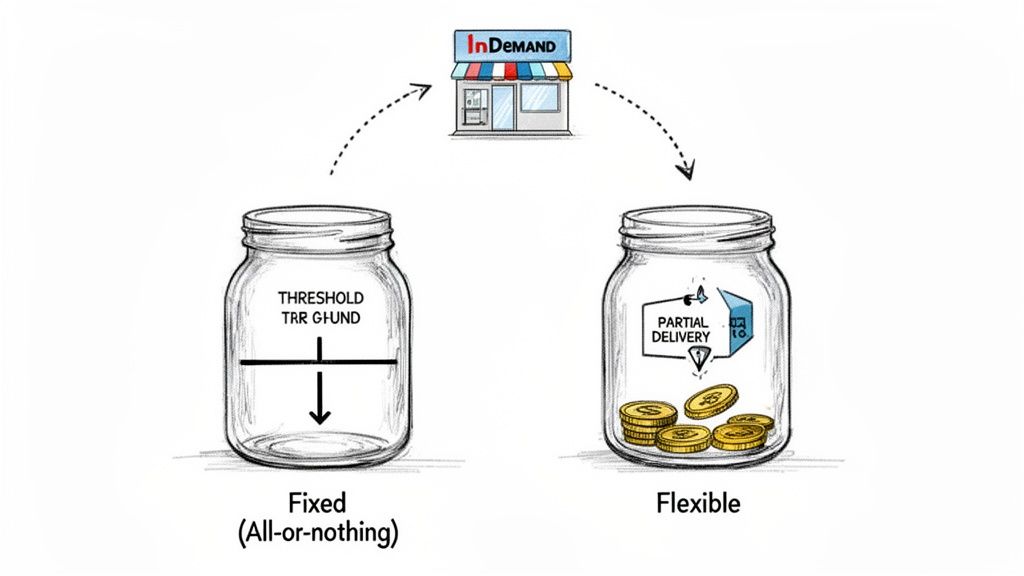
Fixed Funding is exactly what it sounds like—it’s an all-or-nothing game. You set a funding goal, and if you don’t hit that magic number by the deadline, every single backer gets an automatic refund. You don’t get a dime, but you also don't pay any fees.
This model is a lifesaver for projects with hard costs. Say you need a minimum of $20,000 to place a factory order for a new gadget. Anything less than that, and the project is a no-go. Fixed Funding builds huge trust with backers because it eliminates their risk; they know they’ll get their money back if the project isn’t viable.
On the flip side, Flexible Funding lets you keep every dollar pledged, whether you hit your official goal or not. This is the perfect route for projects that can still deliver something of value even with partial funding.
Maybe you’re a documentary filmmaker who can produce a shorter film with the funds raised, or an app developer who can release a version with fewer features. Just remember, while you get to keep the cash, you’re still on the hook to fulfill the perks you promised your backers. As you weigh these options, getting familiar with the basics of payment processing can give you a clearer picture of how funds move from backer to creator.
So, what happens when your 30- or 60-day campaign clock runs out? This is where one of Indiegogo’s killer features comes into play: InDemand. It essentially flips a switch, turning your campaign page into an ongoing storefront. This allows you to keep raising funds and selling your product long after the initial rush is over.
InDemand lets successful campaigns shift seamlessly from crowdfunding to e-commerce without losing momentum. It’s a brilliant way to catch latecomers and build a real, sustainable business right on the platform.
This is a massive advantage for creators, especially those with hardware products that have long lead times. You can use InDemand as a continuous pre-order system while you gear up for a full retail launch, keeping your community engaged and the revenue coming in.
Trying to pick between Indiegogo and Kickstarter can feel like a make-or-break decision for your project. They're both giants in the crowdfunding world, but they operate on totally different wavelengths and pull in different crowds. Getting a handle on these differences is the first step to choosing the platform that will actually help your project succeed.
Here’s a good way to think about it: Kickstarter is like a curated art gallery. It has a strict door policy, a certain prestige, and is known for specific types of creative works—think board games, indie comics, and beautiful art books. Getting featured is a big deal, but you have to live by their all-or-nothing funding rule.
Indiegogo, on the other hand, feels more like an open innovation lab. It’s got a much wider door, welcoming a huge range of projects, especially in the tech and hardware space. That open, flexible approach makes it a fantastic testing ground for new concepts and physical products that might not fit Kickstarter’s mold.
To make the right call, you have to look past the branding and get into the nuts and bolts of how each platform works. The right one can act as a launchpad, while the wrong one can create a ton of friction for you and your backers.
The two platforms diverge pretty dramatically on key things like their funding models, the types of projects that thrive, and what you can do after your campaign clock runs out. These aren't just minor details; they have a huge impact on how you plan your launch and what’s possible for your project long-term.
For a really deep dive into how these two crowdfunding leaders measure up, you can explore a detailed comparison of Kickstarter vs Indiegogo in our other guide.
One of the biggest game-changers is flexibility. Indiegogo's Flexible Funding option gives you a safety net that Kickstarter just doesn't have. It lets you keep the funds you raise even if you miss your goal, which is a massive advantage for projects that can still deliver value on a smaller budget.
Once the campaign confetti settles, managing your backers becomes your new full-time job. Both platforms have some basic tools, but this is where a real pledge manager can save your sanity and boost your bottom line.
Think of it like this: Kickstarter's pledge manager is like Amazon—it gets the job done in a standardized way. But a tool like PledgeBox is like Shopify—it gives you a powerful, customizable storefront just for your backers. Best of all, PledgeBox is free to send the backer survey and only charges 3% of the upsell if there's any, making it a no-risk way to collect info and even increase your total funding.
Making a choice between these two platforms really comes down to the details that align with your project's specific needs. To make it easier to see the differences at a glance, we've put together a simple comparison table.
This table breaks down the core features, from funding models to post-campaign options, highlighting where each platform stands out.
| Feature | Indiegogo | Kickstarter |
|---|---|---|
| Funding Model | Fixed (All-or-Nothing) & Flexible (Keep-What-You-Raise) | Fixed (All-or-Nothing) Only |
| Project Categories | Strong focus on tech, hardware, and design innovation | Dominant in games, comics, art, and creative projects |
| Project Approval | More open, with less stringent review process | Curated, with a stricter project approval process |
| Global Reach | Available in over 235 countries and territories | Available in a more limited number of countries |
| Post-Campaign Tools | Built-in InDemand feature for continuous sales | No native post-campaign sales tool |
Ultimately, the choice depends on your project's nature, your risk tolerance, and your long-term sales strategy. Indiegogo offers a safety net and a path to ongoing sales, while Kickstarter provides a curated community with a massive appetite for creative projects.
No one likes financial surprises, especially when you're pouring everything into launching a new product. So, before you dive in, it’s critical to get a handle on the costs of running an Indiegogo campaign. Let's break down exactly what you should expect to pay.
The main cost to factor in is the platform fee. Indiegogo takes a standard 5% cut from all the funds you successfully raise. This applies whether you choose a Fixed or Flexible funding model, and it’s how the platform keeps the lights on and provides the tools you need to run your campaign.
But that 5% isn't the whole story. You also have to account for payment processing fees. These aren't charged by Indiegogo directly but by their payment processor, Stripe. For creators, this works out to a steady 5% platform fee plus Stripe's 2.9% + $0.30 per transaction. If you're curious about the deeper financial workings, you can find more details on sites like clay.com.
These processing fees aren't set in stone and can wiggle a bit, typically landing somewhere between 3-5%. The final amount depends on things like where your backer is located and which payment method they use. It’s a small variable, but an important one to build into your budget.
Let’s run the numbers with a quick example to see how it all adds up.
Example Campaign Calculation
Imagine your campaign successfully raises $10,000.
- Indiegogo Platform Fee (5%): $10,000 x 0.05 = $500
- Estimated Payment Processing Fee (let's use 4%): $10,000 x 0.04 = $400
- Total Deductions: $500 + $400 = $900
- Your Net Payout: $10,000 - $900 = $9,100
As you can see, you should plan for roughly 8-10% of your total funds raised to go toward these fees. Knowing this from the start means you can set a funding goal that not only covers your project costs but also these essential operational expenses without breaking a sweat.
So, what does a winning campaign on Indiegogo actually look like in the wild? It’s one thing to talk theory, but let's dive into some real-world projects that didn't just meet their goals—they completely shattered them. These stories are perfect examples of the kinds of products and communities that find a natural home on the platform.
One of the most legendary is the Flow Hive, a project that completely changed the game for backyard beekeeping. The creators developed a beehive that lets you harvest honey with a simple turn of a tap, all without disturbing the bees. It was brilliant, solved a real headache for hobbyists, and they raised an incredible $12.2 million. This proved that a clever idea, communicated well, can tap into a massive global audience on Indiegogo.
Then there's the Sondors Electric Bike. Back when e-bikes were clunky, expensive, and out of reach for most people, Sondors launched a campaign for a model that was both affordable and stylish. They saw where the market was headed and jumped in with a product at a price that was hard to ignore, raising over $6 million. It’s a classic case of how Indiegogo can be a powerful launchpad for creators looking to shake up an entire industry.
These examples are just the tip of the iceberg. Indiegogo has been the launchpad for some truly mind-boggling crowdfunding wins, with a few campaigns blowing all expectations out of the water. Take the GPD WIN Max 2, a handheld gaming PC, which pulled in over $46 million. Another one of their products, the GPD WIN4, followed closely behind at $41.64 million.
These aren't just big numbers; they're proof of the platform's incredible power to rally a global community around exciting tech. You can dig into more of these massive raises in this Statista report on top Indiegogo campaigns.
What’s the common thread tying these different success stories together? Each one played to Indiegogo’s unique strengths.
The big takeaway here is that success on Indiegogo isn’t just about having a great idea. It’s about solving a real problem for a specific group of people and using the platform’s tools to keep the momentum going long after the campaign officially ends.
These campaigns offer a powerful blueprint for what’s possible when an innovative product connects with a passionate community. They show creators exactly what Indiegogo is and how they can use it to make their mark.
Hitting your funding goal on Indiegogo is an incredible feeling. But once the confetti settles, you realize the journey is just beginning. Now the real work starts: managing backer expectations, wrangling all the necessary shipping info, and navigating the beast that is fulfillment. This post-campaign phase is where a solid pledge manager goes from a "nice-to-have" to an absolute must-have.
It's a huge shift in focus. You go from marketing guru to logistics expert overnight.
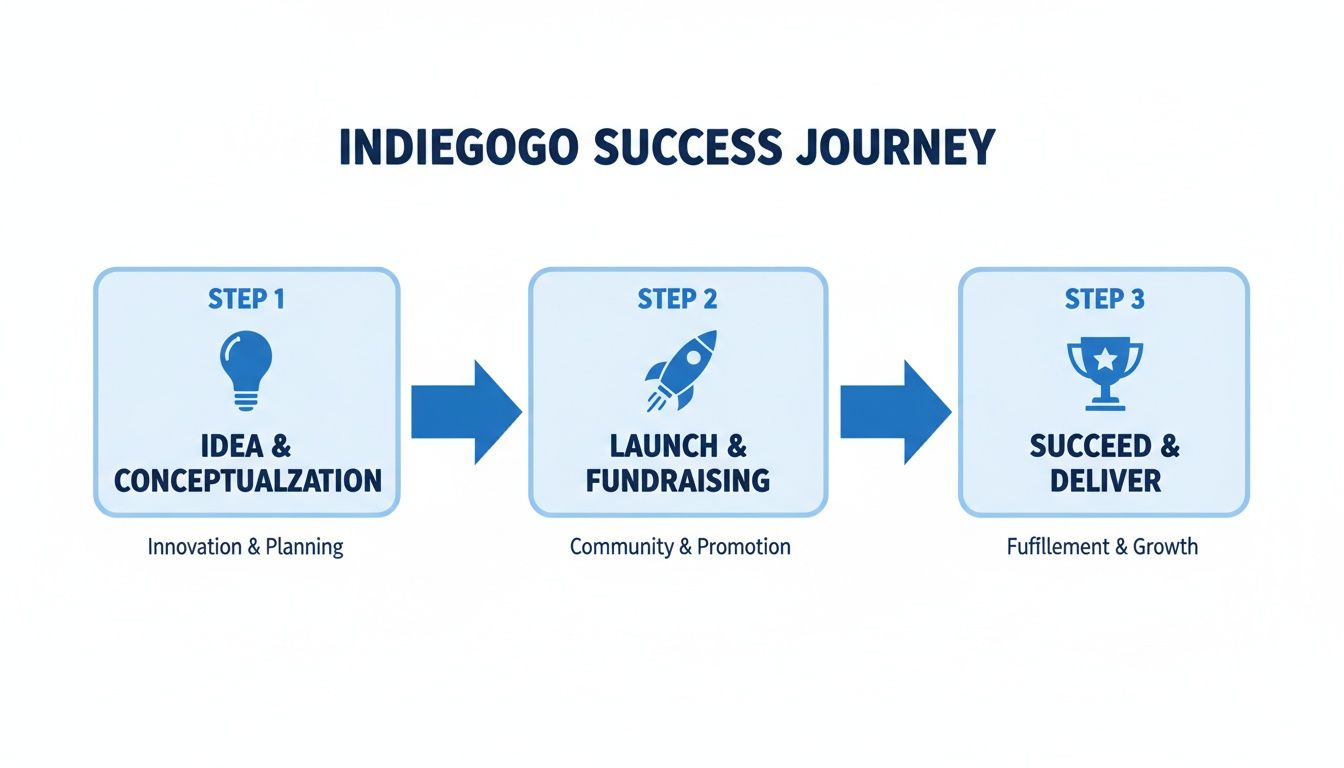
This simple visual nails it—hitting your goal isn't the finish line. It's the starting pistol for the marathon of post-campaign management and getting products into your backers' hands.
Once your campaign wraps up, you’ll have a list of backers, but you're probably missing crucial details like shipping addresses, reward choices, or color preferences. A pledge manager is a tool built specifically to solve this problem, letting you send out backer surveys to collect all that data in one organized place. It makes handling shipping payments, complex reward tiers, and keeping everyone in the loop so much easier.
But here’s the real game-changer: a good pledge manager is also a revenue engine. It lets you offer your backers add-ons and upsells, giving them a chance to grab extra items after the campaign has officially ended. This can seriously boost your total funds raised.
Not all post-campaign tools are built the same. Think of it this way: Kickstarter’s pledge manager is like Amazon. It’s standardized, it works, and it gets the basic job done in a one-size-fits-all package. Functional, but very limited.
A dedicated tool like PledgeBox, on the other hand, is like Shopify. It's a powerful and flexible platform that gives you total control over the post-campaign experience. You can design branded surveys, manage all sorts of intricate reward combinations, and even set up a dedicated storefront for add-ons that feels like a natural part of your brand. You can learn more about the benefits of using PledgeBox for your Indiegogo campaign to see how it all works.
The key difference is control and opportunity. A basic system just collects data, while a robust platform like PledgeBox helps you grow your revenue and strengthen your backer community long after the initial funding period.
Best of all, this power doesn't come with a big upfront cost. PledgeBox is completely free to send the backer survey to all your supporters. The platform only charges a small 3% fee on funds raised from post-campaign upsells, and only if you decide to offer them. This makes it a no-brainer for organizing fulfillment and giving your project’s budget a final, risk-free boost.
Let's wrap things up by tackling some of the most common questions creators and backers have. Getting these details straight will help you navigate the platform with a lot more confidence.
Yes, but there are some important ground rules. You have a lot of flexibility to update your campaign story, swap in new photos or videos, and post updates to keep your backers in the loop. It’s a great way to keep the momentum going.
However, once your campaign is live, some things are locked in for good. You can’t change core details like your funding goal, the campaign deadline, or the descriptions of any perks that backers have already claimed. This is all about maintaining trust and being transparent with the people who’ve already put their money behind your idea.
Once the campaign clock runs out, the real work of managing your backers begins. While some platforms have built-in tools, a dedicated pledge manager gives you and your backers a much cleaner experience. Think of it this way: a platform's native survey tool is like Amazon—it's standardized and gets the job done. A service like PledgeBox, on the other hand, is more like Shopify—it gives you a powerful, brand-focused toolkit to manage everything.
Keep in mind, PledgeBox is free to send the backer survey to all your supporters. It only charges a 3% fee on funds raised from post-campaign upsells, making it a risk-free way to organize fulfillment and potentially boost your total funding.
This is where your choice of funding model really matters. It all comes down to whether you picked Fixed or Flexible funding when you set up the campaign.
Indiegogo is a legitimate and long-standing platform, but it’s important to remember that all crowdfunding comes with some risk. Backing a project isn't the same as buying a finished product from a store; you're supporting an idea that's still in the works.
While Indiegogo has trust and safety policies in place, they don't guarantee that every project will deliver on its promises. As a backer, it's always smart to do a little homework. Look into the creator's past projects, read the comments, and get a feel for how realistic the project seems before you pledge.
Ready to take control of your post-campaign process and boost your funding? PledgeBox offers a powerful, all-in-one toolkit designed to help Indiegogo creators succeed. From sending beautiful, branded surveys to driving extra revenue with add-on upsells, our platform makes managing your backers simple and profitable. Learn how PledgeBox can help you manage your next campaign.
PledgeBox
The All-in-One Toolkit to Launch, Manage & Scale Your Kickstarter / Indiegogo Campaign