 PledgeBox
A Creator's Guide to Winning with Early Bird Deals
Launch a successful campaign with our guide to early bird deals. Learn pricing, timing, and post-campaign strategies that build unstoppable momentum.
Launch a successful campaign with our guide to early bird deals. Learn pricing, timing, and post-campaign strategies that build unstoppable momentum.
Early bird deals are arguably the single most powerful tool a crowdfunding creator has for engineering a massive launch day. When done right, they create a powerful cocktail of discounts and scarcity that can lock in 20-30% of your entire funding goal within the first 48 hours.
That initial surge is everything. It signals a winning project to the platform’s algorithm, gets you featured, and creates the kind of social proof that pulls hesitant backers off the fence.
Let's get one thing straight: early bird tiers aren't just about giving a discount. They are the engine that drives your campaign's initial momentum. A strong start isn't just nice to have; it's a strategic necessity that separates the campaigns that soar from those that fizzle out.
When your project gets a huge rush of pledges on day one, it kicks off a powerful bandwagon effect. Potential backers see the traction and view your project as a sure thing, making them far more likely to jump in. This initial velocity is what you're aiming for. Campaigns that hit that critical 20–30% mark in the first few days see their success rates skyrocket. Early bird pricing is how you make that happen.
Early bird offers tap directly into some potent human psychology: scarcity and urgency. By limiting the number of discounted rewards ("First 100 Backers") or putting them on a tight clock ("48-Hour Special"), you give people a compelling reason to act now instead of "later."
This isn’t about tricking anyone. It’s about rewarding your most dedicated followers—the ones who’ve been waiting for you to launch—for their early commitment. To get a handle on how early birds fit into your overall launch strategy, it helps to understand what lead generation marketing truly entails. For a deeper dive, don't miss our guide on creating urgency and scarcity in your crowdfunding campaign.
To get a clearer picture, let’s break down exactly how these early bird tiers benefit your campaign.
| Benefit | Impact on Campaign | PledgeBox Application |
|---|---|---|
| Generates Initial Momentum | Creates a funding surge in the first 48 hours, signaling a successful project to both the platform and potential backers. | Use pre-launch landing pages to build an email list of eager supporters ready to grab early bird deals the moment you go live. |
| Builds Social Proof | A high backer count early on establishes credibility and trust, encouraging others to pledge. | Highlight the number of early bird backers in campaign updates to showcase momentum. |
| Rewards Early Supporters | Makes your most loyal followers feel valued and appreciated, strengthening your community from day one. | After the campaign, offer exclusive add-ons or upsells to these early backers directly within the PledgeBox survey. |
| Increases Campaign Visibility | Strong initial funding can boost your project's ranking in platform algorithms, leading to more organic traffic. | A strong start means more backers to manage, and PledgeBox simplifies collecting shipping info and managing pledges efficiently. |
These benefits compound, creating a cycle of positive reinforcement that can carry your campaign all the way to its funding goal and beyond.
Here's a secret many first-time creators miss: the value of your early bird backers doesn't stop when the campaign timer hits zero. That's just the start of your relationship. This is where a robust pledge manager becomes your most important tool, letting you continue to engage with your most passionate supporters.
A lot of creators think Kickstarter is the finish line. It's not. It's the starting pistol. Your pledge manager is where you transition from a fundraiser into a real business owner who can nurture the community you just built.
Think about it this way. Kickstarter's pledge manager is like being a vendor in a giant marketplace like Amazon. It gets the job done, but you're just one of many, and your control is limited.
A dedicated pledge manager like PledgeBox, on the other hand, is like getting your own branded storefront, like Shopify. You get to interact directly with your customers (backers) in a space you control. This opens up a world of new opportunities.
With PledgeBox, you can design a smooth, professional survey experience that does way more than just collect shipping addresses. It's your chance to offer exclusive add-ons and upsells, turning those enthusiastic early birds into even bigger supporters. Best of all, PledgeBox is free to send the backer survey and only charges 3% of upsell revenue if there's any. It's a risk-free way to boost your total funding and build lasting relationships with your core community.
Alright, let's move from theory to action. It's time to build the actual framework for early bird deals that don't just get a glance—they demand a pledge. Your goal here is to find that sweet spot between a discount that gets backers excited and a profit margin that keeps your project healthy. This isn't about slashing prices at random; it's a calculated move.
A great starting point I've seen work time and again is the 15-25% discount off your planned retail price (MSRP). This range is hefty enough to create real urgency, but it won't devalue your product or, worse, kill your profits. To dial in your exact number, you absolutely have to work backward from your costs—manufacturing, shipping, platform fees, the works—to make sure every single pledge is a win. For a deeper dive, our guide on developing a pricing strategy for your crowdfunding campaign is a must-read.
Once you’ve got your discount figured out, you need to decide how you'll create scarcity. The two classic methods are limiting your offer by time or by quantity, and each one plays a very different strategic role.
Many of the most successful campaigns I've worked on actually use a hybrid model. They'll have a "Super Early Bird" tier for the first 50-100 backers with a deep discount, then follow it up with a standard "Early Bird" tier for the first 48 hours at a slightly smaller discount. This layered strategy rewards your most passionate followers while still capturing a wider audience.
This process really shows how a strong launch fuels the momentum you need to attract a bigger crowd, which then lets you nurture those relationships for long-term success.
A truly powerful early bird deal isn't always just about the price tag. Sometimes, adding exclusive, non-monetary value can be an even stronger motivator. You just need to think about what you can offer that feels special without blowing up your production costs.
Here are a few real-world examples to get you started:
The key is to offer something that makes the core product even better and makes your first supporters feel like they're part of an inner circle. It helps to understand how effective incentive programs work to build loyalty, as many of the same principles apply here.
So, how do you know if your offers will actually land with your audience? Simple: you test them. Before you even think about launching your campaign, get a pre-launch landing page up and start collecting email addresses.
Don't guess what your audience wants—ask them. A simple survey to your pre-launch email list can reveal whether they prefer a bigger discount or an exclusive add-on. This data is pure gold.
Use this captive audience to see what resonates. You can run a small poll asking which of two potential early bird deals they find more appealing. This data-driven approach takes the guesswork out of the equation and ensures that when you finally hit "launch," your reward tiers are already primed for maximum impact. While the context is a bit different, this value-based approach mirrors trends in investment crowdfunding, where since 2020, 61.7% of early bird deals offered valuation discounts in that same 10–20% sweet spot.
Nailing the perfect early bird deal is only half the battle. Its success lives or dies based on your pre-launch marketing. A killer offer means nothing if your biggest fans don't know about it—or worse, don't know when to show up. To get that massive day-one surge, you need a focused plan to turn casual followers into a fired-up community, ready to pledge the second you go live.
The whole game here is building an engaged email list. I'm not talking about a list of people who are just kind of interested. I mean people who are primed and genuinely excited to claim their early bird spot. This isn't about sending a single "we're live!" email. It's about spinning a narrative over several weeks that builds anticipation, proves your product's value, and climaxes in a launch they can't afford to miss.
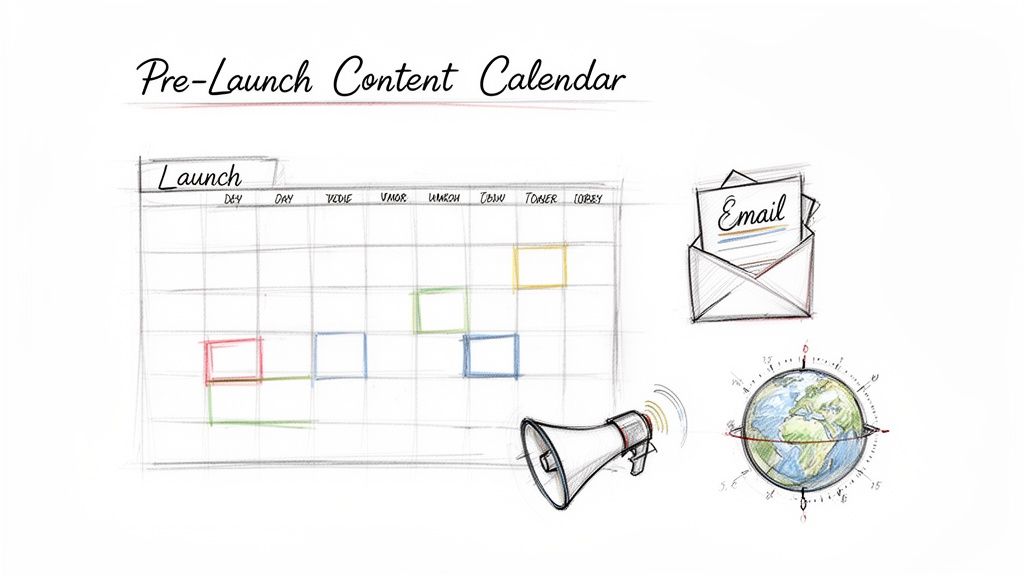
This process is more important than ever. As crowdfunding platforms get pickier, focusing on “fewer but better performing campaigns,” the pressure is on to show strong early metrics. We're talking backer count, funding speed, and conversion rates. Early bird deals, paired with a solid pre-launch email list, are your best weapon for crushing these metrics and proving your project is a winner from the very first hour. You can discover more insights about crowdfunding platform trends and what they look for in successful campaigns.
A successful pre-launch doesn't just happen. You have to map it out with a content calendar that guides your audience straight to launch day. Think of it as a multi-week runway before your big takeoff.
Here’s a simple but effective framework for your email sequence:
Transparency is your best friend during this final countdown. Clearly communicate the exact launch time and date in several major time zones (PST, EST, GMT, JST, etc.). It’s a simple step, but it prevents mass confusion and makes sure your global audience shows up when the doors open.
Your pre-launch marketing should feel less like a hard sell and more like an invitation to an exclusive club. You need to get people talking. Ask questions in your emails and social posts. Run polls asking which color they like best or what feature they're most excited about.
This isn't just about fluffing up your engagement metrics. This two-way street fosters a real sense of shared ownership. When your followers feel like you're actually listening, they stop being passive observers and become genuine advocates for your project.
They become the core crew who will not only pledge on day one but also blast your campaign to their own networks, multiplying your reach. This initial rush is exactly what platform algorithms are built to notice and reward with more visibility. Follow these steps, and you'll create the perfect storm for a powerful launch that sets your entire campaign up for success.
Once the confetti settles and your campaign timer hits zero, the real work begins. Your focus has to pivot from fundraising to fulfillment, and this is where a powerful pledge manager becomes the most important tool in your post-campaign toolkit. It's the bridge connecting your launch day excitement to long-term, sustainable revenue.
Your early bird backers aren't just entries in a spreadsheet; they're your most passionate advocates. The handover from a platform like Kickstarter or Indiegogo to your post-campaign survey needs to feel seamless, professional, and completely on-brand. A good pledge manager makes this transition smooth and intuitive for everyone.
Here’s a simple way to think about the difference: Kickstarter's pledge manager is like being a seller on Amazon, but using PledgeBox is like having your own Shopify store. On the main platform, you're playing in a crowded marketplace with a fixed set of rules. In your pledge manager, you're in control of the entire experience.
And that control is everything. You can design surveys that don't just ask for a shipping address but actually reflect your project's unique personality and brand. It’s your first big chance to build a direct relationship with the community that helped bring your vision to life.
Here's a peek at the clean, creator-first interface you get with PledgeBox.
The dashboard gives you an instant snapshot of your post-campaign health, from how many surveys are completed to the extra funds you've raised through add-ons.
Sure, collecting shipping info and sorting out complicated taxes are the basics. But the real power of a pledge manager? It's the upsell. Your early bird backers have already bought into your dream. They are, by definition, the most likely people in the world to want more from you.
A pledge manager transforms your survey into a targeted, last-chance marketplace just for them. This is where you can offer exclusive add-ons that perfectly complement your main product, turning a simple pledge into a much larger, more valuable order.
This single strategy can seriously boost your average revenue per backer, often adding 10-20% or more to your total funds raised. Knowing how to select the right pledge manager is the key, because the right tool makes setting up these upsells practically effortless.
One of the biggest headaches for creators is dealing with post-campaign costs. The beauty of the PledgeBox model is that it completely removes that financial risk.
PledgeBox is completely free to send your backer survey. The platform only charges a small 3% fee on new funds raised from upsells and add-ons. If you don't sell anything extra, you don't pay anything.
This pricing model is perfectly aligned with a creator's goals. You get a professional-grade tool to manage all the fulfillment logistics at no upfront cost, and it comes with a powerful revenue engine built right in. You can handle everything from address validation to VAT collection and then export clean, organized data for your fulfillment partners.
By using a pledge manager, you turn a logistical chore—the backer survey—into your most profitable post-campaign marketing channel. You give your biggest fans a chance to get more of what they love, and you secure the extra funding you need to grow your business beyond just one successful campaign. It’s the smartest move you can make to honor your early bird supporters while building a brand that lasts.
Even the sharpest early bird deals can go sideways if you’re not careful. Trust me, learning from common mistakes is way smarter—and cheaper—than making them yourself. A few simple missteps can turn your exciting launch day into a logistical mess.
Navigating these challenges is what separates the successful campaigns from the ones that fizzle out. From discounts that are too generous to reward tiers that are just plain confusing, let's break down the most common traps creators fall into and how you can sidestep them.
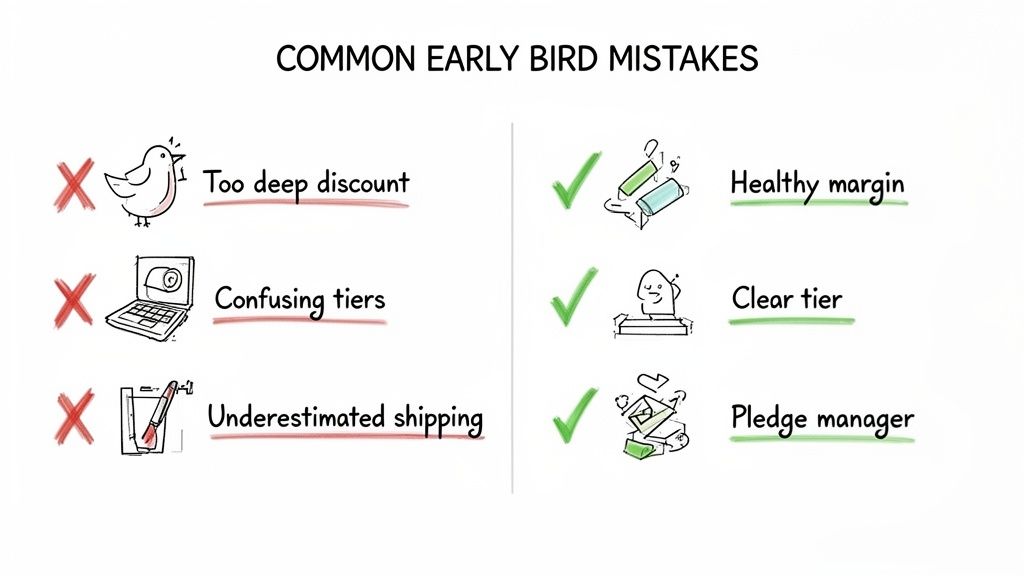
This is probably the most dangerous mistake I see: offering a discount so deep it completely torches your profit margin. In the rush to create a deal nobody can refuse, it’s easy to forget about all the costs—manufacturing, platform fees, marketing, and the inevitable production hiccup. A 25% discount looks great on paper, but if your profit margin is only 30%, you’re barely breaking even.
The fix is to work backward. Before you even dream up a discount, calculate your total cost of goods sold (COGS) for every single unit. Make sure your early bird price easily covers those costs and still leaves you with a healthy profit. An early bird special that bankrupts your project isn't a win, no matter how fast it sells.
On the flip side, a discount that’s too small is just as bad. Offering a measly 5% off doesn't create any real urgency. Potential backers will glance at the tiny savings, shrug, and decide to wait and see how things go. This completely defeats the purpose of an early bird offer, which is all about getting people to act now.
Your offer needs to feel substantial. The sweet spot is usually between 15-25% off the final retail price. This range is significant enough to make backers feel like they’re getting a truly special deal for jumping in early.
A hugely successful launch is amazing until you realize you haven’t planned for fulfillment. I’ve seen so many creators underestimate the sheer complexity of shipping to a global audience. Figuring out accurate shipping costs, dealing with customs forms, and managing VAT for dozens of countries is a massive headache.
This is where a pledge manager becomes an absolute necessity. Don't even think about trying to manage this chaos with spreadsheets.
The time to figure out shipping isn't after your campaign ends. A pledge manager is your fulfillment command center. It organizes backer data, calculates precise shipping and tax rates post-campaign, and ensures your backers have a smooth experience from pledge to delivery.
Think of it like this: Kickstarter's pledge manager is like a giant marketplace, like Amazon. But a dedicated tool like PledgeBox is your own branded storefront, like Shopify, where you control the experience. That control is vital for handling complex fulfillment smoothly. Better yet, PledgeBox is free to send the backer survey and only charges 3% of upsell revenue if there's any, making it a risk-free fix for a major logistical nightmare.
Another classic mistake is having way too many early bird tiers. When a potential backer sees "Super Early Bird," "Early Bird Special," "Day One Backer," and "First 24-Hour Deal," they just get confused. And a confused mind almost always says no.
Keep your reward structure simple and easy to understand.
This two-tier system gives backers a clear path. It rewards your most dedicated followers with the absolute best deal while still giving a wider audience a great reason to pledge early—all without causing any confusion.
You've got the strategies and the warnings, but a few specific questions always seem to pop up when you're in the trenches of planning an early bird launch. Let's tackle the most common ones I hear from creators.
My advice? Keep it simple. One or two distinct early bird tiers is the sweet spot. Any more than that and you risk "analysis paralysis," which is the exact opposite of the lightning-fast decision you want to encourage.
A two-tiered approach often works like a charm:
This setup rewards your most die-hard fans while creating a clear, compelling path for everyone else to jump on board.
First off, pop the champagne! This is a fantastic problem to have. When your limited tiers disappear in minutes, it screams high demand and builds incredible social proof for your project.
Your very next move should be to post a campaign update. Announce the sell-out with genuine excitement—"Wow, our Super Early Bird tier sold out in just 10 minutes!" This creates a powerful sense of FOMO (fear of missing out) and nudges anyone on the fence to grab one of the remaining tiers before they're gone too. Frame it as a huge win, not as lost potential revenue.
Absolutely, and you'd be crazy not to. This is a core function of a pledge manager and one of the best ways to bump up your total funding after the campaign clock runs out.
Once your campaign ends successfully, you'll send backers a survey to lock in their shipping address and confirm their pledge. Inside that survey, you can present a curated menu of exclusive add-ons, upgrades, and accessories. Your early bird backers, being your most fired-up supporters, are prime candidates to buy these extras.
Think of the pledge manager survey not just as a form, but as your exclusive, backers-only storefront. It’s your final, golden opportunity to turn a single pledge into a much larger order.
This is exactly where a tool like PledgeBox comes in. It lets you build this post-campaign storefront effortlessly. And remember, PledgeBox is free to send the backer survey and only charges a 3% fee on new funds raised from these upsells. It’s a completely risk-free way to significantly boost your final revenue.
No. Just no. Never do this. The discount should apply only to the price of your product. Shipping costs, along with any taxes like VAT, must be calculated and collected separately after the campaign. Trying to guess and bundle shipping into your reward price is a one-way ticket to disaster, as shipping rates can fluctuate wildly depending on where your backer lives.
Be completely transparent about this on your campaign page. A simple, clear statement like, "Shipping and taxes will be calculated and collected post-campaign via our pledge manager" is all you need. This protects your margins from getting eaten alive by surprise shipping fees and is standard practice in crowdfunding. Backers get it.
Think of it this way: Kickstarter is like a giant marketplace for launching your idea. Once the campaign is over, you move your backers into your own space. Using PledgeBox is like having your own Shopify store—it gives you total control to manage those crucial final steps, from collecting accurate shipping fees to offering those profitable last-minute add-ons.
Ready to turn your successful campaign into a thriving business? PledgeBox provides all the tools you need, from pre-launch pages to a powerful, revenue-boosting pledge manager. Streamline your surveys, upsell with ease, and manage fulfillment without the headache.
PledgeBox
The All-in-One Toolkit to Launch, Manage & Scale Your Kickstarter / Indiegogo Campaign