 PledgeBox
How to Estimate Shipping Costs for Crowdfunding Campaigns
Learn how to estimate shipping costs for your Kickstarter or Indiegogo rewards. Our guide covers dimensional weight, international fees, and fulfillment tools.
Learn how to estimate shipping costs for your Kickstarter or Indiegogo rewards. Our guide covers dimensional weight, international fees, and fulfillment tools.
Getting your shipping estimates right is one of the most stressful—and most important—parts of running a crowdfunding campaign. You have to figure out package sizes, dimensional weight, carrier rates across dozens of zones, and a whole mess of hidden fees like duties and insurance. If you get it wrong, it can wipe out your profits in a heartbeat.
Seriously, undercharging for shipping is one of the most common pitfalls for new creators. It's an easy mistake to make, but a brutal one to recover from.
Shipping costs are the silent killer of crowdfunding campaigns. What feels like a tiny detail during the rush of a Kickstarter or Indiegogo launch can easily balloon into your biggest, most unpredictable expense. Nailing your shipping estimates from day one isn't just good practice; it's essential for keeping your project in the black and your backers happy.
A lot of creators are shocked when they see their first fulfillment invoice. It's never just one simple number. To truly understand what you'll be paying, you need to break down every single component that adds up to that final price tag.
A real-world shipping quote is a blend of several different fees, and each one needs a line in your budget. If you only plan for the base freight cost, you're setting yourself up for failure. You've got to factor in surcharges that change weekly, the labor cost for actually packing the boxes, and insurance to protect everyone if a package goes missing.
A bad shipping estimate isn't just a math error; it’s a direct threat to your project’s survival. I've seen campaigns fail after funding because they lowballed this one expense by 20-30%. That forced them to eat massive, unplanned costs right out of their production budget.
To build a solid financial plan, you need to know exactly what you’re paying for.
Here’s a quick look at the core components that make up your total shipping and handling costs.
| Cost Component | What It Covers | Why It Matters for Your Budget |
|---|---|---|
| Base Freight | The core charge from a carrier (like UPS or DHL) to move a package from Point A to Point B. | This is your starting point, but it's only a fraction of the total cost. It varies by weight, distance, and service speed. |
| Fuel Surcharges | An additional percentage or flat fee carriers add to cover fluctuating fuel prices. | This fee changes constantly, meaning a quote from today might be different next month. You must budget for this volatility. |
| Handling Fees | The cost of labor and materials for picking, packing, and labeling each reward. | Whether you're paying a 3PL or accounting for your own time, this cost is real and needs to be included in your calculations. |
| Duties & VAT | Taxes imposed by the destination country on imported goods. | For international backers, these can be substantial. Failing to account for them can lead to returned packages and angry backers. |
Understanding these moving parts is the first step. The next is figuring out how to actually collect the right amount from each backer without causing a riot.
Given all this complexity, the old way of charging a flat shipping fee at the time of the pledge just doesn't cut it anymore. Think of Kickstarter's pledge manager like Amazon—it gets the job done, but it’s a one-size-fits-all marketplace. A specialized pledge manager like PledgeBox, on the other hand, is like Shopify; it's your own dedicated storefront, giving you way more flexibility and control.
What really makes a difference is the business model. PledgeBox is free to send the backer survey and collect all the addresses you need. They only charge a small 3% fee on new funds raised from upsells, if there's any.
This changes everything. A logistical chore becomes a risk-free tool that can actually boost your revenue after the campaign is over, making sure you have more than enough cash on hand to cover the true, final costs of shipping.
To get your shipping costs right, you need to stop thinking about your product and start thinking about your package. Seriously. The final, taped-up box you hand over to the carrier is the only thing that matters. Its exact dimensions and weight are what will make or break your budget.
This means you have to account for every single gram and centimeter. Get your hands on a physical prototype of your final, packed reward—and I mean everything. The product, the box, the bubble wrap, any custom inserts, your thank-you flyer, and even the packing tape. It all adds up.
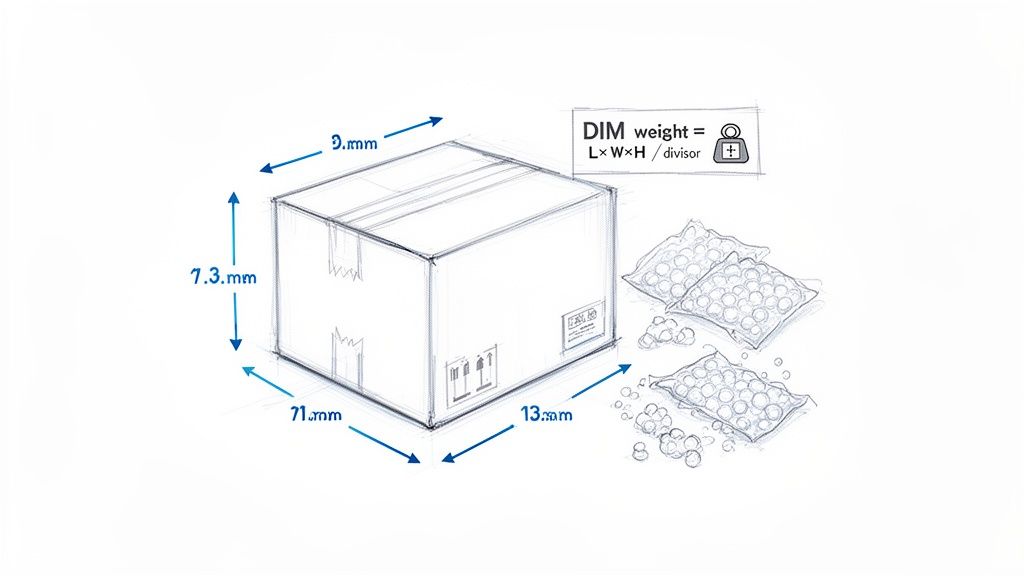
Here’s a costly lesson many creators learn the hard way. Carriers like UPS, FedEx, and DHL don't just charge you based on how heavy a package is (its actual weight). They also care about how much space it hogs on their truck or plane. This brings us to a crucial concept called dimensional weight, or DIM weight.
Dimensional weight is basically a formula that turns your package's size into a theoretical weight. The calculation itself is pretty simple:
(Length x Width x Height) / DIM Divisor = DIM Weight
The carrier then looks at your package's actual weight and its DIM weight and charges you for whichever is higher. This final number is called the billable weight.
This is the number one trap for crowdfunding creators. They budget for a lightweight product, only to get slammed with shipping costs three times higher than expected because their beautiful, custom-designed box is bulky. A killer unboxing experience is great, but not if it bankrupts you.
Let’s look at two different rewards to see how this plays out in the real world.
Using a common DIM divisor of 139 (used by major carriers), let's see what happens.
The Gadget
The Board Game
Even though both products weigh exactly the same, you're paying the shipping rate for a 7-pound package for the board game. That's a whopping 75% increase in billable weight, all because of the box size. This is why packaging design is a critical financial decision. For a deeper dive, PledgeBox has some great info on how to use a cubic calculator for shipping.
Your packaging has two jobs: protect the product and delight your backer. But it also has to be efficient. For example, if you're thinking about buying pizza boxes wholesale for a flat item, you need to know those exact dimensions first.
Here are a few tips to keep your package size and weight in check:
Getting these hands-on measurements is the absolute foundation for every calculation that follows. Without an accurate billable weight, any quote you get from a carrier is pure fantasy.
Once you've nailed down your final package dimensions and billable weight, it's time to tackle the trickiest part of the puzzle: carrier pricing. You can get a quick baseline from online rate calculators, but treating those numbers as gospel is a surefire way to lose money. Carrier rates are anything but static.
These prices are constantly in flux, pushed and pulled by a storm of real-world events. Fuel surcharges can change weekly. So can labor costs, seasonal demand (hello, holiday rush), and major supply chain meltdowns. A conflict on the other side of the planet can suddenly reroute shipping lanes and send rates through the roof overnight.
This is exactly why collecting a fixed shipping fee months ahead of time during your campaign is such a huge gamble. The price you quote in January could be completely wrong by the time you're shipping rewards in July. That gap can easily sink a profitable project, forcing you to eat the difference out of your own budget.
To really get a handle on shipping costs, you have to accept that you're aiming at a moving target. Just look at recent market data—it's a masterclass in volatility. Global trade shifts throughout 2025 and 2026 are forcing creators to react to wild swings that averages just don't capture. Even with a slump in US demand, China's exports jumped 5% year-over-year through November 2025, sending 8.6% more containers to Europe. This kind of traffic jam on specific shipping lanes makes prices jump.
For anyone making hardware or publishing a board game, this means your estimates have to start with real-time data. The Shanghai Containerized Freight Index (SCFI) was at 1,266.56 points in February 2026, which was a 20.50% recent drop, while January saw 11-12% drops to US coasts. If you miscalculate these trends, you could lose 20-30% of your ROI just from uncollected fees. For a deeper dive into these dynamics, you can explore the full freight forecast on Freightos.com.
This chaos is precisely why you need a flexible tool to collect accurate shipping fees after your campaign ends. A pledge manager isn't just a nice-to-have; it's a critical piece of your toolkit.
Here’s a simple way to think about it:
The modern crowdfunding model isn't about guessing shipping costs months in advance. It's about building a system to calculate and collect the actual costs at the time of fulfillment. This shift in strategy protects your profits and ensures sustainability.
Best of all, PledgeBox is free to send the backer survey and handle all your address collections. They only charge a small 3% fee on upsell revenue if there's any. This completely removes the financial risk for creators. It turns a must-have logistics tool into a free way to secure your project’s financial health. By waiting to charge for shipping, you sidestep the volatility problem entirely, making sure every backer pays the right amount and your budget stays safe.
That base shipping rate you see on a carrier’s website? Think of it as just the tip of the iceberg. The real costs—the ones that can quietly sink your campaign's profitability—are often buried in the fine print. To build a budget that actually holds up, you need to account for all these easily overlooked fulfillment expenses.
Trust me, failing to account for these is one of the quickest ways a wildly successful crowdfunding campaign ends up losing money. A backer in Berlin is going to have a much different final cost than a backer in Boston, and you need to be ready for both.
Shipping internationally is a fantastic way to reach a global audience, but it also opens a Pandora's box of taxes and fees. These aren't optional suggestions; they're legal requirements imposed by the destination country's government.
Every country plays by different rules. The tax threshold in the UK isn't the same as it is in Canada, for example. You absolutely have to research the specific requirements for your biggest backer countries to avoid a logistical nightmare. For a deeper dive into managing these expenses, check out our guide on how to reduce shipping costs.
It’s tempting to skip insurance to shave a few dollars off each package. This is almost always a mistake. Carriers lose or damage packages sometimes—it's just a reality of logistics. Without insurance, you're on the hook for replacing the product and paying to ship it all over again.
Think of shipping insurance as a simple risk calculation.
Weigh the small cost of insurance against the full cost of replacing your most expensive reward. If just a few lost packages would seriously ding your budget, insurance isn't a luxury; it's essential.
For high-value items, insuring every package is non-negotiable. For cheaper rewards, you might decide to "self-insure" by adding a small buffer to your overall shipping budget to cover the occasional loss.
Finally, let's talk about the actual work of getting rewards in the mail. Handling fees cover all the labor and materials that go into the pick, pack, and ship process. Whether you’re doing it all from your garage or working with a third-party logistics (3PL) partner, these costs are real.
This includes things like:
These per-package fees can easily add $2 to $5 or more to your total cost for every single backer. Getting a handle on all these variables is the key to building a smart, profitable shipping strategy.
Theory is one thing, but now it's time to get your hands dirty and build a practical tool. The single best way to get a grip on your shipping costs is to create a dynamic financial model, usually right in a spreadsheet. This becomes your command center, letting you tweak variables and see instantly how your total costs change for every single backer.
This isn't just about crunching numbers. Your model is the blueprint you'll use to set up the shipping rules in your pledge manager. Get this right, and you’ll be able to forecast your financial risk with surprising accuracy.
To build a model that actually works, you need to track a few key variables for every possible shipment. Just think of these as the columns in your spreadsheet. Each one peels back another layer of cost that adds up to the final amount you’ll need to charge.
At a minimum, your model should include these columns:
This detailed approach is what separates guessing from data-driven forecasting. As you build out your model, it helps to use online tools to get a quick shipping cost estimate to make sure your own calculations are in the right ballpark.
This infographic breaks down the extra costs that often catch creators by surprise—things like duties, insurance, and handling fees.
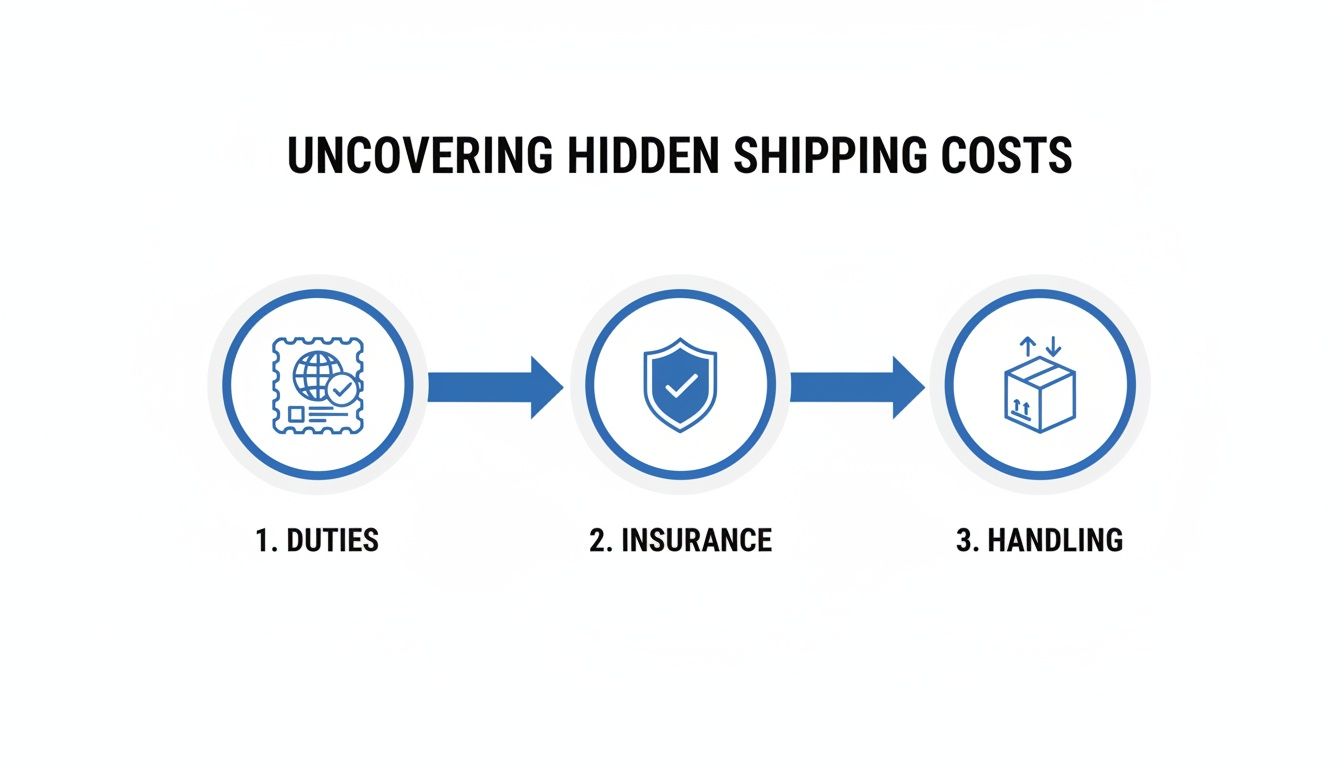
The big lesson here? The sticker price a carrier quotes you is never the final price. These hidden expenses have to be baked into your model from day one.
Once your spreadsheet is set up, the real magic happens when you start running scenarios. Create a few sample rows for different types of backers to see how the costs stack up. This is how you stress-test your model and find out where your biggest financial risks are hiding.
Let's walk through a few common backer scenarios:
By modeling out these different situations, you’ll end up with a clear, data-backed range of what it will truly cost to get your rewards to backers all over the world.
Key Insight: Your spreadsheet model isn’t just an estimation tool. It’s the direct instruction manual for your pledge manager. The data and rules you build here are exactly what you'll use to configure PledgeBox, ensuring every backer is charged the correct, precise amount automatically.
This is where all that prep work pays off. The logic you've meticulously built into your spreadsheet—the different shipping zones, the VAT rules for each country, the weights for every reward—can be directly translated into your pledge manager's shipping configuration.
Platforms are not created equal here. A modern pledge manager gives you the granular control needed to implement these complex, country-specific rules. It's a world away from the one-size-fits-all shipping options you might find in a basic system. And since PledgeBox is free to send the backer survey and only charges 3% of upsells if there's any, you get all this power without any upfront cost.
This isn't just about convenience; it's about protecting your budget in a volatile market. Recent reports from the Bureau of Transportation Statistics showed that overall transportation costs rose 2.2% year-over-year through late 2025, with truck freight spiking over 4%. Even with ocean spot rates falling 25% from their peaks, total door-to-door costs can still inflate by 10-15% if not modeled correctly.
A powerful pledge manager automates these complex calculations, validates addresses, and collects the precise fees needed to keep your project profitable. When you build a solid model first, you're setting yourself up for a fulfillment process that is smooth, accurate, and financially sound.
After you’ve meticulously built your cost model, the final piece of the puzzle is actually collecting those funds from your backers. The old way of doing things—charging a flat shipping fee during the campaign—is a massive financial risk. Carrier rates are always changing, so a price you set in January could be completely off by the time you ship in August.
This is exactly why the industry standard has shifted to collecting shipping fees after the campaign ends. It’s a simple strategic move that protects your project from volatile rate changes. It turns your initial shipping estimates from a risky guess into a well-informed, real-time calculation.
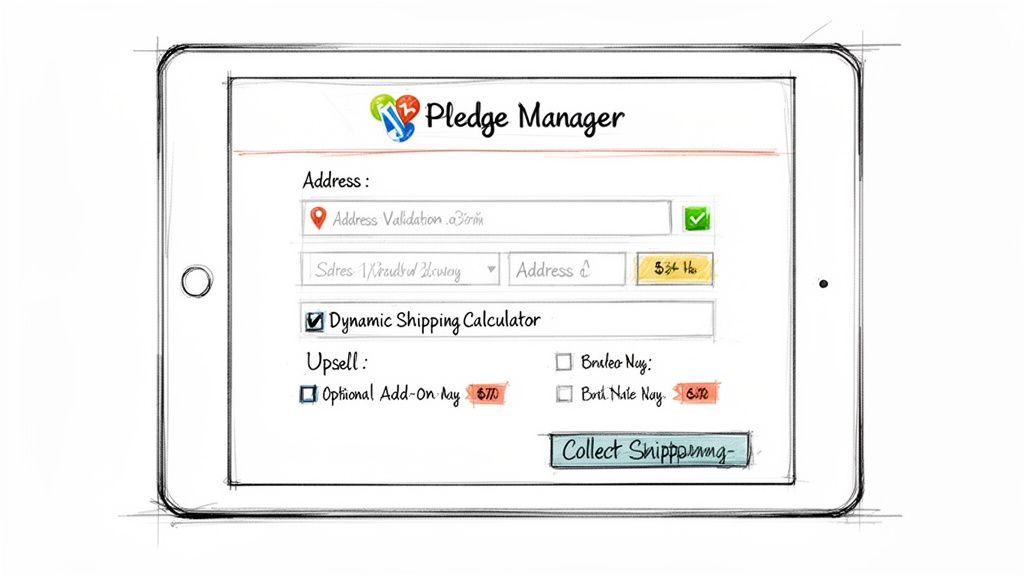
This is where a dedicated pledge manager becomes your most valuable asset. Platforms like PledgeBox are designed specifically to handle the headaches of post-campaign management. They let you send out detailed, branded surveys where backers can confirm their rewards, finalize their shipping addresses, and pay the precise shipping cost for their specific location.
But a modern pledge manager does so much more than just logistics. It can actually become a powerful new revenue stream for your project.
Think of the pledge manager survey as one last, exclusive chance for your most enthusiastic supporters to get more from your project. By offering compelling add-ons, you're not just covering shipping; you're actively increasing your campaign's total funds raised.
PledgeBox is built for this, allowing you to create an upsell flow directly inside the survey. Backers can easily add extra items, upgrade their pledge tier, or grab exclusive accessories they might have missed. This turns a simple administrative task into a strategic opportunity to boost your bottom line long after the funding clock has stopped.
To really get the value, it helps to compare the native Kickstarter survey tool to something like PledgeBox. Think of Kickstarter’s pledge manager as Amazon—it’s a huge, one-size-fits-all marketplace. It works for basic transactions but lacks the deep customization and control you need for complex fulfillment.
A dedicated platform like PledgeBox, on the other hand, is like your own personal Shopify store. You get complete control over the backer experience. You can customize the surveys, set complex shipping rules by country and weight, and, most importantly, create that powerful upsell sequence to generate new revenue. This level of control is essential for anyone serious about running a professional and profitable campaign.
If you're weighing your options, you can explore this detailed guide on how to select the right pledge manager for your project's needs.
Perhaps the most compelling part of this approach is the business model. PledgeBox is completely free to send the backer survey and collect all the essential information you need, like shipping addresses. This removes any financial barrier for creators who need a powerful tool but are working with a tight post-campaign budget.
The platform only charges a small 3% fee on the new funds you generate through optional upsells, if there's any. This aligns their success directly with yours. They only make money when you make extra money. This simple shift transforms the pledge manager from a necessary expense into a risk-free profit center, giving you the tools to accurately collect shipping while simultaneously growing your campaign funds.
Even the most seasoned creators get tripped up by the logistics of crowdfunding shipping. From estimating costs to picking the right tools, it's a lot to handle. We hear the same questions pop up time and time again, so we've put together some straight-up answers to clear the air.
Our goal is to give you the confidence to manage your fulfillment like a pro. Let's get into it.
In a word: no. We strongly recommend you do not include shipping fees directly in your pledge prices. It’s a huge gamble.
Shipping rates are all over the place and can swing wildly between when your campaign ends and when you’re actually ready to ship—which could be months down the line. Plus, costs are completely different from one country to the next.
Locking in a flat rate exposes your project to a massive financial hit. If carrier rates jump up (and they often do), you’re stuck covering the difference right out of your production budget. The smart move—and the industry standard—is to collect these fees after the campaign using a pledge manager. This lets you charge accurate, real-time rates based on each backer's location, protecting your project’s bottom line.
It’s easy to get these two mixed up, but they handle very different parts of the fulfillment puzzle. Think of it like this:
Basically, your pledge manager gathers and organizes all the essential data you need to give your shipping carrier so everything goes off without a hitch.
That's exactly what PledgeBox is built for. Honestly, almost no one knows their final shipping costs during a live campaign, and you aren’t expected to. The platform is designed to let you focus on getting funded first.
Later on, once your product is manufactured and you have the final, packaged item in hand, you can get precise weight and dimension measurements. You then plug that real-world data into PledgeBox to create dynamic shipping rules. When backers complete their survey, the system automatically calculates the exact shipping fee for their specific order and location. No more dangerous guesswork.
It really comes down to our business model and philosophy. You can think of the Kickstarter pledge manager as being like Amazon—it’s a massive, built-in marketplace that offers a single, standardized solution. In contrast, PledgeBox is like Shopify; it gives you your own dedicated, customizable post-campaign storefront, giving you way more flexibility and control.
We believe that essential tools should be available to every creator. That’s why PledgeBox is free to send your backer surveys and collect addresses. We only make money when you make money, so we only charge 3% on any funds you raise through upsells, if there's any. This approach turns a logistical tool into a risk-free way to boost your overall revenue.
Ready to take control of your post-campaign fulfillment and protect your profits? With PledgeBox, you can send branded surveys, collect accurate shipping fees, and generate extra revenue through powerful upsell features. Get started for free and see why over 8,000 creators trust us to streamline their success. Learn more at https://www.pledgebox.com.
PledgeBox
The All-in-One Toolkit to Launch, Manage & Scale Your Kickstarter / Indiegogo Campaign