 PledgeBox
Funding for Apps: Your 2026 Playbook for Success
Secure funding for apps with this step-by-step playbook. Explore bootstrapping, VCs, grants, and crowdfunding to find the right path for your project.
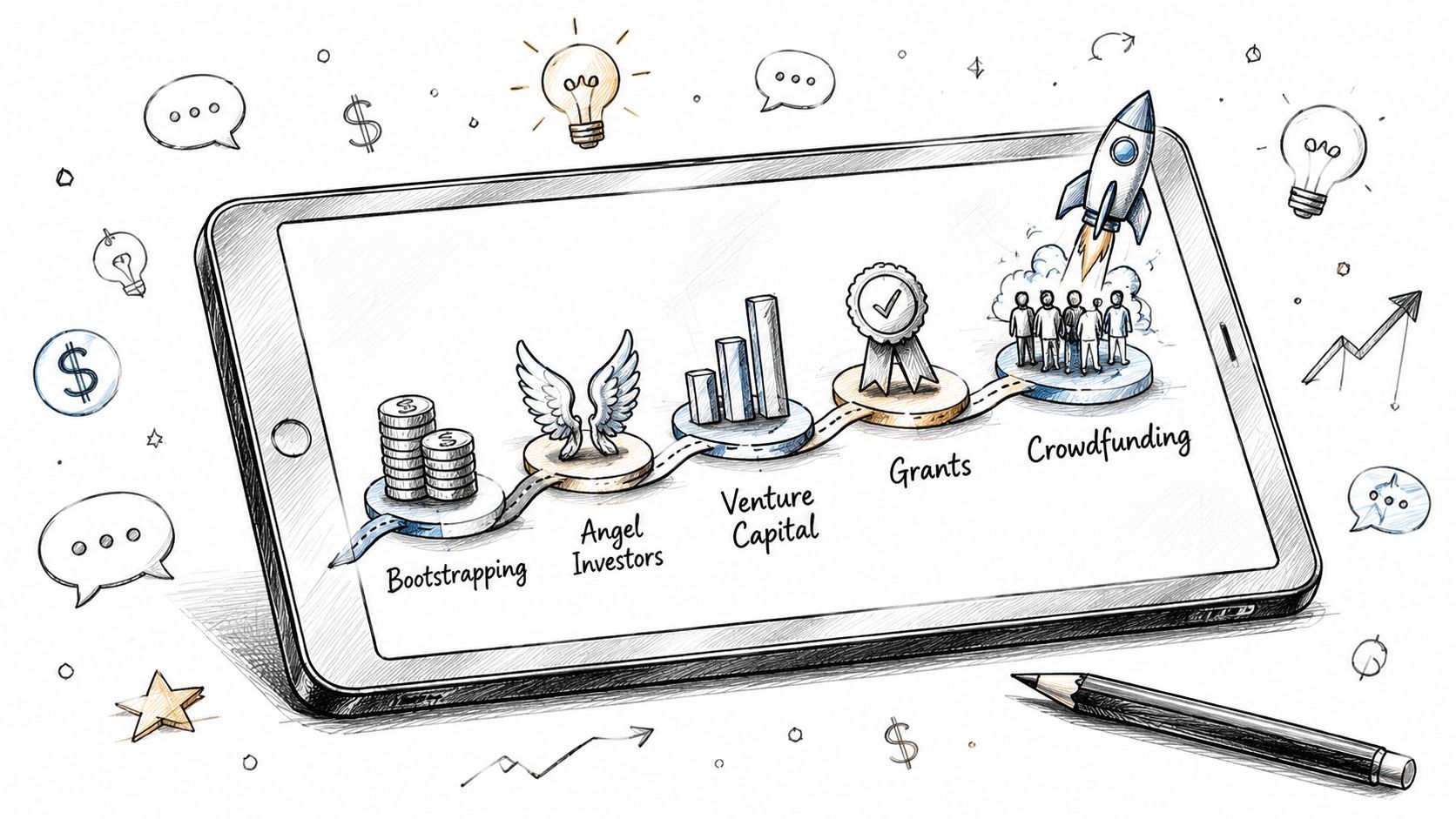
Secure funding for apps with this step-by-step playbook. Explore bootstrapping, VCs, grants, and crowdfunding to find the right path for your project.
You've built the app, tested the flows, fixed the onboarding bugs, and maybe even got a handful of early users to say they'd pay for it. Then a significant problem emerges. Development still costs money, launch costs more, and growth can burn cash faster than most first-time founders expect.
That's where most advice gets unhelpful. It jumps straight to venture capital, or it treats grants like a universal answer. For many app creators, especially those building digital-only products, the better question is simpler: which funding path fits the product, the audience, and your current stage?
Most app founders don't fail because they lacked ideas. They stall because they underestimated the cost of getting distribution after the build is done. In 2025, global app marketing spend hit $109 billion, with user acquisition alone costing $78 billion, and remarketing spend grew 37% year over year according to AppsFlyer's top data trends report. That doesn't mean your app needs a giant budget on day one. It means competing for attention is expensive, and funding for apps has to cover more than coding.

A lot of founders make the same mistake. They think funding is a single event. It isn't. It's a chain of decisions: how you finance the build, how you launch without wasting budget, how you validate demand, and how you keep users engaged after the first install.
If you're planning seriously, the money usually goes into a mix of:
That's why broad startup advice often misses the mark for app teams. The better lens is to look at funding as staged capital. You don't need every dollar at once. You need the right money for the next milestone.
Practical rule: Raise for the next proof point, not for an abstract future. An app with a working demo and a waitlist needs different funding than an app trying to scale paid acquisition.
If you want a broader view of non-crowdfunding options, this guide to startup funding for founders in 2026 is useful because it frames the common paths in plain language. If you're specifically weighing whether crowdfunding belongs in your stack, PledgeBox also has a practical article on raising money for a business that helps place crowdfunding alongside more traditional routes.
Founders often approach funding for apps with a builder's mindset. Ship fast, iterate, keep pushing. That works in product. It works poorly in fundraising.
The teams that move cleanly through funding usually do three things well. They choose a path that matches their current stage, prepare materials before asking for money, and treat post-funding execution as part of the plan rather than cleanup work. That's the difference between getting funded and building a durable app business.
No single funding route is right for every app. A meditation app with an email audience can use crowdfunding very differently from an enterprise AI tool chasing large contracts. You need to weigh capital, control, timing, and the kind of pressure each funding source adds to the business.

Capital is also moving unevenly. Global fintech funding dropped 53% in 2023, while AI is projected to grow at an annual rate of 37.3% from 2023 to 2030, and Agtech & New Food saw a 128% funding increase between 2021 and 2022 based on 42Workspace's funding statistics roundup. The takeaway isn't that you should pivot randomly. It's that investors and institutions aren't funding “apps” as a generic category. They're funding narratives tied to verticals, timing, and defensible demand.
| Funding Path | Typical Amount | Control Kept | Speed | Difficulty |
|---|---|---|---|---|
| Bootstrapping | Low to moderate | High | Moderate to slow | High personal strain |
| Angel investors | Moderate | Medium | Moderate | Relationship-driven |
| Venture capital | High | Lower | Slow at first, then fast if closed | Very high |
| Grants | Varies by program | High | Slow | High compliance burden |
| Accelerators | Moderate plus support | Medium | Structured | Competitive |
| Crowdfunding | Varies by audience demand | High | Fast if audience is warm | Heavy prep and execution |
Bootstrapping works well when you can build lean, charge early, and avoid large fixed costs. It preserves control. It also forces discipline. The downside is time. If your app needs a long development cycle or a major launch push, self-funding can drag the business into a slow crawl.
Angel money is often a fit when you need enough capital to hire, polish, and launch, but you're not ready for institutional venture expectations. The best angels bring operator judgment. The worst add noise and vague advice without helping on distribution.
Venture capital makes sense when the market is large, the category is competitive, and speed matters. It's usually a bad fit for lifestyle apps, narrow niche tools, or businesses that can become profitable without blitzscaling. VC money buys time and acceleration, but it also changes the company you're building.
Grants are attractive because they usually let you keep ownership. They're strongest when your app overlaps with research, public benefit, education, health, or a defined innovation mandate. They're weak if you need fast money or if your product doesn't align tightly with the call.
Accelerators sit in the middle. You get some capital, some structure, and often useful introductions. But they aren't magic. The value depends heavily on the operator network and the relevance of the cohort.
Crowdfunding is the most overlooked path for digital apps. It doesn't just raise money. It tests demand, builds a first customer community, and forces clear positioning. That matters when your app is easier to explain to users than to investors.
Crowdfunding is often the better first funding move when the audience already understands the pain point, even if investors don't.
Use this lens before choosing your path:
For many founders, the smartest answer isn't one path. It's sequencing. Bootstrap the prototype, crowdfund the launch, then use that traction to approach angels or grants from a stronger position.
A weak funding package doesn't fail because the founder lacks passion. It fails because the materials don't match the decision-maker. For grants especially, rejection rates often reach 80 to 90% because of poor alignment, and strong applications verify fit, use the funder's terminology, include pilot data, and justify every budget line, as outlined in this practical grant guidance article on PMC.
That lesson applies far beyond grants. Investors, accelerator reviewers, and crowdfunding backers all want the same basic answer: does this team understand the problem, the buyer, and the path to delivery?
Most app founders need four core assets before they start asking for money.
A pitch deck with a clear argument
Don't build a deck as a design exercise. Build it as a decision document. A strong deck shows the problem, your product, why now, who it's for, how you'll reach users, and what the funding enables.
A working prototype or MVP
Screenshots aren't enough unless the app is extremely simple. You need something people can click, use, or at least watch in a realistic flow. This lowers perceived risk.
A pre-launch page
If nobody joins your waitlist, funding gets harder. A landing page gives you a place to test messaging and collect intent before you spend money on a full launch.
A budget with logic
Every serious funder wants to know where the money goes. You don't need a giant spreadsheet. You do need line-item reasoning.
Here's the standard I use when reviewing a founder's materials:
For consultants helping technical founders package this material, adjacent operational work matters too. Teams that claim innovation incentives or tax credits often benefit from cleaner documentation and advisor workflows, which is why tools focused on streamlining R&D claims for advisors can be useful in the wider financing stack.
The mistake I see most often is reusing the same materials everywhere.
| Funding Type | What gets attention | What gets ignored |
|---|---|---|
| Angel | Founder credibility, market insight, clear wedge | Overbuilt slide design |
| VC | Market size story, speed, repeatable growth path | Small lifestyle outcomes |
| Grant | Fit, compliance, methodology, budget clarity | Hype language |
| Crowdfunding | Emotional story, usability, reward logic, trust | Investor jargon |
Field note: If a creator can't explain the app in one sentence to a stranger, the deck isn't the problem. The positioning is.
You can review options for pledge manager workflows early, even before launch, because the structure of your rewards and surveys affects how you present the campaign from day one.
Most guides on funding for apps still act like crowdfunding is mainly for gadgets. That leaves digital creators underprepared. Yet digital app crowdfunding campaigns grew 18% in 2024 but received only 3% of funding how-to content, which is why many founders never learn how to structure digital rewards or use pledge managers to generate 25 to 30% incremental revenue after the main campaign.

A digital app campaign lives or dies on clarity. Backers can't hold the product in their hands, so your job is to make the value immediate. They need to understand what the app does, who it's for, why it's different, and what they get by backing early.
Crowdfunding doesn't create demand from nothing. It concentrates demand you've already collected.
Focus your pre-launch work on three channels:
Don't wait until launch week to write your story. Your campaign page should answer five practical questions: what the app does, why it matters now, what stage the product is in, what backers receive, and when they should expect delivery.
A platform comparison can help if you haven't chosen a home yet. This breakdown of Indiegogo vs Kickstarter is useful when you're deciding how your app's audience and reward model fit the platform.
Digital-only app campaigns need reward tiers that feel concrete. “Support us” is rarely enough.
Good tiers often include:
The key is to avoid reward sprawl. A few well-defined tiers beat a cluttered pricing ladder.
Here's a short explainer that aligns with that planning process:
Once you go live, the campaign becomes an operating system. You need daily attention.
What doesn't work is treating the campaign page as a static brochure. Backers fund creators who look responsive and capable of shipping.
Launch day matters, but the middle of the campaign is where discipline shows. Teams that keep communicating usually outperform teams that disappear and return at the end.
Three mistakes show up constantly in digital campaigns.
First, they pitch features instead of outcomes. Users don't back “AI scheduling logic.” They back “less time wasted managing meetings.”
Second, they under-explain delivery. For digital products, delivery sounds easy, so founders get vague. That creates distrust. Spell out access timing, platform support, and what happens after the campaign closes.
Third, they ignore post-campaign monetization. If you build your campaign with no plan for surveys, add-ons, late backers, or ongoing communication, you leave money and goodwill on the table.
A funded campaign isn't the finish line. It's where operational mistakes start getting expensive. This is especially true for app creators who assume that because the product is digital, fulfillment will be simple. It usually isn't.

According to internal PledgeBox data, 70% of Kickstarter creators say fulfillment is their biggest post-campaign challenge, and 40% of digital app campaigns in 2024 failed after funding because global VAT and tax liabilities weren't managed properly. That tracks with what experienced campaign operators already know. The campaign can succeed publicly and still break privately if surveys, taxes, upgrades, and delivery flows are messy.
Founders often treat the backer survey like a simple form. It's not. It's your handoff from campaign promise to actual delivery.
A good survey process does four jobs:
The right tooling is essential. The basic Kickstarter pledge manager is like Amazon. It's standardized and limited. PledgeBox is more like Shopify, because it gives creators a customizable backend for surveys, add-ons, tax handling, and backer management. The pricing model is also straightforward: it's free to send the backer survey, and it only charges 3% of upsell revenue if there is any. You don't pay that fee on the money you already raised in the campaign.
Digital creators often assume upsells are mainly for hardware extras. That's too narrow. For apps, post-campaign offers can include premium access, additional seats, coaching, community tiers, template packs, education bundles, or annual plan upgrades.
The practical upside is bigger than revenue alone. Upsells let you segment your backers by intent. Some people want the base app. Others want deeper access or ongoing support. Handling that after the campaign is cleaner than cramming too many choices into the live reward page.
The best post-campaign flow feels like account setup, not damage control.
If I'm reviewing a campaign after funding, these are the first places I look for risk:
| Area | What to confirm |
|---|---|
| Surveys | Backer choices are clear, editable, and exportable |
| Tax handling | VAT or sales tax treatment is defined before collection |
| Access delivery | Codes, onboarding emails, and account creation are mapped |
| Add-ons | Upsells match the original promise and don't confuse fulfillment |
| Support | Backers know where to ask questions and when to expect replies |
A lot of solo founders discover too late that they built a campaign, not an operation. That's why creators benefit from studying operators who build systems around products. This piece on Pieter Levels' story of growth is a good reminder that simple products still need strong backend processes to scale cleanly.
Your backers are not just funders. They're your first retained audience.
Use post-campaign communication to:
What doesn't work is going dark while you “focus on building.” Backers interpret silence as slippage. Consistent communication buys patience and keeps the community warm for the next launch.
Funding for apps works best when you stop thinking about it as a search for money and start treating it as a system. The build phase needs one kind of support. Launch needs another. Post-campaign operations need their own process. Founders who connect those stages make better decisions than founders who treat funding like a one-time event.
The strongest path is usually the one that matches your current proof, not your eventual ambition. If you're early, clarity and validation matter more than scale. If you already have demand, speed and execution matter more than theory. If you crowdfund, a true test isn't just whether people pledge. It's whether you can convert that attention into delivery, retention, and repeatable growth.
A practical app funding stack usually has these qualities:
That's why crowdfunding deserves more serious consideration from digital app creators than it usually gets. It can fund development, validate positioning, build a customer base, and create a repeatable launch playbook. But it only works when the campaign and the follow-through are designed together.
Backers don't just fund an app idea. They fund a team's ability to deliver confidence at every step.
The creators who do this well tend to be boring in the right ways. They prep earlier, define rewards more carefully, write clearer updates, and handle post-campaign details before they become problems. That discipline is what turns a funded launch into an actual business.
If you're planning a Kickstarter or Indiegogo launch for a digital app, PledgeBox is worth evaluating as part of the operational stack. It supports pre-launch and post-campaign workflows, and its pledge manager model is simple: sending the backer survey is free, and the platform only charges 3% on new upsell revenue if you generate any.
PledgeBox
The All-in-One Toolkit to Launch, Manage & Scale Your Kickstarter / Indiegogo Campaign