 PledgeBox
8 Email Marketing Examples Every Crowdfunding Creator Needs
Real email marketing examples for Kickstarter creators, with templates and copy for welcome, upsell, survey, and shipping emails that drive backer revenue.
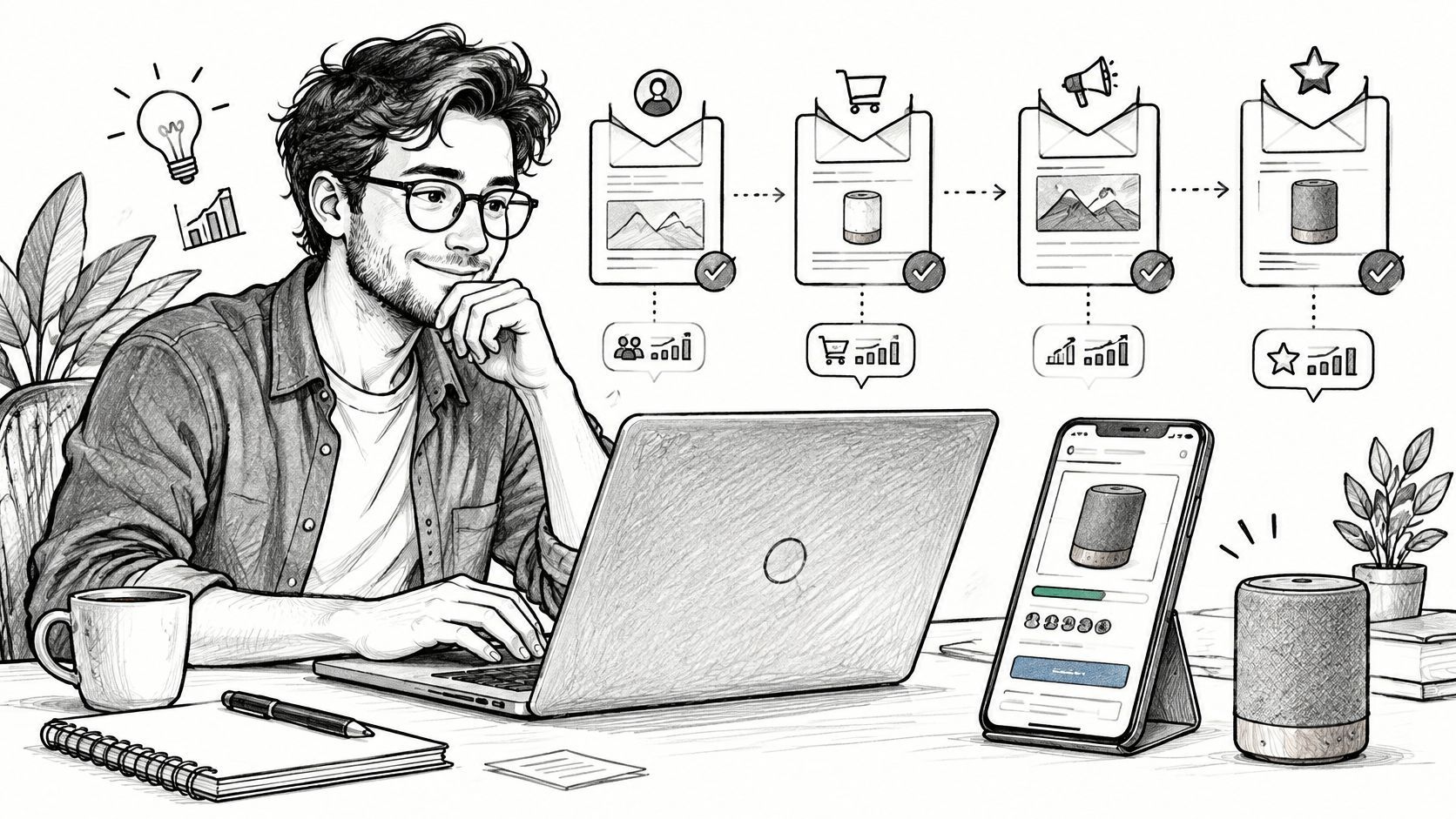
Real email marketing examples for Kickstarter creators, with templates and copy for welcome, upsell, survey, and shipping emails that drive backer revenue.
Email doesn't need a spectacular design to generate a serious return. In its 2019 survey of UK marketers, the Data & Marketing Association's Marketer Email Tracker reported an estimated £42.24 returned for every £1 spent on email. That's a historical, cross-industry benchmark, not a promise for your Kickstarter campaign, but it's a strong reason to treat your subscriber list as a business asset.
For crowdfunding creators, email connects decisions that otherwise happen in separate places: discovering the product, choosing a reward, confirming an address, adding an accessory, and receiving a shipment. A subscriber who needs convincing before launch needs very different information from a backer waiting for a delayed production batch.
The useful email marketing examples aren't just attractive screenshots. They show who should receive the message, why it matters now, and what happens after the click.
These examples pair practical strategy with reusable copy. Adapt the placeholders to your campaign, and only include deadlines, availability claims, and delivery estimates your team can support.
A waitlist subscriber hasn't committed to backing your project. They've agreed to hear more, so start by delivering the information your signup page promised rather than immediately asking them to recruit friends.
For a tabletop campaign, that might mean showing how a turn works before introducing expansion artwork. For a hardware launch, demonstrate the problem your prototype solves before explaining its specifications.
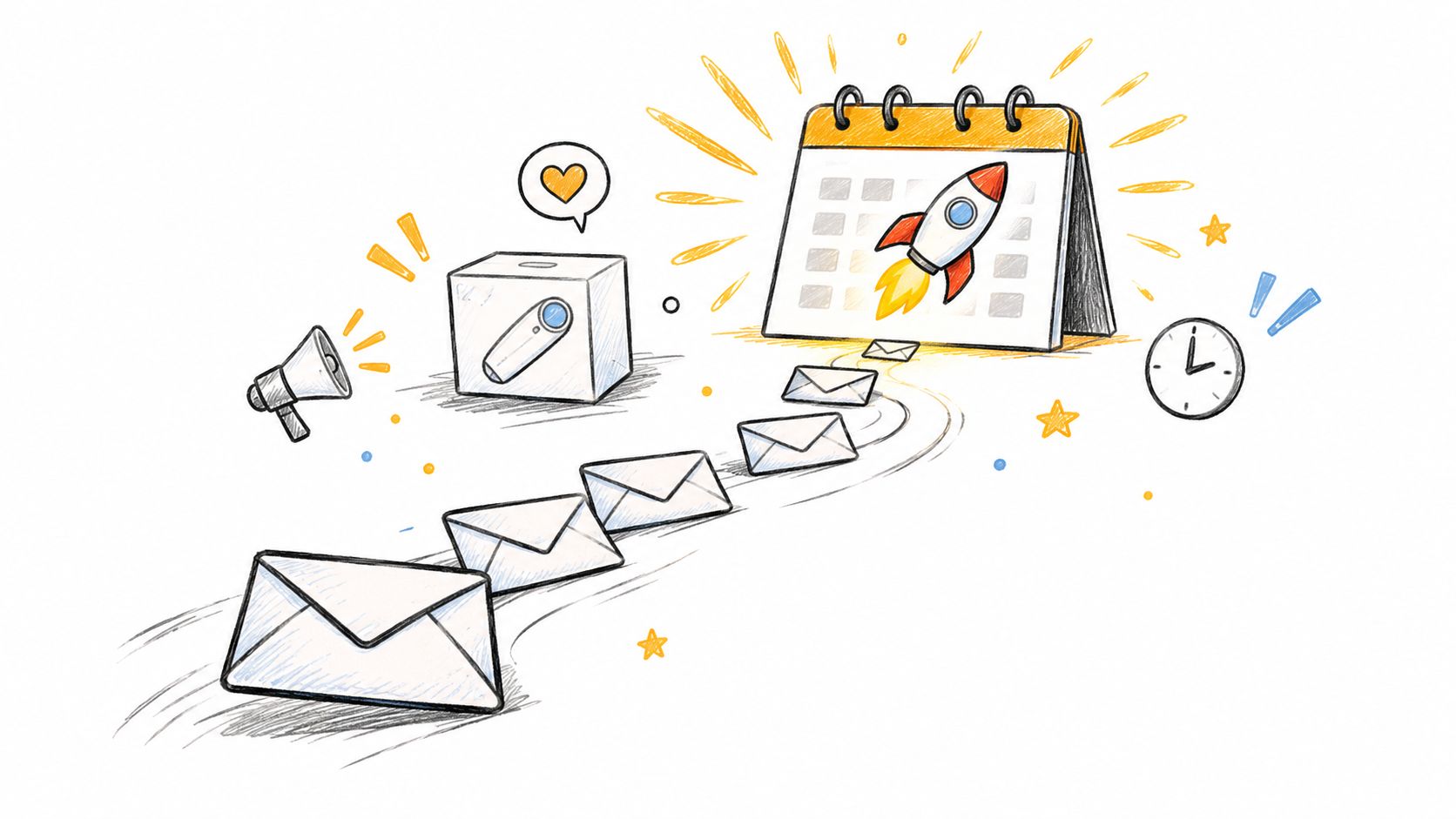
Send a welcome message that confirms what subscribers will receive. Follow with the origin story, a product demonstration, and a launch reminder, adjusting the spacing to your actual development schedule.
Preference gathering belongs here, but keep it lightweight. Knak's coverage of email marketing trends identifies zero-party data, information people intentionally share, as a useful foundation for personalization when tracking signals become less dependable.
Ask which reward interests them or which product problem matters most. Don't collect a shipping address before you need it, and don't turn a simple signup into an application form.
Copy to adapt
Subject: See how [product] handles [specific problem]
You joined because you're interested in [benefit]. This demonstration shows how our prototype handles [real situation], including what we're still improving.
Which matters more to you: [feature] or [alternative feature]? Reply with your preference so we can make future updates more useful.
Watch the product demonstration: [destination]
Why it works: The message gives subscribers something concrete to evaluate and invites a meaningful reply. Save the sharing request for a message that already contains something worth passing along, such as a useful demonstration or playable preview.
Launch day is a decision moment, not the time to repeat your entire development story. Subscribers who've followed the prelaunch sequence need confirmation that the campaign is live, a clear reason to act, and a working route to the reward.
A MarketingSherpa lending-platform case study reported that replacing an educational email with a flyer-style layout increased click-through rate from 2% to 4.3%. That's not a crowdfunding result, but it supports a useful test: when readers understand the offer, a compact message may serve them better than another long explanation.
For a portable projector campaign, lead with the product benefit and the available launch reward. Include an early-bird deadline only if it's genuine, and state the applicable time zone.
Copy to adapt
Subject: [Product] is live on Kickstarter
Our campaign is live. [Product] helps you [specific benefit] without [familiar frustration].
The launch reward includes [contents]. If you've been waiting to join us, you can review the demonstration, estimated delivery schedule, and reward details on the campaign page.
Back [product] on Kickstarter: [campaign destination]
Before sending, test the destination on mobile and confirm the advertised reward is available. Keep the subject readable rather than overstyled; this guide to email subject line capitalization offers useful considerations for keeping presentation consistent.
Launch-day rule: Don't make readers search through your backstory to find the campaign link.
For reminders, prioritize subscribers who haven't pledged rather than assuming an apparent non-open means they missed the message. Suppress confirmed backers so your launch announcement doesn't become an irrelevant sales loop.
A production update should answer the question a backer is already asking: What changed, and what does it mean for my reward? Celebration alone won't answer it.
Say your hardware supplier rejects an enclosure sample. Backers need to know what failed, what your team is doing, and whether the shipping estimate has changed, not just that you're working hard behind the scenes.
Use a predictable publishing schedule your team can maintain. If you don't have a milestone to announce, explain the work underway and the next decision instead of manufacturing excitement.
Copy to adapt
Subject: Production update: [milestone] approved, [issue] under review
We've approved [completed component or process]. During testing, we found [specific issue], and our manufacturing partner is preparing [corrective action].
Our current delivery estimate is [window]. [Explain whether that estimate has changed and what remains uncertain.]
You don't need to change your reward selection. We'll publish the next update after [decision or test], and you can send questions to [support contact].
Why it works: The copy separates facts, uncertainty, and action. Backers can understand the situation without interpreting factory terminology or searching a comment thread.
A tabletop publisher can use the same structure for proof approval, freight booking, or regional fulfillment. Include a production photograph when it explains something, but caption what readers should notice.
An honest update can contain uncertainty. It shouldn't contain ambiguity about what you know and what you're still checking.
Measure recurring support questions alongside engagement. If readers keep asking whether their delivery window changed, revise the update format before experimenting with subject lines.
Your survey invitation is an operational email. Its job is to help backers submit accurate choices, not distract them with every product you could sell.
Before invitations go out, configure products, variants, reward mapping, shipping, tax, and payment settings. Preview the backer experience and resolve blocking setup messages so the email leads to a usable survey rather than an unfinished checkout.
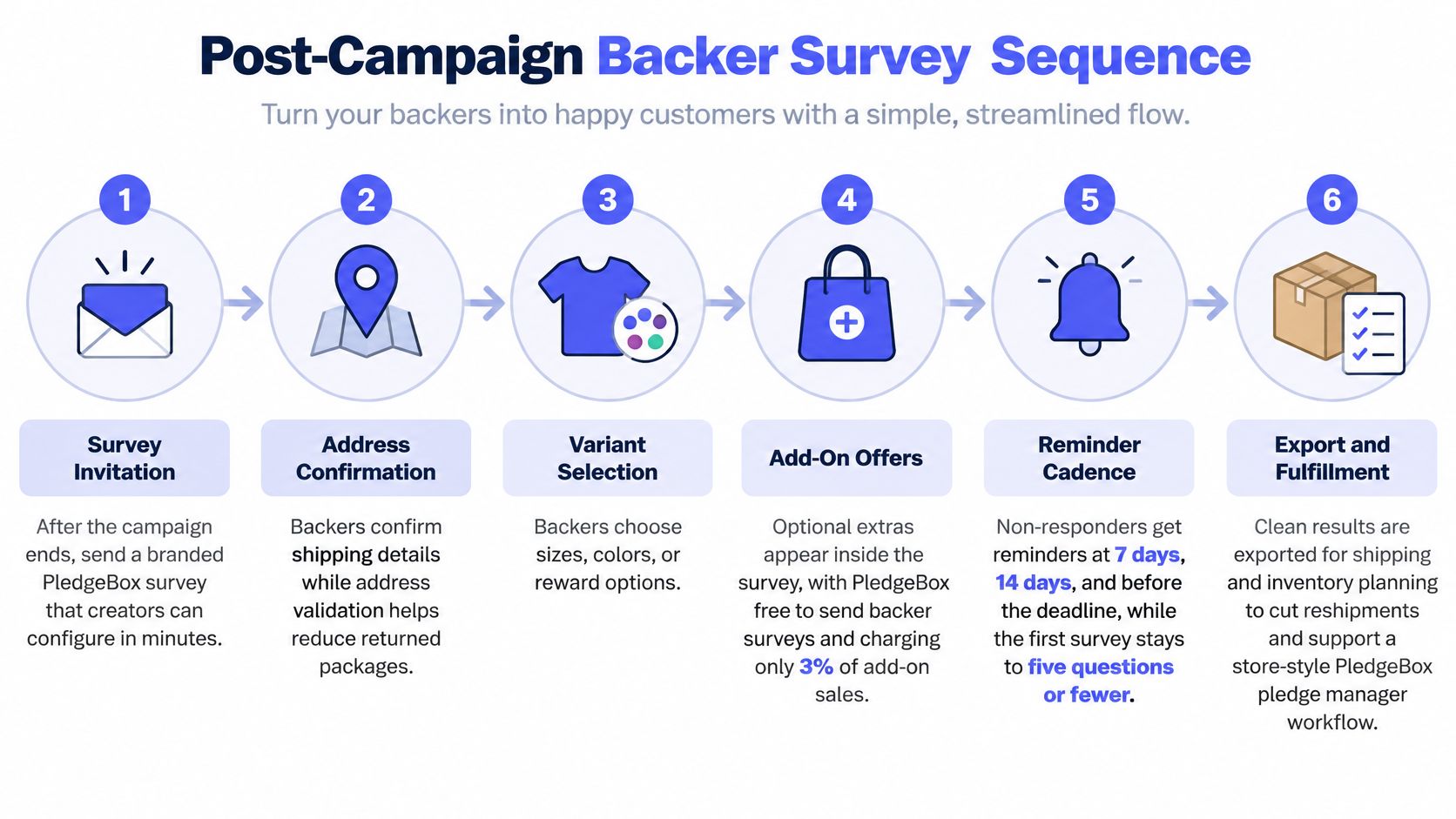
For a board game campaign, the survey might confirm language edition, selected expansions, and delivery details. Keep required fulfillment choices distinct from optional purchases, and explain any shipping or tax payment before backers encounter it.
Copy to adapt
Subject: Confirm your [campaign] reward details
Your reward survey is ready. Please confirm [required choices] and your delivery information so we can prepare the correct reward.
[Explain any shipping or tax payment, or state that this survey only collects information.]
Complete your survey by [actual deadline]: [personal survey destination]. You can change [editable details] until [lock condition]. If something looks wrong, contact [support contact] before submitting.
Use the guide to sending backer surveys to organize the invitation workflow. Send follow-ups to backers with incomplete surveys, and stop reminders once their required information is submitted.
The trade-off: A short survey is easier to complete, but removing necessary questions creates fulfillment problems later. Ask for every detail needed to assign the correct product, and remove questions that won't change an operational decision.
Separate the completion deadline from the address-lock date if they differ. A backer who submits a reward choice now may still need to update an address before shipping.
An accessory sells best when the backer can immediately explain why they need it. A protective case for a portable gadget has an obvious use; an unrelated product bundle needs more justification.
Creative can help communicate that value. In a controlled template test reported by MarketingSherpa, adding brand-specific banners produced an 18.25% increase in revenue per mailing. Treat that as a reason to test relevant visuals, not proof that every upsell email needs a large banner.
For a tabletop project, send an expansion offer to backers whose base game supports it. Exclude anyone who already selected the expansion, and explain whether it changes packing, shipping, or delivery timing.
Copy to adapt
Subject: Add [accessory] to your [product] reward
If you plan to use [product] for [situation], [accessory] adds [specific practical benefit]. It works with your selected [reward or model].
Your additional cost is [amount], including [applicable shipping and taxes]. [Explain any costs that depend on destination and where the final total appears.]
Review the optional add-on before [real cutoff]: [survey destination]. Your original reward remains unchanged if you skip it.
The post-campaign upselling guide can help you plan where these offers fit.
Evaluate additional revenue after product and fulfillment costs, not just clicks. An offer that raises order value but creates expensive split shipments may be less useful than a simpler accessory with predictable handling.
Someone who missed your campaign deadline doesn't necessarily need a discount. They may need reassurance about what's available, how ordering works, and when late orders are expected to ship.
Send this message to subscribers who agreed to relevant campaign communications and haven't already pledged. Don't treat an email open as reliable proof that someone intends to purchase.
For a hardware launch, a late-order email should clarify whether buyers join the existing production batch or a later allocation. For a board game, explain whether campaign-exclusive items are included or unavailable.
Copy to adapt
Subject: Missed [campaign]? Late orders are open
You can now reserve [product] through our late-order page. This offer includes [contents] and differs from the original campaign reward in [price, extras, or availability].
The estimated shipping window for late orders is [window]. [Explain the production status and any important uncertainty.]
Review the late-order details: [destination]. Orders close when [genuine date or production condition].
Why it works: The message answers the fairness question before readers ask it. Original backers shouldn't discover that late buyers received a better package, and late buyers shouldn't have to guess which benefits they missed.
Don't call something remaining stock if it hasn't been manufactured. A reservation for a future production run needs different expectations.
Keep recovery messages distinct from transaction reminders. Someone who abandoned a checkout may need payment help; someone who never chose a reward may need a comparison or demonstration.
Measure completed late orders, cancellations, and support questions about delivery. If the email generates purchases but leaves buyers confused about their batch, rewrite the fulfillment explanation before sending another promotion.
Would a backer feel comfortable forwarding your email without rewriting it? That's a better starting point for a referral program than choosing a prize.
A referral request needs a clear audience, an easy sharing method, and honest terms. If backers earn a reward, explain what counts as a qualifying referral and how you'll confirm it.
For a tabletop campaign, downloadable bonus content may be easier to fulfill than an extra physical component. A hardware creator might offer access to a development session rather than adding another item to every parcel.
Copy to adapt
Subject: Know someone who'd enjoy [product]?
If you know someone who [specific interest or problem], they might enjoy our campaign. This short demonstration explains [distinctive benefit] without needing any background.
Share your referral destination: [personal referral destination]. If a qualifying referral completes [required action], you'll receive [reward], subject to [clear conditions].
Optional text to copy: I'm backing [product], a [plain description] designed for [use case]. The campaign page shows how it works and what's included.
That suggested message should sound like a recommendation, not an advertisement disguised as a personal endorsement. Keep it editable, and don't pressure subscribers to upload their contacts.
The trade-off: Rewards can attract people who care more about the incentive than the project. Track referred pledges and retained subscribers rather than treating every shared destination or signup as equally valuable.
If attribution can't reliably connect the referral to the qualifying action, fix that before promising rewards.
A shipping email should work even when the product photograph doesn't load. Tracking details, delivery estimates, and support instructions belong in live text, not inside a decorative image.
Stripo's guidance on email accessibility in production highlights persistent accessibility problems and the limitations of image-heavy messages. Use semantic headings, descriptive link labels, sufficient contrast, and meaningful alt text so the message remains understandable across reading conditions.
For a board game shipping in regional waves, send notifications based on each backer's actual fulfillment status. Don't tell the entire list that rewards have shipped when only a particular warehouse has begun dispatching.
Copy to adapt
Subject: Your [campaign] reward has shipped
Your parcel containing [reward summary] has been handed to [carrier]. Your tracking reference is [reference], and the current estimated delivery window is [window].
Track your shipment: [tracking destination]. If tracking hasn't updated or your parcel arrives damaged, contact [support contact] with your backer reference and a description of the problem.
[Include any relevant regional delivery instructions or customs information.]
Only use that wording after a genuine carrier handoff. If you've merely created a label, say the parcel is being prepared and explain when tracking should become available.
The shipment-tracking guide can help you organize the handoff between fulfillment records and backer communications.
Why it works: The backer can identify the shipment, check its status, and get help without replying to a general campaign announcement. After delivery, send setup guidance or a feedback request, but suppress promotional follow-ups when a backer has an unresolved shipping problem.
| Email Type | Campaign Stage | Primary Goal | Best Cadence |
|---|---|---|---|
| Prelaunch Waitlist Nurture Sequence | Before launch | Build anticipation and turn subscribers into launch-day backers | 4–6 emails over 2–6 weeks |
| Launch-Day Announcement Blast | Campaign launch | Drive immediate pledges with a direct call to action | Send at launch; follow up within 24–72 hours |
| Backer Update Cadence | During campaign and production | Build trust and keep backers informed | Every 1–3 weeks during production |
| Post-Campaign Backer Survey Sequence | After campaign | Collect accurate shipping, reward, and add-on details | Initial survey, then reminders at 7 and 14 days and before the deadline |
| Add-On Upsell Email Series | During or after campaign | Increase revenue through relevant add-on purchases | Occasional, targeted offers with a clear deadline |
| Late Pledge and Pre-Order Recovery Emails | After campaign | Recover sales from interested non-backers | A limited offer with reminders tied to shipping timelines |
| Referral and Share Program | Before and during campaign | Grow the audience through subscriber and backer referrals | Send milestone-based prompts and progress updates |
| Shipping and Fulfillment Tracking Notifications | Fulfillment and delivery | Keep backers informed and reduce order-status inquiries | At packing, shipping, delivery, and significant delays |
The best email marketing examples share a practical discipline: send the message that fits the backer's current situation. A launch reminder doesn't belong in the inbox of someone who already pledged, and an add-on promotion shouldn't obscure an urgent address correction.
Build your system around lifecycle status rather than a calendar of broadcasts. Maintain clear records for subscribers, confirmed backers, incomplete surveys, completed orders, and fulfillment exceptions.
Choose the primary outcome before writing the subject line. Depending on the message, that might be a completed pledge, a submitted survey, an additional purchase, or fewer unresolved delivery questions.
Test a meaningful variable and keep the comparison interpretable. If you change the audience, offer, layout, and deadline together, you won't know which change mattered. Small lists also require restraint: a handful of purchases isn't a dependable basis for declaring a permanent winner.
For tooling, our PledgeBox InBox email marketing tool includes a drag-and-drop builder that requires no HTML coding and tracks clicks, conversions, and engagement. PledgeBox is free to send the backer survey and only charges 3% of upsell revenue if there's any, with the important qualification that its pricing policy applies the platform fee to additional survey-collected payments, including upgrades, shipping, taxes, and VAT, not the original campaign pledge.
For workflow purposes, Kickstarter's pledge manager is like Amazon, while PledgeBox's pledge manager is like Shopify. The comparison describes an integrated marketplace checkout versus a creator-managed, branded post-campaign operation, not identical features or policies.
Start with the message your campaign needs next. Assign an owner, confirm the destination works, define who must be excluded, and decide what successful completion looks like before scheduling the send.
PledgeBox brings email marketing, branded backer surveys, add-on offers, and fulfillment tools into a connected crowdfunding workflow. Visit PledgeBox to plan your next lifecycle email and connect it to the survey, purchase, or shipping action your backers need to complete.
PledgeBox
The All-in-One Toolkit to Launch, Manage & Scale Your Kickstarter / Indiegogo Campaign