 PledgeBox
Mastering Board Game Shipping for Your Kickstarter
A practical guide to board game shipping for Kickstarter creators. Learn how to calculate costs, choose partners, and master fulfillment without the headaches.
A practical guide to board game shipping for Kickstarter creators. Learn how to calculate costs, choose partners, and master fulfillment without the headaches.
Alright, let's talk about the final boss of your crowdfunding campaign: board game shipping. This is the stage where so many otherwise brilliant projects take a nosedive. Get it wrong, and you can watch your profits evaporate and your reputation crumble. Shipping isn't just about putting games in boxes; it's about protecting your brand and securing the future of your studio.
Once your campaign wraps up, a whole new set of challenges appears. Suddenly, it’s all about the logistics of getting your game from the factory into the hands of your backers. This final step, fulfillment, is what connects a successful funding round to a happy, supportive community.
Think of this guide as your roadmap for navigating the tricky parts, like surprise customs fees, miscalculated shipping costs, and the dreaded "where is my game?" emails. We'll break down everything you need to know, from understanding dimensional weight to deciding whether to ship everything yourself or team up with a pro (a 3PL).
Before we dive in, here's a quick look at the major pieces of the shipping puzzle you'll need to assemble.
This table breaks down the essential factors you need to think about before you even start packing boxes. Getting these right from the beginning will save you a world of headaches later on.
Getting a handle on these key areas is the foundation of a solid fulfillment strategy. Now, let's explore the current environment you'll be shipping in.
The world of manufacturing and shipping has been on a wild ride lately, and it's changed the game for everyone. What used to be a fairly predictable process is now full of new variables.
Disruptions in global supply chains have stretched production timelines from a few weeks to six months or more. Getting a container spot on a cargo ship isn't as simple as it used to be, and costs have fluctuated dramatically. For a successful campaign, truly mastering international supply chain management isn't just a bonus—it's essential for survival.
This is where a good pledge manager becomes your best friend. Think of Kickstarter's pledge manager like Amazon—it’s convenient and integrated, but you're stuck with its features. A dedicated platform like PledgeBox, on the other hand, is like Shopify. It gives you a ton of control and flexibility after the campaign ends.
One of the biggest wins is the cost. With PledgeBox, it's free to send the backer survey. They only charge 3% of upsells if there are any. This is huge. It means you can collect all the addresses and order details you need without spending a dime of your production funds.
By getting these pieces right—understanding the logistics landscape, picking the right pledge manager, and planning your strategy—you can turn the "final boss" of fulfillment into a victory lap. You’ll deliver for your backers and build a reputation as a creator who follows through.
Let's be blunt: guessing your shipping costs is one of the fastest ways to kill your project's budget. It's a classic rookie mistake that can turn a wildly successful campaign into a financial nightmare. Nailing down these costs before you launch isn't just a good idea—it's absolutely critical.
The first thing to understand is that shipping isn't just about weight. While the actual weight of your game matters, carriers have a sneaky little metric that can blow up your costs: dimensional (DIM) weight. This is a calculation based on how big your box is (length x width x height), not how much it weighs.
Carriers will always charge you for whichever is greater—the actual weight or the DIM weight. A big, beautiful, but lightweight game box is a perfect DIM weight trap. For a deeper dive, you can learn more about how to correctly charge for rewards shipping and sidestep these common pitfalls.
Here's a quick guide to getting your shipping estimates right.
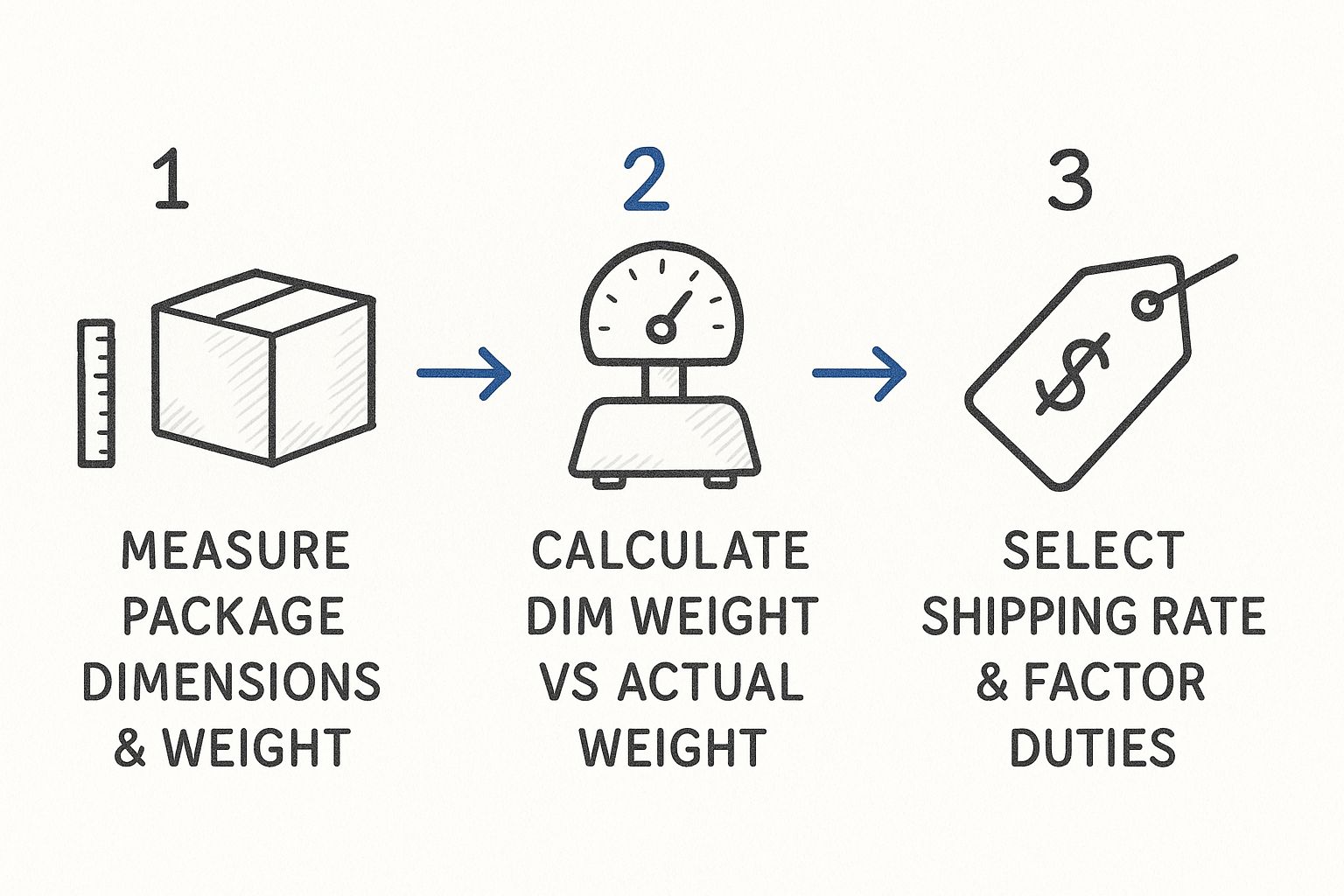
The main takeaway? Accurate measurements are everything. Every time you guess, you're introducing a massive risk to your bottom line.
To get quotes you can actually rely on, you need a near-final prototype. This means the game box, all components, and any stretch goals or add-ons you plan to offer. Don't forget to weigh the packaging materials, too—the shipping box, bubble wrap, and tape all add up.
With your final weight and dimensions in hand, you can start getting real-time rates for your key regions. For most campaigns, this means focusing on:
A few centimeters can make a shocking difference. A box that's just slightly too large can bump your package into a completely different pricing tier, multiplying your costs across thousands of backers.
For example, a game weighing 2 lbs might cost $10 to ship domestically. But if its box dimensions push the DIM weight to 5 lbs, that same shipment could suddenly cost $18. That's an 80% increase that will absolutely demolish your profit margin.
This is where a solid pledge manager becomes your best friend. Kickstarter is great for collecting pledges, but it’s not built to handle the complexities of post-campaign shipping. Using a dedicated tool lets you charge for shipping after the campaign is over, based on each backer's exact location and final order.
This is a game-changer. Think of Kickstarter's pledge manager like Amazon—it's integrated, but rigid. A tool like PledgeBox, on the other hand, is like Shopify, giving you incredible control and flexibility. You can build out precise shipping tables for every region and weight class.
Best of all, PledgeBox is free to send the backer survey. You only pay a 3% fee on upsells if there are any, not on the shipping funds you collect. This means you can gather addresses and charge accurate shipping without it cutting into your production budget. By building a realistic shipping plan and using the right tools, you can head into fulfillment with confidence instead of anxiety.
Once you’ve locked in your cost estimates, you hit a major fork in the road: how are you actually going to get your game into backers' hands? This decision really boils down to two options for your board game shipping. You can either do it all yourself (self-fulfillment) or bring in a third-party logistics (3PL) company.
The right choice depends entirely on the size and scope of your campaign.
Self-fulfillment can sound pretty good on paper, especially if you're working with just a few hundred backers. You get total control over everything—the quality of the packaging, the exact day boxes go out, the whole nine yards. But don't underestimate the grind. We're talking about storing pallets of games, buying packing supplies in bulk, spending endless hours taping up boxes, printing labels, and hauling it all to the post office. It's a massive time sink.
For the vast majority of campaigns, working with a 3PL is the smarter, more scalable play. These are the pros who specialize in storing, packing, and shipping products for businesses like yours. Yes, it adds a per-package cost, but the trade-offs are almost always worth it.
For starters, they get bulk shipping rates that are usually much better than anything you could get on your own. More importantly, they have the warehouses and staff to handle thousands of orders without breaking a sweat. This frees you up to focus on what really matters—taking care of your backers and planning your next big project.
Having a pro handle shipping also ensures your games arrive safely and look professional, which goes a long way in building trust with your community. The global board game market is exploding—it’s projected to hit $22.03 billion by 2025, with North America making up over 41% of that pie. If you want a piece of that action, you need a shipping strategy that can keep up. You can dig into more data on the growth of the board game industry on sqmagazine.co.uk.
No matter which fulfillment path you take, a solid pledge manager is non-negotiable. This is the tool that lets you collect accurate backer addresses, manage any add-ons they purchased, and charge for shipping after your campaign wraps up.
You could use Kickstarter’s pledge manager, but it's pretty basic. Think of it as the Amazon of pledge managers—simple and integrated, but not very flexible. A dedicated tool like PledgeBox, on the other hand, gives you a Shopify-like experience with far more control over the whole post-campaign process. This is absolutely critical when you're juggling the complex logistics of shipping a board game.
Here’s a peek at the PledgeBox dashboard. It gives you a single place to manage all your backers, track survey progress, and see how your upsells are doing.
This kind of centralized view is a lifesaver for tracking who has filled out their survey and how much extra you've made from add-ons. If you want to dive deeper, we have a whole guide on how to select the right pledge manager that breaks it all down.
One of the best things about PledgeBox is the pricing. It’s completely free to send the backer survey to collect addresses and lock in everyone's orders.
The platform only charges 3% of upsells if there are any—that's the extra money you make from add-ons or late pledges. This means you can manage all your core fulfillment data without dipping into your campaign funds, keeping that money safe for manufacturing and shipping.
By matching the right fulfillment partner with a powerful pledge manager, you build a smooth, professional operation. This setup not only makes your life easier but also gives your backers the fantastic delivery experience they deserve. After all, they’re the ones who believed in your game from the start.
Let's be real: your game's journey from a warehouse to a backer's front door is a rough one. Great packaging isn't just a nice-to-have; it's a non-negotiable part of your product that screams professionalism. Think of the unboxing as the grand finale of your campaign—it’s your last, best chance to deliver that "wow" moment.
A game showing up with crushed corners and dented sides isn't just a damaged product; it's a broken promise. Backers who've waited months (or longer!) feel incredibly let down. That disappointment can quickly morph a happy supporter into a vocal critic on social media, poisoning the well for your next project.
This is all about getting the practical details right so your game arrives in perfect condition, creating a memorable experience that backers will be thrilled to share.
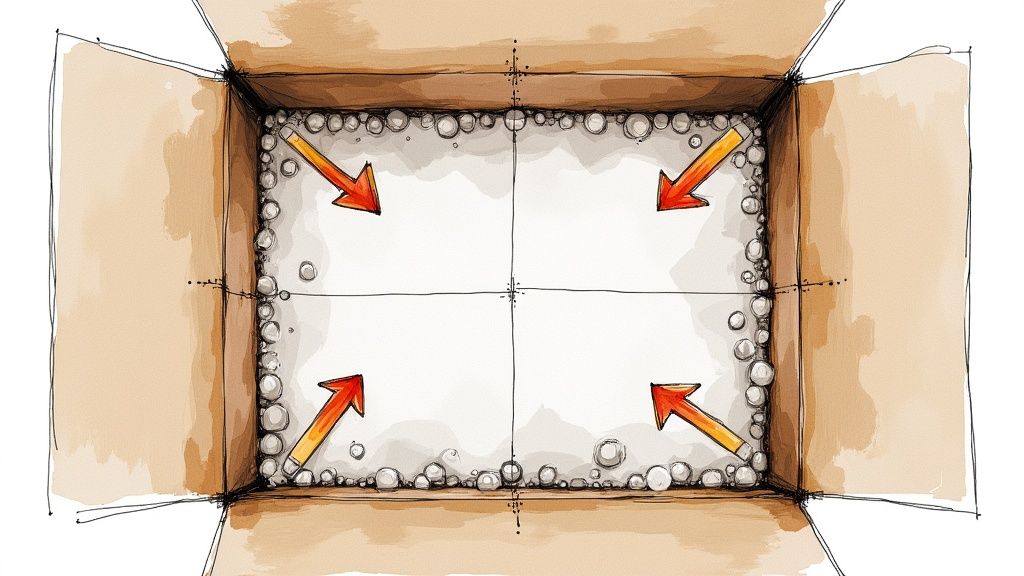
The outer box is the first line of defense. Your mission is to find a box that’s just big enough for the game and some padding, but not so big that everything slides around. Empty space is the enemy—it invites damage and can jack up your shipping costs due to dimensional weight.
A snug fit is everything. The less your game can shift and rattle during its trip, the better its odds of surviving drops, bumps, and being tossed into a delivery truck.
Got the right box? Good. Now you have to fill the empty space inside it. The filler you choose makes a huge difference in how well your game weathers the storm of transit.
The real test of your packaging isn't surviving a single fall. It's about enduring the combined stress of being sorted, stacked, and thrown around day after day. This is why you need both a sturdy box and effective void-fill working together.
Bubble wrap is fantastic for cushioning against direct hits, so it's a great choice for wrapping the game itself. But for filling those larger gaps, I often prefer tightly crumpled kraft paper. It creates a more rigid, supportive structure that stops the game from moving at all.
And please, don't skimp on the packing tape! Cheap tape can split open mid-journey. Always use the "H-tape" method: run a strip down the center seam and then across both edge seams. It’s a small detail that ensures your box stays sealed shut, protecting your creation until it’s safely in your backer's hands.
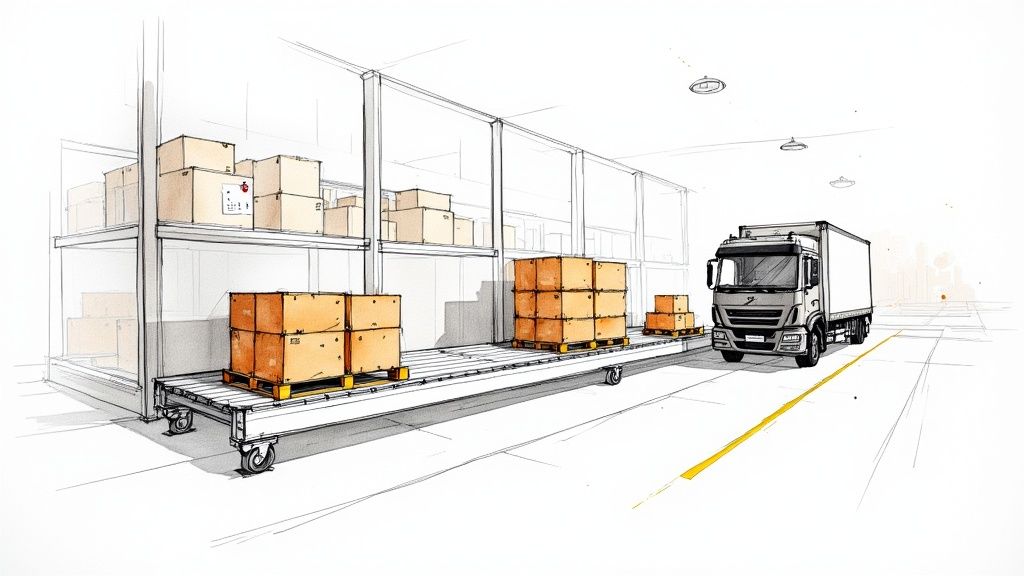
You’ve done it. The campaign is funded, the confetti has settled, and now the real work begins: getting your game into the hands of your backers. This is where you switch gears from marketing and hype to pure operational execution. The world of board game shipping is all about precision, planning, and keeping your backers in the loop.
Your first order of business is getting a handle on all that backer data. You'll need to export everything from your pledge manager—names, shipping addresses, pledge levels, and add-ons. This information then needs to be meticulously formatted to match your fulfillment partner’s requirements. Seriously, don't underestimate this step. Every 3PL has its own spreadsheet template, and one wrong column can throw a wrench in the whole operation and cause major delays.
Right around the time your manufacturer gives you the thumbs-up that production is finished, you’ll be staring down the next big challenge: freight shipping. This isn’t just mailing a few boxes; it’s about moving thousands of games across oceans, clearing customs, and making sure everything arrives at your fulfillment centers safe and sound. It can get complicated fast. We’ve put together a detailed guide on the 5 steps to booking freight to your fulfillment center to help you navigate it smoothly.
While those games are on the slow boat, it’s the perfect window to lock down your backer information. Now is the time to send out your pledge manager surveys to collect final shipping addresses and charge for postage.
This is where a dedicated tool really shines. Think of Kickstarter’s pledge manager like Amazon—it gets the basic job done, but it’s pretty limited. A platform like PledgeBox is like Shopify; it gives you far more power and flexibility.
A huge plus is that PledgeBox is free to send the backer survey. They only charge 3% of upsells if there are any. This is a game-changer for your budget, as it frees up your campaign funds for the big-ticket items like manufacturing and freight.
Timing is everything in fulfillment, especially if your delivery schedule lands anywhere near the end of the year. The holiday rush in Q4 puts an incredible strain on the entire global logistics network. Shipping lanes get clogged, warehouses get backed up, and costs can spike.
Don't just take my word for it. Google Trends data shows a massive spike in searches for board games every Q4 as people hunt for holiday gifts. This surge in demand is great for the industry, but it creates a perfect storm for fulfillment delays. Check out more on these board game market trends on accio.com. Careful planning is the only way to keep your project from getting lost in the chaos.
The golden rule through all of this? Communicate, communicate, communicate. Keep your backers updated on the freight's progress, give them realistic delivery estimates, and get them their tracking numbers the second the packages are out the door. Transparency turns an anxious wait into an exciting countdown and builds the trust you need to bring those backers along for your next project.
Even the best-laid plans hit a few snags. When you're deep in the weeds of board game shipping, you're bound to run into questions and weird edge cases. Knowing how to handle these final hurdles is what separates a smooth, professional fulfillment from a total stress-fest.
Let’s tackle some of the most common questions I see new creators wrestling with.
This is a big one. VAT and customs are a minefield, and if you get it wrong, you’ll have a mob of angry backers hit with surprise fees at their doorstep. Trust me, you don't want that.
The smartest move is to partner with a fulfillment company that has warehouses in key regions like the EU, UK, and Canada. This lets you offer "friendly shipping," where all the duties and taxes are handled on your end before the package even leaves the warehouse.
Be crystal clear about your VAT policy right on your campaign page. Some creators bake the cost directly into the pledge price, while others collect it later using their pledge manager. Either way works, but honesty is everything here. You also need to be aware of other potential financial pitfalls, which is why understanding shipping chargebacks is so important before you start shipping.
Hands down, the single most destructive mistake is underestimating shipping costs. It’s a classic rookie error that can absolutely torpedo your project’s budget.
This usually happens because creators forget to factor in the weight of the packaging itself, don’t account for dimensional (DIM) weight for bulky boxes, or just fail to research shipping rates for every single country they plan to ship to.
My best advice: Always get quotes using a final production prototype. That means weighing the complete, packaged game. A good pledge manager is also your best friend here, as it lets you charge accurate, real-time shipping rates after the campaign ends, saving you from a financial nightmare.
Your pledge manager is basically mission control for everything that happens after your campaign funds. Think of Kickstarter’s pledge manager like the default camera app on your phone—it gets the basic job done, but it’s limited.
A dedicated pledge manager like PledgeBox is like a professional DSLR. It gives you powerful, flexible tools to manage every detail of your post-campaign logistics, from surveys to upsells.
Here’s a key difference: PledgeBox is free to send the backer survey. This means you can collect addresses, finalize orders, and get all your data organized without spending a dime of your production funds. The platform only charges 3% of upsells if there are any—money you make after the campaign from add-ons. It's a model designed to help you run a tight ship without eating into your core budget.
Ready to take control of your post-campaign process and give your backers the smooth experience they deserve? PledgeBox gives you the powerful, flexible tools you need to manage surveys, charge accurate shipping, and even boost your revenue with upsells. Get started with PledgeBox today and lock in your crowdfunding success.
PledgeBox
The All-in-One Toolkit to Launch, Manage & Scale Your Kickstarter / Indiegogo Campaign