 PledgeBox
A Crowdfunder's Guide to CBM for 40 Container Shipping
Master CBM for 40 container calculations. Learn to calculate shipping volume, optimize pallet loading, and manage costs for your Kickstarter campaign.
Master CBM for 40 container calculations. Learn to calculate shipping volume, optimize pallet loading, and manage costs for your Kickstarter campaign.
Let's get straight to the numbers every creator needs to know. A standard 40ft container can hold about 67-68 CBM (cubic meters), while a taller 40ft High Cube container gives you more room, around 76-78 CBM. But remember, those are the absolute maximums—in the real world, you should only plan on using about 85-90% of that space.

When you're arranging bulk freight for your crowdfunding rewards, CBM is the most important number you'll work with. It stands for Cubic Meter, and it's the universal language for measuring shipping volume. Getting this right is your first step to an accurate budget and a fulfillment process without any nasty surprises.
These metal boxes have been the backbone of global trade since they became common in the 1960s. The standard 40-foot container gives you an internal space of about 12.03m long, 2.35m wide, and 2.39m high. That works out to a massive 67-68 cubic meters (CBM) of space—or around 2,390 cubic feet—to fill with your products. You can dive deeper into container specs over at this helpful guide from GamutPackaging.com.
To make it easier, here's a quick look at how the two most common 40-foot containers stack up.
| Specification | 40ft Standard Container | 40ft High Cube Container |
|---|---|---|
| Internal Length | 12.03 m | 12.03 m |
| Internal Width | 2.35 m | 2.35 m |
| Internal Height | 2.39 m | 2.70 m |
| Max CBM | ~67 CBM | ~76 CBM |
| Practical CBM | ~58-61 CBM | ~66-69 CBM |
| Pallet Capacity | 20-21 standard pallets | 23-24 standard pallets |
The key takeaway? The High Cube gives you that extra foot of vertical space, which can make a huge difference when you're trying to squeeze in that last pallet.
Now, here's a lesson that many people learn the hard way. There’s a big difference between a container's maximum CBM and its practical, loadable CBM.
The theoretical CBM is just the empty space inside the container. But you can never actually use 100% of it. You'll always have gaps between cartons, awkward spaces around pallets, and room needed for dunnage (the materials used to secure your cargo).
As a rule of thumb, you should only count on using 85-90% of the container's total volume.
Understanding this distinction is critical. If your calculations fit perfectly on paper but ignore these real-world gaps, you might find yourself with a pile of leftover products that won't fit. For a crowdfunding creator, that mistake can mean paying for an entirely separate, expensive shipment.
This is where having total control over your post-campaign logistics becomes so important. It helps to think of the Kickstarter pledge manager like Amazon—a vast marketplace. A pledge manager like PledgeBox, on the other hand, is like Shopify—it’s a powerful, dedicated platform just for managing your backers and your store.
Best of all, PledgeBox is free to send the backer survey and only charges 3% of upsell if there's any. This setup lets you finalize all your shipping details and even generate extra revenue, all without any upfront cost.
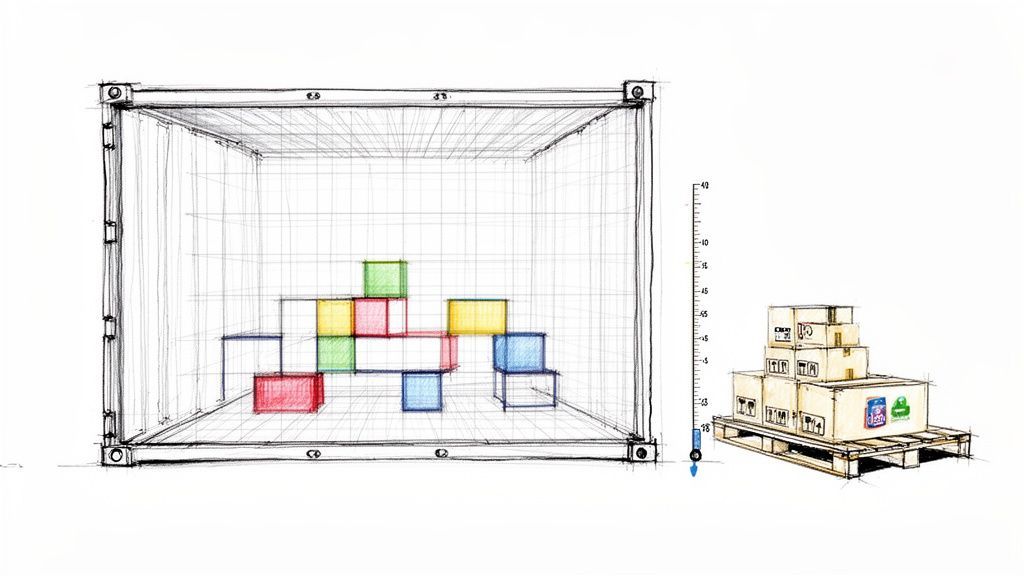
Think of planning your bulk shipping like a high-stakes game of Tetris. Your products are the blocks, the shipping container is the game board, and CBM is the rule that tells you exactly how big each block is. Getting this one number right is probably the single most important thing you can do for your campaign’s finances, because it directly controls your shipping costs.
Freight forwarders and carriers use CBM to figure out your bill, especially if you’re shipping Less than Container Load (LCL) and sharing space with others. Even if you book a Full Container Load (FCL), knowing the total CBM for a 40 container shipment is what helps you pick the right size and not waste money on empty space.
For most crowdfunded products, volume is a much bigger deal than weight. Just think about popular rewards like board games, apparel, or even cool tech gadgets. They tend to be bulky but don't weigh a ton. In the shipping world, this leads to a critical concept called "chargeable weight."
Here's how it works: carriers calculate two figures for your shipment—its actual gross weight and its volumetric weight (which comes from the CBM). You get billed for whichever one is higher. For bulky, lightweight goods, the volumetric weight almost always wins, making CBM the real number driving your costs.
This is exactly why ignoring CBM is one of the most painful—and common—mistakes a creator can make. It’s a direct path to undercharging your backers for shipping, leaving you to pay the difference out of your own pocket and watching your profits disappear. Getting a handle on this metric is key to keeping your campaign financially healthy.
Once you have your CBM figured out, you need a way to actually use that data to charge backers correctly. This is where you see the huge difference between a crowdfunding platform and a dedicated pledge manager. It helps to think of it this way: the Kickstarter pledge manager is like Amazon, where you’re just one seller in a massive marketplace.
A pledge manager, on the other hand, is like your own personal Shopify store. It’s a focused space where you have total control over your backers, your logistics, and your finances. This is where a tool like PledgeBox comes in, giving you the power to manage everything after the campaign ends. Best of all, PledgeBox is free to send the backer survey and only charges 3% of upsell if there's any. This no-risk setup lets you accurately collect shipping fees based on your CBM calculations, offer add-ons, and protect your margins without any upfront cost.
Alright, let's get our hands dirty and figure out the cubic meter (CBM) for your actual products. This is where the abstract theory of shipping becomes a real, usable number that directly impacts your freight budget. The formula itself is refreshingly simple, but mastering it is the key to getting your shipping costs under control.
This visual shows exactly how your product’s dimensions connect to your final freight charges. It’s a roadmap from your workshop to the shipping container.

As you can see, getting that initial CBM calculation right is the first and most important step. Everything else—from container space to final cost—flows from there.
The basic formula couldn't be simpler:
Length (m) x Width (m) x Height (m) = CBM
Just remember to measure in meters. If you have your dimensions in centimeters, no worries—just divide each number by 100 before multiplying to get your CBM.
Let's walk through a classic crowdfunding example: a board game. Following these steps removes the guesswork and shows you how to scale up from a single game box to an entire pallet.
Calculate CBM for a Single Unit: First, measure the board game box after it's fully packaged for retail. Let's say it's 30cm long, 30cm wide, and 10cm high.
Calculate CBM for a Master Carton: Next, you'll likely pack those games into larger "master cartons" to make them easier to handle. Imagine you fit 5 game boxes into a carton that measures 32cm x 32cm x 52cm (this includes a little extra room for padding).
Calculate CBM for a Full Pallet: Finally, you stack 20 master cartons onto a standard shipping pallet. The final dimensions of your loaded pallet are now 1.2m long, 1.0m wide, and 1.15m high.
This bottom-up approach gives you a precise CBM figure for every stage of your fulfillment process. If you want to double-check your math, our guide on using a cubic calculator for shipping can be a great help.
Here's a piece of advice I can't stress enough: always add a buffer to your final CBM calculation. Real-world logistics is never as neat and tidy as a spreadsheet.
Forgetting this buffer can lead to a disastrous situation where your "perfectly" calculated shipment doesn't actually fit into the cbm for 40' container you paid for. Think of it as cheap insurance against very expensive, last-minute problems. Once you have these final, buffered numbers, you can confidently enter them into your PledgeBox survey to charge backers accurately.

Once you've got a solid CBM estimate for your rewards, it’s time to pick your container. Your main choices are the standard 40ft container and the 40ft High Cube. It might seem like a small decision—after all, it’s just one foot of extra height—but that single foot can have a huge impact on your shipping costs and overall efficiency.
The standard 40ft container is the industry's go-to for dense, heavy items. If you're shipping things like bulky metal components, stacks of books, or ceramic goods, its 67 CBM capacity is usually the sweet spot. You’ll probably hit the weight limit long before you run out of physical space.
For many crowdfunding campaigns, though, the rewards are the exact opposite: bulky but lightweight. This is where the High Cube container can be a real campaign-saver.
Think about rewards like apparel, elaborate board games packed with miniatures, or oversized plush toys. These products eat up a ton of volume without tipping the scales. That extra foot of vertical space in a High Cube is often the difference between fitting everything in one go or having to pay for a second, partial shipment.
The 40ft High Cube container gives you 76 CBM of space and has become the secret weapon for hardware startups and board game creators managing global fulfillment. Its internal dimensions are 12.03m long, 2.35m wide, and 2.69m high, which translates to about 13-15% more volume than a standard container. It can handle a payload of up to 28,620 kg or 25 Euro pallets. If you want to dive deeper into how container sizes affect your strategy, this guide from FreightAmigo.com offers a great breakdown.
The decision to upgrade to a High Cube is a strategic one. While it might cost slightly more upfront, it can prevent the disastrously expensive scenario of leaving a few pallets behind because they simply wouldn't fit.
This is exactly why having full control over your post-campaign process is so important. It helps to see the difference between your crowdfunding platform and a pledge manager. Think of the Kickstarter pledge manager as a sprawling marketplace like Amazon, where countless projects are all competing for attention.
A pledge manager like PledgeBox, on the other hand, is like your own dedicated storefront—your Shopify. It’s where you take the reins, manage backer relationships, and nail down your logistics. For example, PledgeBox is free to send the backer survey and only charges 3% of upsell if there's any. This setup lets you finalize addresses, accurately bill for shipping, and turn a logistical headache into a new revenue opportunity.
We walk you through exactly how to handle this in our guide on the 5 steps to booking freight for your campaign.
You’ve got your CBM calculations down, but that’s only half the story. The other, equally critical piece of the puzzle is weight. Every 40ft container has a maximum payload it can carry, usually around 26-28 metric tons. Trying to sneak past this limit isn't just a bad idea—it’s a major safety and compliance violation.
This is where you'll run into the term chargeable weight. Your freight carrier will look at two numbers: the actual gross weight of your shipment and its volumetric weight (which they figure out using your CBM). They'll bill you for whichever is higher. For most crowdfunding rewards, which tend to be bulky but not incredibly heavy, the volumetric weight is almost always the bigger number. That makes your CBM calculation the real driver of your shipping cost.
So, you know your total CBM. Great. But how you use that space inside the container is where the real-world strategy comes in. The economics of global shipping, a massive $14 trillion industry, are built on maximizing the cbm for 40 container. While these containers technically offer 63-67 CBM, you'll quickly find that real-world loading is a different beast.
After you account for the container's own weight and the inevitable gaps between boxes and pallets, you can realistically only use about 56-58 CBM—roughly 85% of the total volume. A key part of hitting that number is knowing exactly how many pallets fit in a 40ft container.
Experienced shippers use tricks like "pinwheeling" or "turn-loading," where you alternate how you orient pallets to squeeze in an extra row. Just as important is distributing the weight evenly. If you stack all your heavy pallets on one side, you create a dangerous imbalance that can make the container unstable at sea or on the road.
Once everything is loaded, you need to make sure it all stays put. This is where dunnage comes in—it’s the catch-all term for inexpensive materials used to brace your cargo and keep it from shifting around during its long journey.
Forgetting dunnage is a classic rookie mistake. Even perfectly packed pallets can shift during a rough sea voyage. That movement leads to crushed boxes, damaged products, and a lot of unhappy backers. A small investment in dunnage is cheap insurance against the high cost of replacements.
This is the kind of detailed, post-campaign planning that shows the true difference between a crowdfunding marketplace and a dedicated pledge manager. Think of it this way: the Kickstarter pledge manager is like Amazon, a huge platform where people discover your project. A pledge manager like PledgeBox, however, is your personal storefront—more like Shopify—giving you total control over the post-campaign experience.
Best of all, PledgeBox is free to send the backer survey and only charges 3% of upsell if there's any, so you can manage all these complex shipping details without any upfront cost.
Alright, you've mastered the math behind CBM. Now for the fun part: putting that knowledge to work to protect your campaign's profits. This is where a pledge manager becomes your best friend.
A good way to think about it is this: The Kickstarter pledge manager is like Amazon where backers first discover you. A pledge manager like PledgeBox, on the other hand, is your personal storefront, more like a Shopify—it gives you the keys to the kingdom for everything that happens after the campaign ends.
With your CBM and weight calculations in hand, you can set up accurate, real-time shipping fees right inside your PledgeBox surveys. This single step is crucial. It helps you avoid undercharging for shipping, which is a surprisingly common mistake that can sink a project's budget. It also lets you be smart about offering add-ons and upsells, ensuring you don't promise more than you can fit within your CBM for 40 container limits.
One of the biggest hurdles for new creators is cash flow. Using a dedicated pledge manager can completely change the financial equation, especially a tool like PledgeBox that's built to support creators without big upfront costs.
The platform is completely free to send the backer survey. PledgeBox only charges a small 3% fee on the funds you raise from upsells. This means you can manage your backers, collect accurate shipping fees, and even earn extra revenue, all without spending a dime to get started.
This risk-free model lets you move forward with confidence, knowing your financial exposure is low while your potential for growing your funds is high. You can then put your energy where it matters most—getting those amazing rewards into your backers' hands.
Your CBM numbers aren't just for booking a shipping container. They're the foundation for collecting the right amount of shipping fees from every single backer, no matter where they are or what they pledged for.
Once you have your total CBM, you can work with your fulfillment partner to get solid shipping quotes for different countries and regions. From there, you can hop into PledgeBox and set up shipping rules based on those quotes. This ensures a backer in Australia with a huge order pays the correct rate, while a backer in the EU with a small item pays their fair share, too.
If you're still figuring out the post-campaign landscape, it's worth learning how to select the right pledge manager for your project's unique needs. Honestly, it's a decision that can make or break your fulfillment experience.
Okay, we've covered a lot of ground on CBM and container planning. By now, you're probably getting the hang of it, but a few real-world questions always pop up when creators start putting their shipping plans together. Let's tackle some of the most common ones so you can lock in your strategy with confidence.
This is the Tetris-like puzzle every creator has to solve to get the most out of their CBM for 40 container. The exact number really hinges on which type of pallet your supplier is using.
Now, you might be thinking, "Can I stack them?" Maybe. If your loaded pallets are short and light enough, double-stacking is a possibility. But—and this is a big but—you absolutely must clear this with your freight forwarder first to avoid busting the container's weight limit or violating safety rules.
This one trips a lot of people up, but understanding it is key to figuring out your final bill. CBM is all about volume—the physical space your shipment occupies. Chargeable weight, on the other hand, is the number the freight carrier actually uses to calculate your cost.
Carriers look at two things: the actual gross weight of your shipment and its volumetric weight (which they calculate from your CBM). They'll charge you based on whichever of those two numbers is higher. For most crowdfunding products—which tend to be bulky but not super heavy—the volumetric weight almost always wins. This makes CBM the most critical number for budgeting your freight costs.
Yes, almost every single time. A standard 40ft container gives you more than double the space of a 20-footer (roughly 67 CBM vs. 33 CBM), but it only costs about 20-30% more to ship.
If your total volume creeps over 33 CBM, it's a no-brainer. Don't split your shipment. Consolidating everything into a single 40ft container is a much, much smarter financial move.
Please, don't skip this step. You must always calculate your CBM using the final, external dimensions of your fully packaged product. I'm talking about the master carton that holds your individual units, not the dimensions of the product itself.
Forgetting to account for the box, the foam, and all the air in between is one of the most common—and costly—mistakes a creator can make. It’s a fast track to underestimating your total volume and getting hit with unexpected shipping fees.
This is where having a dedicated pledge manager really starts to pay off. Think of it this way: the Kickstarter pledge manager is a fantastic marketplace, kind of like Amazon, for getting your idea funded. But a pledge manager is your personal storefront, like Shopify, giving you the granular control you need to execute your fulfillment plan perfectly.
Navigating the complexities of shipping is a whole lot easier when you have the right tools in your corner. PledgeBox helps you collect precise shipping fees and can even bring in extra revenue through add-ons and upsells. It's totally free to send the backer survey and only charges 3% of upsell if there's any, making it a zero-risk tool for your campaign. Learn more and get started at PledgeBox today.
PledgeBox
The All-in-One Toolkit to Launch, Manage & Scale Your Kickstarter / Indiegogo Campaign