 PledgeBox
Address Validation Free: Options, Limits and Next Steps
Explore address validation free options, what each one checks, where they fall short, and how to confirm backer addresses before shipping rewards.
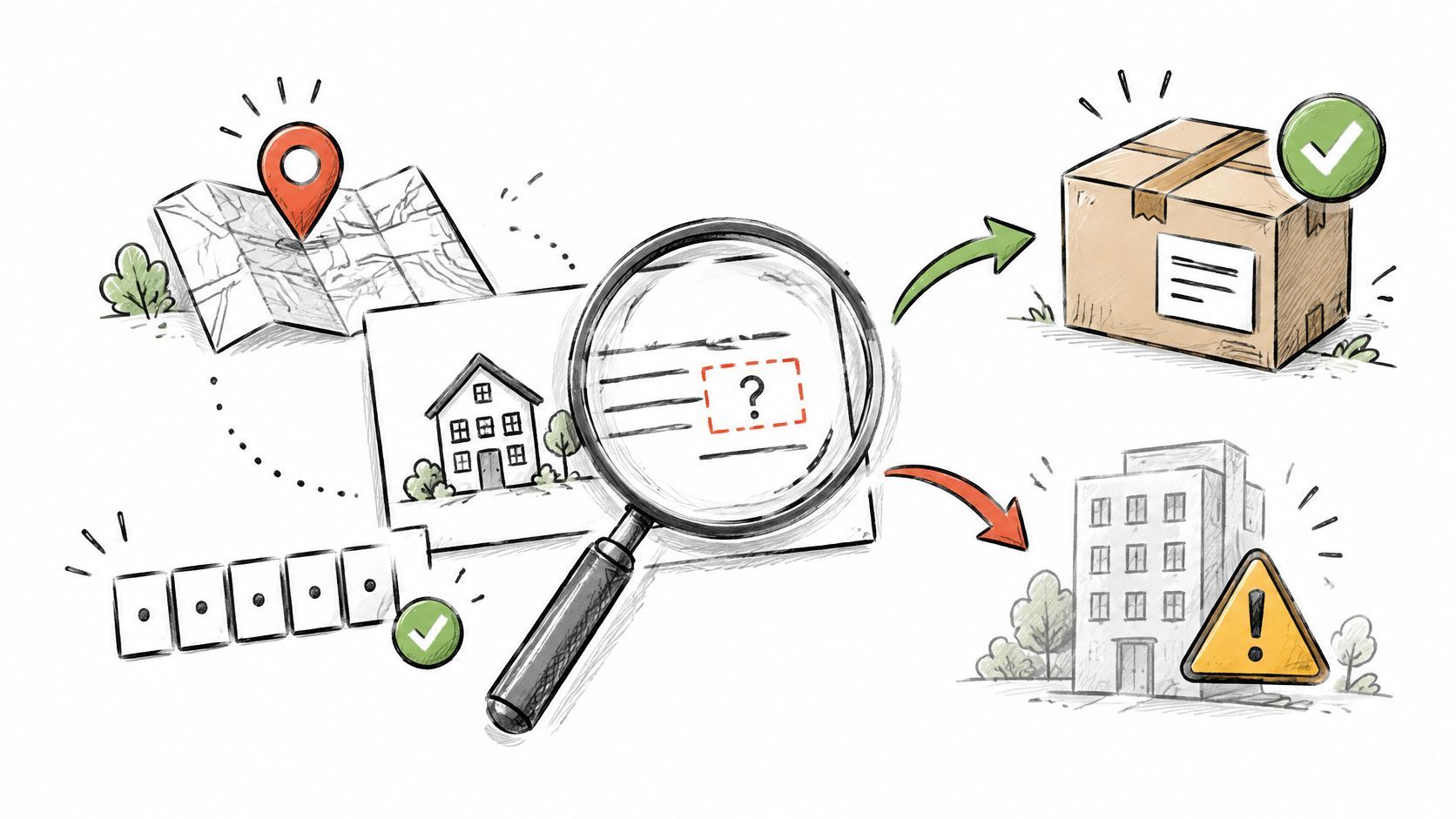
Explore address validation free options, what each one checks, where they fall short, and how to confirm backer addresses before shipping rewards.
A survey closes with 2,000 responses and thirty-one of them look wrong. One reads "123 main st apt 4b springfield" with no state and no postal code. Another carries a postal code for a city the backer left three years ago. The rest are probably fine, and that "probably" is the problem, because somebody has to turn those rows into labels on Friday.
A wrong address doesn't fail without notice. It burns a delivery attempt, lands in an exception queue, opens a support thread, and ends with a second label, a second postage charge and a backer who now distrusts the project. Address validation free of charge is the cheapest control you have over that outcome, provided you know exactly what each free check confirms.
The options below are real and useful. They also stop at sharply different points, and one of them will happily tell you a postal code is valid while the apartment number is still missing. That gap between "the code checks out" and "the parcel arrives" is where campaigns lose money.
Picture a backer who types "Apt 4B" into a free-text box, adds a street name, and leaves the postal code empty because the form never asked again. The dashboard shows a completed pledge. A printed label shows a coin flip.
Free validation options answer different questions, and each one hands you a different kind of confidence. This table maps what each option settles before you export a label file.
| Option | Coverage | What It Checks | Free Limit |
|---|---|---|---|
| USPS ZIP Code Lookup | United States | ZIP code matches city and state | Manual web lookup |
| Canada Post Postal Code Finder | Canada | Postal code matches street and municipality | Manual web lookup |
| Royal Mail Postcode Finder | United Kingdom | Postcode returns addresses on that postcode | Free lookup; full PAF data is licensed |
| GeoNames postal code data | Many countries | Postal code to place name only | Free download under CC BY 4.0 |
| Google Maps Geocoding API | Global | Address resolves to location and matched components | Monthly free usage credit, then paid |
| OpenStreetMap Nominatim | Global, uneven by region | Address resolves to a place, no postal authority check | Free under usage policy request limits |
USPS ZIP Code Lookup is the fastest check for a US list. It confirms that a ZIP code matches the city and state, which catches transposed digits and a state that doesn't belong with the code. It tells you nothing about whether the street number exists or whether "Apt 4B" is a real unit, and because it's a manual web lookup, it suits a spot check rather than a 2,000-row export.
Canada Post's postal code finder does the equivalent job north of the border, matching a postal code to a street and municipality. Royal Mail's Postcode Finder goes a step further in the UK by returning the addresses registered at a postcode, though the full PAF address file sits behind a licence, so the free view gives you a list to read rather than a dataset to import cleanly.
GeoNames publishes postal code data for many countries as a free download under CC BY 4.0. It maps a postal code to a place name and stops there. For confirming that a code belongs to the right town, that's enough. For confirming a street, it isn't.
Google Maps Geocoding API covers the globe and includes a monthly free usage credit before paid usage begins. It returns coordinates and matched address components, which is useful for spotting a city sitting in the wrong country. It resolves to an area or an interpolated point, not to a verified delivery point.
OpenStreetMap Nominatim is free under a usage policy that caps request rates. Coverage is uneven by region, and there's no postal authority behind the data, so a match means the place exists in a map database, not that a postal operator will deliver there.
Choosing between them comes down to the shape of your list. A campaign shipping only inside one country can lean on that national lookup and spend its effort on the rows it flags. An international list needs a mix of sources, because street-level postal coverage is uneven across the world and no free dataset fills every gap.
The limit that never moves: no free source confirms that a specific person lives at a given address. Only the backer can do that.
A backer types an address, a tool accepts it, and a label prints. Those moments look close together, but they rely on different checks. Free validation usually handles the first two checks in that chain. The third check decides whether a parcel can reach the delivery point.
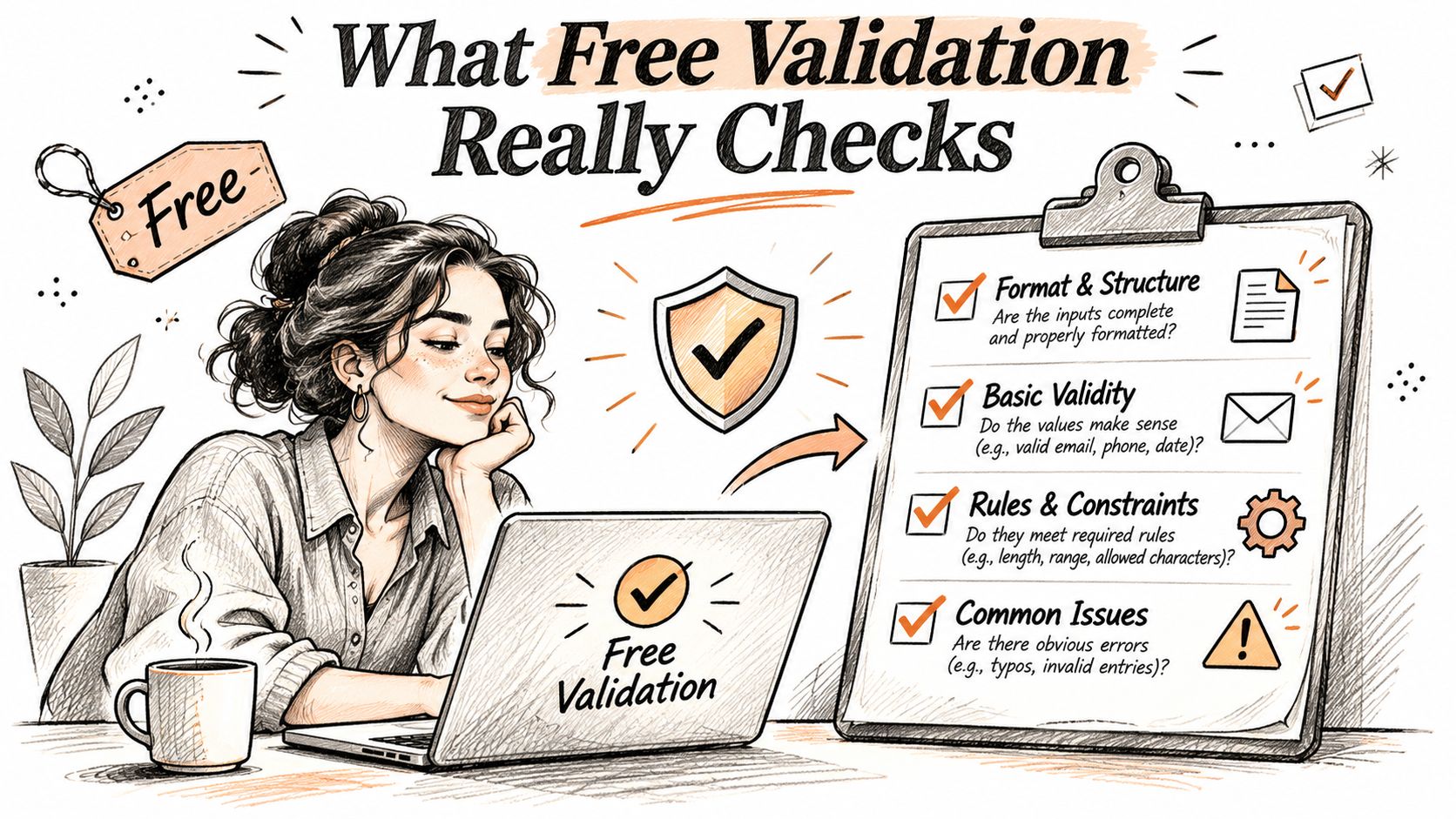
Parsing splits a free-text entry into street, unit, locality, region, postal code and country. That step works like sorting mixed LEGO bricks into labelled trays. An entry such as "Apt 4B with no postal code" becomes visible as an incomplete row, because the missing postal code now has its own empty space in the spreadsheet.
Parsing helps a campaign creator see what the backer supplied. It does not prove that the street exists, that the unit belongs there, or that a postal operator serves the address. It only makes the gaps easier to spot before fulfillment begins.
Normalization rewrites spelling, abbreviations and postal code format to match the destination country's conventions. Street becomes St. A nine-digit US code keeps its ZIP+4. A German address keeps its street-before-number order.
Used carefully, normalization makes a list consistent. Used as one global rule, it breaks more addresses than it fixes. A format that looks neat on screen can still send a reward to the wrong place if the postal code, unit or country has been reshaped into the wrong convention.
That is why normalization belongs in the preparation stage, beside the original entry. Keep the raw text so the creator can compare what the backer wrote with what the tool changed.
In the United States, USPS Delivery Point Validation identifies whether a ZIP+4-coded address exists in the USPS delivery file and can indicate whether primary and secondary information, such as a unit or suite, is verifiable. USPS CASS certification sets a high accuracy bar for software that claims to do this across USPS test categories.
That standard exists because an address can be perfectly formatted and still be undeliverable. The ZIP+4 may be missing. The apartment number may not match a verifiable secondary address. A syntax check waves both rows through because the fields look tidy, while a deliverability check asks whether the postal system recognises the address as a delivery point.
A free check is only as strong as the layer it reaches.
The phone test makes the difference concrete. A format check confirms a number has ten digits. A deliverability check confirms someone answers.
Here's how that checking looks when it sits inside a live fulfillment flow rather than a spreadsheet.
Ask whether it reaches the delivery point or only the postal code. If the answer is the postal code, you're holding a filter, not a gate, and the rows it passes still need a backer's confirmation before a label goes out.
A checklist beats a clever tool every time, because the tool tells you what it knows and the checklist tells you what to do next. Run these steps in order on any campaign list, whether it holds 200 backers or 20,000.
Export the list and keep the original. Pull every address out of the survey or spreadsheet and put the raw text in its own column, untouched. If you overwrite the original with a corrected version, you lose the record you need when a backer disputes where a parcel went.
Split each row into fields. Name, street, unit, locality, region, postal code, country. A single free-text line hides the gaps until a label prints; separate columns make an empty postal code impossible to miss. The UPU addressing solutions programme treats validation as an element-based process, slotting common address elements into country-specific templates rather than forcing one format on every country.
Group by country and run the matching lookup. US addresses through USPS, Canadian through Canada Post, UK through Royal Mail. Manual lookups are slow, so split the list across people or block out a morning rather than promising yourself you'll get to it.
Normalize to the destination country's rules. Correct abbreviations, spelling and postal code format, and store the normalized version beside the original. Applying one country's formatting to another is how a valid Hamburg address starts looking wrong.
Give every row a status. A postal code that matches but has no unit number becomes a backer review. A postal code that doesn't exist goes on hold. Everything else is ready. Three statuses are enough; a tenth category nobody reads is not.
Ask the backer instead of overwriting. Show the normalized address and ask for confirmation. A correction the backer agreed to sticks. One you applied without confirmation gets re-entered wrong next time.
Re-run the check after the survey closes. Addresses go stale between the first response and the final export, and labels, packing lists and customs forms all inherit whatever was true in week one.
The payoff for that discipline shows up in first-attempt delivery rates.
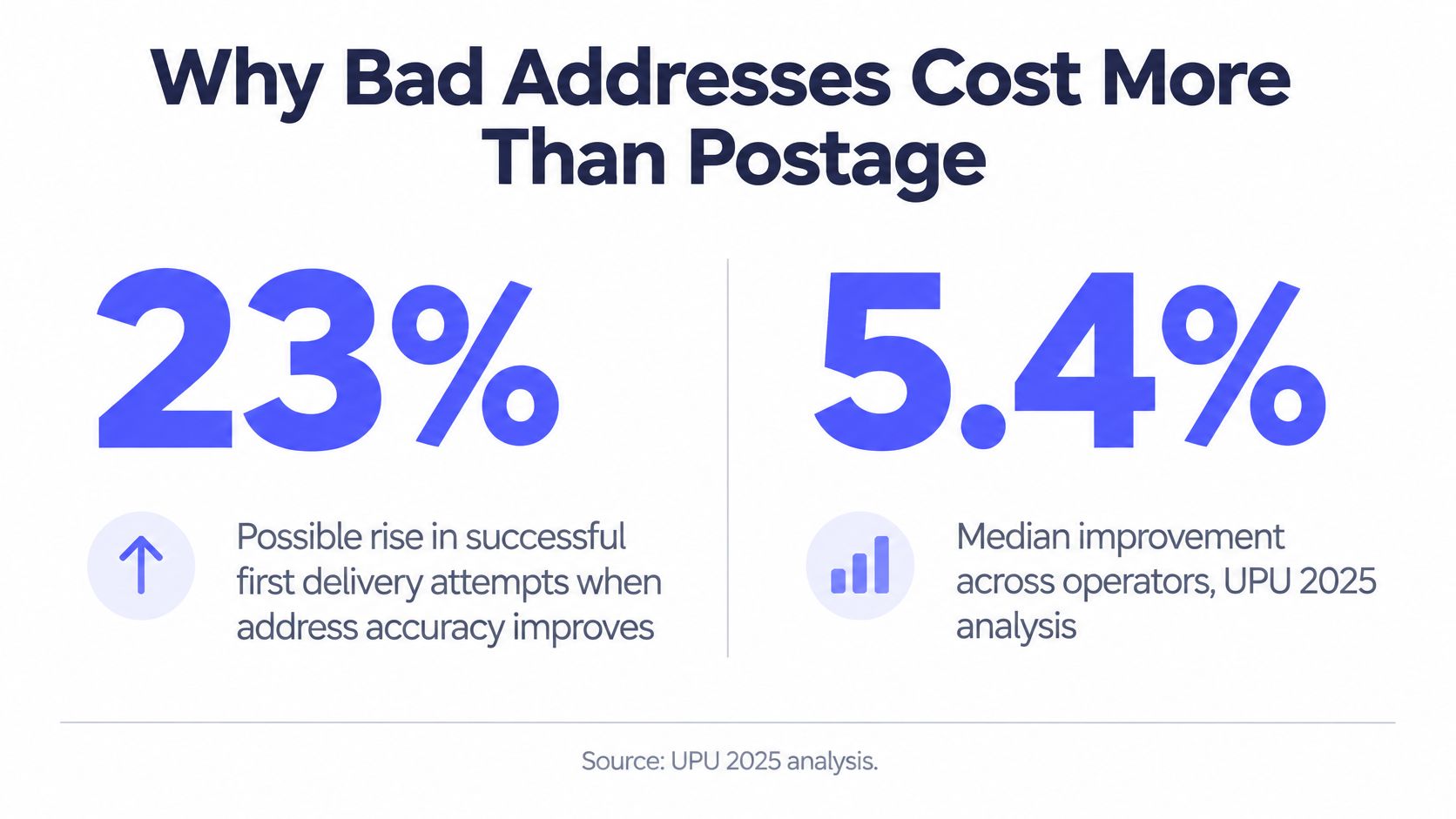
Every row is marked either deliverable or confirmed by the backer. There are zero holds you can't explain in one sentence. You have a short change log showing which addresses were corrected, by whom, and on what date, so support can answer a question months later without reopening the whole survey.
Practical rule: a fix nobody confirmed is a guess with better formatting.
Postage is the cost you plan for. The parcel that comes back is the cost you don't.
A 2025 Universal Postal Union analysis, drawing on postal operator data and checks run through the UPU POST*CODE API, found that improving address accuracy could increase successful first delivery attempts by as much as 23%, with a median improvement of 5.4% across operators. Poor address quality pulled delivery success down by up to 14%. The recurring causes the UPU named were invalid addresses, addresses that could not be found, and addresses that were insufficiently detailed.
That third cause should worry you most, because it describes the row your backer typed in a hurry. An address can be entirely real and still fail for want of a unit number or a postal code.
Run the arithmetic on your own campaign. Say 2,000 backers each receive a reward and 5% of first attempts fail. That's 100 parcels needing a re-ship, a support thread and a second label. At the 5.4% median, catching errors before printing pushes roughly five of those into the delivered column. At the 23% upper bound, it's closer to twenty-three.
Budget for the median, not the headline. The 23% figure is the best case the UPU observed across operators, and your list, your carriers and your destination countries will land somewhere beneath it.
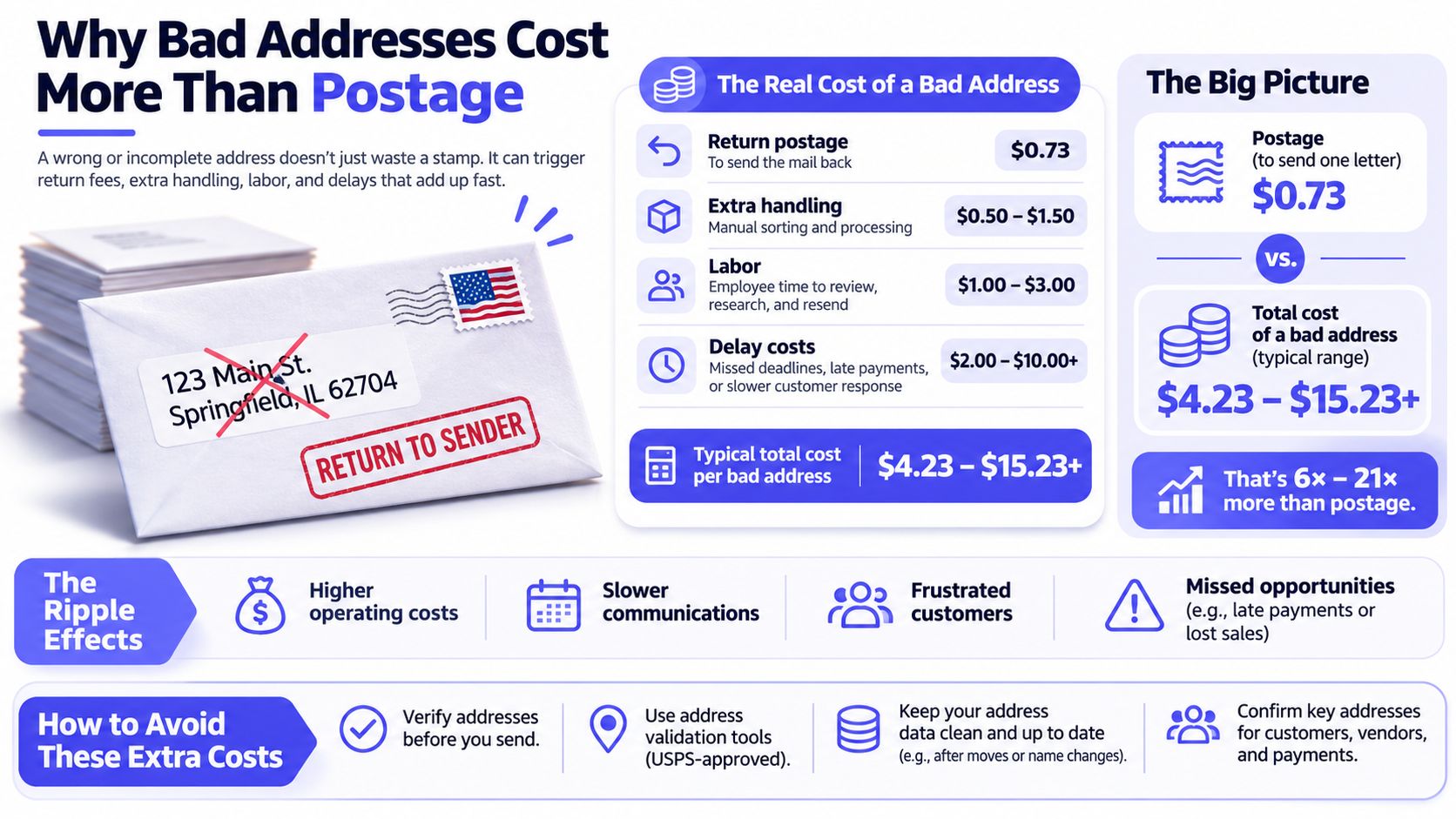
Now price a single failure. Add the returned or re-sent postage, the packaging you consume twice, the labor to pick and pack again, and the support minutes that start with "my reward never arrived." Multiply that total by the failures you didn't catch, and you have the actual budget line a free check protects.
Fewer failed attempts is also the simplest route to lower shipping costs, because the cheapest parcel is always the one you ship once.
Two pledge manager models behave like two very different shops, and the difference decides how much address work you do by hand.
Amazon means the storefront, the checkout and the order record live in one place and you work inside them. Kickstarter's native Pledge Manager runs the same way. It has no upfront cost, with Kickstarter's usual fees deducted from payments made inside the pledge manager, as explained in Kickstarter's Pledge Manager guide. It collects fulfillment information such as shipping addresses, reward preferences, applicable taxes and shipping fees, and when a backer upgrades a reward or picks up an add-on, the survey dynamically includes questions about those selections.
Shopify means you assemble the shop yourself, choosing the pieces that fit the store you're building. The PledgeBox pledge manager works that way: a toolkit you configure around your campaign before the survey goes out. You set up products, variants, reward mapping, shipping, tax and payment settings, preview the backer experience, and clear any blocking checklist messages before invitations are sent. A backer can change a shipping address while the order still allows edits; once the order is locked or shipped, they contact the creator.
A free lookup verifies one address. It can't collect one, can't ask a backer to correct it, and can't write the confirmed result into a fulfillment record that your warehouse reads. That's the boundary between a validation tool and a workflow, and it's why the check belongs inside the survey rather than in a spreadsheet someone updates by hand at midnight.
| Capability | Standalone Free Lookup | Pledge Manager Survey |
|---|---|---|
| Collects addresses from backers | No | Yes |
| Backer confirms or corrects address | No | Yes, while the order allows edits |
| Checks unit or apartment numbers | Flags only | Asks the backer for the missing detail |
| Address changes after lock or shipment | Not applicable | Backer contacts the creator |
| Connects to fulfillment records | Manual export | Built into the survey workflow |
Verification is a feature. Collection, correction and export are a system. If you're still weighing which survey flow suits your campaign, this comparison of crowdfunding pledge manager options lays out the trade-offs.
A complete-looking address can still be a broken one, and the evidence for that goes back further than most creators expect. The U.S. Postal Service Office of Inspector General reported that operational address-data errors rose from 267,478 in fiscal year 2011 to 430,843 in fiscal year 2013, an increase of approximately 61%, with inconsistent updates to local address records and inadequate street reviews behind part of it, per the USPS OIG address management audit.
Address data drifts the same way inside a backer list. Company databases accumulate outdated and erroneous records over time, because people move, buildings get renumbered, and entries that looked complete when typed in expire. A backer who insists their address is fine may be right about the street and wrong about everything else.
A free check confirms that an address exists somewhere in a dataset. It cannot confirm that the right person still stands behind that door, which is why the check belongs early in the fulfillment sequence, catching obvious failures before a backer's reward goes out.
| Case | Free Check Handles It | Needs Review |
|---|---|---|
| Standard street address in a covered country | Yes | No |
| Missing unit or apartment number | Flags it only | Yes, ask the backer |
| PO box or rural route | Only in some countries | Yes |
| Non-Latin script or transliteration | Partly | Yes |
| Address changed after a move | No, it still looks valid | Yes, backer confirms |
| Bulk list of hundreds of addresses | One address at a time | Consider a paid or batch service |
Read the flags as a to-do list for your campaign. A missing unit gets flagged, yet only the backer can supply the number, and no lookup will invent it. A PO box may sail through in one country and return an error in the next, because coverage depends on which national database the tool draws from. A backer who moved last month may still carry an address that looks perfectly valid in every dataset, which means the free check passes a parcel that never arrives. Only that backer's confirmation settles it.
Scale is the quiet limit. Once a list runs into the hundreds, manual lookups start pushing your label deadline, and the hours spent clicking through a web form cost more than the batch service that replaces them.
The decision is simpler than the options suggest. Run the free checks on the list you have now, flag the rows they can't settle, confirm those with the backer, then lock the list before a single label or customs form is produced.
Sending a backer survey sits inside that sequence rather than beside it. PledgeBox charges nothing to send the backer survey, with no upfront fee, no setup fee and no per-backer charge, as set out on the PledgeBox pricing page. The platform charges 3% only on additional revenue collected through the survey, meaning add-ons, upgrades, shipping fees and taxes or VAT. If a survey generates no additional payment, the survey service stays free.
A survey built to collect shipping addresses and product choices, with no extra products on offer, costs nothing to run. Payment-provider processing fees are separate from the platform fee and can vary by account, country, payment method and currency, so budget for them on their own line rather than folding them into the 3%.
Locking the list is also where your label process takes over. Choosing shipping label software that reads the confirmed records rather than the raw survey text stops your fixes from coming undone at the last step.
PledgeBox runs Google Maps-powered address validation inside its backer survey, so incomplete or questionable shipping addresses surface while backers are still filling in the form, not after the labels are printed. Sending the survey is free, and the platform takes 3% only when a survey generates extra revenue through add-ons, upgrades, shipping fees or taxes. Start with PledgeBox and run your next reward cycle on a list that has already been checked.
PledgeBox
The All-in-One Toolkit to Launch, Manage & Scale Your Kickstarter / Indiegogo Campaign