 PledgeBox
A Modern Guide to Your Tabletop Games Kickstarter
Launch a successful tabletop games Kickstarter. Learn pre-launch hype, campaign design, pledge management, and fulfillment from pros who have done it.
Launch a successful tabletop games Kickstarter. Learn pre-launch hype, campaign design, pledge management, and fulfillment from pros who have done it.
Launching a tabletop games kickstarter is a serious undertaking, and I’ve seen firsthand that success is almost always baked in months before the campaign ever sees the light of day. The line between a runaway success and a campaign that sputters out is often drawn by a single factor: an energized community, ready and waiting to pledge the second you go live.
That initial surge of backers is everything. It's the rocket fuel that creates unstoppable momentum and gets you noticed.
The old "if you build it, they will come" mindset is a surefire way to fail on Kickstarter. I can't stress this enough. The most successful campaigns are the result of obsessive pre-launch planning. This is your window to build a groundswell of genuine support, turning casual observers into die-hard fans who can't wait to back your project. Without this push, even the most brilliant game will get lost in the shuffle.
The heart of this strategy is building a direct line to your future backers—your email list. A clean, simple, and compelling landing page is your best friend here. Its sole purpose is to capture an email address. In return, you promise to notify them at launch, maybe with a little exclusive bonus for being an early bird. You're not just collecting contacts; you're curating an audience of your most passionate supporters.
Once you have their attention, the real work begins. Your mission is to transform these subscribers into genuine advocates for your game. An automated email sequence is a game-changer for this. Use it to drip-feed your game's world, show off incredible art, and share behind-the-scenes stories from development. Every email should build another layer of anticipation and prove why your game is a must-have.
This flowchart maps out the journey from sparking initial interest to achieving that critical launch-day momentum. It all starts with your email list.
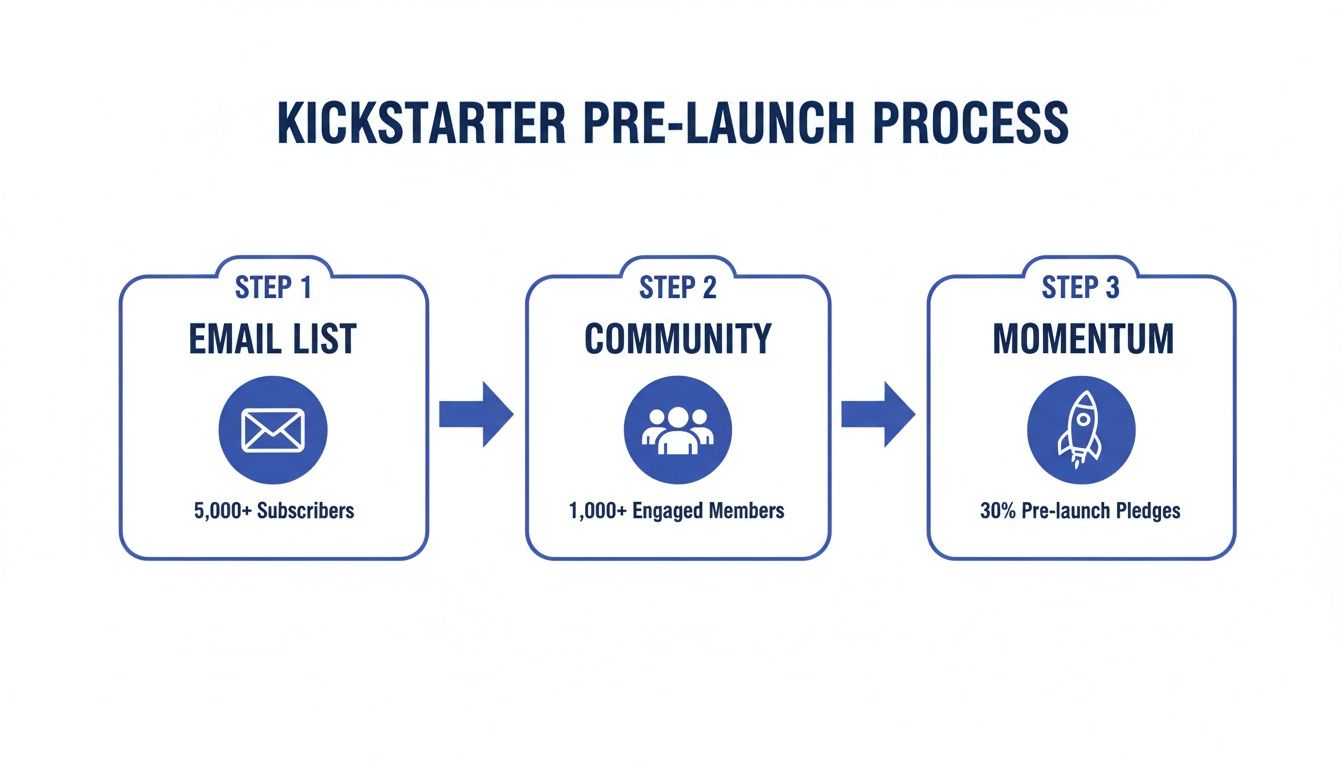
The big takeaway here is how each step feeds the next. You're creating a powerful feedback loop where community engagement directly drives that massive funding surge on day one.
At the same time, you need to be out there engaging authentically. Get active on platforms like BoardGameGeek, relevant Reddit subreddits, and social media. Join conversations, share your progress, and actually listen to the feedback people give you. To really get things buzzing and pull in those first crucial followers, it's worth digging into proven strategies for mastering advertising for games to give your campaign a real boost. Your passion is contagious; it will draw people in long before they can hit the "pledge" button.
Tabletop games are absolute royalty on Kickstarter, consistently crushing it as one of the most-funded categories. While the average video game campaign might pull in around $68.2K, the heavy-hitters in tabletop gaming blow that curve apart. It's not uncommon for top board game publishers to manage campaigns with 10,000+ backers.
Since 2019, over 8,000 creators have turned to tools like PledgeBox, which uses a no-upfront-fee model, to turn that chaotic post-campaign phase into another opportunity for growth.
To keep your pre-launch phase on track, I've put together a simple checklist. Think of this as your roadmap to making sure everything is primed for success before you hit that big green "launch" button.
| Phase | Key Action | Goal and Metric |
|---|---|---|
| Foundation (6-12 Months Out) | Create a compelling landing page. | Grow email list to 1,000+ subscribers. |
| Community Building (3-6 Months Out) | Engage on social media & forums. | Achieve 10%+ engagement rate on key posts. |
| Content Creation (1-3 Months Out) | Share gameplay previews & art. | Finalize campaign video; get 500+ views on teasers. |
| Final Push (1 Month Out) | Run targeted ads to the landing page. | Double email list size; aim for 30%+ open rate on emails. |
| Launch Week Prep (1 Week Out) | Schedule launch announcement emails. | Confirm early-bird bonus and have launch day posts ready. |
This checklist isn't just a to-do list; it’s a strategic guide. Hitting these milestones shows you're not just hoping for a good launch—you're engineering one.
The Kickstarter platform is no longer a gatekeeper; it's a tool. The real gatekeeper is you. The platforms are there, but it's your pre-launch effort that decides if your project gets seen.
Ultimately, a strong pre-launch isn't just about hitting your funding goal. It’s about creating a story of success from the very first hour. Funding rapidly triggers Kickstarter’s algorithm, rocketing your project onto the front page and exposing it to a massive wave of new backers. This is how you create the kind of unstoppable momentum that defines a legendary campaign. If you want to dig even deeper into this, check out these 7 actions to build your community before your Kickstarter campaign.
Think of your Kickstarter page as your digital storefront and your most powerful sales pitch rolled into one. Every single piece of it—from your main video down to the very last FAQ—needs to work in harmony. The goal? To build trust, clearly explain your game, and get people excited enough to click that "Back this project" button.
This isn't just about listing features on a page. It's about telling a story that pulls people in and makes them feel like they're joining you on an adventure. You need to hook them fast. What makes your game special? Is it the jaw-dropping art? A clever mechanic nobody's seen before? A deep, immersive world? Whatever it is, that hook needs to be front and center in your video and at the top of your page. Don't bury the good stuff.
Your pitch video is your best shot at making a real, personal connection. You don't need a Hollywood budget, but you absolutely need to be authentic. A solid video for a tabletop game usually hits these key notes:
Beyond the video, high-quality graphics and GIFs are non-negotiable. They break up the text and make your page feel dynamic. Use them to show off gameplay loops, the quality of your components, or exactly what backers get in each pledge level. A static picture of a miniature is fine, but a 360-degree GIF is so much better.
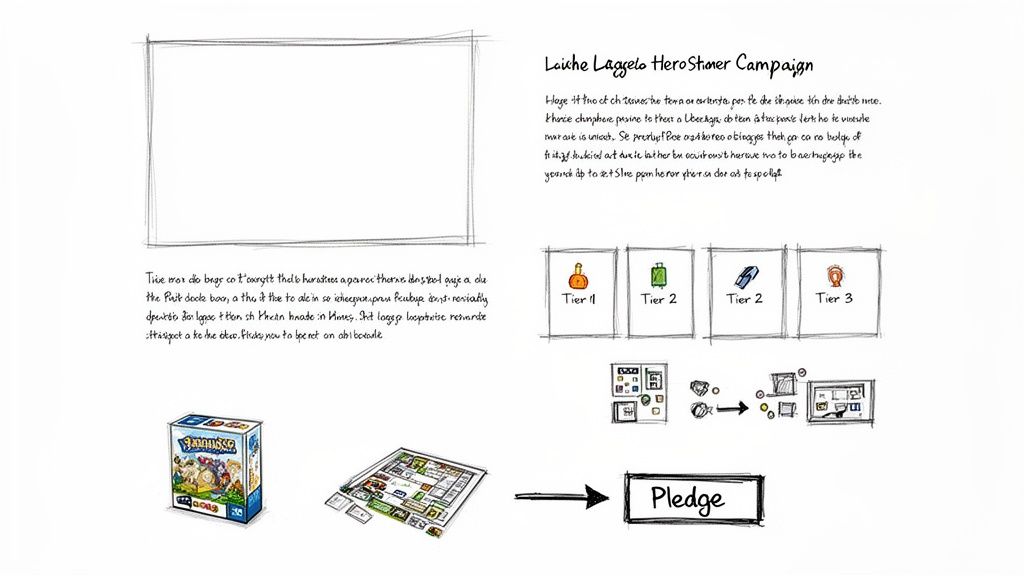
This visual-first approach helps backers quickly understand what they’re getting for their money. For more great ideas, check out our deep dive into Kickstarter campaign page design tips.
Setting up your reward tiers is part art, part science. You want to create a clear ladder of value that nudges backers toward the higher-priced options without overwhelming them. Keep the number of core tiers limited to avoid decision fatigue.
Here’s a structure that just plain works:
Make sure to use anchoring to show the value. Clearly display the future retail price (MSRP) next to the Kickstarter price. A simple banner that says "Save 30% off MSRP!" makes pledging feel less like a purchase and more like a smart investment.
Stretch goals are what keep a campaign exciting after it funds. They give your community something to rally behind and keep the energy high. Make sure you have a good list of these planned out before you launch. The best stretch goals are upgrades that improve the game for everyone, like thicker cardstock, a linen finish on the box, or upgraded wooden tokens instead of cardboard.
Add-ons, on the other hand, are optional buys that people can add to their pledge. Think custom dice, playmats, or an art book. They are a fantastic way to increase your average pledge amount without complicating your core reward tiers.
A critical part of the post-campaign process involves managing all these complexities. This is where the right pledge manager becomes essential. If you think of Kickstarter as the Amazon marketplace, a tool like the PledgeBox pledge manager is like Shopify. It gives you the control and customization to run your "store" your way, maximizing backer satisfaction and revenue.
Crucially, PledgeBox is free to send the backer survey and only charges a 3% fee on upsell funds raised, making it a financially smart choice for managing your growing community and their pledges.
You only have to look at titans like Brandon Sanderson's Cosmere RPG, which flew past $15 million, to see what happens when you tap into a massive, engaged fanbase. Projects like Frosthaven ($12M+) and Kingdom Death: Monster 1.5 ($12M+) show that sequels and niche games can also hit incredible numbers. The big lesson from these giants is the power of the post-campaign phase. Data shows that repeat backers can drive up to 68% of funds in some categories, which proves why having integrated tools for communication and upselling is so vital for long-term success.
You did it. Your tabletop game is funded, the confetti has settled, and you’ve hopefully taken a minute to breathe. Welcome to the next phase—where the real work of turning pledges into delivered games begins.
This post-campaign period is what separates the one-hit wonders from the publishers who build a loyal following. And your very first critical decision is which pledge manager you're going to use.
Many creators, especially on their first project, look at Kickstarter’s built-in survey tool and think, "Great, that's one less thing to worry about." While it can collect shipping addresses, it’s a blunt instrument for a job that needs surgical precision.
Think of Kickstarter as the perfect platform for bringing your idea to the world and getting it funded. It's a marketplace, not a fulfillment center. Once the campaign clock hits zero, its primary job is done.
This is where you'll feel the pinch. With the native tool, you can't easily upsell cool add-ons, open the doors for late pledges, or accurately charge for shipping after the campaign ends. If a backer makes a typo in their address? Get ready for a messy, manual back-and-forth that becomes a customer service nightmare when scaled across hundreds or thousands of backers.
A dedicated pledge manager is your command center for everything that happens next. It's a specialized platform built to handle the chaos of crowdfunding fulfillment, especially for physical products with all their logistical quirks. A good pledge manager lets you:
Here’s a simple way to think about it: if Kickstarter's pledge manager is like Amazon, the PledgeBox pledge manager is like Shopify. One is a basic, one-size-fits-all solution; the other gives you the power to customize the experience, maximize revenue, and build your brand.
For any serious tabletop game creator, a robust system isn't a luxury—it's essential. It professionalizes your entire operation and protects your hard-earned profits from being eaten away by shipping miscalculations and fulfillment errors.
The most crucial decision you'll make post-campaign is choosing the tool that will manage your backers, your funds, and your fulfillment data. This isn't just an administrative choice; it's a strategic one that directly impacts your profitability and reputation.
So, what holds creators back? Often, it's the perceived cost. Some pledge managers come with setup fees, per-backer fees, or take a cut of all your funds, including the money you raised on Kickstarter. That can be a tough pill to swallow right after a campaign.
Thankfully, the model is changing. For instance, PledgeBox is free to send the backer survey and only charges 3% of any new funds raised. This approach completely removes the financial risk. You can send surveys, collect shipping details, and manage all your backers without paying a dime. The platform only makes money when it helps you make more money through upsells and late pledges.
This transforms the pledge manager from a necessary expense into a powerful, risk-free profit center for your project.
To see the difference in black and white, here's a quick head-to-head comparison of what you get with Kickstarter's basic surveys versus a dedicated tool like PledgeBox.
| Feature | Kickstarter Surveys | PledgeBox |
|---|---|---|
| Backer Surveys | Basic, one-time send | Fully customizable, branded, multi-send |
| Shipping Collection | Must be estimated upfront | Collects exact fees post-campaign |
| Add-On Upsells | Not supported | Integrated, high-conversion upsell funnels |
| Late Pledges | Not supported | Built-in pre-order storefront |
| Address Validation | None | Google Maps integration to reduce errors |
| Cost Structure | Included with KS fee | Free to send surveys; 3% on new funds raised |
Ultimately, choosing a dedicated pledge manager is one of the clearest signs that a creator is thinking beyond just the funding goal. It shows you're focused on delivering an exceptional end-to-end experience for your backers, and it’s an essential upgrade for any modern tabletop games campaign.
Shipping is the silent killer of many promising tabletop game Kickstarters. After the high of a successful funding period, the stark reality of global logistics can quickly turn your dream project into a financial nightmare.
Getting this part right isn't just about mailing boxes. It's about protecting your profits, maintaining your reputation, and actually delivering on the promise you made to your backers.
The single biggest mistake new creators make is underestimating shipping costs. A guess or a rough estimate just won't cut it. You absolutely need to get accurate, hard quotes from fulfillment partners for every major shipping region before your campaign even launches. This data is what informs how much you charge for shipping in your pledge manager later on.
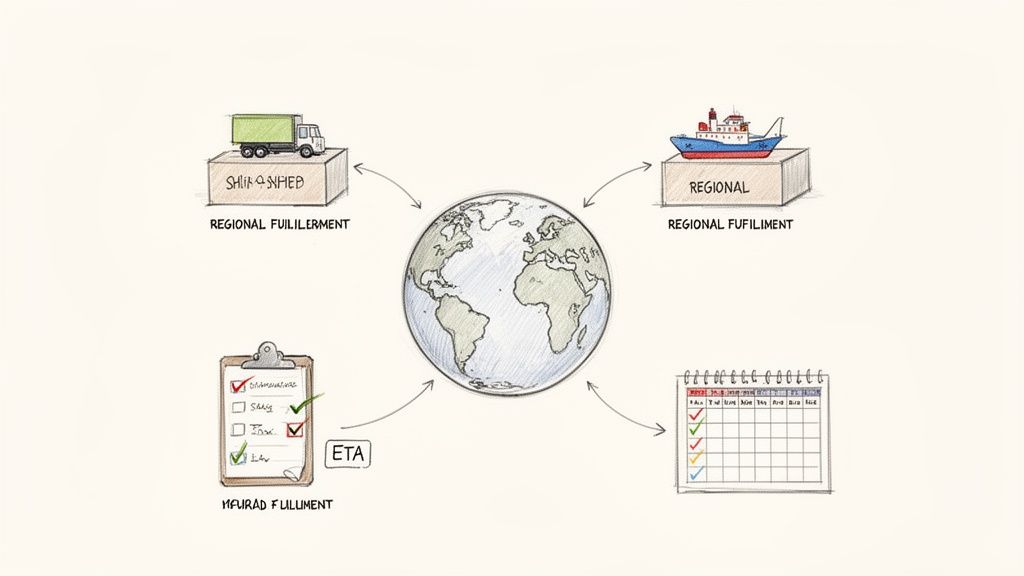
Think of a fulfillment partner as more than just a warehouse; they are your logistics command center. When you're vetting potential partners, you have to look beyond their basic storage and shipping rates.
Here are the critical factors to consider:
This process is about finding a true partner, not just a service provider. Their expertise can save you thousands in painful mistakes. To dive deeper, you can explore our in-depth look at the complexities of board game shipping.
For many creators, Value Added Tax (VAT) and other international taxes are an intimidating puzzle. But ignoring them isn't an option. Failing to collect and remit VAT correctly can lead to fines and your games getting stuck in customs, creating a terrible experience for your international backers.
The rules vary by country, but generally, you're responsible for collecting VAT based on the value of the pledge and shipping for backers in the EU and UK. Manually calculating this for hundreds or thousands of backers is a recipe for disaster.
This is another area where your pledge manager is indispensable. It can be configured to automatically apply the correct tax rates based on each backer's location, making sure you collect exactly what you need.
Using a pledge manager shifts the dynamic entirely. If you think of Kickstarter as the Amazon marketplace where the sale happens, a tool like the PledgeBox pledge manager is your Shopify backend. It gives you complete control over the post-sale experience, from accurate shipping and tax collection to upselling and brand building.
A smooth fulfillment process is a huge part of the overall backer experience. Constant, clear communication is everything. Let backers know when to expect their surveys, when you plan to lock addresses, and provide regular updates as you hit key manufacturing and shipping milestones.
Address management is another huge challenge. Backers move. They need a simple way to update their address, and a good pledge manager provides a self-service portal for them to make these changes themselves before you lock orders for fulfillment.
Furthermore, built-in address validation is an absolute lifesaver. This feature cross-references entered addresses with postal service databases, catching typos and formatting errors before they become returned packages. This small feature alone can slash the number of failed deliveries and customer service headaches you have to deal with.
Ultimately, mastering fulfillment comes down to proactive planning and using the right tools. When you use a system that automates the complexities of shipping, taxes, and address management, you free yourself up to focus on what matters most: communicating with your community and getting your incredible game into their hands. This professional approach builds trust and turns first-time backers into lifelong fans.
A successful tabletop games Kickstarter isn't the finish line; it's the starting gun for your brand. The second your campaign clock hits zero, your role changes. You're no longer just a creator with an idea—you're a publisher with a community of customers who bought into your vision. Your focus has to pivot from a one-time transaction to building a loyal fanbase that will jump on your next project without a second thought.
This shift from funding to fulfillment is where you truly earn your reputation. Backers have put their trust—and their cash—in your hands. The way you handle this post-campaign phase, from communication to navigating the inevitable bumps in the road, will decide if they're a one-time customer or a fan for life.
Your backers are now your single most valuable asset. They aren't just customers; they're your first believers, your sharpest critics, and your most fired-up evangelists. Keeping them in the loop isn't just good service—it's the bedrock of your long-term growth.
This all starts with consistent, high-quality post-campaign updates. Don't go dark for months. Share the whole journey, warts and all.
Every update is a chance to remind them why they backed you and to build anticipation for the day the game finally lands on their doorstep. This kind of open dialogue turns backers from passive funders into active partners in your journey.
What about everyone who found your game a day too late? That's where a late pledge page comes in. This isn't just about scooping up a few extra sales; it's your first real step into the world of direct-to-consumer (D2C) retail.
You need to see the post-campaign phase as a new beginning, not an end. If Kickstarter's pledge manager was the 'Amazon' that helped people discover you, the PledgeBox pledge manager is your 'Shopify'—it's where you build your own brand and control the entire customer experience.
This is where a tool like PledgeBox becomes indispensable. It lets you smoothly convert your campaign into a pre-order storefront. You can keep selling your game, offer exclusive add-ons, and grow your email list long after the Kickstarter timer runs out. Better yet, PledgeBox is free to send the backer survey and only charges 3% of upsell funds raised, making it a no-brainer for extending your campaign's revenue.
The data you gather during the post-campaign phase is absolute gold. By seeing which add-ons flew off the shelves and collecting feedback through your surveys, you get priceless insights into what your audience actually wants. This isn't just guessing—it's data-driven game development for your next project.
Keep that conversation going with your email list long after the games are delivered. Share news about potential expansions, tease early concept art for your next game, and invite your community to weigh in. Ask for their opinions. Make them feel like insiders in an exclusive club.
When you nail this, your next tabletop games Kickstarter won’t start from scratch. You'll be launching to a built-in audience of thousands of happy customers who are already excited to support you. They won't just pledge; they'll become your marketing team, creating the word-of-mouth buzz that powers a truly massive crowdfunding success. This is how you stop chasing one-off hits and start building a real, sustainable publishing business.
Running your first tabletop Kickstarter can feel like you're trying to solve a puzzle with half the pieces missing. New creators often run into the same roadblocks, from sorting out costs to figuring out campaign strategy. Let's tackle some of the biggest questions that pop up when you're trying to bring a board game to life through crowdfunding.
A huge source of confusion for many is what happens after the campaign ends. Specifically, everyone wants to know what they should really be paying for a pledge manager, since these tools have become pretty much non-negotiable for a modern campaign.
Pledge manager pricing can be all over the map, and some models are downright scary. You'll see platforms that want a fee for every single backer or even a slice of the total funds you raised on Kickstarter.
Thankfully, the trend is shifting toward models that are much friendlier to creators. PledgeBox, for instance, is free to send your backer survey and only charges a 3% fee on the upsell funds you raise. This means you can gather all your shipping info and manage your backers without any upfront cost. The tool only makes money if it helps you make more money through add-ons and late pledges. It's a no-brainer.
Think of it this way: Kickstarter's pledge manager is like the Amazon marketplace where the first transaction happens. The PledgeBox pledge manager is your personal Shopify backend, giving you total control over everything that comes next.
Hands down, the most common and devastating mistake new creators make is underestimating shipping and fulfillment costs. This is the silent killer that can vaporize your profit margins or, in a nightmare scenario, sink your entire project into debt.
Too many first-timers just guess at shipping rates or forget to factor in the messy details of VAT, regional taxes, and the reality of fluctuating carrier prices. You absolutely must get firm quotes from fulfillment partners for all your major shipping regions before you even think about hitting the launch button.
Stretch goals are an incredible way to build hype and keep the energy high during your campaign, but they can turn into a dangerous trap if you aren't careful. The temptation to over-promise with a long list of complex goals often leads to what we call "scope creep."
Suddenly, you're facing major production delays and surprise manufacturing costs that put your whole project on shaky ground. The smartest move is to plan a handful of meaningful, high-impact goals that genuinely make the game better for everyone without overhauling your production line. Always, always prioritize delivering a quality game on time over drowning your backers in extras.
For a deep dive into these topics with one-on-one support, resources like the Reddog Consulting Kickstarter Guide can offer personalized guidance built around your project's unique challenges.
Your pitch video is massively important—it's often the very first thing a potential backer sees on your page. No, it doesn't need a Hollywood-level budget, but it must clearly and quickly explain what your game is, who it's for, and why they should be excited to back it.
A great video shows off the cool components, gives a glimpse of gameplay, and—most importantly—lets your passion for the project shine through. Authenticity and clarity will always beat slick production values.
Ready to streamline your next campaign? With PledgeBox, you can build your pre-launch audience, manage backers, and boost revenue with powerful upsell features. Send your surveys for free and only pay a small fee on the extra funds you raise. See how it works at https://www.pledgebox.com.
PledgeBox
The All-in-One Toolkit to Launch, Manage & Scale Your Kickstarter / Indiegogo Campaign