 PledgeBox
How to Publish a Board Game A Creator's Guide to Success
Discover how to publish a board game from concept to crowdfunding. This guide covers design, manufacturing, Kickstarter, and fulfillment for creators.
Discover how to publish a board game from concept to crowdfunding. This guide covers design, manufacturing, Kickstarter, and fulfillment for creators.
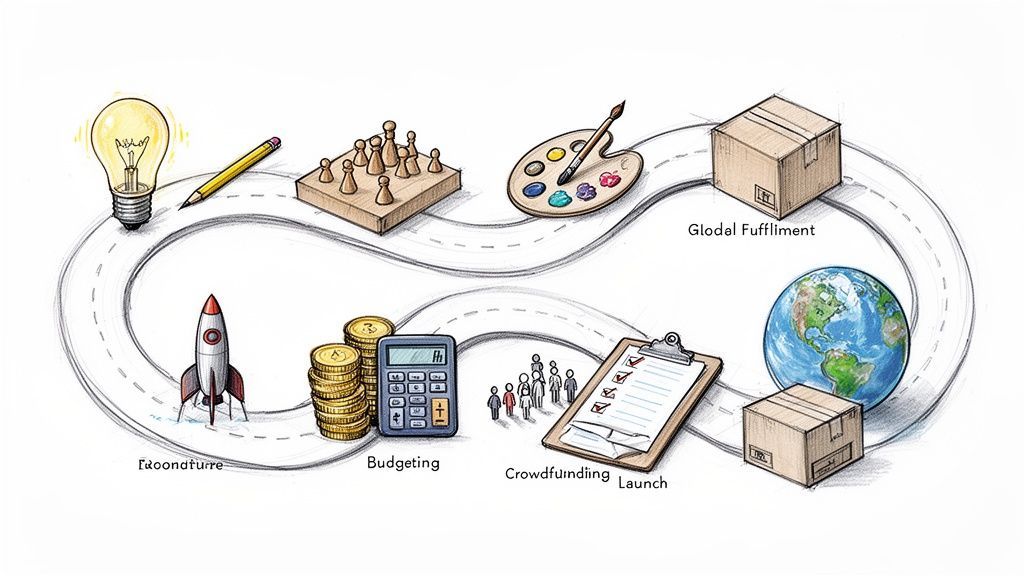
Publishing a board game isn't just one big step; it's a marathon of smaller, crucial stages. You'll take your idea from a simple concept to a physical product, run it through the gauntlet of playtesting, secure funding, find a manufacturing partner, and finally, tackle the beast of global shipping and fulfillment.
But here’s the most important piece of advice I can give you: the entire process hinges on validating your game with real players before you pour a single dollar into professional art or a production run.
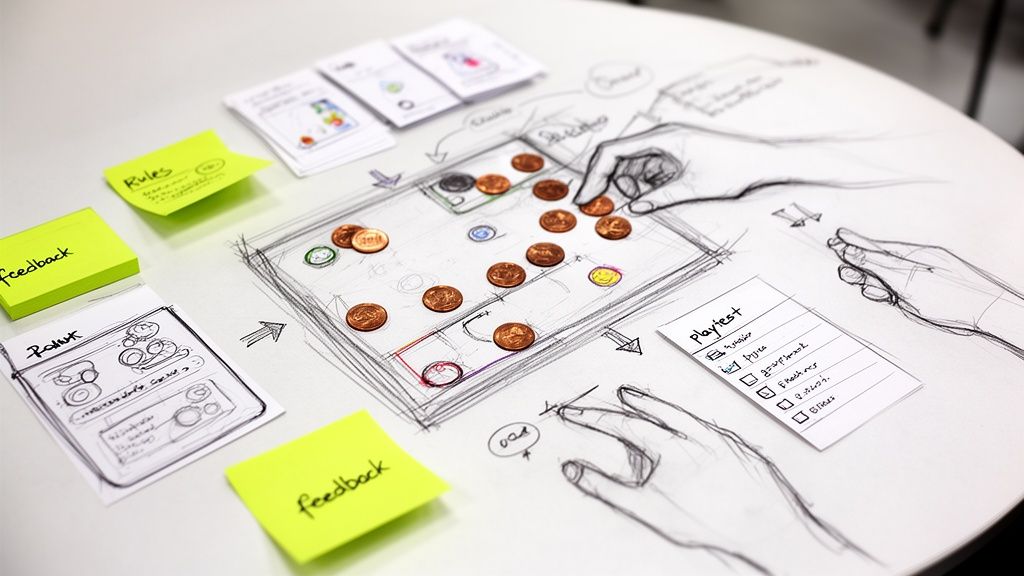
Every amazing board game starts its life as a rough, playable experiment. That brilliant idea you have for a new mechanic or a cool theme? That's just the spark. The real work—and your first major test—is turning that spark into something tangible that people can actually get their hands on and play.
This first version is your prototype. Its only job is to test the core mechanics of your game. Forget about beautiful art, slick graphic design, or fancy components for now. Your first prototype should be scrappy, functional, and built with whatever you can find.
Right now, your motto should be "fast and messy." The goal is to get the game on the table as quickly as humanly possible to see if the core ideas even work. Perfectionism is your enemy at this stage.
This low-cost, low-effort approach means you can make changes on the fly. If a card feels way too powerful in a playtest, you can literally rip it up and scribble a new one in seconds. This kind of flexibility is priceless for refining your game quickly.
Once you have a playable (if ugly) version, it's time for the most critical phase of all: playtesting. This is where your brilliant idea meets the cold, hard reality of other people. Your goal isn't to win or to prove your game is fun. It's to watch, listen, and ruthlessly hunt down every point of friction or confusion.
Start with close friends or family—people you trust to give you honest, even blunt, feedback. As the game gets more solid, you need to move on to "blind playtesting." This is where you hand the rulebook to a group of strangers and just watch them play without any help from you. It’s the ultimate stress test for your rules and the game's intuitive design.
I see so many first-time designers make this mistake: they defend their rules during a playtest. Your job isn't to explain what players should be doing. It's to figure out why they're confused and then fix the root problem in the game itself.
After every session, gathering structured feedback is key. Hearing people talk about the game is great, but written surveys can often give you more detailed and thoughtful insights. If you need some ideas on how to set this up, check out our guide on designing an effective survey for playtest feedback on your board game.
This cycle of building, testing, and tweaking is the heart and soul of creating a successful board game. Each session will expose broken mechanics, confusing rules, or just plain boring moments. By tackling these issues one by one, you'll slowly polish your rough idea into a balanced, engaging experience that backers will be genuinely excited to support.
You’ve done it. You’ve refined your prototype, waded through tons of playtest feedback, and climbed the creative mountain. Now comes a completely different beast: the logistics and finances of turning your one-of-a-kind creation into thousands of identical copies. This is where your passion project starts to feel like a real business, and it demands a sharp pencil and an even sharper eye for detail.
Getting your board game published really boils down to two critical pieces: a rock-solid budget and a manufacturer you can trust. If you get either one wrong, your entire project can go sideways before you even launch. Let's be real—creating a board game is almost always more expensive than first-time creators think.
Underestimating expenses is probably the most common—and fatal—mistake I see in board game crowdfunding. Your funding goal isn't just what it costs to make the game. It's the cost to make it, ship it, fulfill it, pay fees, and have a cushion for all the things that will inevitably go wrong.
A truly comprehensive budget needs to account for all the sneaky costs hiding in the shadows:
My best advice? Build a contingency fund of at least 10-15% of your total estimated costs. Delays, customs hold-ups, or a batch of misprinted cards can happen. That buffer is what will save your project from disaster.
With a budget in hand, you can start looking for a manufacturing partner. Think of this as a long-term relationship. You need trust, great communication, and a shared commitment to quality. You aren't just buying a product; you're handing your baby over to someone else.
The first step is to get quotes from multiple factories—I’d recommend at least three to five. This gives you a realistic price range and helps you spot any lowball or sky-high offers. When you request a quote, be obsessive about the details. Give them a complete list of every component, precise dimensions, material specs (like cardstock GSM and finish), and your estimated print run.
Once the quotes start rolling in, don't just jump at the lowest price. Here’s what you should really be looking at:
It also really helps to understand the lingo. Knowing the practical differences between digital printing vs offset printing will help you make smarter cost and quality decisions when you’re negotiating. If you want a more detailed breakdown, our guide on how to start manufacturing in 5 steps for Kickstarter campaigns is a great resource. Nailing this partnership is an absolute cornerstone of getting your board game published successfully.
You’ve got a polished prototype and your budget is locked in. Now it’s time to step into the arena where most indie board games are born: crowdfunding. Platforms like Kickstarter and Gamefound have become the proving grounds for new creators, but the good news is you’re in the driver's seat.
Success here is almost never an accident. It’s the result of months of careful planning and momentum building, long before your campaign page ever sees the light of day.
Think of crowdfunding as your first big marketing push. It's where you find your people, build a community around your game, and get real-world validation that others are just as excited about your idea as you are. The competition is fierce, so just showing up on launch day isn't enough. Your real work starts now.
The single biggest predictor of a successful campaign? Having a crowd of eager backers ready to hit that pledge button the moment you go live. A strong start creates a powerful snowball effect—it signals to the platform's algorithm and curious onlookers that your project is a hot ticket.
Hands down, the most valuable asset you can build before you launch is an email list.
Your pre-launch strategy should boil down to a couple of key activities:
Putting in this groundwork is non-negotiable. For a deeper dive into these tactics, our guide on how to build a list of potential backers before your Kickstarter campaign launches lays out a fantastic roadmap.
For years, Kickstarter was the undisputed king of board game crowdfunding. While it still hosts the largest volume of projects, Gamefound—created by the publisher of major hits like Tainted Grail—has emerged as a powerful, specialized alternative. Knowing the landscape can help you decide where your game fits best.
| Metric | Kickstarter (Recent Data) | Gamefound (Recent Data) |
|---|---|---|
| Total Projects (Board Games) | Consistently hosts thousands of projects annually. | Fewer projects, but highly curated and often larger in scale. |
| Average Funding Per Project | Lower average due to a high volume of smaller projects. | Higher average, attracting more established publishers. |
| Success Rate | Roughly 40-50% for tabletop game projects. | Higher success rate, but fewer projects are launched. |
| Backer Demographics | Broad, diverse audience; less specialized in board games. | Niche audience of dedicated board game enthusiasts. |
| Built-in Tools | Basic project management; relies on third-party pledge managers. | Integrated pledge manager and robust post-campaign tools. |
While Kickstarter offers a massive potential audience, Gamefound provides a more tailored experience for both creators and backers who are serious about the hobby. The choice often comes down to whether you want to cast a wide net or fish in a well-stocked pond.
Your campaign page is your digital storefront, and you have just seconds to hook a potential backer. It needs to tell a story, look professional, and make it crystal clear why someone should give you their money.
A killer page needs these elements:
This flowchart breaks down the major cost centers that will directly shape your funding goal and campaign strategy.
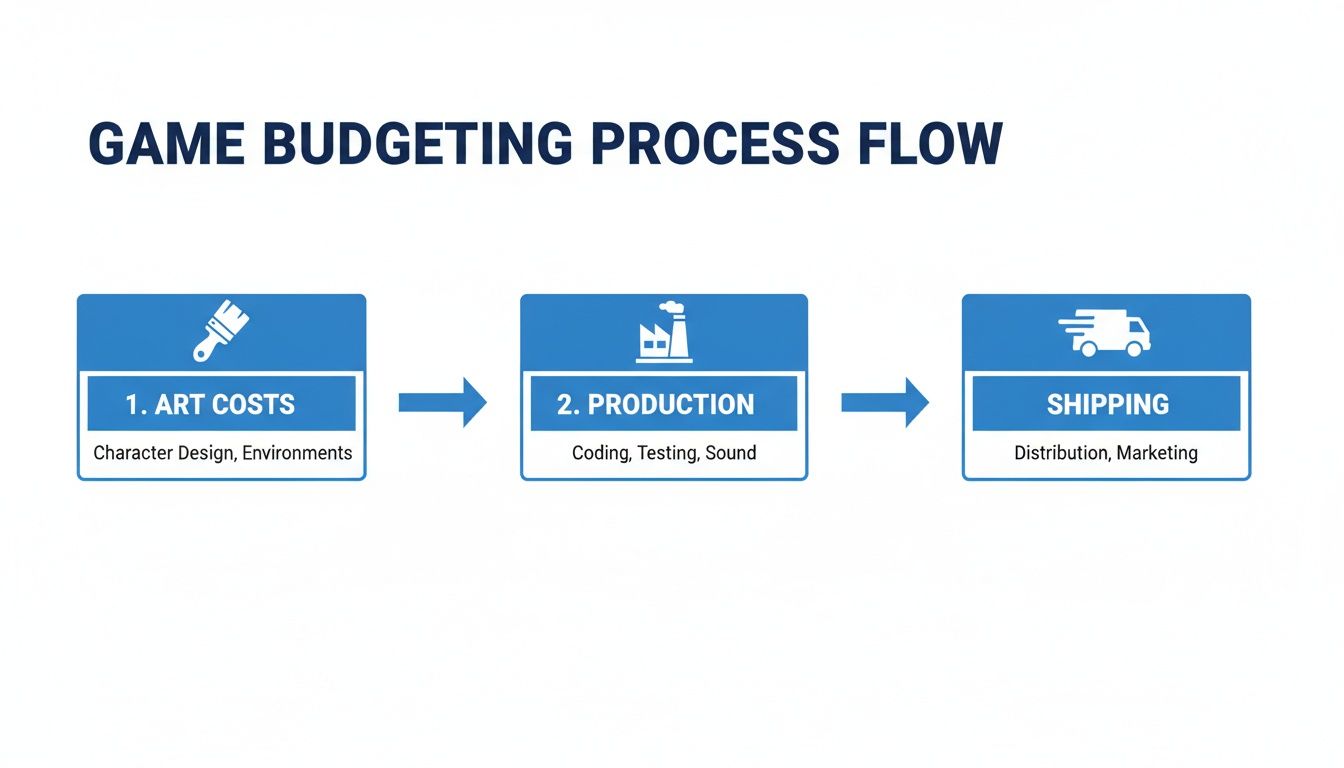
Getting a handle on these core budget items—art, production, and shipping—is absolutely essential for setting a realistic funding goal that actually ensures you can deliver your game.
Your funding goal should be the absolute minimum amount you need to manufacture and deliver the game, period. That includes platform fees, payment processing fees, and a healthy contingency buffer for unexpected problems. It’s tempting to set a low goal to fund quickly, but if that number doesn’t cover your real costs, you're just crowdfunding your own failure.
Stretch goals are a fantastic tool for keeping the energy high after you've funded. But be warned: they're also a classic trap that can add crippling complexity and cost, a problem we call "scope creep."
A poorly planned stretch goal can absolutely sink a project. Adding custom miniatures or a whole new deck of cards sounds amazing, but it can easily add months to your production timeline and thousands to your budget. Always design stretch goals that add real value without putting fulfillment at risk.
The best stretch goals are often simple component upgrades (like thicker cardstock or a linen finish) or small additions that don't require new manufacturing molds or a ton of new art. They should feel like a reward for the community's success, not a last-minute design change you haven't budgeted for.
You’ve hit your funding goal—congratulations! But the real work is just beginning. How you manage things after the campaign wraps up can make or break your project's long-term success. Now it's all about keeping your backers happy while finding smart ways to drive a little extra revenue.
Think of the Kickstarter pledge manager like Amazon—it's a massive, one-size-fits-all marketplace that's functional but lacks customization.
This is where a dedicated pledge manager like PledgeBox comes in. If the Kickstarter pledge manager is like Amazon, then PledgeBox is like Shopify—it’s a powerful platform that gives you complete control to build your own post-campaign storefront.
It’s completely free to send your backer survey, and PledgeBox only charges a small 3% fee on any funds raised from upsells. There are no hidden setup costs or per-backer fees, which is a huge advantage for creators managing a tight budget.
This opens up a ton of possibilities. You can easily add new pledge levels, offer exclusive add-ons, and even capture late pre-orders long after your Kickstarter campaign has officially ended.
The clock hitting zero on your campaign doesn't mean the interest disappears. In fact, millions of dollars flow in from late pledges after campaigns close.
This post-campaign window is a goldmine for publishers looking to boost their final numbers and give enthusiastic fans another chance to get on board. A powerful pledge manager automates everything from upsell workflows and VAT collection to shipping fee calculations and backer communication, making this process incredibly smooth.
Millions of dollars are raised from late pledges after campaigns end, proving backers keep spending long after the initial funding period. You can learn more about these late pledge findings on BoardGameWire.
When it comes to delivering your board game, clear communication is everything. It’s how you maintain trust and keep your backers feeling confident.
I recommend segmenting your survey by pledge level. This simple step helps avoid confusion and makes your data collection way more accurate. Tools that offer automated reminders and customizable deadlines are also a lifesaver, encouraging backers to respond promptly without you having to chase them down manually.
Here’s a quick look at how the basic Kickstarter survey stacks up against a dedicated pledge manager.
| Feature | Kickstarter Survey | PledgeBox Manager |
|---|---|---|
| Custom Branding | No | Yes |
| VAT & Tax Automation | No | Yes |
| Survey Cost | Free | Free (3% on upsells) |
| Upsell Fee Structure | N/A | 3% |
| Data Export | Limited CSV | Full Export & Reports |
Getting post-campaign management right is a critical step in learning how to publish a board game successfully.
By using a dedicated pledge manager, you turn that initial Kickstarter momentum into continuous growth and build incredible backer loyalty. With a tool like PledgeBox handling the tedious surveys, upsells, and logistics for no upfront cost, you can keep your creative focus right where it belongs: on the game itself.
Connecting your pledge manager to your shipping partners will also dramatically reduce errors and speed up your entire delivery cycle.
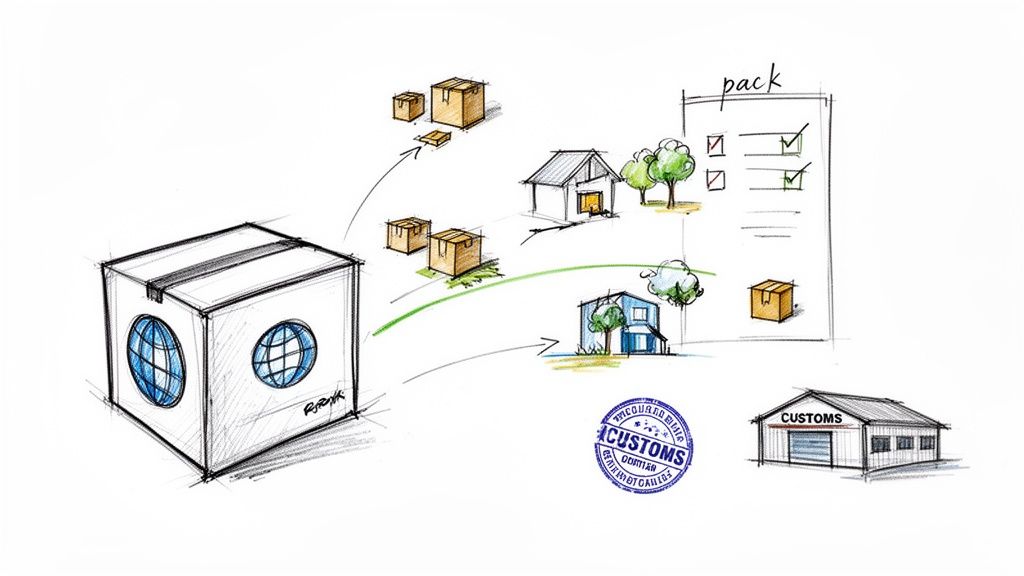
Shipping your game from an overseas factory into the hands of backers around the globe feels like a huge milestone—but it’s where many creators stumble.
A slick fulfillment process can turn one-time backers into lifelong fans. Delays or hidden charges? That can undo all the hard work you poured into your campaign.
You’ve got a few options, each with trade-offs in cost and complexity. Unless you’ve got a warehouse at home, DIY shipping hundreds or thousands of boxes isn’t realistic.
Choosing the right fulfillment partner is as important as choosing your manufacturer. Look for companies with a proven track record in crowdfunding and board games; they know how to handle complex orders and multiple add-ons.
If you’re eyeing market growth in regions like North America and Asia-Pacific, a solid global shipping plan is non-negotiable. You can explore more about these market trends and their implications for creators at Stonemaier Games.
Getting accurate postage quotes starts with the final, packaged weight and dimensions of your game—not your tabletop prototype.
Failing to capture the right figures can leave you scrambling at the last minute. A robust pledge manager automates VAT and postage calculations for dozens of countries, saving you hours of spreadsheet agony.
A good pledge manager:
Your game box will travel far and wide, so protect it every step of the way.
Clear communication ties it all together. Send updates when the games leave the factory, hit the dock, land at each hub, and roll out local shipping. Even if there’s a hiccup, transparency keeps backers engaged—and ready to back your next project.
Diving into your first board game project can feel like navigating a maze. Let's clear up some of the biggest questions creators have on the journey from idea to a finished game.
There’s a huge range here, but a typical campaign budget falls somewhere between $10,000 and $50,000, sometimes even more. The big-ticket items are always art, manufacturing, shipping, and marketing.
Art alone can easily run from $2,000 to $10,000+, all depending on the artist and how much work is needed. And don't forget freight shipping—that can tack on another $2,000 to $8,000. It's crucial to map this all out before you even think about a funding goal.
Always, always build in a contingency buffer of at least 10-15%. Trust me, unexpected fees or delays will pop up.
Your main costs will be:
This is the classic dilemma. Self-publishing through crowdfunding gives you total creative freedom and much better margins, but it also means all the risk and work lands on your shoulders. Going with a traditional publisher means they handle the heavy lifting—manufacturing, logistics, marketing—but you'll share revenue and give up some creative control.
If you do go the self-publishing route, you'll need a solid plan for after the campaign ends. Kickstarter's built-in survey tool is, frankly, pretty basic. It gets the job done, but it's not flexible. A dedicated pledge manager like PledgeBox is a game-changer. You can send your backer surveys for free and only pay a 3% fee on any extra money you make from upsells, if there are any. It handles VAT collection, tricky shipping calculations, and address validation all in one place.
Underestimating shipping costs is the number one profit killer. It happens all the time and can wipe out your margins in a flash. Another common misstep is launching with zero audience, which, combined with an unrealistic funding goal, is a recipe for a failed campaign.
Poor communication after the campaign ends is another big one. It erodes trust and causes delays. This is where a robust pledge manager like PledgeBox really shines. It automates surveys, VAT, and late pledges, saving you headaches while actually boosting your revenue. If you test your survey setup early and are crystal clear with your shipping estimates, you’ll sidestep most backer frustrations.
“Missing a clear shipping plan and survey system is how many projects stall, not funding.”
On Kickstarter, visuals are everything. It’s not an exaggeration to say they are mission-critical. Good art is what stops the scroll. It sells your theme and instantly tells backers that you're serious about quality.
Investing in a talented artist and graphic designer with board game experience almost always delivers the highest return on investment for your campaign. They can create stunning mockups and a solid style guide that keeps your whole project looking cohesive. It shows backers you mean business, and that confidence translates directly into more pledges.
Keep these insights in mind, and you'll be able to confidently navigate the path from a simple concept to delivering a game to backers' doorsteps. With the right planning and tools, your game can and will make it to tables around the world. Good luck.
Ready to level up your post-campaign management with free surveys and worry-free upsells? Try PledgeBox.
PledgeBox
The All-in-One Toolkit to Launch, Manage & Scale Your Kickstarter / Indiegogo Campaign