 PledgeBox
Your Guide to the Crowdfunding Platform Kickstarter
Master the crowdfunding platform Kickstarter. Our guide offers proven strategies for launching, funding, and successfully managing your next project.
Master the crowdfunding platform Kickstarter. Our guide offers proven strategies for launching, funding, and successfully managing your next project.
Kickstarter is a global crowdfunding platform where creators bring their projects to life with direct funding from a community of backers. Its whole identity is built around a single, powerful concept: the "all-or-nothing" funding model. If a project hits its funding goal by the deadline, the creator gets the money. If it falls even a dollar short, nobody gets charged.
At its core, Kickstarter is a bridge. It connects creators with wild, innovative ideas to a global community that's genuinely excited to help make them happen. Think of it as a launchpad for everything from clever board games and futuristic tech gadgets to indie films and ambitious art installations. Creators build a dedicated page for their project, offering unique rewards to backers in exchange for their financial pledges.
This model is an incredible way to test the waters and validate a product idea before sinking a ton of cash into a massive production run. Since launching back in 2009, Kickstarter has become a crowdfunding giant. It's been home to over 651,000 projects, with backers from all over the world pledging more than $8.53 billion.
Here's the kicker: its success rate hovers around 42%. That's nearly double the industry average for crowdfunding, and it’s a direct result of the trust built by its all-or-nothing system.
This signature policy is really what makes Kickstarter tick. It creates a low-risk, high-trust environment for everyone involved.
This structure naturally pushes creators to set realistic, achievable goals. It also forces you to build a passionate community around your project—you need that groundswell of support to get across the finish line. The entire journey, from idea to delivery, is a pretty straightforward process.
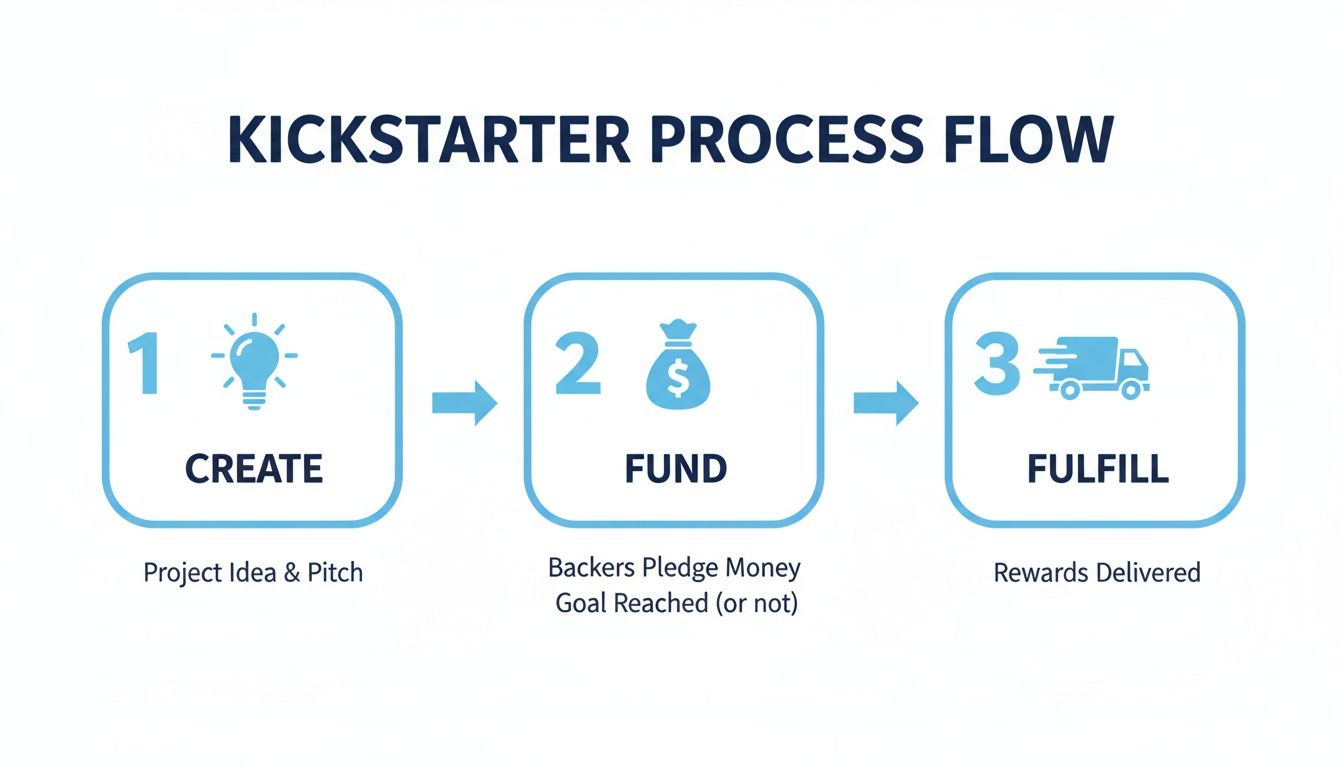
This simple flow—Create, Fund, Fulfill—is a good reminder that the campaign itself is just the middle piece of a much bigger puzzle. The real work starts long before you launch and continues long after the funding period ends.
Let's break down these core ideas into a quick-reference table.
| Concept | What It Means for Creators |
|---|---|
| All-or-Nothing Funding | You must meet or exceed your funding goal to receive any money. This forces realistic planning and community building. |
| Project Page | Your central hub for storytelling, showcasing your product, and outlining rewards. It's your primary sales tool. |
| Backers | Your community of supporters. They aren't just customers; they are early adopters who are invested in your journey. |
| Rewards | The products or experiences you offer in exchange for pledges. These need to be compelling and well-structured. |
| Fulfillment | The final, crucial step of producing and shipping rewards to your backers. Don't underestimate the complexity here. |
This table covers the basics, but what happens after the campaign is successfully funded is a whole different ballgame.
While Kickstarter gives you the stage, managing all the details after the curtain closes can get complicated fast. This is where specialized tools called pledge managers come into the picture.
Think of it this way: Kickstarter's pledge manager is like Amazon—a standardized marketplace. A pledge manager like PledgeBox is like Shopify—your own powerful, customizable post-campaign storefront that gives you far more control.
A critical difference is the cost. PledgeBox is free to send the backer survey—you only pay a 3% fee of the upsell if there's any. This makes it a no-risk way to organize fulfillment and actually boost your final revenue.
This kind of tool gives you the flexibility to handle complex shipping calculations, collect final order details, and let backers purchase add-ons with ease. To get a better sense of how different platforms operate, check out our deep-dive guide comparing Kickstarter vs Indiegogo and see which one fits your project best.
Before you even think about hitting that "launch" button, you need to get real about the numbers. A successful Kickstarter campaign isn't just about the thrill of hitting your funding goal; it's about what's left in the bank after everyone takes their cut. So many promising projects stumble here because they miscalculate the costs.
Kickstarter’s fee structure is pretty straightforward. If your project gets funded, they take a 5% platform fee right off the top. Then, their payment partner, Stripe, takes its own slice for processing all those backer payments. This usually adds up to another 3-5%, depending on where your backers are from.
So, what does that mean for you? Plan on 8-10% of your total funds vanishing into fees. If you raise $10,000, that’s anywhere from $800 to $1,000 you'll never see. You absolutely must build this into your funding goal from day one. For a deep dive into mapping out all these costs, check out our guide on crafting a Kickstarter project budget.
Knowing where the money goes is one thing; knowing where it comes from is another. Kickstarter is home to all sorts of creative endeavors, but a few categories consistently pull in the big bucks. The data is clear: tangible, product-focused projects are what get the Kickstarter community excited.
Games are the undisputed king of the platform. This one category has raked in a mind-boggling $2.63 billion in pledges over its lifetime. To put that in perspective, Design comes in second at $1.78 billion, followed by Technology at $1.66 billion. In fact, a staggering 92% of all projects on Kickstarter belong to just these three categories, which tells you a lot about what backers are shopping for.
So, what’s their secret sauce?
This doesn't mean you can't succeed with a film or a comic book, but it’s a crucial insight into the mindset of the typical Kickstarter backer.
Don't close your spreadsheet just because the campaign timer hits zero. Some of your most important financial moves happen after you’re funded, during the fulfillment stage. This is where a pledge manager becomes your best friend, helping you protect your budget and even grow your final revenue.
Think of it this way: Kickstarter's pledge manager is like Amazon, a standardized marketplace. A dedicated pledge manager like PledgeBox is more like Shopify, giving you your own powerful, customizable storefront for managing backers, collecting shipping, and upselling more products.
The best part is how it impacts your bottom line. With PledgeBox, it’s completely free to send the survey to all your backers. The platform only charges a 3% fee of the upsell if there's any. This model lets you offer extras, charge accurate shipping, and handle taxes without any upfront cost, turning fulfillment from a logistical headache into one last chance to boost your project’s success.
The confetti has settled, you’ve smashed your funding goal, and the campaign clock has finally hit zero. It’s an incredible moment, for sure. But for a Kickstarter creator, this isn't the finish line—it's the starting gun for the most critical phase of all: fulfillment.
Many first-time creators make the mistake of thinking the hard part is over. In reality, your journey just shifted from fundraising to full-blown project management. Your backers have put their trust—and their money—in your hands. Now it’s time to deliver on your promise, which is a massive logistical puzzle involving manufacturing, quality control, shipping, and a whole lot of communication.
Without a rock-solid plan, this fulfillment phase can quickly spiral into a nightmare. A few common pitfalls can turn a celebrated success into a backer relations disaster. Miscalculating shipping costs is a classic one; what feels like a tiny error per backer can wipe out your entire profit margin when multiplied by thousands of shipments.
Production delays are another huge hurdle. Unexpected issues with a manufacturing partner can easily push your delivery date back by months, leaving you with a growing chorus of frustrated backers. Clear, proactive communication is your only real defense here, but trying to manage thousands of individual messages and address updates without the right system is next to impossible.
A robust post-campaign strategy isn't just a "nice-to-have"—it's an essential component of a successful project. Neglecting this phase is one of the quickest ways to disappoint the community that brought your idea to life.
To get a handle on all this complexity, you need a tool built specifically for the job. This is where a pledge manager becomes your best friend.
So, what is a pledge manager? It's a specialized software tool that helps you organize all your backer information, collect final details, and manage the entire fulfillment process after the campaign ends. While Kickstarter has its own basic survey tool to collect shipping addresses, it's often not powerful enough for projects with even a moderate amount of complexity.
Here’s a good way to think about it: Kickstarter’s pledge manager is like Amazon—a standardized, one-size-fits-all marketplace with limited flexibility. A pledge manager like PledgeBox, on the other hand, is like having your own Shopify store. You get complete control to create a customized, branded experience for your backers long after the campaign is over.
With a pledge manager, you can:
Best of all, a powerful pledge manager doesn't have to sink your budget. For instance, PledgeBox is completely free to send the backer survey. The platform only charges a 3% fee of the upsell if there's any. This no-risk model makes it a no-brainer for creators looking to simplify fulfillment and even increase their funding after the campaign has officially closed. It turns a logistical headache into one last opportunity for growth.
Once your Kickstarter project is funded, the real work begins. You're now faced with a decision that can make or break your entire fulfillment phase: stick with Kickstarter’s built-in survey tools, or upgrade to a specialized pledge manager? It’s a choice many new creators overlook, but it can be the difference between a smooth delivery and a logistical nightmare.
Think of it this way. Kickstarter's pledge manager is like running a stall in a giant, pre-built Amazon marketplace. It’s functional, sure, but you’re stuck with their rules and layout. You get a basic, one-size-fits-all setup that gets the job done, but with very little flexibility.
A dedicated pledge manager like PledgeBox, on the other hand, is like setting up your own beautiful, custom Shopify store. You're in complete control. You can design the experience, offer more products, and turn a simple data-gathering chore into one last chance to boost your campaign's revenue.
Kickstarter’s own tools are built for simplicity, but that simplicity comes with serious handcuffs. Their survey system is completely closed off to upselling or add-ons, which means you’re leaving money on the table. The questions are rigid, and once a backer submits their address, changing it becomes a manual headache for both of you. This is a recipe for shipping mistakes and unhappy supporters.
This is exactly where a dedicated pledge manager shines. Tools like PledgeBox are designed specifically to solve these problems. They let you set up a seamless upsell flow where backers can easily add extra items to their pledge after the campaign is over. Address management becomes a breeze, as backers can log in and update their own details right up until you lock orders for shipping. You also get access to analytics that give you much clearer insights into your community. To help manage all these moving parts, exploring task management integrations can also save you a ton of time.
The best part? The financial model is a no-brainer. PledgeBox is completely free to send the backer survey to all of your supporters. It only charges a 3% fee of the upsell if there's any, making it a zero-risk tool for maximizing revenue and streamlining fulfillment.
This pricing model means there’s no upfront cost, so you can adopt a professional-grade tool without digging into your campaign funds.
To really see the difference, let’s put the two options side-by-side. When you look at the features that matter most after a campaign, the choice becomes crystal clear.
Here's a quick look at how Kickstarter’s built-in survey stacks up against a purpose-built tool like PledgeBox.
| Feature | Kickstarter's Native Tool | PledgeBox |
|---|---|---|
| Upselling & Add-ons | Not supported. You cannot offer additional items post-campaign. | Fully supported. Create a custom storefront to sell more products. |
| Address Management | Rigid. Backer addresses are difficult to change after submission. | Flexible. Backers can update their own addresses until shipping lock. |
| Shipping Calculation | Basic. Does not handle complex, weight-based, or regional rates well. | Advanced. Calculates precise shipping costs based on location and items. |
| Backer Communication | Limited to Kickstarter's messaging system. | Centralized communication with automated reminders and updates. |
| Cost to Use | Included in the 5% platform fee. | Free for surveys; 3% fee only on funds from upsells. |
As the table shows, a pledge manager isn't just a "nice-to-have"—it's an essential tool for any serious creator. It’s an investment in your project's success and, frankly, your own sanity.
Properly managing this final stage is critical for building a brand that backers will trust again and again. For a deeper dive, our guide on how to select the right pledge manager can help you identify the features your project needs most. With the right tools, you can transform post-campaign management from a chaotic chore into a controlled, profitable, and professional operation.
Thinking of launching a project on Kickstarter? It’s a lot more than just hitting ‘publish’ and hoping people show up. The truth is, a winning campaign is a carefully planned event, and most of the heavy lifting happens long before you even think about launching. This playbook will walk you through the entire lifecycle, step by step.
It all starts in the pre-launch phase. This is where you build your army. The goal here is to create a core group of excited fans who are ready to back your project the moment it goes live. Start with a solid landing page to collect email addresses—this is still one of the best ways to drive that crucial day-one funding. Pair that with a consistent social media game to build buzz and share the story behind what you're creating.
Once you've got an audience waiting, your project page becomes your single most important sales tool. Every single element needs to work together to build trust, generate excitement, and convince visitors to click that "Back this project" button. A high-quality project video isn't just a nice-to-have; it's a must. This is your chance to connect with people, show your passion, and prove you know what you're doing.
Your writing needs to be just as sharp. Clearly explain what you're making, why it's important, and who you are. Don't just throw up a wall of text. Break it up with images, GIFs, and graphics to make the page easy to scan and visually interesting.
"The page should be an extension of that game—the first place where someone can immerse themselves in the theme, mechanics, and fit-and-finish of the game. Even the best games don’t sell themselves." - Asher McClennahan, Kickstarter’s Head of Games
That feeling of immersion should carry right over to your reward tiers. They need to be irresistible. Think carefully about how you structure them to guide backers toward the pledge level you want them to choose. Avoid huge price jumps. Instead, create a smooth path where each step up offers a clear and compelling reason to upgrade. The last piece is a realistic funding goal that covers all your costs—manufacturing, fees, and shipping—without looking like an impossible mountain to climb.
The launch is just the starting line. Every campaign hits a slow patch in the middle, famously known as the "mid-campaign slump." You need a plan to push through it. Regular, meaningful updates are your best weapon here. Share behind-the-scenes looks, celebrate milestones, and jump into the comments to answer questions.
Engaging with your community shows you're invested and listening. Stretch goals are another great way to inject new energy, but don't reveal them all at once. Announce them one at a time as you approach funding milestones. This creates a constant sense of forward motion and gives backers new reasons to share your project. It's all part of the strategy for finding funding for your projects.
When the countdown finally hits zero, a whole new phase of work begins. While Kickstarter has its own built-in tools, managing fulfillment for a complex project often demands something more robust. This is where a pledge manager like PledgeBox comes in. You can think of Kickstarter’s pledge manager like Amazon—it's a standardized, one-size-fits-all solution. PledgeBox, on the other hand, is more like Shopify, giving you a customizable storefront just for your backers.
This approach brings some huge benefits. For starters, PledgeBox is free to send the backer survey, so you can get organized without any upfront cost. The platform only charges a 3% fee of the upsell if there's any, which turns the logistical headache of fulfillment into one last chance to boost your revenue.
Diving into your first crowdfunding platform Kickstarter project can feel like navigating uncharted territory, and it's natural to have a lot of questions. We've compiled some of the most common queries from creators and backers to give you clear, straightforward answers and help you launch with confidence.
Got questions about running a successful Kickstarter campaign? We’ve got answers.
| Question | Answer |
|---|---|
| What happens if my project doesn’t reach its goal? | Kickstarter is "all-or-nothing." If you don't hit your funding goal, no money changes hands. Backers aren't charged, and you don't pay any fees. It's a safety net for everyone involved. |
| Can I change my goal or rewards after launch? | Your funding goal and existing reward descriptions are locked in once you go live. You can, however, add new reward tiers. This is why careful planning is so critical. |
| How much should I set for my funding goal? | Your goal should be the absolute minimum you need to produce your project and fulfill all rewards. This includes manufacturing, shipping, taxes, and fees (Kickstarter’s 5% plus 3-5% for payment processing). |
| Is a pledge manager necessary for every project? | While not mandatory, it's a game-changer for projects with multiple rewards, add-ons, or international shipping. It handles all the post-campaign logistics so you can focus on creating. |
Let's dive a little deeper into some of these key points.
Kickstarter operates on an "all-or-nothing" funding model. It’s pretty simple: if your campaign falls short of its financial goal by the deadline, no one is charged a dime. Your backers keep their money, and you won’t owe any platform fees.
This system is a built-in safety net. It protects creators from the nightmare of trying to fulfill rewards without enough money, and it assures backers that their pledge will only be used if the project gets the green light.
Once your campaign is live, your funding goal and the descriptions for your existing reward tiers are set in stone. You can add new reward tiers anytime, which is great for introducing stretch goals or limited-time offers.
This rigidity is exactly why your pre-launch planning is so important. You have to get these details right before you hit the launch button.
Your funding goal should represent the absolute bare minimum you need to bring your project to life and get every single reward into your backers' hands. This isn't just the cost of making your product; it has to cover everything.
That means accounting for manufacturing, shipping, taxes, Kickstarter's fees (around 5%), and payment processing fees (another 3-5%). Setting a realistic, well-researched goal builds trust with your backers and helps you generate that crucial early momentum.
A classic rookie mistake is forgetting to budget for the unexpected. Seasoned creators often add an "Oh Shit, I Forgot" (OSIF) fund—a small percentage of padding—to cover those unforeseen expenses that always seem to pop up during production and fulfillment.
While you don't have to use a pledge manager, it’s highly recommended for any project that isn’t dead simple. If you have multiple reward options, add-ons, or are shipping internationally, a pledge manager will save you from a world of logistical headaches.
Think of it this way: Kickstarter's pledge manager is like Amazon, a basic marketplace. A dedicated tool like PledgeBox is more like Shopify—a powerful, customized storefront just for your backers. It lets you handle complex orders and even allows for upselling, which can seriously boost your final funding total.
Best of all, Pledgebox is free to send the backer survey and only charges 3% of the upsell if there's any. This makes it a no-risk way to streamline fulfillment, give your backers a better experience, and increase your project's revenue after the campaign is already over.
Ready to streamline your next campaign from pre-launch to fulfillment? PledgeBox offers a powerful, all-in-one toolkit designed to help you manage backers, boost revenue with upsells, and simplify your entire post-campaign process. Get started for free and see how thousands of creators are maximizing their success. Learn more at PledgeBox.
PledgeBox
The All-in-One Toolkit to Launch, Manage & Scale Your Kickstarter / Indiegogo Campaign