 PledgeBox
How Kickstarter Works A Creator's Guide to Campaign Success
Discover how Kickstarter works with our complete guide. Learn about all-or-nothing funding, fees, rewards, and post-campaign fulfillment to ensure success.
Discover how Kickstarter works with our complete guide. Learn about all-or-nothing funding, fees, rewards, and post-campaign fulfillment to ensure success.
At its heart, Kickstarter runs on a simple but powerful principle: all-or-nothing funding. This is the secret sauce that makes the platform tick. Simply put, a project only gets the money people have pledged if it hits its funding goal by the deadline. Every single pledge is a vote of confidence, a step closer to turning a great idea into reality.
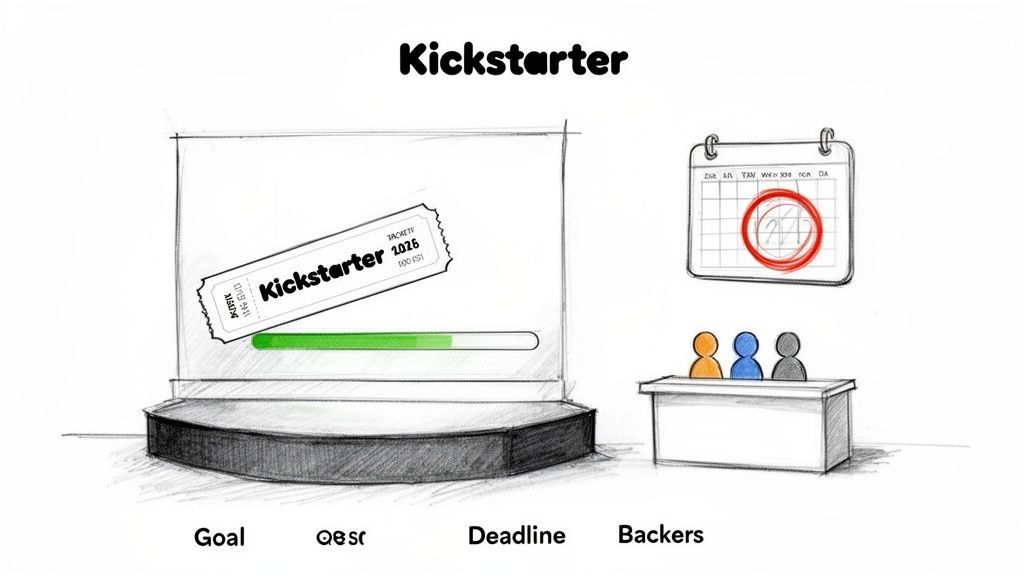
The whole model is designed to create a bit of urgency while protecting both creators and their backers. Think of it like a band trying to book a stadium for a concert. They need to sell enough tickets to cover the cost of the venue, the crew, and the pyrotechnics. If they don't sell enough, the show is canceled, and nobody's credit card gets charged. That's exactly how Kickstarter operates.
This approach is smart for two big reasons. First, it protects backers from throwing money at a project that doesn't raise enough capital to actually get made. No one wants to fund half a board game. Second, it creates a powerful "we're all in this together" vibe, sparking a community to rally behind a project and push it over the finish line.
That all-or-nothing model injects a healthy dose of risk and reward into every campaign. If you don't hit your goal within the timeframe (usually 30 days), you get nothing. It's a high-wire act, and the numbers show it. As of January 2025, Kickstarter's overall success rate is just 41.98% across more than 651,000 launched projects. That figure tells you everything you need to know about the platform's incredible potential and its very real stakes. You can read more about the platform's statistics and how it differs from other crowdfunding models.
This makes setting your funding goal one of the most stressful—and important—decisions you'll make. Aim too high, and you risk walking away with empty pockets. But set it too low, and you might not have enough cash to actually produce and ship your rewards to the backers who believed in you.
To really get a handle on this, let's use an analogy. Think of Kickstarter as the Amazon of crowdfunding. It’s a huge, trusted marketplace where you list your product idea to find your first wave of customers, who we call backers. It’s the public-facing stage where you host your launch party and make those initial sales.
But once the party’s over and the campaign is successfully funded, the real work begins "backstage." This is when you have to manage all those orders, collect shipping info, figure out taxes, and maybe even sell a few extra add-ons. That's where specialized pledge managers come into play.
If Kickstarter is your Amazon, then a tool like PledgeBox is your Shopify. It's the back-end operations hub that gives you total control over the entire fulfillment process. It's free to send the backer survey, and PledgeBox only charges a small 3% fee on any funds raised from post-campaign upsells. This makes it a no-risk way to streamline your logistics and even boost your total funding after the main event on Kickstarter is over.
Once your campaign smashes its funding goal and the confetti settles, it's time to talk numbers. It’s a common rookie mistake to think the total amount pledged is what lands in your bank account. Kickstarter takes a slice of the pie, but only if you succeed—which is fair. If your campaign doesn't make it, you pay no fees.
For every successful project, two main fees are deducted from your total funds. First up is Kickstarter's platform fee, a straightforward 5% of everything you raised. Then there’s the payment processing fee, which their partner Stripe handles. This one varies a bit, typically falling between 3% and 5%, depending on where you and your backers are located.
Let's put this into a real-world scenario. Imagine your project raises a nice, round $10,000. Here’s a quick, back-of-the-napkin calculation of what you'd see:
So, in this case, you’d be looking at about $9,100 to actually make your project happen. This is exactly why you need to bake these fees into your funding goal from day one. If you don't, you could end up short on cash for production and fulfillment. For a more detailed look at the fee structure, you can learn more about what percentage Kickstarter takes from a campaign.
After your campaign officially ends, Kickstarter kicks off a 14-day window to charge your backers' credit cards. This is where you'll encounter an unavoidable headache: dropped pledges. This happens when a backer's card fails—maybe it expired, they're low on funds, or their bank flagged the transaction.
Kickstarter does its part by automatically emailing these backers and giving them seven days to fix their payment info. But life happens, and not everyone gets around to it. Most creators can expect to lose anywhere from 2% to 5% of their total funding to these failed payments. It’s a smart move to factor this potential loss into your budget. Planning for both fees and dropped pledges is the difference between starting on solid financial ground and scrambling to cover unexpected costs.
Your Kickstarter page is your project’s digital headquarters. It’s your virtual storefront and your entire sales pitch, all rolled into one powerful package. And believe me, first impressions are everything.
Experienced creators know that a killer launch isn’t something that just happens on day one. It’s the direct result of months of careful, strategic groundwork. The most successful campaigns don’t just show up and hope for the best; they build their own tidal wave of momentum long before they ever hit "launch."
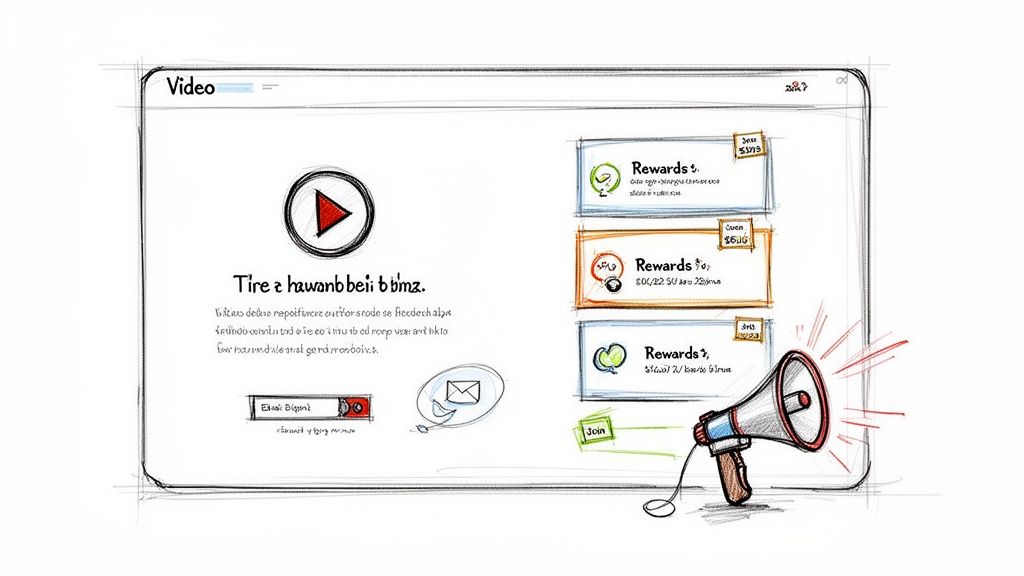
This prep work starts way before your campaign is even a draft. To get it right, you first need to understand how to build a marketing plan that gives your project a solid foundation. In this pre-launch phase, your number one job is to build a community—an email list of people who are genuinely hyped for what you're making.
These people are your day-one army. They’re the ones who will pledge the second you go live, sending a massive signal to everyone else on Kickstarter that your project is something special.
A campaign page that converts curious visitors into loyal backers is built on three core pillars. If you neglect even one of these, you're seriously hurting your chances of getting funded.
These are the non-negotiables:
If you want to go deeper on structuring all these pieces, our complete guide on how to create a Kickstarter campaign page is a great next step.
Generating real excitement before you go live is what separates the six-figure campaigns from the ones that fizzle out. This means doing more than just putting up a landing page. You have to get out there and actively engage with potential backers where they already hang out.
Jump into relevant social media groups, find your people on forums, and get active in Discord servers. Share your progress, ask for honest feedback, and start building genuine relationships.
The goal of the pre-launch phase is to ensure your campaign is at least 30% funded within the first 24 hours. Projects that hit this milestone are statistically far more likely to succeed, as it triggers Kickstarter’s internal algorithms to show your project to a wider audience.
This early burst of funding creates a powerful psychological effect called social proof. When new visitors land on your page and see that it’s already racking up pledges, they’re far more likely to jump on board themselves. It creates a snowball effect of support.
All that pre-launch work is the crucial first push that gets the snowball rolling down the hill. By focusing on building your audience early, you're not leaving your success up to chance—you're taking control of your own destiny.
Let’s be honest: not all Kickstarter campaigns are created equal. For every viral success story you see raising millions, there are dozens of fascinating projects that quietly fizzle out without hitting their funding goal. The difference often boils down to one critical factor that new creators almost always overlook: the power of community.
The projects that truly explode on the platform are rarely discovered by chance. Instead, they're launched directly into a pre-existing, passionate community that is already hungry for what the creator is offering. This is the secret sauce behind Kickstarter's most dominant categories.
Certain project categories on Kickstarter have a massive head start because they cater to highly organized and engaged audiences. These communities have their own ecosystems of influencers, forums, and social media groups, creating the perfect environment for a new project to catch fire and spread quickly.
This dynamic explains why some niches consistently knock it out of the park while others struggle. Success on Kickstarter is heavily tilted by these category-specific dynamics. Just look at tabletop games, which boasted an incredible 80% success rate in 2024—a testament to the deep community engagement in major markets like North America and Europe. Since Kickstarter started tracking stats in June 2012, over 651,000 projects have launched by January 2025, with 41.98% succeeding under the all-or-nothing rule and raising billions. You can dive deeper into these Kickstarter statistics and their impact on the platform's history.
The core lesson is this: You don't just launch a product on Kickstarter; you launch it to a community. If that community doesn't exist or you haven't connected with it, your campaign is starting with a massive disadvantage.
This is exactly why a creator with a new board game often has a clearer path to success than someone launching a new fashion line. The board game community is centralized and actively uses Kickstarter to find its next obsession. The fashion world, on the other hand, is far more fragmented and hasn't adopted the platform in the same way.
No matter what category you’re in, there are key funding milestones that act as powerful signs of your campaign's health. These aren't just for you to watch—Kickstarter's own visibility algorithms pay close attention. Hitting these benchmarks can trigger a domino effect, getting your project featured more prominently across the site.
Here are the critical numbers to aim for:
If you don't hit these early milestones, it doesn't mean your campaign is doomed. It just means you’ll have to work much harder to drive new traffic and build excitement. That first week is your golden window to create urgency and momentum.
Finally, success requires a dose of realism. Before you even think about hitting "launch," you need to spend time researching similar projects in your category. Look at both the runaway successes and the quiet failures.
Analyze what the successful campaigns did right. How did they set up their reward tiers? What did their project video look and feel like? How did they talk to backers in their updates? More importantly, dig into what the failed campaigns did wrong. Was their funding goal way too high? Was the product not compelling enough? Did they completely forget to build an audience beforehand?
By immersing yourself in your category's dynamics, you can learn from the collective wins and losses of those who came before you. This research helps you set realistic goals, sidestep common traps, and position your project in a way that truly connects with the community you're trying to serve. It’s not just about having a great idea—it’s about proving you understand the people you're asking to support it.
The moment your campaign clock hits zero and you see that "Successfully Funded" banner, you feel an incredible wave of relief. You did it! But don't pop the champagne just yet. This is where the real work begins—the marathon of turning a funded idea into a physical product in your backers' hands.
This post-campaign phase is where many promising projects stumble. It's a logistical beast, and your first big challenge is gathering all the critical information from your backers. You need their shipping addresses, reward choices (like t-shirt sizes or color preferences), and a way to sort out any last-minute details. This all happens through backer surveys, and how you handle this process sets the tone for your entire fulfillment journey.
Let's use an analogy. The Kickstarter pledge manager is like Amazon, a massive marketplace where people discover your project and make their initial "purchase." But once the sale is made, you need your own storefront to manage the customer relationship. A dedicated pledge manager like PledgeBox is your personal Shopify store for backers.
Kickstarter provides a built-in survey tool, which is fine for incredibly simple campaigns—say, a single book with no variations. It’s basic and gets the job done. But for the vast majority of projects with multiple reward tiers, add-ons, and international backers, its limitations can quickly turn into a massive headache.
This is where a specialized tool like PledgeBox becomes a lifesaver. It takes the simple survey process and transforms it into a powerful command center for your entire post-campaign operation.
This diagram shows how different types of campaigns, like complex tabletop games, navigate their path to success. You'll notice that robust post-campaign management is a huge piece of the puzzle.
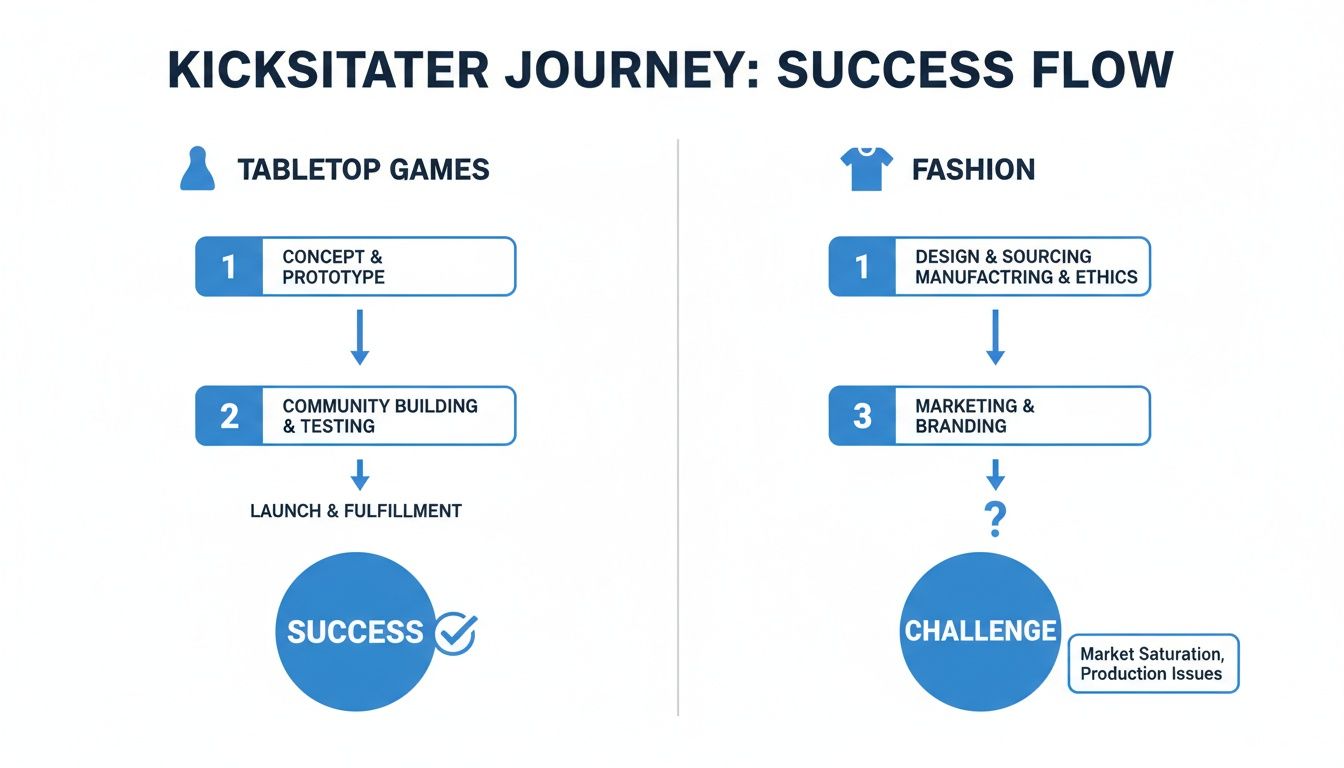
The takeaway here is that successful projects, especially in categories with lots of moving parts, rely on a streamlined post-campaign process to keep things on track.
Using a pledge manager gives you the control and flexibility Kickstarter's native tools just don't offer. It helps you get ahead of the most common—and costly—fulfillment nightmares before they spiral out of control.
PledgeBox helps creators go way beyond the basics of just collecting an address. Here's a look at what you can do.
| Feature | Kickstarter's Native Surveys | PledgeBox Pledge Manager |
|---|---|---|
| Basic Info Collection | Yes (shipping address, simple questions) | Yes (advanced, customizable fields) |
| Complex Reward Choices | Limited (difficult for sizes, colors, etc.) | Fully supported with a user-friendly interface |
| Add-Ons & Upsells | Not supported | Yes, backers can add items post-campaign |
| Shipping Fee Collection | Not supported (must be included in pledge) | Yes, charge precise shipping after the campaign |
| VAT/Tax Collection | Not supported | Yes, automated for UK/EU backers |
| Address Updates | Backer can update once, before shipping | Backers can easily update until you lock orders |
| Cost to Creator | Free | Free to send surveys; 3% fee on new funds from upsells |
A key reason some creators hesitate to use a pledge manager is the perceived cost. But tools like PledgeBox are built to be completely risk-free. PledgeBox is free to send the backer survey, and you only pay a small 3% fee on new funds raised from upsells. If you don't sell any add-ons, you pay nothing.
This model completely removes the financial barrier. You get a professional-grade tool to organize everything, plus the chance to boost your revenue at no upfront cost.
Ultimately, picking the right survey tool isn't just a matter of convenience. It’s about protecting your project’s budget, your sanity, and delivering a smooth, professional experience for the community that brought your dream to life. To learn more, check out our guide on everything you need to handle after your crowdfunding project ends.
One of the most common—and costly—mistakes a creator can make is assuming Kickstarter’s built-in audience is enough to fund a campaign. While the platform gives you a stage, it’s your job to bring the crowd. Proactive, strategic promotion is what separates projects that build unstoppable momentum from those that fizzle out before they even get started.
The reality is, crowdfunding today is deeply connected to digital advertising. Kickstarter's projected growth to $6.6 billion in total pledges by 2026 is exciting, but success now demands smart promotion that goes far beyond just hoping people find you. With over 651,000 projects launched and a historical success rate hovering at just 41.98% (as of January 2025), ads on platforms like Meta, Google, and TikTok have become indispensable tools. For those who dive in, it becomes clear that creative choices drive as much as 80% of ad outcomes. You can dig deeper into the numbers in this analysis of the Kickstarter advertising landscape from Boost Your Campaign.
Your first big promotional goal should be hitting 20-30% funding within the first 48 hours. Why? Reaching this milestone creates powerful social proof. It signals to potential backers that your project is a winner, and it tells Kickstarter’s algorithms to start showing your project to more people.
Paid ads, especially on platforms like Meta (Facebook and Instagram), are one of the most reliable ways to manufacture this initial surge. By targeting audiences who have shown interest in similar projects, you can drive high-intent traffic directly to your page right when it matters most. This early velocity is everything.
A common misconception is that advertising is just about spending money. Smart advertising is about investing in momentum. A modest ad budget can be the catalyst that turns a slow start into an exponential growth curve, paying for itself many times over.
To make sure your ad spend isn't just disappearing into the void, you need to track the metrics that actually matter. Forget about likes or shares for a moment and focus on the numbers that directly translate to pledges. This is how you figure out your return on investment and make smart, data-driven decisions.
Here are the key metrics you need to live and breathe:
By keeping a close eye on these numbers, you can A/B test different ad creatives, headlines, and audiences to see what truly resonates. It's an ongoing process of tweaking and optimizing, but it's what gives you control over your campaign's destiny, turning a hopeful project into a funded reality.
Even after you’ve got the basics down, a few questions always pop up when you're getting ready to launch. It’s totally normal. Here are some straightforward answers to the things new creators wonder about most.
This is a big one, but the answer is simple. If you don't hit your funding goal by the deadline, the all-or-nothing model means no money changes hands. Your backers aren't charged a dime, you don't receive any funds, and you don't owe anyone rewards.
Kickstarter won't charge you any fees for an unsuccessful campaign. Think of it as a free lesson. You can take what you learned, tweak your project, and come back stronger for a relaunch.
Nope, and this is a really important rule to remember. Once your campaign goes live, your funding goal and deadline are locked in. You also can't change or delete any reward tiers that already have at least one backer.
You can, however, add new reward tiers anytime you want. This is a great way to add stretch goals or limited-time offers. But it also shows why planning every little detail before hitting that launch button is so critical for success.
This is where a lot of new creators get tripped up. Honestly, Kickstarter’s built-in tools just aren't set up for handling complex shipping calculations, and that's a huge headache waiting to happen. It's exactly why nearly every experienced creator uses a pledge manager after their campaign.
Here’s a good way to think about it: Kickstarter is like the storefront where the initial sale happens. A pledge manager like PledgeBox is your back-end command center, where you manage all your customer relationships and fulfillment logistics.
With a tool like PledgeBox, you can charge for shipping after the campaign ends, which lets you set accurate rates by country or item weight. You can also correctly collect regional taxes like VAT. This is the secret to avoiding that gut-wrenching moment when you realize unexpected shipping costs just ate up all your profit.
Absolutely! In fact, it's one of the smartest things you can do to increase your final funding total. Using a pledge manager is the key to making this a seamless experience for both you and your backers.
Your backers get an easy way to add extra items to their pledge—things like accessories, special upgrades, or even a second copy of your product for a friend. This doesn't just bump up your revenue; it gives your biggest fans a chance to get more of what they love from you.
The best part? PledgeBox is free to send the backer survey and only charges 3% of the upsell if there’s any. This makes it a completely risk-free strategy to raise more funds and make fulfillment a breeze.
Managing a Kickstarter campaign has a ton of moving parts, from the pre-launch buzz to post-campaign fulfillment. PledgeBox gives you an all-in-one toolkit designed to help you at every stage. It simplifies surveys, boosts your revenue with upsells, and ensures a smooth delivery process that will keep your backers happy. Learn how PledgeBox can help your next project succeed.
PledgeBox
The All-in-One Toolkit to Launch, Manage & Scale Your Kickstarter / Indiegogo Campaign