 PledgeBox
Your Guide to the Rainbow Six Siege Board Game
Master the Rainbow Six Siege board game with this complete guide. Learn setup, rules, and winning strategies for this tactical tabletop experience.
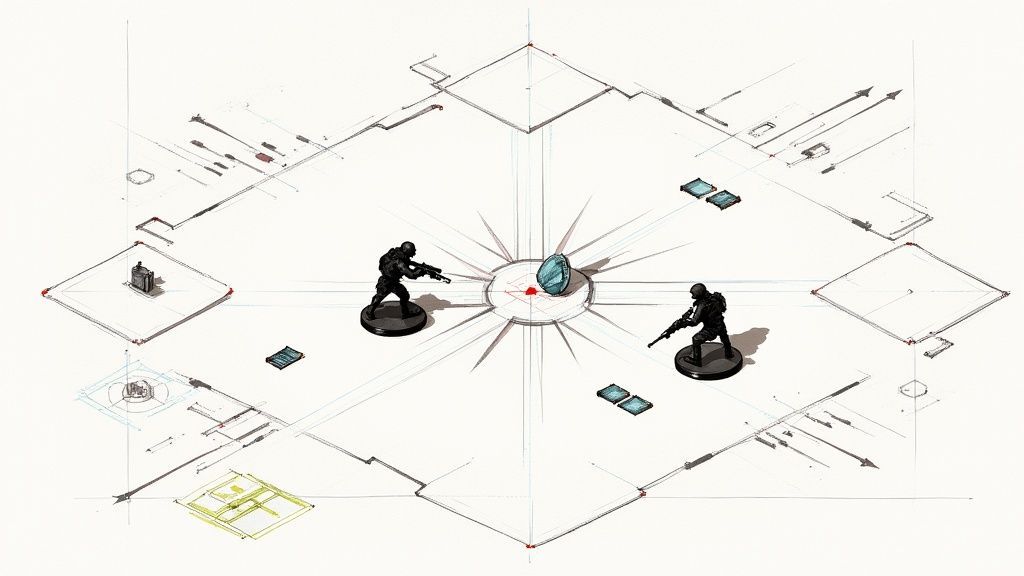
Master the Rainbow Six Siege board game with this complete guide. Learn setup, rules, and winning strategies for this tactical tabletop experience.
The Rainbow Six Siege board game, officially known as 6: Siege – The Board Game, brilliantly captures the tense, close-quarters combat of its video game counterpart and brings it straight to your tabletop. It’s an asymmetric showdown for 2-4 players pitting elite Attackers against dug-in Defenders, each with their own game-changing gadgets and abilities.
Turning a fast-paced shooter into a turn-based board game is no small feat, but 6: Siege nails the feeling of the original. The core gameplay loop feels incredibly familiar: one team breaches a fortified location to secure an objective, while the other uses every trick in the book to stop them cold.
To see just how well the core concepts were adapted, let's break down how some of the most iconic parts of the Rainbow Six Siege video game made the jump to the tabletop.
This thoughtful translation preserves the tactical heart of the video game while creating a deep, strategic experience that stands on its own.
This tabletop version was born from a massive crowdfunding campaign, proving just how passionate the video game’s fanbase is. The original Rainbow Six Siege has held onto a massive global audience, which helped fuel the excitement for expansions into new media. In fact, Ubisoft's latest reports show the game has maintained around 30 million unique active players annually for four straight years. You can dive into the details yourself in Ubisoft's FY 2024-25 report.
Many of the game's earliest fans got their copies by backing its Kickstarter. After a successful campaign, creators need a way to manage all the post-campaign chaos—collecting shipping info, handling add-ons, and charging for postage. That’s where a pledge manager comes in.
A pledge manager is basically a command center for crowdfunding creators after their campaign ends. It lets them send out surveys, collect shipping addresses, and even offer backers a last chance to grab expansions or other cool extras.
For example, a creator might use a service like PledgeBox for its simple, creator-friendly model. It’s free to send the backer survey, and the service only takes a 3% fee on successful upsells. If you think of Kickstarter's pledge manager as the Amazon of crowdfunding—a huge, all-in-one marketplace—then the PledgeBox pledge manager is more like Shopify. It gives creators their own dedicated space to manage their community and sales after the campaign hype dies down.
You can learn more about what it takes to build successful Kickstarter tabletop games right here. This hands-on approach gives creators way more control and helps them build a direct relationship with their supporters—something that was crucial for a project as big as the Rainbow Six Siege board game.
Cracking open the Rainbow Six Siege board game for the first time is an event in itself. You're immediately greeted with a fantastic spread of high-quality components that practically beg you to get a game started. The first things that will catch your eye are the miniatures—each one is incredibly detailed, perfectly capturing the look and personality of the iconic Operators from the video game.
These minis are more than just eye candy; they're your boots on the ground. Each one represents a specific Operator, giving every match a real, tangible feel. Digging deeper, you’ll find the modular map tiles. These double-sided pieces let you build and rebuild different arenas, which means no two games ever have to be the same.
The box is absolutely loaded with the tokens and cards that make the game tick. Getting a handle on what each piece does is your first step to mastering the flow of a match.
Of course, all these physical goodies bring the tactical experience to life, but they also create a huge logistical puzzle for the people making the game. The sheer weight and volume of all these parts make shipping a serious challenge. For anyone curious about the behind-the-scenes work, you can get a good sense of the hurdles involved in board game shipping and how companies navigate it.
At its heart, the game is a deep tactical puzzle born from how all these components work together. You'll play Action cards to move your Operator mini across the map tiles, then use Gadget cards to blow holes through walls represented by tokens. Every single piece has a job, and figuring out how they all connect is the key to victory.
The real magic of 6: Siege is how these physical pieces translate digital mechanics into a compelling tabletop experience. A simple token for a destroyed wall has the same strategic impact as blowing a hole in a wall in the video game—it creates new sightlines and forces both teams to adapt.
Every component, right down to the dice you'll roll for combat and the rulebook itself, is there to support this core loop of planning, executing your plan, and adapting on the fly. Once you're familiar with the pieces, you can stop worrying about the rules and start focusing on outsmarting your opponent. That's when your first match goes from a learning experience to a thrilling tactical operation.
Jumping into a game as detailed as the Rainbow Six Siege board game can feel like its own mission, but a little prep work goes a long way. The key is to get methodical. Think of it less like a chore and more like the pre-mission briefing where every piece you place sets the stage for victory.
To make sure every session kicks off without a hitch, it's smart to treat the setup like a Standard Operating Procedure (SOP). Once you get a repeatable system down, you'll get the game on the table fast and without any confusion.
This little map shows you the basic flow, from laying out the battlefield to getting your Operators geared up and ready to go.
As you can see, each step naturally leads to the next. You start with the big picture—the map—and then zoom in on the specific choices each player has to make.
First things first: build your map. The scenario book is your guide here, showing you exactly how to arrange the modular, double-sided map tiles for your mission. You’ll want to pay close attention to how each tile is oriented—getting a doorway or window out of place can completely change the tactical situation.
With the tiles locked in, it's time to bring the environment to life. This means placing all the objective markers, barricades, and any other special tokens the scenario calls for. This is also when the Defenders get to reinforce certain walls, adding a crucial layer of strategy before anyone even takes a turn.
Map’s hot. Now, each player picks their side—Attacker or Defender—and chooses their Operators. Don't rush this part. Every Operator brings a unique gadget and stats to the fight, so think about who pairs well with your teammate.
Once you've chosen your squad, it's time to set up your personal player area. This is your command center.
Keeping your space organized means you can see all your options at a glance, which is exactly what you need when you have to make split-second decisions.
A quick note for crowdfunding backers: you’re probably familiar with pledge managers. If a Kickstarter pledge manager is like a massive marketplace like Amazon, think of the PledgeBox pledge manager as Shopify. It gives creators their own dedicated storefront to manage their community.
This is a big deal. With Pledgebox, it’s free to send the backer survey, and creators only pay 3% of upsell revenue if you decide to grab some add-ons. It's a creator-first approach that helps amazing games like 6: Siege connect with their communities long after the initial campaign hype has died down. Now that your setup is complete, you're ready to breach and clear.
Getting into the Rainbow Six Siege board game is all about getting a feel for its core mechanic: a slick action point system. Forget having a set number of actions per turn. Here, what you can do is dictated by the Action cards you're holding. It’s a design that keeps the game fluid, tactical, and incredibly tense.
Think of these cards as the currency for everything your Operator wants to do, from sprinting down a hallway to slapping a breach charge on a wall. Every single action—moving, shooting, deploying a gadget—has a specific card cost. This forces you to constantly juggle your options and manage your hand, perfectly capturing the split-second, high-stakes feel of the video game.
This kind of strategic depth is a big reason why modern board games have absolutely exploded in popularity. The global board games market was valued at around USD 21.07 billion in 2023 and is expected to nearly double to USD 41.07 billion by 2029. This surge is fueled by players hungry for exactly the kind of engaging, tactical challenge that 6: Siege delivers. You can discover more insights about the expanding board game industry and its market trends.
A round in the Rainbow Six Siege board game follows a straightforward, turn-based flow. Players take turns activating one of their Operators to perform actions. The round keeps going in this back-and-forth rhythm until every Operator on the board has had their moment to act.
On your turn, you spend your Action cards to make things happen. The real magic of the system is its flexibility. Got enough cards? You can chain multiple actions together with a single Operator. This opens the door for some seriously powerful plays, like moving into position, blowing a hole in a wall, and taking a shot all in one swift, game-changing turn.
One of the most critical concepts to master is Line of Sight (LoS). An Operator can only shoot at an enemy if they can trace a clean, straight line from their square to the target's square. Cover, shown by tokens or parts of the map, can block LoS or give defensive boosts, making your positioning absolutely vital.
Getting the hang of this sequence is your first step to crafting winning strategies. It’s a constant chess match of anticipating your opponent’s moves while figuring out how to spend your precious cards to secure the objective before time runs out.
While every Operator brings their unique gadgets to the fight, everyone has access to a set of core actions. Nailing these fundamentals is non-negotiable for both new players and seasoned veterans. To give you a quick overview, here's how the two teams approach the game's core mechanics.
This asymmetric design is what makes the game click. Attackers are the aggressors, using destruction and information to methodically break the defense. Defenders, on the other hand, are masters of area denial and patience, waiting for the perfect moment to strike. The team that plays its role best is the one that walks away with the win.
Knowing the rules is one thing, but truly mastering the art of the attack and defense is where the real game begins. The Rainbow Six Siege board game isn't just about lucky dice rolls—it's a brutal, cerebral dance of positioning, resource management, and trying to outthink your opponent at every turn. To succeed, you need to adopt a completely different mindset for each role.
Attackers have to be the aggressors. You're proactive, methodical, and always ready to adapt when a plan goes sideways. Your whole job is to crack a fortified nut before that round tracker hits zero. That means every single action needs purpose, pushing you one step closer to the objective. Just charging in is the fastest way to get your Operators sent back to the box.
Defenders, on the other hand, play a game of patience and control. Your goal is to make the Attacker’s push so expensive and time-consuming that they simply run out of steam. You start with the advantage of a prepared position, so you'd better use it to dictate how and where every fight happens.
For the attacking team, information is your most powerful weapon. Before you even think about slapping a breach charge on a wall, you need to know what—and who—is waiting for you on the other side. This is where your drones and intel gadgets are worth their weight in gold.
As a Defender, your mission is to turn the map into an absolute deathtrap. Your gadgets aren't just for getting kills; they're for bleeding the Attackers' time and resources dry. Every Action card they have to spend clearing barbed wire or dealing with a deployable shield is one less action they can use to push the objective.
A well-placed crossfire is the cornerstone of any solid defense. By positioning two Operators to cover the same doorway from different angles, you guarantee that any Attacker who peeks is immediately caught in a lethal pincer.
Use your setup phase to reinforce walls that will funnel Attackers right into these pre-planned kill zones. And don't be afraid to move! If the Attackers breach an unexpected wall, falling back to a secondary position is almost always smarter than trying to hold a compromised spot.
Remember, you don't actually have to wipe out the entire attacking team to win—you just have to run out the clock. Victory is often measured in seconds, not kills.
If you backed the Rainbow Six Siege board game on Kickstarter, you weren't just pre-ordering a game; you joined a massive community that helped bring it to life. But once the campaign confetti settles, the real work begins. This is where a pledge manager comes in—a critical tool that handles everything from collecting your shipping address to letting you snag last-minute add-ons.
Getting a handle on this system is super important, especially when you consider this game's wild ride to production. The 6: Siege campaign hit some serious turbulence, facing huge cost increases in manufacturing and shipping. This pushed the original developers, Mythic Games, to ask backers for more funds to get the project over the finish line, highlighting just how vital that post-campaign phase is. It's a fascinating look at the challenges of crowdfunding and how a dedicated community can rally to make sure a game actually gets made.
Think of a pledge manager as the crucial link between a funded campaign and the game arriving on your doorstep. Different platforms approach this in different ways, which creates a totally different experience for both creators and the backers supporting them.
A good way to think about it is this: if Kickstarter's pledge manager is like Amazon—a huge, all-in-one marketplace—then a tool like the PledgeBox pledge manager is the Shopify of crowdfunding. It gives creators their own storefront to manage their community and finalize everything.
This creator-first approach has some big perks. For example, Pledgebox is free for creators to send their backer survey. The platform only takes a 3% fee on successful upsell items, like expansions or cool cosmetic extras. This model is a huge help for creators trying to manage their budget, and for backers, it makes it simple to finalize a pledge, pay for shipping, and grab anything they might have missed during the campaign.
For creators, a system like this is a lifesaver. It helps them untangle the complex logistics of fulfillment without massive upfront costs. If you're curious about what it takes from the creator's side, take a look at our guide on how to successfully publish board games on Kickstarter. It’s packed with insights on making projects like this a reality.
Any time you get into a deep, tactical game like the Rainbow six siege board game, you’re bound to have some questions. It’s a complex beast! Whether you backed the original campaign or you're just now discovering it, let's clear up a few common points.
First, let's talk about who's running the show. After a pretty bumpy production ride, the rights for 6: Siege – The Board Game were picked up by Steamforged Games in early 2025. They're the ones to watch for reprints and future content, so keep an eye on their site for any news.
Absolutely. Steamforged Games isn't just reprinting the original core box and its expansions; they've already announced plans for brand-new material. This is great news for everyone, as it means a healthy future for the game with fresh challenges for veterans and a solid starting point for newcomers.
Another question that pops up constantly is about one of the game's trickiest mechanics: "Riposte," or what most of us would call overwatch.
Here's the key rule to burn into your brain: Riposte triggers every single time an Operator moves into a new square that's in an enemy's Line of Sight (LoS). It's not a one-and-done reaction. If you dash three squares through an enemy's LoS, you're potentially facing three separate Riposte attacks. This makes every move incredibly tactical and risky.
For anyone who backed the game during its crowdfunding days, the pledge manager is a familiar topic. Creators use these tools after a campaign to sort out the logistics—collecting shipping addresses, offering last-minute add-ons, and finalizing orders.
It helps to think of it like this: the Kickstarter pledge manager is a bit like a huge marketplace like Amazon. A dedicated service like the Pledgebox pledge manager is more like Shopify—it gives creators their own branded storefront to manage backers directly.
This is a big deal for creators. Pledgebox is free to send the backer survey and only charges 3% on upsell revenue. That model makes it much easier for creators to manage their costs while getting everything finalized for production and shipping.
Ready to streamline your next crowdfunding campaign? See how PledgeBox can help you manage backers, boost upsells, and simplify fulfillment. Learn more and get started at https://www.pledgebox.com.
PledgeBox
The All-in-One Toolkit to Launch, Manage & Scale Your Kickstarter / Indiegogo Campaign