 PledgeBox
Kickstarter Video Games A Founder's Crowdfunding Playbook
Launch successful Kickstarter video games with this guide. Learn pre-launch strategy, campaign building, pledge management, and post-campaign upsells.
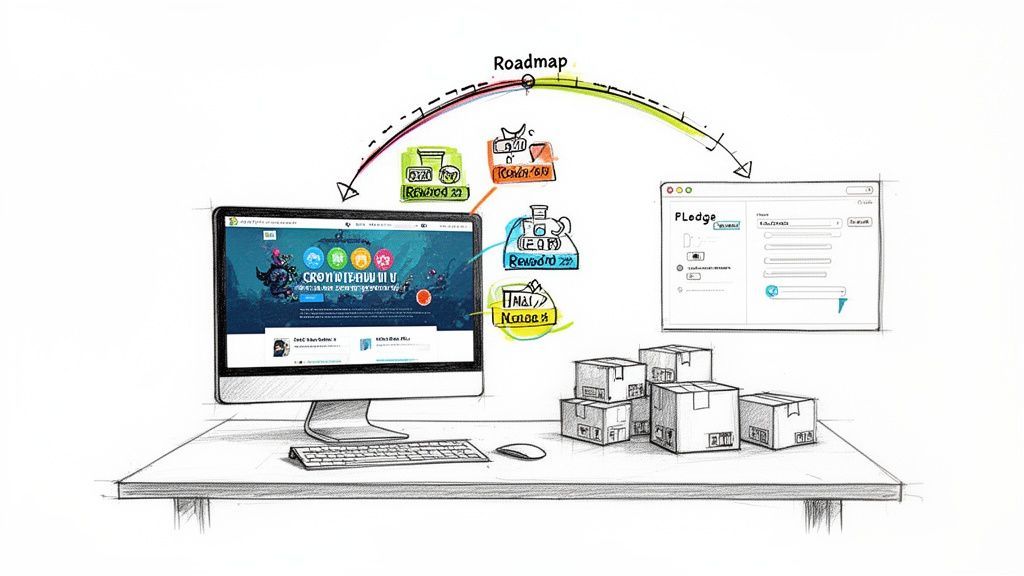
Launch successful Kickstarter video games with this guide. Learn pre-launch strategy, campaign building, pledge management, and post-campaign upsells.
So, you've got an amazing game idea and you're thinking about Kickstarter. Smart move. But launching a successful campaign for Kickstarter video games is about way more than just having a cool concept. It’s about building a solid, end-to-end plan that takes you from generating pre-launch hype all the way through to getting rewards into your backers' hands.
This isn't just about hitting "launch." It's a complete blueprint for modern game developers, covering everything from building that crucial early community to navigating the tricky world of logistics and even boosting your revenue after the campaign is over.
For indie developers, crowdfunding has become a go-to way to bring a vision to life without being tied to traditional publishers. The space is definitely more crowded than it used to be, but for those who come prepared, the payoff is huge. Just look at the recent numbers—Kickstarter had a banner year for games, with 441 successful projects raising a cool $26 million. You can dig into the specifics in the latest video game funding report.
A winning campaign isn't just a 30-day sprint; it's a marathon with distinct stages. This guide breaks that whole journey down, phase by phase, so you know exactly what to do long after you pop the champagne for hitting your funding goal.
Here’s where a lot of first-timers get tripped up. They focus so much on the 30-day funding window that they forget about the months of work that come before and after. If you don't think about the entire process from day one, you're setting yourself up for major headaches later, especially with backer management and fulfillment.
To help you visualize the entire journey, here's a quick breakdown of the key phases involved in bringing your game from concept to reality through crowdfunding.
| Phase | Core Objective | Critical Actions |
|---|---|---|
| Pre-Launch | Build an audience & generate hype. | Create a landing page, grow an email list, engage on social media, prepare campaign assets. |
| Live Campaign | Get funded & unlock stretch goals. | Drive traffic, communicate with backers, post regular updates, manage advertising. |
| Post-Campaign | Manage backers & prepare for fulfillment. | Send surveys, manage pledges, handle add-ons, collect shipping fees, finalize production numbers. |
Each of these phases is critical, but the Post-Campaign stage is where the real operational challenges begin, and having the right tools makes all the difference.
This is where so many creators stumble. Once the campaign ends, you're suddenly responsible for hundreds—or thousands—of backers. You need to collect their shipping info, let them choose reward variations, and handle all the logistics.
Kickstarter’s built-in tools are okay for super simple projects, but they just don't cut it for a video game campaign with multiple reward tiers, add-ons, and international shipping complexities. This is exactly why a dedicated pledge manager is no longer a "nice-to-have"—it's an absolute must.
A common mistake is treating the pledge manager as an afterthought. It should be part of your initial strategy, as it directly impacts your ability to collect accurate information, manage fulfillment, and even increase your total funds raised.
Think of it this way: Kickstarter's pledge manager is like Amazon—a marketplace with a standard, one-size-fits-all approach. A powerful pledge manager like PledgeBox is like Shopify; it gives you your own customizable storefront. It lets you send detailed backer surveys for free and only takes a 3% fee on new funds you raise from upselling add-ons. It's a risk-free way to give your backers what they want and boost your project’s bottom line after the clock on Kickstarter has run out. Trust me, making this distinction early on is key to a smooth and profitable fulfillment process.
A killer Kickstarter video game launch almost never happens by accident. You see those projects that absolutely crush their funding goals in the first 48 hours? That’s not luck. It’s the direct result of months of smart, strategic groundwork laid long before the campaign ever saw the light of day.
This pre-launch phase is where the real magic happens. Your whole mission is to build a groundswell of support—an engaged, excited community just waiting to hit that "Back this project" button. Nailing this early surge is critical. It sends a massive signal to Kickstarter's algorithm that your game is hot, which can get you featured and attract a wave of organic traffic.
First things first, you need a central command post for all your pre-launch buzz: a top-notch landing page. This is way more than just a placeholder; it's a finely tuned machine with one critical job: to capture email addresses. Trust me, your email list is your single most powerful asset. It’s a direct line to your most passionate fans.
Your landing page needs to grab people. Use stunning concept art, a punchy pitch that explains your game’s hook, and a big, obvious sign-up form. Give them a compelling reason to subscribe. Maybe it’s access to an exclusive demo, a peek behind the dev curtain, or a special bonus for backing on day one.
Quick tip: Social media followings are rented land, completely at the mercy of algorithms. An email list is an asset you own. It's the only way to guarantee your message lands in front of your core supporters right when it matters most.
Beyond the landing page, you have to build a genuine community. This is where tools like Discord and dev blogs shine. A Discord server can become the go-to spot for fans to geek out, give feedback, and feel like they’re part of the journey. Share exclusive art, host Q&As with the team, and build real relationships. For a deeper look, our guide has some great https://pledgebox.com/post/7-actions-to-build-your-community-before-your-kickstarter-campaign you can start using today.
A huge part of building momentum is making sure people actually want the game you're making. It sounds obvious, but it’s a step many developers skip. Learning how to effectively validate your startup idea gives you a solid framework for testing demand and getting feedback before you're locked in. This ensures you're building a game a community is genuinely excited to fund.
Next up, it’s time to start your outreach to media and influencers. Put together a professional press kit that has everything a journalist or streamer could possibly need:
Start building relationships with indie game journalists, YouTubers, and Twitch streamers who cover your genre. Don't just blast out a generic email. Personalize your messages. Tell them why your game is a perfect fit for their audience and offer them an early build if you can. A single great review or a popular stream can funnel a massive amount of traffic to your campaign. It all comes back to community—turning casual interest into committed backers on launch day.
Think of your Kickstarter page as your game’s digital storefront, investor pitch, and community hub all rolled into one. When someone lands on your page, you have just seconds to grab their attention and convince them your vision is worth backing. Every single element, from the headline to the smallest GIF, has to work together to tell a killer story about your kickstarter video games project.
You're not just selling a product here; you're inviting people to join you on a creative journey. The real goal is to turn a casual visitor into an enthusiastic backer who feels like they have a personal stake in your game's success.
Let's get one thing straight: your campaign video is the most important part of your page. Many potential backers will watch it before they read a single word. It absolutely needs to be polished, engaging, and get right to the good stuff.
This is not the time for a slow, cinematic opening. You need to show exciting gameplay within the first 5-10 seconds. Hook them immediately with whatever makes your game special—the core mechanic, the killer art style, or the fascinating world you've built.
A solid video structure usually follows this path:
Keep it short and sweet, ideally between two and three minutes. If your video is too long, you risk losing people's attention before you've even made your case.
Once your video has them hooked, the rest of the page needs to seal the deal. Lay out your content in a logical flow, using plenty of visuals like GIFs, screenshots, and concept art to break up the text. Nobody wants to read a wall of text to figure out what you're making.
To make sure your page truly pops, it helps to apply some core design principles. This guide offers some great insights into effective design principles for attracting attention that, while written for physical banners, are just as relevant for creating visually compelling digital content.
A proven layout that just works goes something like this:
Your page isn't just a document; it's a sales funnel. Every section should lead the reader seamlessly to the next, building excitement and confidence until backing the project feels like the natural next step.
Reward tiers are the engine of your campaign. You need a balanced mix of options to appeal to everyone, from the casual supporter on a budget to the superfan ready to go all-in.
Stretch goals are your secret weapon for keeping the campaign exciting after you've hit your funding target. Instead of just asking for more money, frame them as community achievements. Something like, "If we reach $50,000, we'll add a whole new playable character!" keeps your existing backers engaged and gives them a reason to share the campaign to unlock more cool stuff. For more great ideas, you can find a ton of Kickstarter campaign page design tips to help you get it just right.
You did it. The confetti has settled, the funding goal is in the rearview mirror, and your Kickstarter video game project is a success. Now for the hard part.
This is where the real work begins—transitioning from a fundraising campaign to a full-blown logistical operation. The post-campaign phase is where many projects stumble, not from a lack of vision, but from the overwhelming challenge of managing hundreds, or even thousands, of backers.
Successfully collecting accurate information, handling global shipping, and delivering rewards on time is a massive undertaking. This is precisely where a powerful pledge manager becomes your best friend. Honestly, skipping this tool can lead to shipping errors, frustrated backers, and a mountain of administrative headaches you simply don't have time for.
Kickstarter offers a basic, built-in survey tool to collect backer information. For a super simple campaign with one or two digital rewards, it might get the job done. But for a video game project with multiple tiers, physical goodies, and international backers? You'll hit its limits fast.
Think of it this way: Kickstarter's pledge manager is like Amazon—a standardized marketplace. A dedicated pledge manager like PledgeBox, on the other hand, is like Shopify; it gives you a fully customizable hub for your backers. You get complete control over how you interact with your community after the funding ends.
This distinction is crucial. Your relationship with your backers doesn't end when the timer hits zero. The post-campaign experience is your chance to solidify their trust and turn them into long-term fans of your studio.
With a specialized tool, you're not just collecting data; you're managing a community and opening up new revenue streams. This has been a game-changer for indie developers navigating the complexities of crowdfunding. Over its lifetime, video game projects on Kickstarter have amassed $377 million across 5,526 campaigns, averaging $68,200 per successful effort—a testament to the category's steady draw. You can find more crowdfunding insights from these Kickstarter video game statistics on SearchLogistics.com.
The right tools help you deliver on the promises that got you funded in the first place.
As this process shows, a strong video, compelling story, and clear rewards are the foundation. A pledge manager is the tool that makes sure you can actually deliver on all of it without pulling your hair out.
To put it plainly, relying solely on Kickstarter's built-in tools for a complex project is a recipe for manual data entry, backer confusion, and costly shipping mistakes. A dedicated pledge manager automates the messy parts so you can focus on the game.
| Feature | Kickstarter Surveys | PledgeBox |
|---|---|---|
| Upsells & Add-ons | Not supported. | Fully supported; boost funding post-campaign. |
| Shipping Calculation | Manual estimates only. | Real-time, weight-based rates by country. |
| Address Verification | No verification. | Automatic validation to prevent errors. |
| VAT/Tax Collection | Not supported. | Automated VAT calculation for EU/UK. |
| Customer Support | Limited to Kickstarter platform. | Dedicated creator and backer support. |
| Customization | Very basic, no branding. | Branded surveys, custom questions. |
The difference is clear. For anything beyond the most basic digital-only campaign, a specialized tool isn't a luxury—it's essential for a smooth fulfillment process.
One of the biggest hurdles for creators is the budget. After a long campaign, the last thing you want is another hefty upfront fee. This is where the business model of your pledge manager becomes incredibly important.
PledgeBox operates on a creator-friendly model. It is completely free to send your backer surveys. You can create unlimited, branded surveys, send reminders, and manage all your backer data without paying a cent upfront. This removes a significant financial barrier and allows every project, regardless of size, to access professional-grade tools.
The platform only charges a small 3% fee on new funds raised from upsells. This means you only pay when you make additional money from add-ons purchased during the survey process. It’s a performance-based model that aligns perfectly with your goals—to raise more funds and delight your backers.
For any project with physical rewards, shipping and taxes are a logistical nightmare waiting to happen. Calculating rates for dozens of countries and correctly handling Value Added Tax (VAT) can quickly become overwhelming. This is where mistakes get expensive.
A robust pledge manager automates this entire process. Key features that save you from costly headaches include:
By offloading these complex tasks to a specialized system, you free up your team to focus on what you do best—finishing and polishing your game.
Here’s a secret many new creators miss: the number you see when your Kickstarter campaign timer hits zero is just the starting line, not the finish. If you treat the end of the campaign as a hard stop for sales, you’re leaving a ton of money on the table. The post-campaign phase is a golden opportunity to bump up your total funding in a big way.
This is where a dedicated pledge manager comes in, turning what used to be a boring data-collection chore into a powerful e-commerce experience. It’s your chance to offer backers awesome add-ons they were on the fence about during the campaign and, just as importantly, to capture sales from people who missed out completely.
The trick is to stop thinking of the backer survey as a form and start treating it like an exclusive, personalized storefront. This is where your most loyal fans get one last chance to upgrade their pledge and grab cool extras.
Think of it this way: Kickstarter’s pledge manager is like Amazon—a standardized marketplace experience. A platform like PledgeBox, on the other hand, is more like Shopify. It gives you the tools to build a custom shopping experience with high-quality images, detailed descriptions, and total control over how you present your add-ons.
Your goal is to make the survey feel less like homework and more like a last-call opportunity for backers to get everything they want from your kickstarter video games project. A clean, visual setup is far more likely to encourage browsing and a few extra purchases.
The best part? You don't need to pay anything upfront to get this functionality. PledgeBox is completely free to send your backer surveys, regardless of how many backers you have. The platform only takes a simple 3% fee on new funds raised through upsells. It's a zero-risk model where they only make money when you do.
The most effective add-ons aren't just random merch; they're natural extensions of your game's world that appeal to different types of backers.
Here are a few ideas that consistently work well for game developers:
For a deeper dive into making these offers irresistible, check out our guide on how to increase average order value with smart upselling.
So what happens to the folks who find your game the day after the campaign ends? You set up a pre-order storefront. This is essentially a public-facing page, separate from your backer surveys, that lets latecomers buy the game and add-ons just like an original backer.
This serves two crucial functions. First, it captures revenue that would have otherwise been lost forever. Second, it keeps your community growing, bringing new people into your Discord and social media channels who are just as hyped as your day-one supporters. You can keep this pre-order store running for months, creating a steady stream of funding while you get back to focusing on development.
Jumping into crowdfunding for your video game can feel like you're entering a whole new world with its own set of rules. It's totally normal to have a ton of questions. We've gathered some of the most frequent ones from developers gearing up for their own Kickstarter video games campaigns to give you the clear answers you need.
This is the million-dollar question, isn't it? Your funding goal can't just be a number you hope to hit. It has to be the absolute minimum amount required to actually create the game and deliver everything you've promised. And I mean everything—not just the development.
Make sure your budget covers all the bases:
Be upfront about this breakdown on your campaign page. When backers see exactly where their money is going, it builds a massive amount of trust.
Lots of creators get tripped up on this one. What's the difference between Kickstarter's own survey tools and a dedicated pledge manager?
Think of it like this: Kickstarter's pledge manager is like Amazon, a massive marketplace where you're one of many sellers. A service like PledgeBox, on the other hand, is like Shopify; it gives you your own powerful, fully customizable storefront after the campaign ends. You can brand the entire experience, sell complex add-ons, handle shipping charges with precision, and give your backers a smooth, professional journey.
Here's the kicker: with PledgeBox, it's completely free to send surveys to all your backers. The platform only charges a 3% fee on any revenue you generate through upsells. This means you only pay when you make extra money, making it a no-brainer for creators of any size.
Kickstarter runs on an all-or-nothing model. If you don't hit your funding target by the deadline, no money changes hands. Backers aren't charged, and you don't get a single penny.
While that might sound like a huge bummer, it's actually incredibly valuable feedback. It could mean your marketing didn't quite reach enough people, your funding goal was a bit too ambitious, or the game concept just didn't connect with the audience in the way you'd hoped. It's a risk-free way to test the market waters before you pour years of your life into development.
The sweet spot for most successful campaigns is 30 days. This timeframe is long enough to build momentum and allow for discovery but short enough to create a sense of urgency that gets people to hit that "Back this project" button.
Shorter campaigns can work, but you usually need a massive, hyped-up community ready to go on day one. On the flip side, campaigns that drag on for 60 days often hit a dead zone in the middle and suffer from backer fatigue. Trust the process and stick to the 30-day window.
Timing really does matter. Try to avoid launching your project right around major holidays like Christmas or New Year's when people are busy, traveling, or watching their wallets. The same goes for when your campaign is set to end.
Historically, launching on a Tuesday morning (in U.S. time zones) tends to work well, giving you the entire week to build buzz and connect with press. But honestly, the most important thing is simply being ready. A well-prepared launch on a Thursday will always outperform a chaotic, rushed launch on a Tuesday.
Ready to streamline your campaign from pre-launch to fulfillment? PledgeBox offers an all-in-one toolkit designed for Kickstarter creators like you. Send branded backer surveys for free, boost your revenue with powerful upsells, and simplify your entire post-campaign process. Get started today and see how thousands of creators have successfully managed their campaigns at https://www.pledgebox.com.
PledgeBox
The All-in-One Toolkit to Launch, Manage & Scale Your Kickstarter / Indiegogo Campaign