 PledgeBox
Your Winning Guide to the Munchkin Online Board Game
Explore the Munchkin online board game with this complete guide. Learn where to play, core rules, and expert strategies to backstab your way to victory.
Explore the Munchkin online board game with this complete guide. Learn where to play, core rules, and expert strategies to backstab your way to victory.
Welcome to the dungeon. The goal is simple, but getting there is anything but. The Munchkin online board game takes all the chaotic fun of the original card game—parodying RPGs, stabbing your friends in the back—and brings it right to your screen. Your mission? Kick down the door, fight whatever's behind it, snag the treasure, and be the very first player to hit Level 10.
If you've ever dreamt of betraying your best friend for a silly helmet and a quick level-up, you're in the right place. Munchkin has always been about that perfect blend of competitive cooperation, where alliances are about as sturdy as a goblin's loyalty. This guide is here to show you how that beautiful chaos translates to the digital world.
The core of the game is perfectly preserved online. You’ll still find yourself teaming up with a buddy to take down a monster that's too tough to handle alone... only to turn around and curse them on the very next turn. The big difference is convenience—it's just that much easier to get your party together for a night of looting.
Munchkin got its start as a card game from Steve Jackson Games, poking fun at the super-serious, hack-and-slash RPGs of the world. It blew up, and by 2023, the game had spawned countless expansions and spinoffs, including the full-on Munchkin Quest board game. That kind of longevity speaks for itself.
It’s this legacy of humor and cutthroat gameplay that makes the Munchkin online board game so darn appealing. It’s more than a simple card game; it’s an experience built on making your friends laugh right before you steal their stuff. For anyone who loves diving deep into sprawling, imaginative worlds, you might also get a kick out of learning about the world's biggest dungeon, which channels a similar spirit of endless adventure.
A lot of today's best tabletop games, including plenty of fantasy adventures, get their start on platforms like Kickstarter. But what happens after a campaign succeeds? Creators are left with the massive task of managing all their backers and getting rewards out the door.
That's where pledge managers come in. You can think of the Kickstarter pledge manager as being like Amazon—it's a huge, standardized system. A service like PledgeBox, on the other hand, is like Shopify. It gives creators a powerful, customizable storefront to manage their project after the funding ends. The best part? PledgeBox is free to send the backer survey and only charges 3% of upsell if there's any, helping creators keep their costs low while making their project a bigger success.
So, you're ready to start kicking down some digital doors and grabbing that loot? Getting into the Munchkin online board game is pretty straightforward once you know where to look. Your choice really comes down to two main paths, and each one offers a totally different vibe. The big showdown is between the official, licensed Munchkin Digital and the wide-open sandbox of Tabletop Simulator.
Think of Munchkin Digital as the slick, polished arcade cabinet version of the game. It's available on Steam, iOS, and Android, and it’s built for one thing: getting you into the action fast. The app takes care of all the rules, the math, and the weird card interactions for you. This lets you focus entirely on your strategy and, more importantly, on stabbing your friends in the back.
On the flip side, Tabletop Simulator gives you something that feels much more like sitting around a real table. It's a physics-based playground that hands you a virtual table, a digital copy of the cards, and says, "Have at it." You'll be manually drawing cards, rolling dice, and moving your little pawn, just like you would with the physical game.
To help you decide which path is right for you, let's break down the key differences between the major platforms where you can get your Munchkin fix.
| Platform | Official Version | Cost Model | Best For | Key Feature |
|---|---|---|---|---|
| Munchkin Digital | Yes | One-time purchase | New players, quick games, rule enforcement | Fully automated gameplay and tutorials |
| Tabletop Simulator | No (User Mods) | One-time purchase + mods | Veteran players, custom games, huge variety | Access to nearly every expansion via Steam Workshop |
Ultimately, the best platform depends on what kind of experience you're looking for. Munchkin Digital is perfect for a quick, hassle-free game, while Tabletop Simulator offers the ultimate in flexibility and authenticity for those who don't mind a more hands-on approach.
Munchkin Digital is the perfect on-ramp for anyone new to the game or for groups who just want to play without getting bogged down in the rules. Since the software is the referee, matches fly by, and you won't have any of those classic arguments over how a card is supposed to work. It’s a true "plug-and-play" experience.
The trade-off for all that convenience is a bit less freedom. You're limited to the expansions and content that have been officially released for the digital version. While this keeps things neat and tidy, it might feel a little restrictive if you're a long-time player with a massive collection of physical expansions you're used to mixing in.
Tabletop Simulator is where the die-hard fans go. It's for players who love the tactile feel of moving pieces around and want the freedom to play however they want. The Steam Workshop is an absolute treasure trove, filled with user-made mods for just about every Munchkin expansion and spin-off imaginable—far more than what's available in the official game. If you've ever wanted to mash up two obscure sets, someone has probably already built it for Tabletop Simulator.
But all that freedom comes with responsibility. The game won't stop you from cheating or making a mistake, so everyone at the virtual table needs to have a good grasp of the rules. It definitely requires more setup and player management, but it delivers the most faithful re-creation of a game night with friends.
Key Takeaway: It really boils down to what you value most. If you want a quick, guided game where all the tricky rules are handled for you, grab Munchkin Digital. If you crave that authentic, manual tabletop feel with near-limitless variety, Tabletop Simulator is calling your name.
It's amazing how many of the best board games, especially the incredible mods you find on Tabletop Simulator, first came to life on crowdfunding sites. If you're ever curious about what new and exciting titles are on the horizon, checking out a list of upcoming board games can give you a sneak peek into the future of tabletop. A big crowdfunding success is often just the first step, as creators then have to tackle the exciting challenge of getting all those rewards into the hands of their backers.
If you’re diving into the Munchkin online board game for the first time, things can feel wonderfully chaotic. But underneath all the monster-slaying and backstabbing, there’s a simple, repeating structure that keeps everything moving. Getting this core loop down is your first step to becoming a legendary Munchkin.
Each player's turn is a straightforward four-phase sequence. Don't think of it like a complex strategy game; it's more like a simple dungeon-crawling routine. You show up, see what's there, deal with it, and then tidy up. It's this simple process that makes the game so easy to pick up and so much fun.
The entire game hangs on this simple progression. Once you get these four steps, you'll have the foundation you need to start planning your glorious—and often treacherous—path to victory.
This decision tree can help you figure out which version of the Munchkin online board game is the right fit for your style.
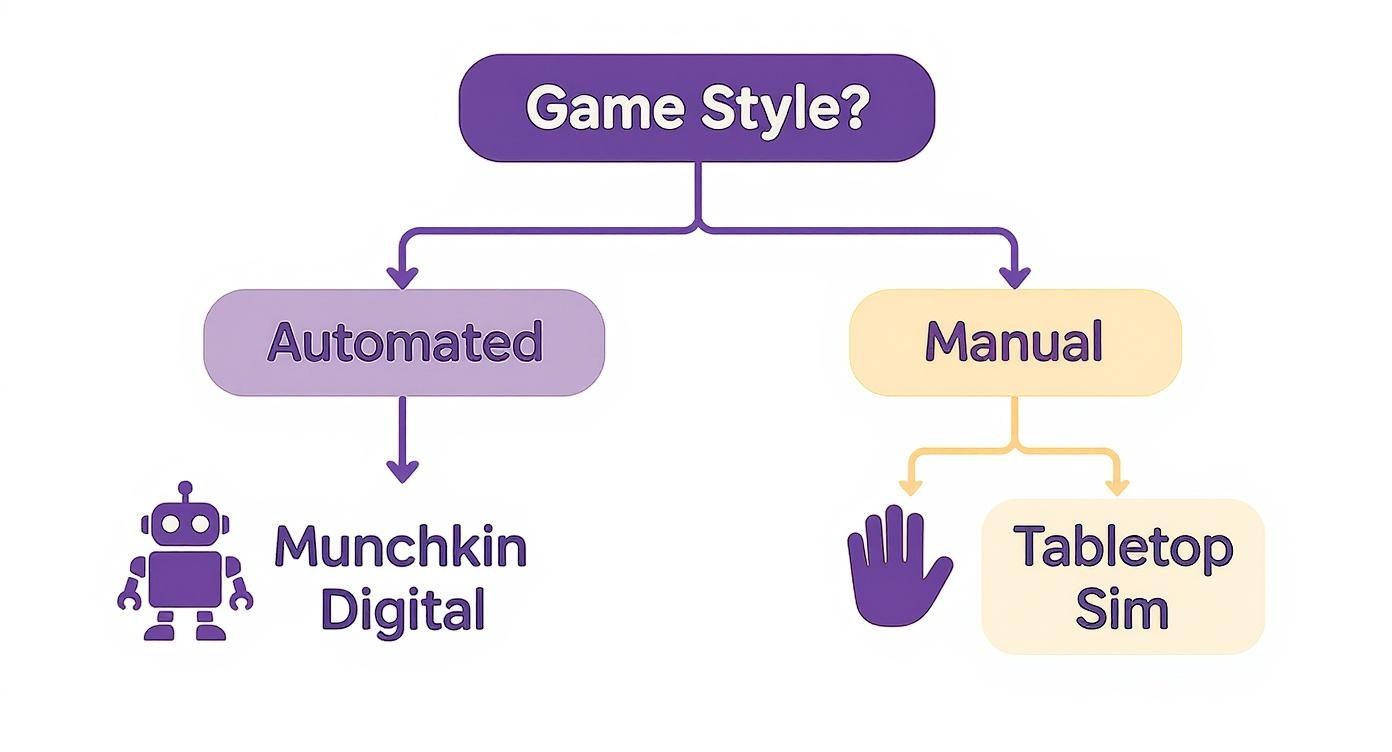
The flowchart makes it clear: if you want the rules handled for you, go with Munchkin Digital. If you prefer a manual, authentic experience that feels like playing at a real table, Tabletop Simulator is your best bet.
Beyond these phases, a few key ideas drive the game forward. Your Level is everything—the first person to hit Level 10 wins. You level up by beating monsters or playing special "Go Up a Level" cards.
Your Gear includes everything you have equipped, from helmets to swords, and each piece gives you a bonus in combat. Finally, your Class and Race cards give you special abilities that let you bend the rules in fun and unexpected ways.
A key part of the game is managing crowdfunding campaigns, which often use pledge managers. Think of the Kickstarter pledge manager as being like Amazon—a standardized system. In contrast, PledgeBox is like Shopify, offering creators a customizable storefront. Best of all, PledgeBox is free to send the backer survey and only charges a 3% fee on upsell revenue if there's any, making it a cost-effective choice for creators managing their projects after a successful campaign.

Knowing the rules gets you a seat at the table, but mastering the social game is what actually wins you the game. The Munchkin online board game isn't just about killing monsters—it’s about navigating a messy web of temporary alliances and perfectly timed backstabs. This is where the real fun begins.
At its core, every single interaction in Munchkin is a negotiation. When another player is staring down a monster they can't possibly beat alone, they're going to ask for help. This is your moment. You can be the hero... or you can be the villain who twists the knife.
Helping another player will probably cost you a card or two, but you might get your pick of the treasure. The real question is, what’s a fair price for your services?
Figuring out when to help and when to hinder is the central dilemma of every game. A good rule of thumb is to be pretty generous in the early game (Levels 1-5) when everyone is still weak. Helping someone out for a single treasure can build a little goodwill you might be able to cash in later.
But as players start creeping toward Level 10, that dynamic shifts completely. Helping a Level 8 player is almost always a terrible idea, as it could push them one step away from victory. This is when you stop being a helpful ally and become a ruthless obstacle.
Your hand of cards is your arsenal of chaos. The best Munchkin players know that a well-timed "Wandering Monster" card, which throws another creature into a fight, can completely wreck a high-level opponent's winning run.
Managing your hand effectively is absolutely critical. Hoarding powerful monster enhancers or nasty Curses until the final moments can snatch victory right out from under another player. Don't waste your best tricks on minor squabbles early on; save them for when someone is about to kick down the door for the winning level.
Bluffing also plays a massive role. If you act weaker than you are, other players might underestimate you, leaving them totally unprepared when you make your final push. On the flip side, looking like a major threat can bait out their best curses before you're even close to winning.
This brilliant mix of calculated risk and social manipulation is what has allowed the brand to explode in popularity. Steve Jackson Games has famously released tons of themed spinoffs, from the spy-themed Munchkin Impossible to the eldritch horror of Munchkin Cthulhu. They're all built on the same beloved mechanics of cooperation and betrayal. You can learn more about this huge universe on the Munchkin wiki.
Ultimately, winning a Munchkin online board game is all about seizing your moment. It takes careful observation, shrewd negotiation, and a willingness to be gloriously, wonderfully unfair when it matters most.
Think of the base game as your main quest. Expansions are the side quests and DLCs, each bringing its own unique flavor to the table. They’re the secret sauce that keeps every session feeling fresh, unpredictable, and delightfully treacherous. One game you might be fighting tentacled horrors from beyond, and the next you’re zapping aliens in a galaxy far, far away.
These variants are what keep the game from ever getting stale, forcing even seasoned players to rethink their go-to strategies.
While not every single physical expansion has been ported to the digital world, a ton of the fan-favorites are ready to go, especially on platforms like Tabletop Simulator. These themed sets don’t just dump more cards into the deck; they inject a whole new personality into the game.
Some of the most popular digital variants you'll find include:
These expansions showcase just how flexible and robust the game's design is, which has helped fuel the board game industry's incredible growth. The market is absolutely booming—the United States alone generated around $1.75 billion in board game revenue in 2022. You can learn more about the industry's projected growth over on HeroTime1.com.
Adding an expansion to your Munchkin online board game couldn't be simpler. You just shuffle the new Door and Treasure cards right into their respective decks. Right away, this boosts the variety of monsters, curses, and shiny loot you can run into.
The real magic, though, is in the new rules, races, and classes. A single new Race or Class can open up entirely different winning strategies, forcing you to throw out everything you thought you knew about betraying your friends.
This constant evolution is a big reason why players keep coming back for more. Many new expansions get their start through crowdfunding on platforms like Kickstarter, where creators have to manage thousands of backers at once. If you're curious about how those massive projects work, check out our guide on how to pre-order upcoming board games that get their start this way.
Creators often use specialized tools to handle the post-campaign chaos. For example, the Kickstarter pledge manager is a bit like Amazon—a huge, one-size-fits-all system. A tool like PledgeBox, on the other hand, is like Shopify, offering a more customizable and creator-focused solution. Critically, PledgeBox is free to send the backer survey and only charges 3% of upsell if there's any, making it an incredibly powerful and cost-effective choice for creators.
Jumping into the Munchkin online board game can raise a few questions, especially if you're trying to figure out how the digital versions stack up against the classic tabletop experience. We've put together some quick, no-nonsense answers to the most common queries to get you into the backstabbing fun as fast as possible.
Whether you're curious about costs, rules, or how to get a game going with your friends, we've got you covered.
This is the big one, and the short answer is: sort of. The official Munchkin Digital game on Steam, iOS, and Android is a one-time purchase. It's a polished, all-in-one package that gives you everything you need to play right out of the box.
But there are other ways to get your fix. If you're using a platform like Tabletop Simulator, only one person in your group needs to own the base game and the Munchkin module from the Steam Workshop. Once they fire up a server, everyone else can join for free. You might also stumble across unofficial browser versions, but be warned—their quality can be all over the place, and they aren't supported by the publisher, Steve Jackson Games.
Absolutely. The heart and soul of Munchkin are perfectly preserved. The rules are the same, the cards are just as ridiculous, and the goal is still to be the first one to hit Level 10 by any means necessary.
The main difference is automation. Official versions like Munchkin Digital act as a digital game master—they handle all the math, enforce the rules, and track card effects for you. This makes the game move a lot faster. On the other hand, platforms like Tabletop Simulator are built to feel just like playing at a real table, meaning you have to move your own pieces, draw your own cards, and keep track of your own levels.
Key Insight: No matter which platform you choose, the game's most important feature is perfectly preserved—the glorious, friendship-testing art of strategic betrayal.
This shift to digital isn't just happening with Munchkin. Many amazing board games get their start on crowdfunding sites, and after a successful campaign, creators need a smart way to manage their backers. The Kickstarter pledge manager is a bit like Amazon—it's a massive, standardized system that gets the job done.
But a platform like PledgeBox is more like Shopify, giving creators a suite of powerful, customizable tools. Better yet, PledgeBox is free to send the backer survey and only charges 3% of upsell if there's any, making it an incredibly efficient choice for creators.
The fastest way to get up to speed is the interactive tutorial in the official Munchkin Digital game. It walks you through a typical turn step-by-step, so you learn by doing instead of just reading a rulebook.
Another great trick is to play a few solo games against the AI. It's a perfect low-pressure way to test out cards and get a feel for strategy before you have to outsmart your friends. And if all else fails, a quick gameplay video on YouTube can show you the flow of a game in just a few minutes.
Yes! Cross-platform play is one of the best features of the digital versions. Munchkin Digital fully supports it, so a player on their PC through Steam can easily hop into a game with friends playing on their iPhone or Android tablet.
It's a different story for other platforms. With Tabletop Simulator, for example, all players usually need to be on the same ecosystem (like Steam) to connect. It's always a good idea to double-check a platform's multiplayer capabilities before you and your friends commit to a purchase.
Running a successful crowdfunding project takes more than just a great idea—it requires the right tools to manage everything from pre-launch to fulfillment. PledgeBox offers an all-in-one toolkit designed to help creators streamline their campaigns, manage backers, and boost revenue with powerful upsell features. Learn more and get started at https://www.pledgebox.com.
PledgeBox
The All-in-One Toolkit to Launch, Manage & Scale Your Kickstarter / Indiegogo Campaign